Table of Contents >> Show >> Hide
- What a Passageway Set Actually Does (and Doesn’t)
- Why White Porcelain Still Looks Fresh (Even If Your House Is Not)
- What’s in a White Porcelain Door Knob Passageway Set?
- Before You Buy: The Measurements That Save Your Weekend
- Choosing the Right Look: Knob Shape, Plate Style, and Finish
- Installation: A Straightforward Saturday Project
- Care and Cleaning: Keeping Porcelain Pretty
- Common Problems (and Fixes That Don’t Require a Dramatic Monologue)
- Where a White Porcelain Passage Set Works Best
- Conclusion: Small Hardware, Big Upgrade Energy
- of Real-World Experiences with White Porcelain Passage Knobs
There are two kinds of home upgrades: the ones you post on social media, and the ones you quietly enjoy every single day.
A white porcelain door knob passageway set is firmly in the second categoryuntil a guest grabs it and says,
“Wait… why does this feel so fancy?” (That’s your cue to shrug casually, like you didn’t plan this moment.)
Porcelain knobs have been showing up in American homes for generations for a reason: they’re timeless, bright without being loud,
and they make even a basic hallway door feel intentional. Pair that with a passage function (no lock, just a latch),
and you’ve got hardware that’s practical, classic, and weirdly satisfying to use.
What a Passageway Set Actually Does (and Doesn’t)
“Passage” sounds like something from an epic fantasy novel (“You shall not pass… without a latch!”), but it’s simple:
a passage door knob turns freely on both sides and operates a latchwithout any locking mechanism.
It’s built for interior doors where you don’t need privacy or security.
Passage vs. Privacy vs. Dummy: quick sanity check
- Passage: Latches shut, no lock. Great for hallways, closets, pantries, laundry rooms.
- Privacy: Latches shut and locks from the inside. Usually for bathrooms and bedrooms.
- Dummy: No latch operationpurely decorative, often used on double doors or closets where one side is fixed.
If you’re shopping specifically for a white porcelain passage set, you’re choosing “close the door, don’t lock the door.”
It’s the hardware equivalent of a friendly handshake.
Why White Porcelain Still Looks Fresh (Even If Your House Is Not)
White porcelain sits in a sweet spot: it’s classic, but it can also feel surprisingly modern. In traditional spaces,
it reads as vintage and architectural. In modern homes, it becomes a crisp contrast against darker doors or bold paint colors.
It’s like the little black dress of door hardwareexcept it’s white, and it doesn’t judge your snack choices.
Porcelain vs. “white-painted metal”
Porcelain isn’t just white paint on a knob. A well-made porcelain knob has a glazed finish that feels smooth and substantial.
It tends to look cleaner longer because the glossy surface doesn’t “drink in” grime the way matte finishes can.
(It will still show fingerprints, because fingerprints are humanity’s signature, apparently.)
Styles that pair beautifully with white porcelain
- Farmhouse / Cottage: White knobs + warm brass or aged bronze = cozy without trying too hard.
- Victorian / Traditional: Add a decorative backplate (sometimes with a keyhole look) for period vibes.
- Modern Contrast: White porcelain on matte black doors can look sharp and intentional.
- Coastal: Clean white hardware complements light walls and natural textures.
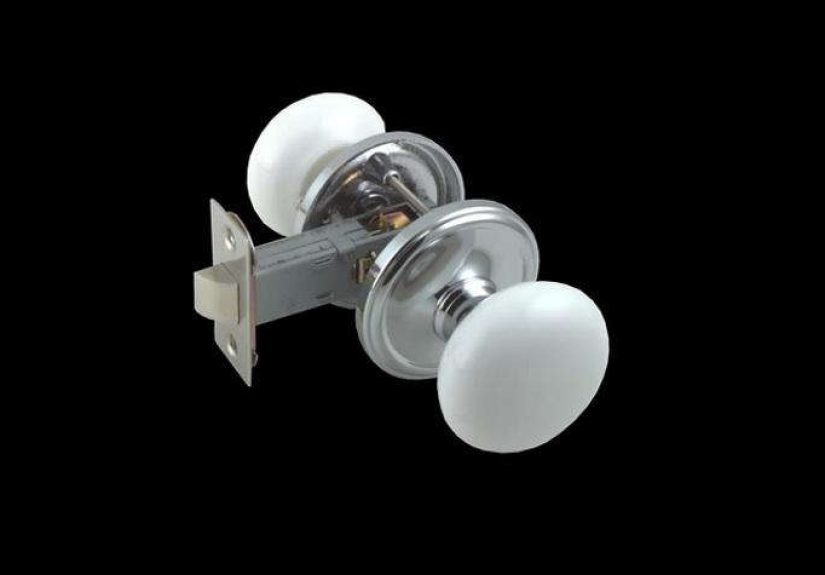
What’s in a White Porcelain Door Knob Passageway Set?
Most passage sets include the same core components, but the “feel” and longevity often come down to material quality,
the latch mechanism, and how everything fits together.
1) The knobs
Many porcelain knobs are around 2-1/4 inches in diameter (a common, comfortable size).
Some are perfectly round; others have subtle shaping. Higher-quality knobs feel heavier and smoother, with a consistent glaze.
2) Rosettes or backplates
You’ll typically see either a round rose (clean and classic) or a plate/backplate (more vintage).
Backplates can be plain or decorative and may include a faux “keyhole” stylegreat if you want old-house charm without
dealing with a real mortise lock.
3) The latch and strike plate
A passage set uses a latch bolt to keep the door closed. The latch fits into the door edge, and the strike plate mounts to the jamb.
Smooth latching is where “nice hardware” quietly proves itself every day.
4) Screws, spindle, and mounting hardware
Some porcelain knobs use a spindle and set-screw style (common in vintage-inspired designs).
Others use a modern chassis that fits standard door prep. Either can work wellwhat matters is solid fit and proper installation.
Before You Buy: The Measurements That Save Your Weekend
Door hardware shopping is easy right up until you realize doors have “standards”… plus a thrilling variety of exceptions.
Measure first. Brag later.
Know these common door-prep specs
- Cross-bore (big hole through the face of the door): commonly 2-1/8 inches
- Edge bore (hole in the door edge for the latch): commonly 1 inch
- Backset: typically 2-3/8 inches or 2-3/4 inches (edge of door to center of the cross-bore)
- Door thickness: commonly 1-3/8 inches to 1-3/4 inches
If your door is older, it might have a smaller bore hole. In that case, you may need to re-drill to the modern standard,
choose hardware designed for smaller prep, or use an adapter/cover plate depending on the scenario.
Handing: do you need right-hand or left-hand?
Many passage knobs are reversible, meaning they work regardless of which side the hinges are on.
Some higher-end configurations may specify handingso check before you fall in love with a knob that only opens for “left-hand doors”
like it’s a doorman with opinions.
Choosing the Right Look: Knob Shape, Plate Style, and Finish
“White porcelain” is the headliner, but the supporting cast matters tooespecially the metal finish and the backplate style.
Round rose vs. decorative plate
- Round rose: cleaner, more universal, easy to match with modern interiors.
- Decorative plate: more dramatic, more traditional, can cover old paint lines or wear around the knob area.
- Keyhole-style plate: vintage charm without committing to antique mortise lock complexity.
Popular finishes paired with white porcelain
- Polished brass: warm, traditional, brightclassic “historic home” energy.
- Antique brass: softer, more lived-in, forgiving with fingerprints.
- Satin nickel: cooler tone, works well in transitional interiors.
- Oil-rubbed bronze / dark bronze: high contrast, especially great on light doors.
- Unlacquered brass: designed to patina over time (a fancy way of saying it will age like a charming protagonist).
Don’t forget the latch face style
Some latches use a drive-in style (round collar) while others use a faceplate that may be
square-corner or rounded-corner. If you’re replacing existing hardware, matching the old prep can save timeor at least
reduce your relationship with wood putty.
Installation: A Straightforward Saturday Project
Installing a passage knob is usually a DIY-friendly job if your door is already prepped with standard holes.
The key is slow, steady, and not overtightening anything just because you’re feeling confident.
Tools you’ll likely want
- Phillips screwdriver (and possibly a flathead)
- Tape measure
- Drill/driver (optional, helpfuluse gently to avoid stripping screws)
- Chisel (only if you need to adjust a latch faceplate mortise)
Step 1: Confirm backset and door prep
Measure from the door edge to the center of the big bore hole. That’s your backset: typically 2-3/8″ or 2-3/4″.
Make sure the latch in your set matches (or is adjustable).
Step 2: Install the latch
Slide the latch into the edge bore with the bevel facing the direction the door closes.
If it’s a faceplate latch, you may need to align it neatly with the edge mortise.
Secure with the provided screws.
Step 3: Mount the knobs and rosettes/plates
Align the spindle or chassis through the latch mechanism. Attach the interior side and tighten evenly.
If your knob uses set screws, snug them firmlyjust don’t Hulk-smash the porcelain. Porcelain is tough,
but it’s not auditioning to be a bowling ball.
Step 4: Install the strike plate
Close the door and check where the latch hits the jamb. The strike plate opening should be aligned so the latch slides in smoothly.
Misalignment is the #1 reason doors “feel cheap,” even with expensive hardware.
Step 5: Test, tweak, repeat
Turn the knob several times. Close the door gently and confirm it latches without forcing.
If anything rubs, adjust the strike plate slightly rather than “just pushing harder” (a strategy that works for gym workouts, not doors).
Care and Cleaning: Keeping Porcelain Pretty
A white porcelain knob is easy to live with, but the wrong cleaner can dull finishes or scratch surfaces.
The safest routine is simple: a soft cloth, mild soap, and minimal water.
Do this
- Wipe porcelain with a soft, damp cloth and mild dish soap if needed.
- Dry the knob and metal parts right after cleaning.
- Use gentle, finish-appropriate care for the metal (especially for special finishes).
Avoid this
- Abrasive cleaners or scrubbing pads (they can scratch metal finishes and dull surfaces).
- Harsh chemicals and solvents.
- Soaking hardware in water (water can creep into joints and promote corrosion over time).
Common Problems (and Fixes That Don’t Require a Dramatic Monologue)
The knob feels wobbly
Most wobble is from mounting screws that need snugging, or a set screw that loosened over time.
Tighten gradually and evenly. If it’s a spindle/set-screw design, re-center the spindle before tightening.
The latch sticks or won’t retract smoothly
Check for paint buildup around the latch or strike area, or screws that are slightly misaligned.
Also make sure the latch is installed with the correct orientation (bevel toward the closing direction).
The door won’t latch unless you lift/push it
That’s usually a strike plate alignment issue (or a door that’s shifted with humidity).
Adjusting the strike plate opening by a small amount often solves it.
Hairline crack in porcelain
Porcelain can crack if it takes a hard impact or if set screws are overtightened.
If the crack is minor and stable, the knob may still function, but consider replacement if it spreads
or if the knob loosens. Also check that installation pressure is even and not stressing one side.
Where a White Porcelain Passage Set Works Best
A passage knob is meant for interior doors where latching is helpful but locking isn’t necessary.
These are the classic spots:
- Hallway doors
- Closets and linen closets
- Pantry doors
- Laundry rooms
- Living areas and home offices (if you don’t need privacy locks)
For bathrooms or bedrooms, you’ll typically want a privacy function instead. And for exterior doors,
you’ll want hardware designed for security and code requirementspassage sets are not built for that job.
Conclusion: Small Hardware, Big Upgrade Energy
A white porcelain door knob passageway set is a simple change that can make your home feel more finished.
It’s classic without being fussy, bright without screaming, and functional without complicated locks you don’t need.
Measure carefully, choose a finish that complements your space, install it with patience, and you’ll get a daily-use upgrade
that feels surprisingly luxurious for something you touch 40 times a day.
of Real-World Experiences with White Porcelain Passage Knobs
If you want the honest truth about door knobs, here it is: you don’t notice them until they’re bad… and then you notice them
every single time you use the door. That’s exactly why white porcelain passage knobs end up feeling like a bigger upgrade than
you’d expect.
One of the most common “first experiences” people have is the swap from a builder-grade knob that feels hollow to a porcelain knob
that feels solid and smooth. The difference isn’t just aestheticit’s tactile. Porcelain has a cool, glossy feel that reads as
“quality” in the same way a ceramic mug feels nicer than a paper cup. It’s a tiny sensory upgrade that stacks up over time.
Another real-life win: white porcelain plays well with imperfect homes. If you’ve got slightly mismatched trim, a door that’s been
painted one too many times, or a hallway that needs “something,” porcelain adds brightness without requiring a renovation budget.
Pairing it with a decorative backplate can even hide old paint outlines or surface wear around the knob arealike a stylish hat
covering a bad hair day.
People also tend to underestimate how much the finish choice changes the vibe. White porcelain with polished brass can feel
warm and historic, like it belongs in a 1920s craftsman. White porcelain with satin nickel feels cleaner and more modern. White
porcelain with dark bronze feels bold and graphic, especially on white doors. Same knob color, totally different personality.
Then there’s the “door behavior” experience. A properly aligned latch and strike can make a door close with a satisfying, gentle
clickno shoulder-checking required. A lot of the “my doors feel cheap” complaint is really “my latch and strike don’t line up.”
When people install new passage hardware and take a few extra minutes to align the strike plate correctly, the door suddenly feels
smoother, quieter, and more expensiveeven if nothing else changed.
Practical day-to-day: porcelain is easy to wipe clean, which matters more than we admit. On closet and pantry doors that get used
constantly, a quick wipe keeps things looking crisp. The main lesson people learn is to avoid harsh cleaners and rough scrubbers
not because porcelain is fragile, but because metal finishes can be sensitive. If you treat the set like a nice watch (soft cloth,
gentle cleaning), it keeps that “new hardware” glow much longer.
Finally, there’s the unexpected compliment factor. Guests might not say “Nice drywall,” but they will absolutely comment on a
beautiful porcelain knob. It’s one of those details that makes a home feel curatedwithout you having to announce that you have
“design taste.” The knob does the talking. Quietly. Like a polite adult.