Table of Contents >> Show >> Hide
- What “Pencil Vs Camera” Actually Is (And Why Your Brain Loves It)
- The Origin Story: A Viral Concept With Old-School Craft
- So… What Was Behind the Paper?
- 1) The Idea: The Drawing Isn’t DecorationIt’s Direction
- 2) The Location: You’re Not Just Scouting a BackgroundYou’re Casting a Co-Star
- 3) The Drawing: Perspective Is the Real Celebrity Here
- 4) The Paper: It’s a Prop… and a Lighting Problem
- 5) The Camera Work: Depth of Field Is Your Best Friend (Until It Isn’t)
- 6) Post-Production: The Quiet Part Everyone Pretends Isn’t There
- Why the Best Pencil Vs Camera Images Feel “Bigger” Than a Trick
- How to Make Your Own Pencil Vs Camera-Style Image (Without Losing Your Mind)
- Common Mistakes (And How to Fix Them Fast)
- Creative Prompts to Restart Your Pencil Vs Camera Project
- FAQ
- Bonus: Behind-the-Paper Experiences (The Part Nobody Shows on Instagram)
- Conclusion
You remember it, right? A hand holds up a sketch in front of a real street, and suddenly the paper becomes a portal: the sidewalk turns into a river, a statue grows wings, a bored commuter gains a superhero cape. The whole thing looks like a magic trick… except the wand is a pencil, the spellbook is a sheet of paper, and the stage is whatever location you can talk a friend into standing still in for five minutes.
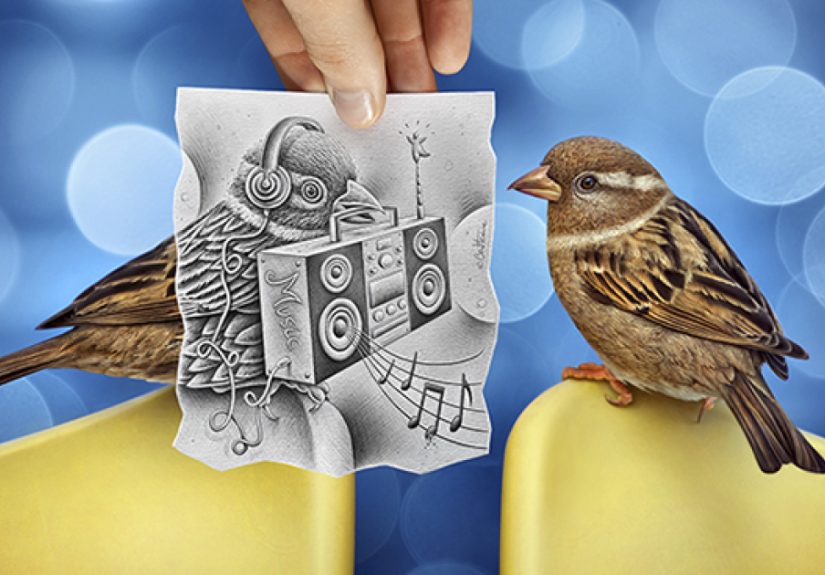
Online, this style became widely recognized through Ben Heine’s “Pencil Vs Camera” seriesan approach that blends drawing and photography to create one seamless “new reality.” The funny part? Most people assume the paper is doing the heavy lifting. Spoiler: the paper is just the door. What’s behind it is planning, perspective, patience, and a surprisingly intense relationship with lighting.
Let’s pull back the curtain (gently, so we don’t smudge the graphite) and unpack what’s really behind the paper: the idea, the craft, the camera choices, the editing decisions, and why this concept keeps popping up in classrooms and creative feeds years later.
What “Pencil Vs Camera” Actually Is (And Why Your Brain Loves It)
At its core, a Pencil Vs Camera image is a single photograph that includes a hand-held drawing aligned with the real-world background. The charm comes from the “seam”: the border where real pixels meet hand-drawn marks. Your brain sees two different realities and tries to stitch them into one story. That mental stitching is the secret sauce.
It’s also why the best pieces feel more like tiny visual short stories than simple optical illusions. The drawing isn’t merely an add-onit’s a plot twist. A good Pencil Vs Camera scene asks a question like:
- What if this ordinary place had a different history?
- What if the hidden emotion of the scene became visible?
- What if reality had to negotiate with imagination… and imagination won?
That’s the “vs” in the title: not a cage match between pencil and camera, but a playful argument between reality and imagination, staged in one frame.
The Origin Story: A Viral Concept With Old-School Craft
When the concept hit the internet, it stood out because it felt refreshingly hands-on. In a world where “cool photo” often means “filter + luck,” Pencil Vs Camera screamed: someone made this. You could practically hear the pencil scratching.
And it spread because it’s instantly readable. Even if you’ve never heard the name “Pencil Vs Camera,” you understand the trick in half a second: “Oh! They’re holding a drawing in the scene.” That clarity is marketing gold and art gold at the same time. (Rare combo. Like finding fries at the bottom of the bag when you thought you were out.)
So… What Was Behind the Paper?
Here’s the truth: the paper is the easiest part. Behind it is a workflow that looks a lot like a mini film productionjust with fewer unions and more eraser crumbs.
1) The Idea: The Drawing Isn’t DecorationIt’s Direction
Strong Pencil Vs Camera concepts don’t start with “What can I draw?” They start with “What do I want this image to say?”
Try building ideas from one of these “message engines”:
- Contrast: Make the drawing the opposite mood of the photo (sunny sketch over a gloomy street).
- Reveal: Use the sketch to expose a hidden layer (a building’s “soul,” a person’s thoughts, a city’s past).
- Upgrade: Turn something ordinary into something mythic (a traffic cone becomes a wizard hatdon’t laugh, it works).
- Commentary: Let the sketch say what the photo can’t (satire, hope, irony).
A practical test: if you remove the drawing and the photo still “works” the same way, the drawing is probably just garnish. You want the drawing to be the main courseor at least the spicy sauce that makes the whole plate memorable.
2) The Location: You’re Not Just Scouting a BackgroundYou’re Casting a Co-Star
Location in Pencil Vs Camera isn’t a backdrop. It’s a partner. The best scenes have clear shapes and strong lines you can “connect” with your sketch:
- Stair railings, bridges, fences (great for perspective alignment)
- Statues, murals, architecture details (great for playful “continuations”)
- Street signs and typography (great for visual jokes)
- Horizon lines, sidewalks, building edges (great for forced perspective)
Pro move: take a few test photos first, then do quick thumbnails over them. If you can’t find a satisfying “join” between drawing and reality, the location is fighting you. And you never win a fight with a sidewalk. Sidewalks have patience. They’ve been doing this longer than you.
3) The Drawing: Perspective Is the Real Celebrity Here
Most people think Pencil Vs Camera is about being “good at drawing.” Not exactly. It’s about being good at matchingmatching scale, angle, vanishing points, and visual weight.
Here are the drawing skills that matter most:
- Simple value control: clear darks and lights so the sketch reads instantly.
- Perspective awareness: your drawn lines should respect the scene’s vanishing points.
- Edge decisions: decide where the drawing ends and reality begins. Don’t be vaguebe intentional.
- Graphic clarity: bold shapes beat fussy details (especially on small screens).
If you’re new to perspective, don’t panic. You can build strong images with silhouettes and simple forms. A perfectly aligned cartoon can beat a wobbly “realistic” sketch every time.
4) The Paper: It’s a Prop… and a Lighting Problem
Paper seems innocent until you photograph it. Then it becomes a diva.
Here’s what paper is doing in the final image:
- It reflects light differently than the environment.
- It introduces a new color temperature (paper “white” is rarely actually white).
- It creates a hard edge that must look deliberate, not accidental.
- It can bend, glare, wrinkle, or shadow your hand like it’s auditioning for a drama.
Choosing paper thickness matters. Thicker paper stays flat and looks cleaner. Matte surfaces reduce glare. If you work with colored paper or add color, you’re adding another layer of challenge: now the sketch must harmonize with the scene’s palette.
5) The Camera Work: Depth of Field Is Your Best Friend (Until It Isn’t)
To sell the illusion, you usually want both layers sharp: the drawing and the background. That means balancing distance and depth of field. In practice, you’re juggling:
- Aperture: stopping down helps keep both planes in focus.
- Distance: moving the paper closer or farther changes scale and sharpness.
- Angle: tilt too much and the paper blurs or warps; too flat and the drawing feels pasted-on.
- Light direction: the paper should be lit like it belongs in the scene.
Quick technique: shoot a burst while making tiny micro-adjustments to the paper. Your “perfect alignment” moment is often one frame in a 20-shot sequence. The hero shot is real, but it rarely shows up on the first try.
6) Post-Production: The Quiet Part Everyone Pretends Isn’t There
Let’s talk about the thing artists whisper about like it’s a trade secret: editing.
In many Pencil Vs Camera workflows, editing isn’t “cheating”it’s finishing. Even when the alignment is done in-camera, a final image often needs:
- Color correction (paper whites, skin tones, background balance)
- Contrast tweaks (so the sketch reads clearly)
- Cleanup (dust, smudges, tiny distractions)
- Sharpening and detail control (so both layers feel consistent)
There’s also a long-running debate online: are some pieces composited? Some viewers claim certain images look digitally combined. Regardless of how any single image is constructed, the bigger truth is this: the art is the final illusion. Pencil Vs Camera sits in a mixed-media lane where the goal is cohesion, not a purity test.
Why the Best Pencil Vs Camera Images Feel “Bigger” Than a Trick
The strongest pieces work on three levels at once:
- Instant read: “Oh, I get it.” (That’s the hook.)
- Second look: “Waithow did they align that?” (That’s the craft.)
- Third look: “What’s the message here?” (That’s the meaning.)
When you hit all three, you don’t just get likesyou get saves, shares, and “I keep thinking about this” comments. That’s the difference between a clever photo and a sticky idea.
How to Make Your Own Pencil Vs Camera-Style Image (Without Losing Your Mind)
If you want to create your own Pencil Vs Camera project (or revive one you started and abandoned like a gym membership), here’s a clean, repeatable process.
Step 1: Build the concept in one sentence
Example formulas:
- “This place looks normal, but on paper it becomes ______.”
- “The photo shows reality; the sketch shows ______.”
- “I want the drawing to say ______ about the scene.”
Step 2: Take test photos first
Don’t marry the first angle you see. Take wide, medium, and close shots. Then pick the one with the clearest “join” lines.
Step 3: Sketch to the scene, not to your imagination
Use the photo as the anchor. Match the perspective. Let the real environment dictate your vanishing points and scale.
Step 4: Shoot for sharpness and consistency
Stabilize yourself. Use a fast enough shutter to avoid hand blur. If you can, shoot in bright overcast or open shade to reduce harsh paper glare.
Step 5: Edit like a photographer, not like a magician
Keep the paper edge honest. Clean up distractions. Balance tones. Make the image feel like one worldeven if it’s a world with a hand-drawn whale swimming through a parking lot.
Common Mistakes (And How to Fix Them Fast)
The drawing looks “stuck on”
- Fix: match contrast and lighting direction; reduce the paper’s brightness slightly so it sits in the scene.
The alignment is almost right… and that’s worse than wrong
- Fix: choose fewer connection points but make them perfect. Two clean joins beat ten sloppy ones.
The background steals the show
- Fix: simplify the scene or reframe. Busy backgrounds fight the sketch.
The idea is clever but forgettable
- Fix: add meaning. Give the drawing a message, not just a costume.
Creative Prompts to Restart Your Pencil Vs Camera Project
- Time travel: sketch the “past version” of a modern place (old storefronts, vanished trees, a historic event).
- Hidden feelings: sketch what someone is thinking, but let the photo show what they’re doing.
- Nature takeover: let vines, animals, or weather “reclaim” an urban sceneonly on paper.
- Wordplay: use signs, street names, or ads as the setup for a drawn punchline.
- Myth mode: turn a statue into the creature it secretly wants to be.
FAQ
Do I need a fancy camera?
No. You need light, stability, and patience. A phone can work if you control glare and keep both layers sharp.
Do I have to be amazing at drawing?
Not at all. Clear shapes and solid alignment matter more than rendering every pore like you’re auditioning for an art school montage.
Is editing allowed?
Editing is part of photography. The goal isn’t to win a “no-adjustments” medal. The goal is to make a compelling image that reads as one world.
Bonus: Behind-the-Paper Experiences (The Part Nobody Shows on Instagram)
Here’s what you’ll probably experience when you actually try to make one of these imagesespecially if you’re picking up the project again after a long break.
First, you feel a little ridiculous. You’re standing in public holding up a sheet of paper like it’s a sacred relic. Someone walks by. You pretend you’re “checking the light.” They pretend they didn’t see you. This is the unspoken social contract of street creativity: we all agree not to make it weirder than it already is.
Then the paper starts misbehaving. It catches glare. It bends. It flaps in the wind like it’s trying to escape your artistic vision. You learn, quickly, that “a piece of paper” is not one objectit’s an entire physics lesson. You’ll start angling it by millimeters, chasing the sweet spot where the drawing reads clearly but the paper doesn’t scream “I am reflecting the sun directly into the lens.”
Next comes the alignment obsession. You discover that your eyes are excellent liars. What looks aligned in real life can look slightly off in the camera. You take a shot, review it, adjust, shoot again, review againsuddenly you’re doing a tiny dance where every step is “two inches left, tilt forward, lower the top edge, no waitundo that.” If someone filmed you, it would look like you’re trying to teach paper how to parallel park.
And then, the moment hits. You capture one frame where everything clicks: the drawn line meets the real edge, the perspective behaves, the paper sits naturally in the scene, and your concept reads in a heartbeat. It feels weirdly satisfyinglike solving a puzzle that you built yourself. That “click” is addictive. It’s why people keep making these images: the process is part engineering, part storytelling, part scavenger hunt for visual harmony.
After that, you start noticing stories everywhere. A crack in the sidewalk becomes a river waiting for a drawn boat. A blank wall becomes a stage for a sketched shadow creature. A boring bench becomes a throne if you draw it that way. The project changes how you see. You stop walking through places and start reading themlooking for lines, symbols, jokes, contrasts, and emotional cues. It’s like your brain upgrades its operating system from “commute mode” to “creative mode.”
Finally, you learn patience with your own work. Some ideas will fail. Some drawings will look better in your sketchbook than in the photo. Some locations will fight you. But every attempt teaches you something concrete: how light behaves on paper, how perspective sells the illusion, how simplicity often beats complexity, and how a strong message turns a trick into art.
If you’re reviving your Pencil Vs Camera project, that’s the real gift behind the paper: it’s not just an image format. It’s a repeatable way to practice observation, composition, perspective, and storytellingwhile having fun and making the world look a little less ordinary.
Conclusion
Pencil Vs Camera works because it’s both simple and deep: a hand, a sketch, a real place, and a single frame where imagination negotiates with reality. The paper is the doorway, but behind it lives the real craftidea design, perspective, alignment, light control, and careful finishing. Whether you’re studying Ben Heine’s work or building your own version, the best results come when the drawing isn’t just cleverit’s meaningful.
So yes: remember that project? Now you know what was behind the paper. And if you pick it up again, don’t aim for perfect on day one. Aim for one strong “join,” one clear message, and one image that makes someone stop scrolling and think, “Okay… that’s actually brilliant.”