Table of Contents >> Show >> Hide
- Why This Benchmark Battle Matters
- What Actually Changes Between 32-bit and 64-bit?
- What the Benchmarks Keep Showing
- So Which Workloads Benefit Most from 64-bit?
- Where 32-bit Still Has a Real Argument
- The Hidden Villains: Storage, Cooling, and Browser Weight
- Practical Recommendation: Which One Should You Install?
- Final Verdict
- Extended Experience: What Using 32-bit and 64-bit on a Pi 4 Really Feels Like
- SEO Tags
Note: Clean HTML body only, ready to copy and publish.
If you have ever stared at a Raspberry Pi 4 and wondered whether it should run a 32-bit or 64-bit operating system, congratulations: you have officially entered one of the nerdiest rabbit holes on the internet. It is a lovely place. There are benchmarks, compiler flags, heated forum debates, and at least one person somewhere insisting that “real performance” can only be measured while compressing files in a basement at 2 a.m.
The good news is that this debate is not just academic. The Raspberry Pi 4 uses a 64-bit Arm Cortex-A72 processor, yet for a long stretch of its life many users still ran a 32-bit environment by default. That created a very practical question: does a Pi 4 actually perform better in 64-bit mode, or is this just another tech argument powered by coffee and overconfidence?
The short version is simple: in most CPU-heavy Raspberry Pi 4 benchmarks, 64-bit wins, often clearly. But the full story is more interesting, because desktop smoothness, memory footprint, software compatibility, storage speed, and thermals all get a vote too. And some of them are louder than others.
Why This Benchmark Battle Matters
The Raspberry Pi 4 is not a toy pretending to be a computer. It is a real little machine with a quad-core Cortex-A72 CPU, support for up to 8GB of LPDDR4 memory, Gigabit Ethernet, USB 3.0, and dual micro-HDMI output. In plain English, it has enough muscle to serve as a home server, coding box, retro gaming machine, kiosk, media device, lab computer, or lightweight desktop.
That makes the 32-bit versus 64-bit choice matter more than it did on earlier, more modest boards. Once you move from blinking LEDs to running containers, compiling code, opening a dozen browser tabs, or juggling Python, databases, and a web dashboard at the same time, the operating system architecture stops being trivia and starts becoming workflow.
This is also where the Raspberry Pi 4 gets mischievous. On 4-series devices, the 32-bit Raspberry Pi OS setup already uses a 64-bit kernel with a 32-bit userland. So when people argue about “32-bit versus 64-bit” on the Pi 4, they are often really arguing about application and user-space architecture, not whether the chip itself suddenly forgot how to count past 4 billion.
What Actually Changes Between 32-bit and 64-bit?
The Big Technical Difference
A 64-bit environment can address more memory, use a more modern programming model, and take fuller advantage of the Armv8-A architecture. On paper, that means larger address spaces, more efficient access to certain instructions, and better potential performance for workloads that love registers, math, cryptography, compression, multimedia processing, and other CPU-intensive chores.
That sounds glamorous, but here is the less glamorous part: 64-bit is not free. Wider pointers can increase memory usage. Programs can become a little larger. On a machine with limited RAM, that matters. So 64-bit is not automatically “better at everything.” It is more accurate to say it usually offers a stronger ceiling, while 32-bit can still be leaner in some lighter deployments.
Why 32-bit Is Not a Relic from the Stone Age
Let’s be fair to 32-bit for a second. It is older, yes. It is less fashionable, definitely. But it can still be perfectly sensible on a Raspberry Pi 4 if your workload is modest, your software stack is older, or you care more about compatibility and RAM efficiency than maximum benchmark glory.
Think small kiosks, stripped-down appliance builds, legacy scripts, certain older packages, and simple home automation roles. In those situations, 32-bit does not walk into the room wearing a cone hat labeled “slow.” It just has different priorities.
What the Benchmarks Keep Showing
CPU-Heavy Workloads Usually Favor 64-bit
This is the part where 64-bit starts grinning.
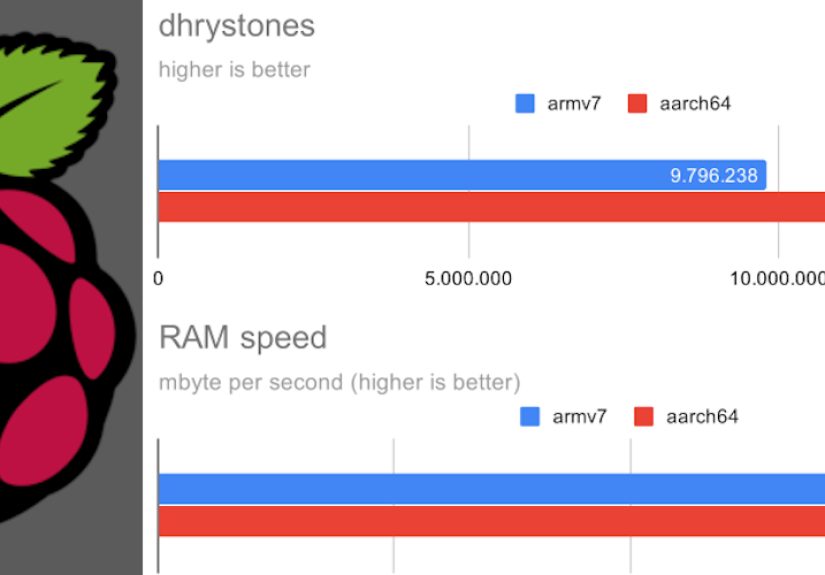
Broad benchmark testing has repeatedly shown that Raspberry Pi 4-class hardware tends to run faster in a full 64-bit OS for processor-heavy tasks. In one especially eye-catching set of tests, the geometric mean across a large benchmark sweep favored the 64-bit OS by a wide margin. That does not mean every single thing you do on a Pi 4 suddenly becomes dramatically faster. It does mean the pattern is too strong to dismiss as benchmark theater.
Jeff Geerling’s Raspberry Pi testing reached a similar conclusion from a more practical angle. CPU-heavy operations got noticeably faster, and in one MP3-encoding comparison the 64-bit setup delivered a very obvious improvement. That matters because media encoding, compiling, packaging, compression, and similar jobs are exactly the kind of things hobbyists and developers regularly ask a Pi 4 to do.
So if your Pi 4 spends time building software, crunching data, zipping giant folders, running Docker images, or acting like a tiny machine with large ambitions, 64-bit is usually the more performance-friendly choice.
Desktop Feel Is More Complicated Than a Single Benchmark Chart
Here is where many articles oversimplify the story. A faster CPU benchmark does not always mean your desktop suddenly feels like a premium laptop. The Raspberry Pi 4 is still constrained by storage, thermal behavior, browser efficiency, background services, and how aggressively you multitask.
In real desktop use, the operating system architecture matters, but so does everything else. If your Pi 4 boots from a slow microSD card, opens a modern browser, loads a media-heavy website, and tries to stream video while downloading updates in the background, your bottleneck may not be “32-bit versus 64-bit.” Your bottleneck may simply be “tiny computer doing a heroic impression of a much larger computer.”
Tom’s Hardware testing is a great reminder of this. Moving the Pi 4 from microSD storage to SSD produced dramatic application-launch improvements. In other words, if your Raspberry Pi desktop feels sluggish, changing storage can sometimes feel more dramatic than changing bitness. That is not a knock on 64-bit. It is just a reminder that performance is a team sport.
Memory and Multitasking Tell a More Nuanced Story
The Raspberry Pi 4 became much more interesting once higher-memory models arrived. When you have 4GB or 8GB available, 64-bit stops feeling like a theoretical luxury and starts making practical sense. Larger memory configurations are exactly where 64-bit software can stretch its legs more comfortably.
On the flip side, lighter systems with tighter RAM budgets can still benefit from the relative thriftiness of 32-bit applications. If your device is doing one small job and doing it all day without complaint, you do not always need the brawnier setup. Sometimes the most efficient solution is the one that does not turn your Pi into a motivational poster about “unlocking full potential.”
So Which Workloads Benefit Most from 64-bit?
The strongest candidates are the kinds of tasks that keep the CPU busy and reward modern instruction handling:
- Compiling code and build pipelines
- Compression, decompression, and archival jobs
- Audio or media encoding
- Databases and analytics workloads
- Containers and development environments
- Cryptographic operations and hashing
- Heavy multitasking on 4GB and 8GB models
In these scenarios, 64-bit Raspberry Pi OS generally feels like the Pi 4 is finally being allowed to act its age. Or, more accurately, its architecture.
Where 32-bit Still Has a Real Argument
Despite the benchmark wins for 64-bit, 32-bit is not some embarrassing fallback you only admit to using after the lights go out.
It still makes sense when:
- You depend on older or niche software with better 32-bit support
- You want the smallest practical memory footprint
- Your Pi 4 is acting as a simple appliance rather than a mini workstation
- You are maintaining older project images and do not want to break a stable setup
That last one matters. Plenty of Raspberry Pi users value stability over theoretical speedups. If your existing system is reliable, low-maintenance, and good at its one job, switching architectures “because benchmarks said so” may be unnecessary drama. Your Pi did not ask for that kind of stress.
The Hidden Villains: Storage, Cooling, and Browser Weight
One of the funniest things about Raspberry Pi performance debates is how often the operating system gets blamed for crimes committed by storage and heat.
A Pi 4 booting from a decent SSD can feel noticeably snappier than one crawling along on mediocre microSD storage. Likewise, a Pi 4 that is well cooled and not throttling under load can deliver more consistent performance than one quietly roasting itself while pretending everything is fine.
Browser behavior also matters more than most people expect. A modern browser is basically a small city powered by JavaScript, ads, animations, and bad decisions. If your benchmark target is “how fast can I open three local tools and edit code,” 64-bit may look excellent. If your target is “how gracefully can I browse a bloated shopping site with 28 tabs open,” the answer may still be, “Please lower your expectations and maybe close Pinterest.”
Practical Recommendation: Which One Should You Install?
Pick 64-bit if You:
Use a Raspberry Pi 4 with 4GB or 8GB RAM, run development tools, compile software, work with containers, do media work, or want the more forward-looking choice. If performance is your main concern, and your software stack is current, 64-bit is the better fit most of the time.
Pick 32-bit if You:
Need a lighter memory footprint, rely on older packages, or are building a simple, stable appliance where benchmark wins will not change your daily experience. If your Pi 4 mostly lives a quiet life serving one task, 32-bit can still be perfectly rational.
My Straight Answer
For most modern Raspberry Pi 4 users, 64-bit is the better default. It aligns with the hardware, performs better in many compute-heavy benchmarks, and makes more sense as workloads become more ambitious. But 32-bit is still a useful option for specific compatibility-minded or lightweight setups.
Or to put it less politely: running a Pi 4 in 32-bit mode is not wrong. It is just a bit like buying a pickup truck and using it only to carry one banana.
Final Verdict
The Raspberry Pi 4 benchmark story is not really a mystery anymore. Across broad testing, 64-bit generally outperforms 32-bit for CPU-bound work, often by enough to matter. That advantage comes from the Pi 4’s architecture, the strengths of AArch64, and the fact that modern workloads increasingly reward a 64-bit environment.
But benchmarks do not exist in a vacuum. Your real-world experience is also shaped by storage, thermals, browser demands, RAM pressure, and whether your software actually needs the extra architectural elbow room. That is why the smartest answer is not “64-bit always, no exceptions.” It is “64-bit for most people, 32-bit where it still solves a real problem.”
In other words, the Raspberry Pi 4 does not need ideology. It needs the right tool for the job. And maybe a heatsink. Honestly, probably a heatsink.
Extended Experience: What Using 32-bit and 64-bit on a Pi 4 Really Feels Like
The day-to-day experience of using a Raspberry Pi 4 in 32-bit and 64-bit modes is less like switching between two different computers and more like switching between two personalities of the same computer. One feels lean, cautious, and reliable. The other feels more ambitious, more modern, and occasionally a little more eager to show off in front of a benchmark chart.
In a basic setup, both can seem surprisingly similar at first. You boot the board, launch a terminal, open settings, maybe browse the web, and think, “Well, this is not exactly teleportation-speed, but it is perfectly usable.” That first impression is why some users assume the whole 32-bit versus 64-bit debate is overblown. For light use, the difference really can feel subtle.
Then you start doing the things that make a Pi 4 sweat.
Compile a project. Extract a large archive. Install and update several packages. Run a local database and a small web app together. Open a browser, then a code editor, then a documentation tab, then one more tab, then twelve more tabs because self-control is apparently not installed by default. This is where 64-bit often starts to feel less like a minor tweak and more like the board is breathing with a little less effort.
The biggest surprise for many people is that “faster” does not always announce itself with fireworks. It often shows up as fewer little pauses. Menus feel a touch more willing. Heavy tasks finish before you have time to get distracted. Multitasking becomes less dramatic. The Pi stops behaving like it needs a pep talk every time you ask it to do two respectable things at once.
That said, 32-bit still has a certain charm. On streamlined builds, especially for dedicated tasks, it can feel tidy and disciplined. A Pi 4 serving one service, one dashboard, one kiosk screen, or one automation role can run happily without caring that benchmark charts on the internet are busy crowning 64-bit the king of the hill. Stability is a performance feature too, even if it does not make for sexy graphs.
There is also the psychological side of it. A lot of people switch to 64-bit expecting a cinematic transformation, like the wallpaper will become sharper and the mouse cursor will gain confidence. That is not how this works. The upgrade is real, but it is workload-sensitive. If your storage is slow, your thermals are bad, or your browser session looks like a digital hoarder convention, the operating system architecture alone cannot save you.
In the end, the most honest experience-based takeaway is this: 64-bit on the Raspberry Pi 4 usually feels like the more natural fit for the hardware, especially once you start asking the board to do serious work. Meanwhile, 32-bit still feels entirely valid for focused, lightweight, and compatibility-sensitive projects. Neither choice is ridiculous. One is just more future-facing, while the other remains pleasantly practical.