Table of Contents >> Show >> Hide
- Why Better Folding Saves Time, Not Just Space
- Before You Fold: Set Yourself Up for Speed
- Drawer-Friendly Folding: The “File” Approach
- Closet-Friendly Folding: Stacks That Don’t Collapse
- How to Fold Towels So They Store Neatly and Grab Easily
- The Fitted Sheet: Tame the Elastic Monster
- Storage Moves That Multiply Your Folding Results
- Mistakes That Waste Space and Time (And What to Do Instead)
- Real-Life Experiences and Routines That Make Folding Stick (Extra Length Section)
- Conclusion
Folding laundry isn’t a personality trait. It’s a system. And the good news? You don’t need to be “a neat person”
to get neat resultsyou just need a repeatable method that makes your clothes easy to see, easy to grab, and
hard to mess up.
This guide will show you how to fold the most common clothing items and towels in ways that save space and
shave minutes off your weekly routine. You’ll learn drawer-friendly “file” folds (so you can see everything at a glance),
shelf-stable folds (so stacks don’t avalanche), and towel folds that look hotel-level without requiring a hospitality degree.
Why Better Folding Saves Time, Not Just Space
“Saving space” sounds like an organizing goal. But the real win is saving time. Most laundry time isn’t spent
foldingit’s spent digging, re-folding, and re-stacking after the pile collapses.
The two problems that make laundry feel endless
- Pile blindness: When items are stacked, you can’t see what you own. You end up re-buying basics and wearing the same three shirts.
- Stack collapse: One shirt pulled from the middle turns the whole shelf into a fabric landslide.
The fix is simple: pick folds that create uniform shapes and store them in a way that prevents shifting.
Uniform shapes stack better, stand up better, and take up less room because there’s less trapped air (yes, air is a space hog).
Before You Fold: Set Yourself Up for Speed
The fastest folding method is the one you’ll actually do. So let’s make folding easy to start and easy to finish.
1) Sort once, fold in batches
As soon as laundry is dry, sort into quick piles: tops, bottoms, underwear/socks, towels, and “hang-ups” (anything you prefer to hang).
Batching reduces decision fatigue because you repeat the same motion several times in a row.
2) Pick one “standard size” per storage area
Your dresser drawers and shelves each want a different fold. Drawers love compact rectangles that can stand upright.
Shelves love flatter rectangles that stack without tipping. Decide which items go where, then fold to match the storage style.
3) Create a tiny folding station
Any flat surface worksbed, table, top of the dryer. The key is consistency. If you always fold in the same spot,
you eliminate the “Where do I even start?” delay. Bonus tip: keep a small basket nearby for “belongs elsewhere” items
so you don’t wander off mid-fold and get distracted by a snack, a notification, or your sudden urge to reorganize the spice rack.
Drawer-Friendly Folding: The “File” Approach
If you want maximum visibility and minimum mess, store folded clothes vertically like files in a cabinet.
Instead of stacking shirts, you line them up so each item stands on its own. You can see everything, pull one item,
and nothing else collapses.
T-shirts and casual tops (fast, tidy, and stack-proof)
- Lay the shirt face down and smooth it flat.
- Fold one side inward so the sleeve creates a straight edge; fold the sleeve back over itself.
- Repeat on the other side, making a long rectangle.
- Fold the bottom up toward the collar in halves or thirds until the shirt becomes a compact rectangle that can stand upright.
Why it works: The rectangle is dense and stable. Standing shirts upright makes your drawer function like a menu:
pick what you want, put the rest back with zero re-folding.
Long-sleeve shirts
- Lay flat; fold one side in.
- Fold the sleeve down along the edge (like you’re tracing the rectangle), then fold the cuff up if it’s long.
- Repeat the other side.
- Fold from the bottom up in two or three folds until it stands.
Pro move: Keep the sleeves inside the rectangle so they don’t create bulky “arms” that snag when you pull the shirt out.
Hoodies and sweatshirts (bulky but manageable)
Hoodies love to trap air and expand like they’re auditioning to be a beanbag chair. Your goal is to compress them into a stable shape.
- Lay flat; fold sleeves inward.
- Fold the sides in to create a rectangle.
- Fold the bottom up toward the hood in two folds.
- Tuck the hood down over the top like a cap if you want a tighter bundle.
Pants, jeans, and leggings (the “clean rectangle” method)
- Lay pants flat; smooth pockets and seams.
- Fold in half lengthwise (one leg on top of the other).
- If the seat/crotch area sticks out, fold that section inward so the sides are straight.
- Fold from the hem up toward the waistband in two or three folds until it forms a tidy rectangle.
Why it works: Straight edges = better packing. Tucking in that “sticky-outy” seat area prevents odd lumps that waste drawer space.
Shorts and skirts
Treat them like mini pants. Fold in half, straighten the edges, then fold up into a compact rectangle.
For flowy skirts, fold lengthwise first (to reduce width), then fold up in sections.
Underwear (simple, quick, consistent)
- Lay flat; fold the crotch up toward the waistband (creating a rectangle).
- Fold sides in if needed.
- Fold once more so it fits your drawer depth.
If you want extra speed, skip “perfect” and aim for “uniform enough.” The magic is in consistent sizing, not origami-level precision.
Socks (no more stretched-out sock balls)
The classic sock-ball stretches elastic and creates bulky lumps in drawers. Instead:
- Lay one sock over the other.
- Fold in half or thirds (depending on sock length).
- Option A: Place as a flat bundle in a divider.
- Option B: Wrap the outer sock’s cuff lightly around the bundle to hold itno tight twisting.
Closet-Friendly Folding: Stacks That Don’t Collapse
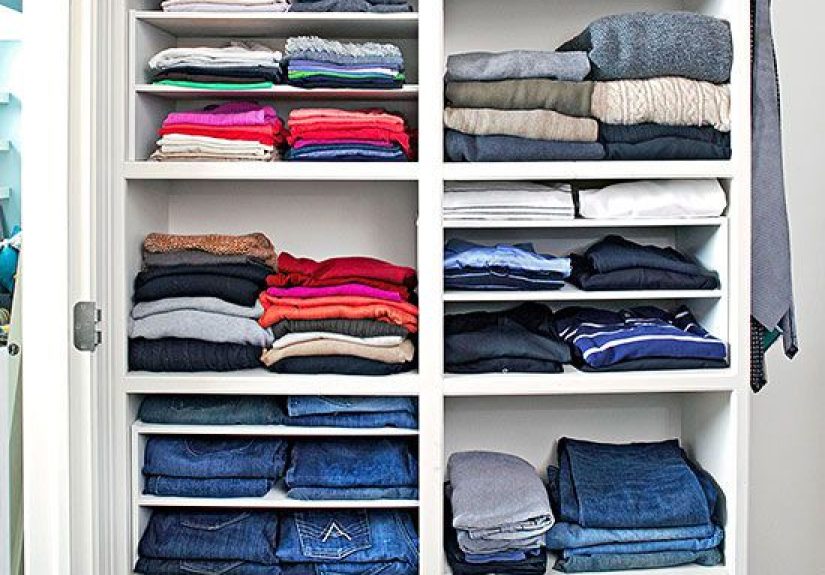
Shelves can be great for folded itemsif your stacks don’t topple. The trick is to keep stacks short, consistent, and supported.
Sweaters and knits (fold to prevent stretching)
- Lay sweater face down; fold sleeves inward.
- Fold sides in to create a rectangle.
- Fold in half (or thirds for chunky knits).
Why it works: Knits can stretch if hung. Folding keeps shoulders from getting those sad little bumps that look like your hanger is winning a wrestling match.
Dress shirts (minimize wrinkles without taking forever)
If you hang dress shirts, skip this. If you fold them:
- Button the top one or two buttons (helps keep shape).
- Lay face down; fold one sleeve across the back at a gentle angle, then fold it back down.
- Repeat the other sleeve.
- Fold sides in slightly, then fold the shirt up from the bottom in one or two folds.
Store these on top of a shelf stack so they’re not crushed by heavier items.
Make shelf stacks “grab-proof”
- Keep stacks to 8–12 inches tall max.
- Group by category (tees with tees, towels with towels).
- Use shelf dividers or bins to keep piles from drifting sideways.
How to Fold Towels So They Store Neatly and Grab Easily
Towels are basically soft, absorbent space-eaters. Fold them the right way and you’ll get cleaner stacks, fewer towel avalanches,
and a linen closet that doesn’t feel like it’s practicing for a dramatic reveal.
The classic shelf fold (great for linen closets)
- Lay the towel flat and smooth it.
- Fold lengthwise into thirds (so the long edges align).
- Fold in half (or into thirds) widthwise depending on your shelf depth.
Tip: Match your towel fold width to your shelf or basket. A “perfect” fold that doesn’t fit is just a well-meaning mistake.
The bar fold (for hanging on a towel bar)
- Fold the towel lengthwise into thirds.
- Fold in half widthwise.
- Drape over the bar so the clean, finished edge faces outward.
The spa roll (great for baskets, guests, and looking fancy)
- Fold the towel in half lengthwise.
- Fold in half widthwise.
- Roll tightly from one short end to the other.
- If you want a “locked” roll, leave a small flap on one end and tuck it around the roll at the finish.
Why it works: Rolled towels remove the “pull one, collapse the pile” problem. You can grab a roll and everything else stays put.
Washcloths and hand towels
Keep small linens from becoming drawer confetti by folding them into consistent mini rectangles and storing them upright in a small bin or divider.
One bin for washcloths, one for hand towels, and you’ll stop mixing them up mid-morning when you’re half-awake and just trying to exist.
The Fitted Sheet: Tame the Elastic Monster
A fitted sheet is basically a flat sheet that took one look at your life and chose chaos. But it can be folded neatly
especially if you use a quick corner-tuck method.
A simple fitted-sheet fold that stays neat
- Hold the sheet inside out with your hands in two adjacent corner pockets.
- Bring one corner pocket into the other so they nest together.
- Repeat with the remaining corners so all corners are tucked into a single “stack.”
- Lay the sheet on a flat surface; straighten edges into a rough rectangle.
- Fold lengthwise into thirds, then fold into a compact rectangle that fits your linen shelf.
Time-saving linen closet trick: store as sets
Keep matching sheet sets together by folding the flat sheet and pillowcases into a rectangle, then wrapping them inside the folded fitted sheet.
You’ll pull out one tidy bundle instead of playing “Where did the pillowcases go?” every laundry day.
Storage Moves That Multiply Your Folding Results
Use dividers to make “lanes”
Dividers turn a drawer into sections (tees lane, workout lane, socks lane). Without them, file-folded items can lean and flop.
With them, everything stays upright and easy to grab.
Create zones based on how you get dressed
Store items in the order you use them. Example: underwear/socks closest to where you stand to get dressed, then tops, then bottoms.
The fewer steps you take while half-awake, the more likely your system survives Monday morning.
Rotate seasonally
Bulky sweaters, heavy towels, and extra blankets should live in the back of the closet or a labeled bin when out of season.
This “less in the drawer” approach is the easiest space-saving trick because it reduces what you’re trying to manage daily.
Mistakes That Waste Space and Time (And What to Do Instead)
- Mistake: Over-stacking shelves. Fix: Two shorter stacks beat one tall oneevery time.
- Mistake: Folding everything the same way. Fix: Drawers = upright folds; shelves = flatter folds.
- Mistake: Stuffing towels into any empty gap. Fix: Pick one towel fold size that matches your shelf depth.
- Mistake: Mixing categories (“random drawer energy”). Fix: One drawer per major category, with dividers if needed.
- Mistake: Waiting for a “big laundry day.” Fix: Fold in small batches so it doesn’t become a weekend event.
Real-Life Experiences and Routines That Make Folding Stick (Extra Length Section)
Folding advice often sounds great until it meets real life: small closets, busy mornings, roommates, kids, sports uniforms, or the classic
“I swear I just did laundry yesterday” phenomenon. So here are realistic ways people make folding work when life is… life.
Experience #1: The small-drawer problem. In tight spaces (think apartment dressers, dorm rooms, or older homes with shallow drawers),
stacking shirts turns into a messy tower fast. What tends to work better is a “two-row file system”: fold shirts into smaller rectangles,
then store them upright in two rows from front to back. The front row is what you wear weekly; the back row is backups and seasonal items.
This keeps the “daily driver” clothing easy to reach, so you’re not pulling out half a drawer to find one tee.
Experience #2: The family laundry mountain. When there are multiple people, the slowest step is usually sortingnot folding.
A routine that often saves time is the “basket-per-person” approach: as soon as clothes come out of the dryer, sort into individual baskets
(one per person) and a separate towel/linen basket. Then each person’s clothes can be folded in a batch. If you’re the one doing everything,
this still helps because you can carry one basket at a time and put items away in one trip instead of five mini trips.
Experience #3: The towel avalanche. Linen closets get chaotic because towels shift. A common fix is switching from stacked,
loose piles to either (a) rolled towels in a bin, or (b) folded towels stored vertically like books (especially hand towels).
Both methods make it easy to remove one towel without disturbing the rest. People also find it easier to keep “guest towels” separate
a dedicated bin means you’re not rummaging when someone asks for a towel, and you avoid accidentally handing them the towel that’s been through
a thousand gym bags.
Experience #4: The “I hate folding” reality. Some people don’t hate folding itselfthey hate the setup and the decision-making.
Two practical adjustments can help: First, fold items immediately while they’re warm and already flat from the dryer (less wrinkling, less fighting fabric).
Second, choose one “default fold” for most items, even if it’s not the most space-maximizing fold on Earth. A consistent, good-enough fold
that you repeat automatically is faster than a perfect method you avoid.
Experience #5: The morning rush test. A folding system is only successful if it survives a busy morning. One of the best stress-tests is:
can you remove one shirt, one pair of pants, and one pair of socks with one hand without destroying the drawer? If the answer is no,
add a divider, lower the stack height, or switch that category to upright file-folding. The goal is “grab and go,” not “grab and rebuild.”
Experience #6: The travel shortcut that sneaks into daily life. Rolling methods (often used for packing) can be surprisingly useful
for small items like workout clothes, pajamas, or beach towelsespecially when stored in bins. People who adopt rolling for travel sometimes keep it
for specific drawers because it’s quick and creates consistent shapes. The key is choosing where rolling helps (bins and baskets) versus where
folding helps (drawers that need upright stability).
In other words: the “best” folding method is the one that matches your storage space and your daily habits. If you build your folding routine around
the way you actually livelimited time, real mornings, real closetsyour system won’t just look nice for a day. It’ll stay nice.
Conclusion
Folding clothes and towels to save space and time isn’t about being perfectit’s about being consistent.
Use drawer-friendly file folds to make outfits visible and grab-friendly. Use shelf-safe folds for bulky items to prevent collapses.
Fold towels to match your shelf depth, and store linens as sets so you can grab what you need in one move.
Start small: pick one drawer (like tees), switch it to upright storage, and add a divider if needed. Once you feel how much faster it is
to find what you want without digging, you’ll be tempted to fold everything in sightincluding towels, sheets, and possibly your entire life.