Table of Contents >> Show >> Hide
- What “V-Shaped Layers” Actually Means (Because Haircuts Are Secretly Geometry)
- Who V-Shaped Layers Flatter (and Who Should Proceed Like It’s a Suspicious Email Link)
- Tools That Make This Easier (and One Tool That Should Be Banned From Bathrooms)
- Before You Cut: Prep Like a Pro
- The Pro-Inspired Method: Sectioning + Guide = A Clean V
- Step 1: Establish a balanced baseline length
- Step 2: Plan your V (small V first, dramatic V later)
- Step 3: Create the V-shaped perimeter (the outline)
- Step 4: Build long layers that support the V
- Step 5: Add face-framing “V-style” layers (optional, but highly satisfying)
- Step 6: Cross-check like you’re your own quality control department
- The DIY-Safer Method: Ponytail Techniques That Create Layering (With Guardrails)
- How to Avoid the “V-Tail” Problem
- Troubleshooting: Fixes for Common “Oops” Moments
- Styling Tips That Make V-Shaped Layers Look Their Best
- Maintenance: How to Keep the Shape Without Constant Cutting
- Final Reality Check (The Friendly Kind)
- of Real-World Experience: What People Learn After Cutting V-Shaped Layers
A V-shaped layered haircut is basically the hair equivalent of a great exit strategy: it keeps your length, adds movement, and tapers to a point in the back so your ends look swishy instead of… blunt and a little “I cut this with craft scissors in my kitchen.”
Done well, V-shaped layers can remove heaviness from thick hair, create a prettier silhouette on long hair, and give you that “my blowout has a fan club” kind of flow. Done poorly, it can also create a sad little tail, uneven sides, or layers that start somewhere around your shoulder blades even though you swore you “barely cut anything.” So we’re going to do this the smart way: pro-inspired structure, DIY-safe options, and lots of checkpoints.
What “V-Shaped Layers” Actually Means (Because Haircuts Are Secretly Geometry)
The “V” can be your perimeter, your layers, or both
People say “V-shaped layers” and mean one of two things:
- V-shaped perimeter: the outline at the bottom forms a V point in the back.
- V-style layering: layers get shorter toward the face (often with face framing) and longer toward the back, supporting that V silhouette.
Most flattering versions combine both: a soft V perimeter plus long layers that blend into it, so you get shape without losing density at the ends.
V vs. U vs. straight across (aka: choose your vibe)
- V-shape: more dramatic taper; can make hair look longer; can look thinner at the very ends if overdone.
- U-shape: softer curve; often reads “thicker” at the perimeter; great if you hate the idea of a pointy tail.
- Straight across: bold and dense; great for maximum thickness, less great for movement unless layered internally.
Who V-Shaped Layers Flatter (and Who Should Proceed Like It’s a Suspicious Email Link)
Usually a win for:
- Long hair (below the shoulders): you need enough length for the V to read as intentional, not accidental.
- Thick hair: the taper and layers can reduce bulk and add swing.
- Straight to wavy textures: easier to see symmetry and the V line while cutting.
- People who want movement without losing length: layers give lift and shape while keeping the overall length intact.
Use extra caution if:
- Very curly/coily hair: shrinkage can make layers jump shorter than expected; cut less than you think you need.
- Fine hair: an aggressive V can make ends look wispy; consider a softer V or U perimeter.
- You’re craving a major change: DIY is best for trims and subtle shaping, not dramatic reinvention.
Tools That Make This Easier (and One Tool That Should Be Banned From Bathrooms)
- Hair-cutting shears: sharp, clean, and made for hair. Kitchen scissors create frayed ends and regret.
- Fine-tooth comb: for clean partings and consistent tension.
- Sectioning clips: the difference between “controlled haircut” and “I blacked out and now I have bangs.”
- Two mirrors: one for the front, one for checking the back (or a friend you trust with your future selfies).
- Spray bottle (optional): for lightly dampening sections, not soaking them.
- Hair ties (optional): if you’re using ponytail-based methods.
Before You Cut: Prep Like a Pro
- Start with clean, detangled hair. Knots are tiny chaos gremlins.
- Decide wet vs. dry. Dry (or lightly damp) is usually safer for DIY because you can see the real length and shape.
- Wear it how you normally do. Natural part, usual texture, typical styling. Don’t reinvent your part and your haircut in one afternoon.
- Trim your expectations. The goal is a beautiful V shape with blended layers, not a salon-level transformation in 12 minutes.
The Pro-Inspired Method: Sectioning + Guide = A Clean V
This method is more structured than ponytail hacks and tends to give more predictable resultsespecially for a polished V perimeter and long layers that blend.
Step 1: Establish a balanced baseline length
- Part your hair down the middle from forehead to nape.
- Bring hair forward over both shoulders and check that the front lengths look even.
- If one side is longer, do tiny corrections first. You want your perimeter balanced before you carve any V shape.
Step 2: Plan your V (small V first, dramatic V later)
Decide how “pointy” you want the V. A subtle V is easier to blend and usually looks healthier at the ends. A dramatic V is gorgeousbut it’s also easier to create a thin tail if you take off too much from the sides.
Quick planning trick: pick your intended shortest perimeter point (usually the sides) and your longest point (center back). Your job is to connect them smoothly.
Step 3: Create the V-shaped perimeter (the outline)
- Split hair into two sections: left and right, still parted down the middle. Clip away the top half if your hair is thick, so you can work in layers.
- On one side, identify:
- The short point: where the side perimeter will sit.
- The long point: where the center back will land (this is the “V point”).
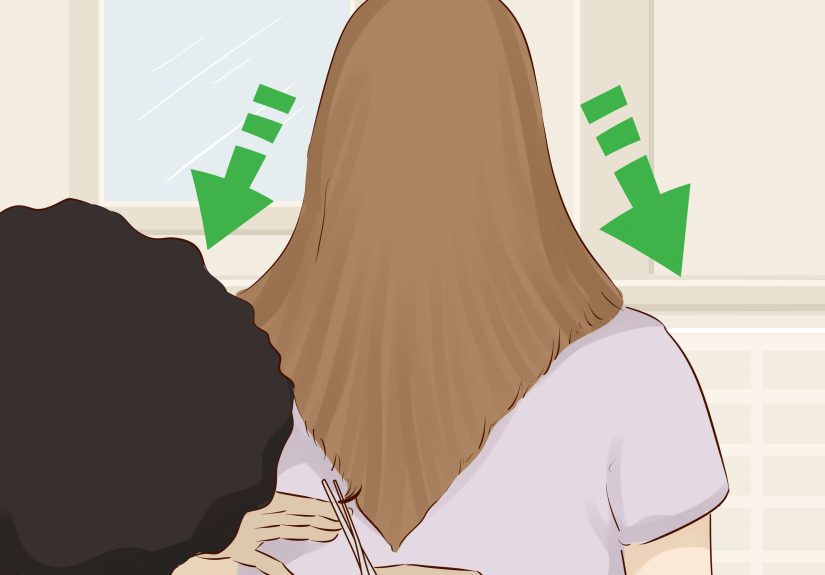
- Using your fingers like a ruler, angle your fingers so you can cut a straight line that connects your short point to your long point. You’re not “drawing a V” in the airyou’re connecting two points with a clean line.
- Point cut into that line (tiny snips with scissors held vertically) to soften the edge and prevent a blunt shelf.
- Repeat on the other side, mirroring the same short and long points. Go slow and compare often.
Step 4: Build long layers that support the V
Long layers work because of elevationhow high you lift the hair away from the head while cutting. Higher elevation generally creates more layering. For long, blended layers, many pros use moderate-to-higher elevations and then refine with point cutting so it doesn’t look “choppy.”
- Create a center guide: Take a small section at the crown (top back). Lift it up and decide where the shortest layer will start.
- Cut conservatively: Start longer than you think. You can always refine.
- Work in vertical sections: Take a section behind the ear, elevate it up toward your guide, and cut to match the guide length.
- Repeat around the head: Keep your sections consistent. The more consistent the sectioning, the more blended the layers.
- Refine with point cutting: This helps the layers melt together instead of stacking like a layer cake.
Step 5: Add face-framing “V-style” layers (optional, but highly satisfying)
Face framing is where a V-cut really looks expensive. The idea: shorter pieces around the face that gradually connect into longer lengths toward the back. The safest move is to start your shortest face-framing piece somewhere between the cheekbone and chinthen adjust later.
- Make a small triangle section at the front hairline (think: fringe/face frame zone).
- Split it in half down the middle.
- Over-direct one half slightly toward the opposite side to avoid harsh, chunky lines.
- Cut on a diagonal, then point cut to soften.
- Repeat on the other side and compare symmetry.
Step 6: Cross-check like you’re your own quality control department
- Bring hair forward: check that the left and right perimeters match.
- Check the back V: use a handheld mirror. Look for a smooth taper, not a sudden skinny tail.
- Twist test: twist small sectionsif you see long “spikes,” those are uneven ends that need gentle refining.
- Cut less than you want: then style it. You’ll see what actually needs adjusting.
The DIY-Safer Method: Ponytail Techniques That Create Layering (With Guardrails)
Ponytail methods are popular because they’re fast and surprisingly effective for soft layers. The tradeoff is precision: you can’t customize the shape as much, and it’s easier to over-layer the front. Use these methods if you want a DIY-friendly approach that leans “good enough and cute,” not “I could teach a masterclass.”
Option A: The “Unicorn” ponytail for face-framing layers
- Brush hair smooth and gather a high ponytail near the front hairline (top of forehead zone).
- Secure tightly. The tighter the ponytail, the more consistent the result.
- Slide your fingers down to where you want the shortest layer to start.
- Snip with the scissors angled vertically (point cutting) rather than one blunt chop.
- Take the ponytail out, shake it out, and check the front layers. Style before you “fix” anything.
Option B: Two-ponytail layering to keep the back longer
If you want layers but you’re trying to protect the back length (aka: the part everyone sees in photos from behind), a second ponytail can help distribute layering.
- Create the unicorn ponytail and do a tiny trim for the top/front layers.
- Then create a second ponytail at the crown (not as far forward), and trim even lessthis helps blend without making the front too short.
- Release, comb through, and refine with small point cuts only where needed.
How to keep ponytail methods from turning into a “why are my layers in my mouth?” situation
- Start with 1/4 inch. Then reassess. Layering adds up fast.
- Point cut, don’t chop. Blunt cuts look harsh and are harder to blend.
- Fine hair: go softer; avoid a dramatic V perimeter at home.
- Curly hair: cut even less; consider curl-by-curl trimming instead of ponytail methods.
How to Avoid the “V-Tail” Problem
The classic DIY mistake is creating a V so dramatic that the ends look thin and stringy, like your hair is trying to cosplay as a carrot. Here’s how to keep the V looking intentional and healthy:
- Make the V subtle first. You can always sharpen it later.
- Don’t over-layer the bottom. Layers + aggressive taper = thin ends.
- Keep your perimeter dense. If your ends are already fine, consider a soft V or U instead.
- Refine with micro-trims. If you see a tail forming, trim just the very tip of the V point.
Troubleshooting: Fixes for Common “Oops” Moments
Problem: One side looks longer
- Bring hair forward and compare the perimeter evenly.
- Correct the longer side using tiny trims, then re-check the V point.
- Don’t chase perfection by cutting both sides repeatedlypick one reference and match to it.
Problem: Layers look choppy
- Use point cutting along the ends to soften harsh lines.
- Check your sectioningbig, uneven sections create uneven layers.
- Style the hair before you keep cutting. Texture can disguise (or reveal) issues.
Problem: The front is too short
- Stop cutting. Seriously. Put the scissors down like they’re on fire.
- Blend the transition by lightly point cutting the pieces behind the too-short section (minimal trimming).
- Use styling tricks (blow-dry forward then back, curtain-bang styling, soft waves) until it grows.
Problem: The V point looks too sharp
- Trim the very tip of the point in tiny increments to soften it.
- Or convert toward a U-shape by slightly rounding the perimeter on both sides.
Styling Tips That Make V-Shaped Layers Look Their Best
- Blow-dry with direction: lift at the crown, smooth down the lengths, and flip the ends slightly for movement.
- Loose waves: they show off layering and make blending look more seamless.
- Texturizing products: a lightweight mousse or spray can help layers separate without looking frizzy.
- Curly hair: define curls first, then evaluate shape; layers behave differently curl-to-curl.
Maintenance: How to Keep the Shape Without Constant Cutting
V-shaped layers look best when your ends are healthy and the perimeter stays intentional. If you’re growing your hair, aim for small trims rather than frequent major cuts. A quick dusting every couple of months can keep split ends from traveling up the hair shaft and turning your layers into fuzz.
Final Reality Check (The Friendly Kind)
If you want a dramatic V with perfectly blended long layers and customized face framing, a pro stylist can tailor it to your density, texture, and face shape with way more control. But if your goal is a flattering V silhouette with soft movementand you’re willing to cut slowly, check often, and keep it subtlethis is absolutely doable.
Remember: haircuts are not a race. The only thing that should move fast is your hair in a slow-motion hair flip video after you finish.
of Real-World Experience: What People Learn After Cutting V-Shaped Layers
People who try a V-shaped layered cutwhether at home or in a salontend to have the same set of “aha” moments, and they’re honestly worth reading before you touch a single strand. First, most folks realize the V shape isn’t the hard part. The blending is the hard part. Creating a point in the back is easy; making the transition look smooth from the sides into that point is where patience pays rent. The best outcomes usually come from taking off less than you think you need, styling it, then making tiny adjustments like you’re editing a photo instead of trying to redraw the entire haircut.
Another common experience: the first time you add face-framing layers, it feels like magicuntil you discover how quickly “face framing” can become “face invading.” A lot of DIY cutters notice that ponytail-based methods create shorter pieces around the face than expected, especially if the ponytail sits too far forward. The lesson people repeat is simple: place the ponytail carefully, start with a micro-trim, and use point cutting so the result stays soft. Folks who rush often end up styling around the mistake for a few weeks, learning the ancient truth that hair grows… but not on your timeline.
People with thick hair often report the happiest results because V-shaped layers can remove weight without sacrificing length. Many describe the “before” as hair that felt heavy, bulky, or triangular in an unflattering wayand the “after” as hair that moves, flips, and sits closer to the head in a more polished shape. Meanwhile, people with fine hair often discover they prefer a subtle V or a U-shaped perimeter because a dramatic V can make ends look wispy. That’s not a failure; it’s just good matchmaking. The haircut should flatter your density, not punish it.
Curly-haired cutters frequently share a different lesson: shrinkage is undefeated. A curl-by-curl approach feels slower, but it prevents the surprise of layers bouncing up higher than planned. Curly textures also tend to look more forgiving if the cut is slightly uneven, but they can look wildly different when styled differentlyso many people learn to evaluate their cut only after washing, styling, and letting curls settle naturally.
Finally, there’s the emotional experience: doing a V-shaped layered cut can feel weirdly empowering. People talk about the moment they realize they can maintain their hair between salon visits, dust their ends, and keep their shape fresh. The best advice repeated in forums, stylist Q&As, and DIY communities is: cut slowly, check often, and stop earlier than you want. You can always refine, but you can’t un-cut. The goal isn’t perfectionit’s a flattering shape that makes you feel like your hair has better things to do than just hang there politely.