Table of Contents >> Show >> Hide
- Why Tiny Polymer Clay Creatures Are So Hard to Resist
- A Few Favorite Tiny Creatures From the Collection
- What Polymer Clay Has Taught Me About Looking Closely
- From Lump of Clay to Tiny Beastie
- The Joy of Making Creatures Almost Every Day
- Why These Tiny Favorites Matter More Than Their Size
- Final Thoughts on a Tiny, Wild, Clay-Filled Journey
- Extra Reflections From the Worktable: Two Years of Tiny Creatures, Daily Lessons, and Unexpected Joy
- SEO Tags
Some people meditate. Some people jog. Some people alphabetize their spice rack and call it self-care. Me? I make tiny creatures out of polymer clay and spend an unreasonable amount of time asking serious artistic questions like, “Does this pigeon look sleepy enough?”
Over the past two years, making miniature animals has turned from a casual creative hobby into a daily ritual. What started as a simple urge to sculpt something cute became a full-blown obsession with feather textures, tiny paws, rounded bellies, curious eyes, and all the little details that make a creature feel alive. The result is a growing parade of miniature foxes, owls, pandas, sparrows, bees, bears, and odd little mythical gremlins that somehow look like they might blink if you stare too long.
This is not just a story about polymer clay creatures. It is a story about patience, observation, tiny fingerprints, artistic growth, and the surprisingly emotional act of making something small enough to sit on a fingertip but charming enough to completely hijack a person’s heart. If you have ever wondered why miniature art is so addictive, pull up a chair. Preferably one not covered in clay dust.
Why Tiny Polymer Clay Creatures Are So Hard to Resist
There is something delightfully unfair about miniature animals. They skip past your critical thinking, take a shortcut to your emotions, and set up camp there. A fox that is barely over an inch tall feels more magical than a full-size sculpture because it invites you to lean in, inspect closely, and imagine an entire tiny world around it.
That sense of intimacy is one reason polymer clay miniatures are so appealing. The material itself is wonderfully suited to small-scale work. It can be conditioned until soft, shaped into fine details, refined with simple tools, and baked to harden into durable little keepsakes. For artists and hobbyists alike, polymer clay offers the sweet spot between accessibility and precision. It is beginner-friendly enough to start with confidence, yet versatile enough to reward obsessive detail lovers who are fully prepared to sculpt twenty-seven individual feathers on a bird smaller than a walnut.
Miniature creature art also sits at a lovely crossroads of realism and whimsy. You can make an anatomically inspired owl with carefully painted markings, or you can make a plump little raven that looks like it knows exactly where you hid the cookies. Both approaches work. Both are delightful. Both may lead to an alarming number of references saved on your phone.
A Few Favorite Tiny Creatures From the Collection
After nearly two years of daily sculpting, some pieces naturally stand out. Not always because they are the most technically perfect, but because they capture a mood, a memory, or a personality that feels bigger than their size.
The Sleepy Pigeon
Every collection needs a surprise star, and the sleepy pigeon is exactly that. Pigeons do not always get the glamorous treatment in art, which makes them even more fun to sculpt. Rounded body, tucked posture, a slightly dazed expression, and suddenly this ordinary city bird becomes the kind of tiny sculpture people instantly want to protect with their entire soul. It is proof that “cute” is often more about attitude than species.
The Tiny Foxes
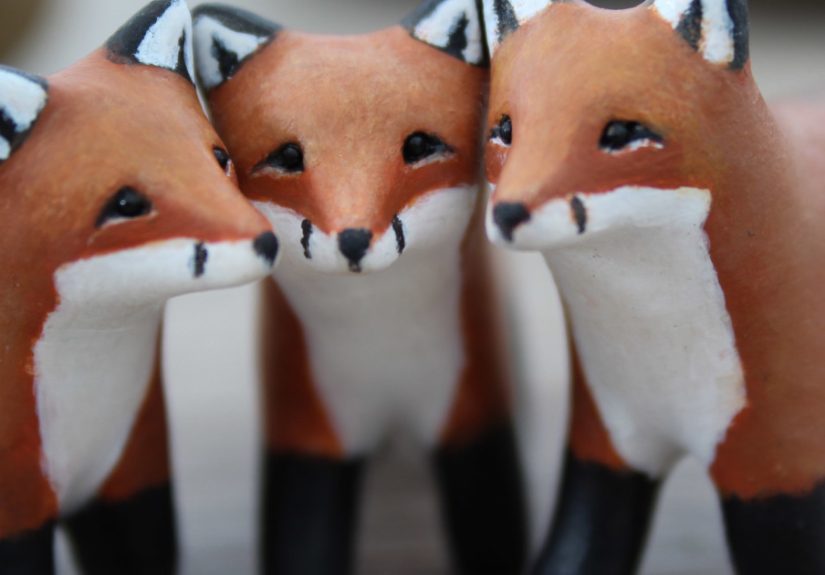
Foxes are miniature sculpture royalty. Their shapes are clean, recognizable, and loaded with personality: pointy ears, narrow muzzle, curved tail, sly expression. Small fox figures are perfect for ornaments, necklaces, shelf décor, and seasonal collections. They can be realistic, woodland-sweet, or just a little mischievous. The best ones feel like they have a secret and no intention of sharing it.
The Barn Owl and the House Sparrows
Birds are where sculpting becomes both joyful and humbling. Feathers demand structure and softness at the same time. Owls especially have that dramatic facial disc and intense gaze that makes every detail count. Sparrows, meanwhile, offer subtler beauty. Their muted patterns, rounded forms, and familiar charm make them deeply satisfying subjects. They may not scream for attention, but once finished, they often become the pieces people love most.
The Red Panda, Bumblebee, and Panda Necklace
Some creations succeed because they blend precision with playfulness. A red panda offers bold markings and a lovable silhouette. A bumblebee can be tiny, bright, and instantly cheerful. A panda necklace turns a creature into wearable joy. These pieces remind me that miniature art does not have to sit quietly on a shelf. It can hang on a wall, live on a necklace, perch on a holiday branch, or brighten a desk on a Monday that desperately needed help.
The Tiny Yeti and Other Wild Cards
Not every favorite has to be realistic. Mythical or slightly oddball creatures often become creative palate cleansers. After sculpting real birds, mammals, and insects, a tiny yeti or whimsical fantasy beast lets the imagination stretch its legs a little. It is the artistic equivalent of dessert: unnecessary, delightful, and absolutely worth it.
What Polymer Clay Has Taught Me About Looking Closely
One of the biggest surprises in making tiny creatures every day is how much it changes the way you see the world. You stop noticing “a bird” and start noticing the exact angle of its beak, the way the chest feathers puff out, the subtle shift in color from back to wing, and the way its feet rest when it is calm. The same thing happens with mammals, insects, and even made-up creatures. You become a student of posture, proportion, and personality.
That close looking changes your work. A miniature animal becomes more convincing when it does not just resemble the species, but suggests behavior. A fox with a lifted chin feels alert. A pigeon with a tucked neck feels sleepy. A sparrow with a slight forward lean feels curious. Tiny sculpture is not only about shape. It is about storytelling in posture.
Working this small also teaches restraint. When your sculpture fits in the palm of your hand, every mark matters. Too much texture and the piece looks messy. Too little and it looks unfinished. The challenge is finding that balance where the creature feels detailed but still readable at a glance. It is tiny art with big editing energy.
From Lump of Clay to Tiny Beastie
The process usually begins with reference photos, rough sketches, or a mental image that refuses to leave me alone. Then comes conditioning the clay until it is workable and smooth. From there, the sculpture develops in stages: a simple body shape first, then head placement, then limbs or wings, then refining the silhouette. Tiny ears and tails are often added later, once the main form feels stable.
For realistic creatures, color planning matters almost as much as sculpting. Some artists prefer to blend colors directly in the clay. Others bake first and add painted details later. Both approaches have their merits. Sculpted color feels integrated and clean; painted details allow for subtle markings, shadows, and soft highlights. For mini animals, combining both methods can create the best results.
The baking stage is where excitement and mild paranoia meet for coffee. Polymer clay needs careful curing according to the manufacturer’s directions. Too little heat and the piece may stay weak. Too much and you risk discoloration or cracking. After cooling, the creature often gets additional refinement: painting, sealing where appropriate, attaching findings for ornaments or necklaces, or simply a final once-over to remove any suspiciously dramatic speck of lint.
That last part is important. Tiny sculptures attract dust, fibers, pet hair, and chaos with supernatural efficiency.
The Joy of Making Creatures Almost Every Day
There is a special kind of happiness in returning to the same craft day after day. Daily practice removes some of the pressure to make every piece a masterpiece. Not every tiny creature has to become The Great American Owl. Some pieces are warm-ups. Some are experiments. Some are charming little weirdos whose job is simply to teach you what not to do next time.
That repetition builds confidence. Hands get steadier. Shapes get cleaner. Finishing improves. Your eye sharpens. You learn how much clay is too much for a beak, how thin is too thin for a fox tail, and how a millimeter can be the difference between “adorable bird” and “potato with opinions.”
Creative consistency also builds a quiet emotional archive. Each tiny creature holds a memory of the day it was made. Some were sculpted during peaceful mornings. Others were finished late at night with tea, music, and the stubborn determination to get one eyebrow absolutely right. Looking back at a collection like this is not just looking at art. It is looking at time made visible.
Why These Tiny Favorites Matter More Than Their Size
At first glance, miniature polymer clay animals may seem like simple cute objects. And to be fair, they are very cute objects. But they are also evidence of discipline, curiosity, and a willingness to keep learning in public through the work itself.
Over time, favorite pieces become markers of growth. The early creatures may have oversized heads, clunky feet, or expressions that suggest they have just heard shocking gossip. Later pieces show more control, better anatomy, cleaner finishing, and stronger personality. That evolution is part of the beauty. It proves that skill is not usually born in one dramatic lightning strike. It is built slowly, one tiny beak, paw, wing, and whisker at a time.
There is also something generous about sharing favorite miniatures. People respond to them instantly. They smile. They point. They name the species. They pick a favorite. They decide the fox is brave, the owl is wise, the pigeon is exhausted, and the bee is definitely the friendliest one in the group. Good miniature art invites that kind of participation. It is not distant. It is approachable, joyful, and easy to love.
Final Thoughts on a Tiny, Wild, Clay-Filled Journey
Spending nearly every day for two years making tiny creatures out of polymer clay sounds a little eccentric on paper. Honestly, it is. But it is also a deeply rewarding way to build artistic skill, create beauty, and bring a little more wonder into everyday life.
The best part is not simply ending up with a shelf full of small foxes, birds, pandas, and miniature oddballs. The best part is becoming the kind of person who notices details, commits to practice, and finds delight in making something by hand again and again. In a world obsessed with bigger, faster, louder, there is something quietly powerful about choosing tiny.
And if that tiny thing happens to be a very round pigeon with an elite nap schedule, even better.
Extra Reflections From the Worktable: Two Years of Tiny Creatures, Daily Lessons, and Unexpected Joy
When I think about what these two years have really meant, I do not just think about finished miniatures lined up on a table. I think about the routine. I think about sitting down with clay even on days when I felt uninspired, tired, distracted, or convinced that my hands had forgotten how to make anything decent. Those were often the days that taught me the most.
There is a strange and wonderful honesty in polymer clay. It does not flatter you. If your proportions are off, they are off. If your surface is rough, it will tell on you immediately. If your creature lacks character, no amount of wishful thinking is going to sneak personality into its face. But when something clicks, when the eyes sit right, the stance feels believable, and the texture supports the form, it feels like magic made by patience.
Making tiny creatures almost every day also changed the way I measure success. At the beginning, I thought success meant realism. I wanted each animal to look accurate and polished. Over time, I realized that realism is only one kind of achievement. Sometimes success is capturing mood. Sometimes it is learning a better way to shape a wing. Sometimes it is simply finishing a piece instead of abandoning it halfway through because the first version was not perfect. Tiny creatures have been excellent teachers in the art of continuing.
I have also learned that favorite pieces are not always the ones I expected. Some of the technically strongest sculptures are not the ones people remember most. People remember the creature with the funny expression, the extra-rounded body, the tiny tilted head, or the ornament that somehow looks like it has a full emotional backstory. That has made me braver about leaving room for charm. Precision matters, but charm is the thing that makes people fall in love.
Another unexpected gift of this process is how it connects art to observation. The more creatures I made, the more I noticed wildlife around me. A common sparrow became worth studying. A pigeon became a marvel of shape and attitude. A fox in a photograph became a lesson in balance and silhouette. Even imaginary creatures improved when they borrowed something truthful from real animals. Daily sculpting turned ordinary looking into active seeing.
Most of all, this tiny-creature habit has given me a creative rhythm I trust. I know that even if a piece fails, the next one can be better. I know that skill grows quietly. I know that consistency beats dramatic bursts of inspiration. And I know that making small things can have a surprisingly big emotional impact. These little sculptures are not just decorations or cute projects. They are proof that attention, repetition, humor, and curiosity can build a body of work one tiny creature at a time.
So yes, I have spent almost every day for two years making miniature animals out of polymer clay. That sentence still sounds delightfully absurd, and I hope it always does. But it has also become one of the most grounding, joyful, and creatively satisfying parts of my life. Not bad for a hobby that often begins with a lump of clay and the bold ambition to sculpt a bird the size of a grape.