Table of Contents >> Show >> Hide
- Who Was Anna Coleman Ladd?
- Why WWI Created So Many Facial Injuries
- How the Portrait Masks Were Made
- More Than Appearance: Why the Masks Changed Lives
- Where Art and Medicine Met
- The Limits of the Masks
- Why Anna Coleman Ladd’s Story Still Matters
- Final Thoughts
- Related Experiences: What This Story Might Have Felt Like on the Ground
Some historical photos stop you in your tracks. Not because they are flashy, but because they quietly reveal just how inventive, compassionate, and stubbornly hopeful human beings can be. The before-and-after images connected to Anna Coleman Ladd’s work do exactly that. At first glance, they look like a story about faces. Look closer, though, and they become a story about identity, dignity, and the strange way art sometimes steps in where medicine runs out of road.
During World War I, modern weapons caused a staggering number of facial injuries. Men survived blasts, shrapnel, and gunfire that earlier wars might not have allowed them to live through. Survival, however, came with a brutal catch: many returned with faces so altered that eating, speaking, working, and simply walking down a street became emotionally exhausting. This was not just a medical problem. It was a social one, a psychological one, and, frankly, a deeply human one.
That is where Anna Coleman Ladd came in. An American sculptor working in Paris with the support of the Red Cross, Ladd created delicate portrait masks for badly wounded soldiers. These masks did not “cure” facial injuries in the modern surgical sense. What they did do was help veterans reclaim some control over how they were seen by the world. For men who had already lost so much, that mattered more than words can neatly package.
Who Was Anna Coleman Ladd?
Before she became associated with war work, Anna Coleman Ladd was already a respected sculptor. Born in Philadelphia and active in Boston’s art circles, she built a career in portraiture and sculpture long before the First World War turned Europe into a machine for mass suffering. She was not a surgeon. She was not a military officer. She was, instead, an artist who understood form, expression, and the emotional force of a human face.
That background turned out to be unusually powerful in wartime. After learning about efforts in Britain to create facial masks for disfigured soldiers, Ladd established a Paris studio dedicated to portrait masks for wounded men. It was an unusual workshop: part sculpture studio, part prosthetic lab, part morale station, and part refuge from a world that could be cruelly unprepared to look at injured veterans with compassion.
And yes, that combination sounds improbable. But history is full of moments when the job description “artist” ends up doing heavy lifting nobody expected.
Why WWI Created So Many Facial Injuries
World War I changed warfare in terrifying ways. Trenches protected much of the body, but the head and face were often exposed. Soldiers peered over trench lines, moved through artillery fire, and faced shell fragments, bullets, and exploding debris on an industrial scale. At the same time, advances in emergency care, infection control, and anesthesia meant more men survived injuries that previously would have been fatal.
That created a grim new reality: large numbers of veterans living with severe facial wounds. Surgeons such as Harold Gillies pioneered reconstructive techniques that would later shape modern plastic surgery, but even groundbreaking surgery had limits. Some men needed years of operations. Some could not be fully reconstructed. Others were left with features that remained visibly altered despite heroic medical effort.
In other words, medicine could save a life without fully restoring a face. Ladd’s work existed in that gap.
How the Portrait Masks Were Made
The process was painstaking, customized, and anything but mass-produced. First, a cast of the injured man’s face was made once the wound had healed enough for fitting. Ladd and her assistants then studied the remaining facial structure along with prewar photographs when available. Using sculpture techniques, they modeled the missing features in clay or a similar material, aiming not for fantasy but for resemblance: the face the man had once presented to the world.
From that model, a paper-thin metal mask, usually made from copper, was created and then carefully painted while the patient wore it so the tone matched his skin as closely as possible. Real hair might be added for eyebrows, eyelashes, or mustaches. Some masks were attached with eyeglasses, while others used wire or ribbon. The finished result was light enough to wear and discreet enough, at least from a conversational distance, to soften the shock of disfigurement.
These were not perfect illusions. They were still masks, still static, still fragile, and still limited by the materials of the time. But they could be astonishingly effective in photographs and surprisingly powerful in daily life. A veteran did not need a miracle worthy of a movie soundtrack. He often needed something far more basic: the ability to go outside without becoming the center of a stunned silence.
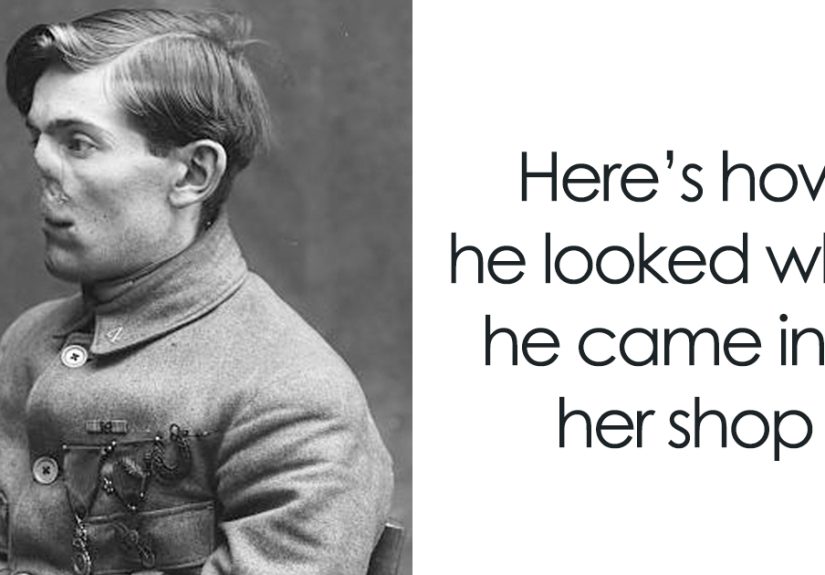
What the “Before and After” Photos Really Show
The famous before-and-after pictures can be misunderstood if viewed too quickly. They are not simply cosmetic transformations, as if the story were an Edwardian makeover show with higher stakes and lower patience for nonsense. What they reveal is the restoration of social presence. In the “before” images, viewers see the evidence of devastating injury. In the “after” images, they see what Ladd was trying to return: recognizability, privacy, and the chance to be met first as a person rather than as a wound.
That is why the photographs remain so affecting today. The visual change is obvious, but the emotional implication is bigger. These men were not asking to be turned into someone new. They wanted the possibility of being seen as themselves again.
More Than Appearance: Why the Masks Changed Lives
It is tempting to reduce Ladd’s work to appearance alone, but that misses the point by a mile. Faces are not decorative extras. They are central to identity, communication, and belonging. A damaged hand affects what you can do. A damaged face can affect how the world reacts before you even speak.
For WWI veterans, that mattered at every level of ordinary life. Could they board a train without being stared at? Could they return to work? Could they visit family friends? Could children look at them without fear? Could they resume courtship, marriage, churchgoing, shopping, or the thousand tiny interactions that make a person feel rejoined to society rather than sealed off from it?
Ladd’s masks offered a practical answer to those questions. They helped veterans manage public life. They gave some men the confidence to reenter social spaces. They reduced the immediate visual shock that often made strangers recoil. Even when the masks were imperfect, they created a buffer between injury and public reaction. That buffer could mean everything.
In a world still learning how to care for psychological trauma, that kind of restoration was not superficial. It was survival with dignity attached.
Where Art and Medicine Met
One of the most fascinating parts of this story is how clearly it shows the overlap between art and medicine. Ladd’s studio did not replace surgery. It complemented it. Surgeons reconstructed tissue, bone, and function whenever possible. Ladd reconstructed likeness, expression, and social visibility. One discipline addressed anatomy. The other addressed identity.
Today we might call this interdisciplinary care, which sounds tidy and modern and the sort of phrase that belongs in a grant proposal. In practice, it meant that war forced doctors, artists, technicians, and support workers to collaborate because no single field could solve the problem alone.
That collaboration also helped shape later ideas about prosthetics and facial restoration. Ladd’s work now sits in the broader history of anaplastology and reconstructive care, where science and craftsmanship meet in service of the patient. Her masks were early examples of something medicine still understands well: recovery is not just about staying alive. It is about living in public, in community, and in your own skin, or as close to it as history will allow.
The Limits of the Masks
To praise Ladd’s work honestly, it is important to acknowledge its limits. The masks could not move like living tissue. They could not fully restore speech or chewing if those functions had been badly affected. They could wear down, require maintenance, and never completely erase the underlying injury. Some likely felt uncanny, especially up close. They were, in many ways, a compromise shaped by the technologies of the time.
But compromise is not failure. For many veterans, the alternative was not a better, more natural solution waiting right around the corner. The alternative was isolation, unwanted attention, or the exhausting labor of enduring other people’s reactions every time they stepped into view.
In that context, the portrait masks were extraordinary. They were crafted not because they were perfect, but because they were possible, humane, and urgently needed.
Why Anna Coleman Ladd’s Story Still Matters
Anna Coleman Ladd’s legacy endures because it expands our definition of what wartime service can look like. She did not carry a rifle. She carried artistic skill into one of the most emotionally difficult corners of the war’s aftermath. She recognized that wounded veterans needed more than clinical treatment. They needed restoration of selfhood.
Her work also reminds us that “before and after” images can carry ethical weight. In the wrong hands, they can become spectacle. In Ladd’s story, at their best, they reveal compassion in action. They show what happened when someone looked at a terrible injury and asked not, “Can this be hidden?” but “How can this person return to life with more comfort, confidence, and choice?”
That is a better question. It was a better question in 1918, and it remains one now.
There is also something quietly radical in the fact that an artist helped solve a problem the industrial age had created. World War I used modern machinery to tear faces apart. Ladd used old-fashioned human attention, one patient at a time, to piece identity back together. No assembly line. No shortcuts. Just observation, patience, skill, and the conviction that dignity was worth the trouble.
Final Thoughts
The fascination of these before-and-after photographs is not really about the “after” alone. It is about the distance between the two images and what had to happen in that space: care, trust, artistry, and the refusal to let a veteran’s public life end with injury. Anna Coleman Ladd did not erase the damage of war. Nobody could. What she did was offer wounded men a way to face the world again on terms that felt a little more like their own.
That is why her story still resonates. It sits at the crossroads of war history, women’s history, medical history, disability history, and art history, and it speaks to all of them at once. The photographs endure because they document more than restoration of facial form. They document restoration of possibility.
And sometimes, in history as in life, possibility is the most generous kind of repair.
Related Experiences: What This Story Might Have Felt Like on the Ground
To understand why Anna Coleman Ladd’s work mattered, it helps to think beyond the famous photographs and imagine the daily experience surrounding them. Not in a melodramatic way, and not as historical fan fiction with better lighting, but as a grounded reflection on what veterans, families, and even Ladd herself likely confronted every day.
Imagine being a young soldier who survived the war but no longer recognized his own reflection. The victory parades are over. The headlines have moved on. The uniforms are folded away. Yet every ordinary errand now carries tension. Going outside is no longer simple. A walk becomes an encounter with glances. A train ride becomes a test of who can pretend not to stare. A shop counter becomes a tiny social battlefield. You are alive, yes, but life has become strangely public in all the wrong ways.
Now imagine entering Ladd’s studio. It is not a battlefield hospital, not exactly. It is a workspace full of casts, sculpting tools, metal forms, and people trying very hard to make the place feel less bleak than the world outside. There are flowers, flags, and voices that aim for normal conversation instead of pity. That atmosphere matters. Recovery is not only what happens on an operating table. Sometimes recovery begins when a room tells you that you are still welcome in it.
For families, the experience must have been just as layered. A wife, fiancee, mother, sibling, or child might feel relief that a loved one survived and grief for the visible evidence of what survival cost. The mask could not erase trauma, but it might soften the first return home. It might make reunion a little less shocking, a little more manageable, and a little more focused on the person rather than the injury.
There is also the experience of wearing the mask itself. It was probably uncomfortable at times. It probably felt strange, fragile, and imperfect. It certainly did not restore sensation or movement. But it may also have delivered a powerful kind of relief: the chance to choose when to reveal injury and when not to. That choice matters. Choice is a form of dignity.
As for Ladd, her experience was likely emotionally complicated in ways we can only partly grasp. She was creating objects that had to be artistically precise and psychologically gentle at the same time. She was not sculpting for a gallery wall. She was sculpting for someone’s next conversation, next meal in public, next walk down the street, next attempt to feel ordinary again. That is a tremendous burden for an artist to carry, and it may explain why her work continues to feel so deeply human.
Seen this way, the real transformation in those before-and-after images is not only physical. It is experiential. The “after” represents a man who might once again board a tram, sit in a cafe, greet a neighbor, or stand in daylight without feeling like the entire world has frozen around his face. That is not vanity. That is participation in life.
And that may be the most moving lesson of all: restoration is not always about returning someone to exactly what was lost. Sometimes it is about giving them enough confidence, comfort, and visibility to keep going. In the wake of war, that is no small gift. It is the beginning of a future.