Table of Contents >> Show >> Hide
Movie monsters are one of cinema’s greatest gifts. They stomp, slither, screech, burst out of people at deeply inconvenient times, and generally make normal life look wildly overrated. But once the credits stop rolling and your brain turns back on, some of these creatures start to wobble harder than a cardboard tombstone in a low-budget graveyard scene.
That does not mean they are bad monsters. In fact, some of the best movie monsters are gloriously impossible. Their job is not to pass a biology exam or survive a physics lecture. Their job is to hijack your imagination, ruin your sleep, and make popcorn feel like a risky food group. Still, it is fun to ask a simple question: if these monsters had to operate in anything resembling the real world, which ones would fall apart first?
This is where things get entertaining. Some monsters are too big for their own skeletons. Some depend on rules that make no practical sense. Some grow faster than logic, metabolism, and basic common sense should ever allow. And some are terrifying only because the movie politely asks you not to think too hard.
So let’s do exactly the opposite. Here are six famous movie monsters that are iconic on screen, unforgettable in pop culture, and absolute disasters once you drag them into daylight and make them explain themselves.
What makes a movie monster “not work”?
A monster can fail for more than one reason. Sometimes the problem is science. Giant creatures run into the square-cube law, which is the universe’s way of saying, “Nice try, but your legs are not enough.” Sometimes the issue is behavior. A monster may be scary in a contained story, yet wildly impractical in any world with police radios, floodlights, or a functioning public health department. And sometimes the problem is the monster’s own rulebook. If the creature can only exist because everyone agrees not to ask obvious follow-up questions, the whole thing is hanging by a very thin cinematic thread.
That is the spirit of this list. These monsters are not being judged on coolness. Coolness is safe. Coolness is intact. They are being judged on whether the concept survives contact with physics, biology, logic, and, in one case, clocks.
1. King Kong
Why the giant ape collapses under basic physics
King Kong is legendary because he feels massive, emotional, and tragic all at once. He is not just a giant ape. He is the giant ape. The skyscraper-climbing, plane-swatting, Beauty-and-the-Beast blueprint for every oversized creature that came later. Unfortunately, if Kong were real, he would have the structural integrity of a very dramatic disaster.
The biggest issue is scale. Animals do not simply get larger and keep all the same proportions like someone zooming in on a photo. As bodies get taller, volume and weight rise much faster than the strength of bones and muscles. That means a giant gorilla would not just be a regular gorilla with bigger attitude. It would be carrying absurd mass on limbs and joints that would struggle to support it. Kong does not need a villain. Kong needs orthopedic intervention and a very serious engineering team.
Then there is movement. The movie version can climb, leap, fight, and cling to buildings while holding a full-grown human in one hand like an anxious handbag. In reality, a creature that large would face crushing stress in its bones, enormous energy demands, and major heat-management problems. At a certain point, “towering primal force” becomes “planet’s saddest biomechanics case study.”
On screen, Kong works because emotion overwhelms logic. In real life, gravity would win before the third roar.
2. Godzilla
Why a radioactive lizard is a terrible business model for nature
Godzilla is not just a monster. He is a symbol. He carries postwar dread, nuclear anxiety, and a level of cinematic swagger that should frankly be taxed. But if we treat him as a literal living organism, the concept turns into a parade of scientific headaches wearing scales.
First, radiation does not function like a magic growth serum. Movies love the idea that nuclear exposure makes things enormous, angry, and conveniently photogenic. Real radiation is far less cooperative. It causes damage, mutation, illness, and death. It does not usually produce a skyscraper-tall reptile with theatrical timing and excellent city-entry instincts.
Second, Godzilla suffers the same giant-creature problem as Kong, only louder. A towering, land-walking reptile would need impossible skeletal support, impossible circulation, and a calorie budget that would make national supply chains sweat. The famous tail, the upright posture, the stomping mass, the urban wrestling matches, all of it sounds cool until you remember that a living body has to power that nonsense.
Then there is the heat issue. A creature that huge would need to regulate temperature while moving through air, water, and urban environments without cooking itself from the inside or freezing itself at the wrong moment. And that is before we even get to atomic breath, which is less biology and more “the screenwriters handed a reptile a superweapon.”
Godzilla absolutely works as myth. He absolutely does not work as zoology.
3. Gremlins
Why the rules are adorable, famous, and completely ridiculous
Gremlins is one of those movies that gets away with everything because it is funny, chaotic, and weirdly charming. The creature design is excellent. The destruction is joyful. Gizmo is cute enough to make rational thought take a holiday. But the monster system itself is held together by rules that collapse the moment you ask one normal-person question.
You know the rules: keep them away from bright light, never get them wet, and never feed them after midnight. That last one is doing some truly heroic nonsense. After midnight where? For how long? What counts as feeding? A snack? A crumb? Toothpaste? A rogue sesame seed? If a mogwai flies across time zones, does the curse clock reset? The entire species appears to operate on a rule written by a sleep-deprived wizard who refused to define terms.
Even beyond the timing issue, these creatures are a containment nightmare with a design that should have prevented their existence from day one. If exposure to water triggers reproduction, then humidity alone should make ownership feel like a hostage situation. Add food restrictions, bright-light sensitivity, and a talent for destruction, and you do not have a pet. You have a cursed compliance seminar with claws.
Gremlins work because the movie moves too fast and has too much personality for you to stop and file a complaint. In real life, their first owner would need a lawyer, a biologist, and several labeled wall clocks.
4. The Blob
Why a giant jelly nightmare becomes less scary once people act like adults
The Blob is a great concept because it strips fear down to one ugly, elegant idea: what if hunger itself rolled toward you? No face. No motive. No speech. Just a spreading mass that absorbs whatever it touches and keeps getting worse. That is excellent horror.
It is also a monster that depends heavily on everyone around it being slow to respond. The Blob becomes terrifying in part because adults dismiss warnings, authorities hesitate, and the creature keeps building momentum. That is good storytelling. In real-world threat analysis, though, it starts to look less like an unstoppable apocalypse and more like the world’s worst hazmat incident.
The Blob has obvious weaknesses as a living system. It appears to lack conventional limbs, stable anatomy, and clear sensory organs, yet it somehow locates prey, moves strategically, and scales up into a highly efficient predator. That is already a big ask. But even if we grant it alien biology, a growing gelatinous mass would be unusually visible, unusually difficult to hide, and unusually vulnerable to coordinated containment once people realized it was not a prank, a rumor, or a suspicious dessert.
That is the secret flaw in many “unstoppable” movie monsters: they are unstoppable only until institutions stop underreacting. The Blob is horrifying in a small-town panic. The Blob is much less impressive once engineers, military logistics, environmental controls, and very cold storage enter the chat.
5. The Xenomorph from Alien
Why this perfect organism cheats the energy bill
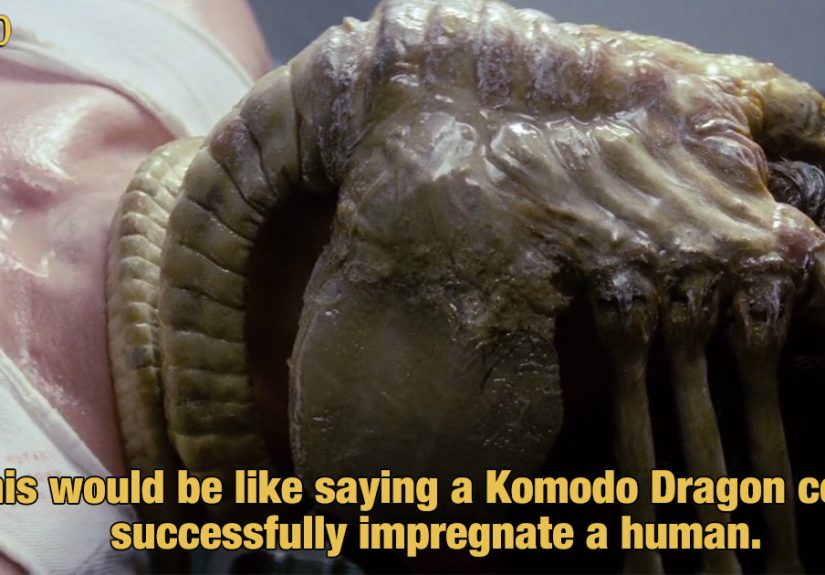
The Xenomorph may be the most effective movie monster ever designed. It is sleek, hostile, biomechanical, and deeply committed to making every corridor feel like a bad decision. Better yet, its life cycle borrows from real parasitic behavior, which is one reason it feels so disturbingly plausible. Nature, unfortunately, is sometimes an overachiever.
But the Xenomorph still breaks down once you examine how fast it develops. The creature goes from implanted embryo to chestburster to towering, fully weaponized adult at a speed that would make actual biology file for emotional damages. Growth requires matter. It requires energy. It requires time. A monster cannot become that large, that strong, and that well-armored almost instantly without obtaining a staggering amount of resources.
And then there is the acid blood. It is a fantastic cinematic detail because it turns even injuring the creature into a tactical problem. In biological terms, though, it raises awkward questions. How does the organism safely contain such a corrosive substance without destroying itself? What does its internal plumbing look like, and why has no one in the universe won a Nobel Prize for studying it?
Still, the Xenomorph comes closer than most. It borrows from parasitoids, predation, and body horror in ways that feel unnervingly grounded. But “closer than most” is not the same as workable. It is less a real organism than a nightmare running on premium horror fuel.
6. The Birds
Why a full avian uprising sounds scarier than it is biologically
Alfred Hitchcock’s The Birds remains brilliant because it takes something ordinary and turns it hostile. Birds are everywhere. They decorate mornings. They steal fries. They judge you from power lines. Turning them into a coordinated threat is genius because the familiar suddenly becomes untrustworthy.
But as a real-world monster scenario, the premise is shaky. Birds flock, mob predators, migrate in huge numbers, and perform astonishingly coordinated movements. That part is real. The problem is leaping from “collective behavior exists” to “multiple bird species launch a sustained campaign of organized human assault for no clear ecological reason.” That is not bird logic. That is plot logic wearing feathers.
Birds do not share a universal anti-human command center hidden in a lighthouse basement. Different species have different feeding habits, flight patterns, temperaments, habitats, and risk thresholds. A crow, a gull, and a sparrow are not naturally joining a strategic strike force because one seaside town had a bad week.
Also, birds are fragile compared with the level of destruction the movie implies. Yes, they can injure, panic, and overwhelm in numbers. But a species-wide avian war would run into basic issues of coordination, energy, and survival very quickly. Hitchcock knew this, of course. He was not making a wildlife documentary. He was weaponizing atmosphere.
And he succeeded. The birds work as dread. They do not work as a long-term military coalition.
Why impossible monsters still make great movies
Here is the twist: the fact that these monsters would not work is often exactly why they do work in movies. Horror, science fiction, and creature features are not legal contracts with reality. They are exaggeration engines. They take fear, grief, anxiety, technology, war, nature, and chaos, then give those forces teeth, claws, slime, or wings.
King Kong is about scale, loneliness, and spectacle. Godzilla is about catastrophe and trauma. Gremlins is about disorder breaking into cozy American life with a chainsaw grin. The Blob is panic without personality. The Xenomorph is invasion, violation, and survival stripped to the bone. The birds are nature refusing to remain background scenery.
In other words, movie monsters do not need to pass reality checks to justify their existence. They only need to express something true about fear. The trick is that some monsters feel more convincing than others when you slow the movie down and make them stand under fluorescent lighting.
The experience of rewatching impossible movie monsters
One of the funniest things about growing up with monster movies is realizing that the experience changes completely depending on your age. When you are a kid, a movie monster is simple. Big ape? Bad news. Giant lizard? Run. Alien with acid blood? Absolutely not. Your relationship with the creature is immediate and physical. You do not analyze the logistics of food intake or wonder how cartilage handles pressure. You just know that whatever is on screen is larger, stranger, and more confident than you are, which is plenty.
Then you get older, and the brain becomes unhelpfully active. Suddenly you are not just watching the monster. You are watching the infrastructure around the monster. You are thinking about emergency response times. You are wondering why nobody has set up a perimeter. You are questioning how a chestburster becomes a full adult seemingly between scenes. You are stuck on the Gremlins rule like a tax auditor for cursed pets. The movie is still fun, but now it is fun in stereo. One channel is fear; the other is commentary.
That second viewing experience is not lesser. In many ways, it is richer. You begin to appreciate how much craftsmanship goes into making an impossible thing feel emotionally real. A monster does not need to be plausible to be effective. It needs shape, rhythm, reveal, presence, and consequences. It needs to control the room. Think about the first time you see the Xenomorph fully formed, or Kong framed against the skyline, or hear the chaos of wings in The Birds. Your body reacts before your logic starts complaining.
There is also a specific joy in watching older monster movies with modern eyes. You can feel the historical anxieties baked into them. Godzilla carries atomic terror. King Kong carries colonial fantasy, spectacle, and tragedy. The Blob feels like paranoia sliding across a supposedly normal town. Gremlins practically throws holiday consumer comfort into a blender. These movies are not just about creatures. They are about the eras that invented them, the fears those eras could not quite say directly, and the delicious trick of making dread entertaining.
And honestly, there is something lovable about a monster that does not quite hold up. It reminds you that movies are acts of persuasion. They ask for your imagination first and your skepticism later. For ninety minutes, they get to say, “Trust us, this giant ape can do parkour,” and a surprising part of your soul replies, “You know what? Fine.” That bargain is part of the magic.
So yes, these six movie monsters would probably fall apart under real-world scrutiny. Their biology is suspect, their physics are rude, and their rulebooks are occasionally written in moon logic. But none of that erases their power. If anything, it highlights what monster movies do best: they turn impossibility into emotion. They let us watch fear become visible, oversized, and weirdly memorable.
That is why we keep coming back. Not because the monsters would work, but because the movies do.
Final thoughts
The best movie monsters are not always the most realistic ones. Sometimes they are the ones that crack open the fastest under scrutiny but still leave the deepest mark on pop culture. King Kong, Godzilla, Gremlins, The Blob, the Xenomorph, and the birds all survive for the same reason: they are bigger than logic, cleaner than realism, and sharper than ordinary fears.
If they showed up in the real world, most would fail spectacularly. On screen, though, they remain immortal. And that is a pretty good trick for creatures that technically should not make it past the first serious conversation with physics.