Table of Contents >> Show >> Hide
- Why Learning to Order Food in Spanish Is So Useful
- 1. Start With a Friendly Greeting and Ask for a Table
- 2. Ask for the Menu and Recommendations
- 3. Use Polite Ordering Phrases Like “Quisiera” and “Me trae”
- 4. Customize Your Order With “Con,” “Sin,” and “Aparte”
- 5. Order Drinks, Dessert, and Food To Go
- 6. Ask for the Check and Handle Payment Politely
- Common Spanish Restaurant Vocabulary
- Polite Tips That Make Your Spanish Sound Better
- Mini Scripts for Real Ordering Situations
- Common Mistakes to Avoid When Ordering Food in Spanish
- of Real-World Experiences: What Ordering Food in Spanish Actually Feels Like
- Conclusion
Ordering food in Spanish does not have to feel like a final exam with salsa on the side. Whether you are traveling through Mexico City, visiting a tapas bar in Madrid, stopping at a food truck in Los Angeles, or simply trying to impress your friends at a local taqueria, a few practical phrases can turn nervous pointing into confident conversation.
The good news is that restaurant Spanish is wonderfully predictable. Servers ask familiar questions. Menus use repeated words. Most orders follow a simple pattern: greet, ask for a table or menu, request what you want, customize it, confirm whether it is for here or to go, and pay. Once you learn those building blocks, you can order tacos, coffee, empanadas, soup, or a heroic plate of enchiladas without accidentally asking for a shoe.
This guide breaks down 6 easy ways to order food in Spanish using natural phrases, clear examples, pronunciation-friendly tips, and real restaurant situations. You will also learn polite wording, common mistakes, useful vocabulary, and small cultural details that make the whole experience smoother. Grab your appetite. Your Spanish is about to become delicious.
Why Learning to Order Food in Spanish Is So Useful
Food is one of the easiest and most rewarding places to practice Spanish because the goal is simple: you speak, someone brings food, and everybody wins. Restaurant interactions are short, practical, and repetitive. That makes them perfect for beginners who want real-world confidence fast.
Spanish is also extremely useful in the United States. It is the most widely spoken non-English language in U.S. homes, and Spanish-speaking communities shape the country’s food culture every day. From Mexican bakeries and Cuban cafés to Salvadoran pupuserías and Puerto Rican restaurants, knowing how to order food in Spanish helps you connect more naturally with people, menus, and flavors.
You do not need perfect grammar. You need useful phrases, a polite tone, and the courage to try. A friendly “por favor” can rescue a sentence that is wobbling like flan on a hot dashboard.
1. Start With a Friendly Greeting and Ask for a Table
The first easy way to order food in Spanish is to begin politely. Before you even get to the menu, you may need to greet the host or ask for a table. This small step sets the tone and makes you sound more natural.
Useful phrases for arriving at a restaurant
- Hola, buenas tardes. Hello, good afternoon.
- Buenas noches. Good evening.
- Una mesa para dos, por favor. A table for two, please.
- Somos cuatro. There are four of us.
- ¿Tiene una mesa disponible? Do you have a table available?
- Tenemos una reservación. We have a reservation.
If you are dining alone, say una mesa para uno. For two people, say para dos. For three, para tres. The pattern is simple, which is a relief because hunger does not improve math skills.
Example conversation
You: Hola, buenas tardes. Una mesa para dos, por favor.
Host: Claro. ¿Adentro o afuera?
You: Afuera, por favor.
That last line means “Outside, please.” You may also hear adentro for inside, afuera for outside, or en la terraza for on the patio. If you do not understand everything, smile and say, ¿Puede repetir, por favor? That means, “Can you repeat that, please?” It is one of the most useful Spanish phrases you will ever learn, right behind “Where is the bathroom?”
2. Ask for the Menu and Recommendations
Once you are seated, the next easy way to order food in Spanish is to ask for the menu and request recommendations. This helps you avoid staring at a menu like it contains ancient treasure map instructions.
Menu phrases you should know
- La carta, por favor. The menu, please.
- ¿Me puede traer la carta? Can you bring me the menu?
- ¿Tiene un menú en inglés? Do you have a menu in English?
- ¿Qué recomienda? What do you recommend?
- ¿Cuál es la especialidad de la casa? What is the house specialty?
- ¿Qué lleva este plato? What comes in this dish?
In many places, la carta means the menu. You may also hear el menú, especially when referring to a set meal or daily special. In Spain and parts of Latin America, menú del día often means a fixed-price daily lunch menu. It may include a first course, second course, drink, bread, and dessert or coffee. In other words, it is the restaurant saying, “Relax, we made the decisions for you.”
How to ask what is inside a dish
If you are unsure about ingredients, use ¿Qué lleva? This literally means “What does it carry?” but in restaurant Spanish it means “What is in it?”
Examples:
- ¿Qué lleva la sopa? What is in the soup?
- ¿Qué lleva el burrito? What is in the burrito?
- ¿Lleva carne? Does it have meat?
- ¿Lleva queso? Does it have cheese?
This is especially helpful for vegetarians, picky eaters, people with allergies, and anyone who has ever discovered mystery seafood too late.
3. Use Polite Ordering Phrases Like “Quisiera” and “Me trae”
The heart of learning how to order food in Spanish is knowing the phrase that gets food from the kitchen to your table. There are several ways to order, and each has a slightly different tone.
Best phrases for ordering food in Spanish
- Quisiera… I would like…
- Me gustaría… I would like…
- ¿Me trae…? Could you bring me…?
- Para mí, … For me, …
- Voy a pedir… I am going to order…
- Quiero… I want…
Quisiera is polite and widely useful. Me gustaría is also polite, though in many casual restaurants it can sound slightly more formal. Quiero means “I want,” and while it is grammatically correct, it can sound blunt if you forget por favor. Add “please,” and you are back in safe territory.
Simple ordering examples
- Quisiera los tacos de pollo, por favor. I would like the chicken tacos, please.
- ¿Me trae una ensalada, por favor? Could you bring me a salad, please?
- Para mí, la sopa de tortilla. For me, the tortilla soup.
- Voy a pedir el pescado. I am going to order the fish.
- Quiero un café con leche, por favor. I want a coffee with milk, please.
One of the easiest formulas is:
Quisiera + food item + por favor.
For example: Quisiera una hamburguesa, por favor. That sentence alone can carry you through many restaurants, cafés, bakeries, and food counters. It is the Swiss Army knife of Spanish dining.
4. Customize Your Order With “Con,” “Sin,” and “Aparte”
Ordering food is not only about choosing the dish. Sometimes you need it without onions, with extra sauce, or with the dressing on the side because salad should not arrive wearing a soup costume.
Key customization words
- con with
- sin without
- extra extra
- aparte on the side / separate
- poco a little
- mucho a lot
- picante spicy
Customization examples
- Sin cebolla, por favor. Without onion, please.
- Con queso, por favor. With cheese, please.
- La salsa aparte, por favor. Sauce on the side, please.
- Un poco picante. A little spicy.
- No muy picante, por favor. Not very spicy, please.
- Con extra aguacate. With extra avocado.
If you have an allergy, be direct and clear. You can say:
- Soy alérgico al maní. I am allergic to peanuts. Said by a male speaker.
- Soy alérgica al maní. I am allergic to peanuts. Said by a female speaker.
- No puedo comer mariscos. I cannot eat seafood.
- ¿Tiene gluten? Does it have gluten?
Do not rely on jokes or vague wording when discussing allergies. This is the one moment when “close enough” should leave the building. Speak slowly, confirm the ingredient, and use a translation app if necessary.
5. Order Drinks, Dessert, and Food To Go
Many restaurant conversations happen outside the main dish. You may want water, another coffee, dessert, leftovers packed up, or a takeout order. These are easy Spanish phrases that make the experience much smoother.
How to order drinks in Spanish
- Quisiera agua, por favor. I would like water, please.
- Agua sin gas. Still water.
- Agua con gas. Sparkling water.
- Un café, por favor. A coffee, please.
- Un té helado, por favor. An iced tea, please.
- ¿Qué bebidas tienen? What drinks do you have?
In some Spanish-speaking countries, ordering water may bring bottled water unless you specify. If you want tap water, you can ask for agua del grifo in Spain or simply say agua de la llave in many parts of Latin America. Availability and customs vary, so be flexible.
How to order dessert
- ¿Tiene postres? Do you have desserts?
- ¿Qué postres tienen? What desserts do you have?
- Quisiera el flan. I would like the flan.
- Para compartir, por favor. To share, please.
Para compartir is useful when ordering appetizers, desserts, or anything you pretend is for the table but secretly plan to dominate. No judgment. Churros have that effect.
How to ask for takeout or leftovers
- Para llevar, por favor. To go, please.
- ¿Me lo puede poner para llevar? Can you pack it to go?
- Quisiera ordenar para llevar. I would like to order takeout.
- ¿Tienen servicio a domicilio? Do you offer delivery?
Para llevar is one of the most important food phrases in Spanish. Use it at bakeries, cafés, restaurants, food stands, and casual counters. If you want to eat there, you may hear or use para comer aquí, meaning “to eat here.”
6. Ask for the Check and Handle Payment Politely
The final easy way to order food in Spanish is knowing how to end the meal. Asking for the check is simple, but customs can vary. In many Spanish-speaking countries, the server may not bring the bill until you ask. This is not neglect; it is often considered polite not to rush you.
Check and payment phrases
- La cuenta, por favor. The check, please.
- ¿Me trae la cuenta? Can you bring me the check?
- ¿Puedo pagar con tarjeta? Can I pay by card?
- ¿Aceptan efectivo? Do you accept cash?
- ¿Está incluida la propina? Is the tip included?
- Todo estuvo delicioso. Everything was delicious.
La cuenta, por favor is short, polite, and universally useful. If the meal was good, add gracias or todo estuvo muy rico. In many Latin American countries, rico means tasty or delicious, not just rich. So yes, your tacos can be “rich” without owning beachfront property.
Common Spanish Restaurant Vocabulary
Learning a few restaurant words helps you understand menus and server questions. You do not need a giant vocabulary list. Start with high-frequency words that appear everywhere.
Basic food and restaurant words
- el restaurante restaurant
- la mesa table
- el mesero / la mesera waiter / waitress
- la carta menu
- el plato dish or plate
- la bebida drink
- el postre dessert
- la cuenta check or bill
- la propina tip
- el tenedor fork
- la cuchara spoon
- el cuchillo knife
- la servilleta napkin
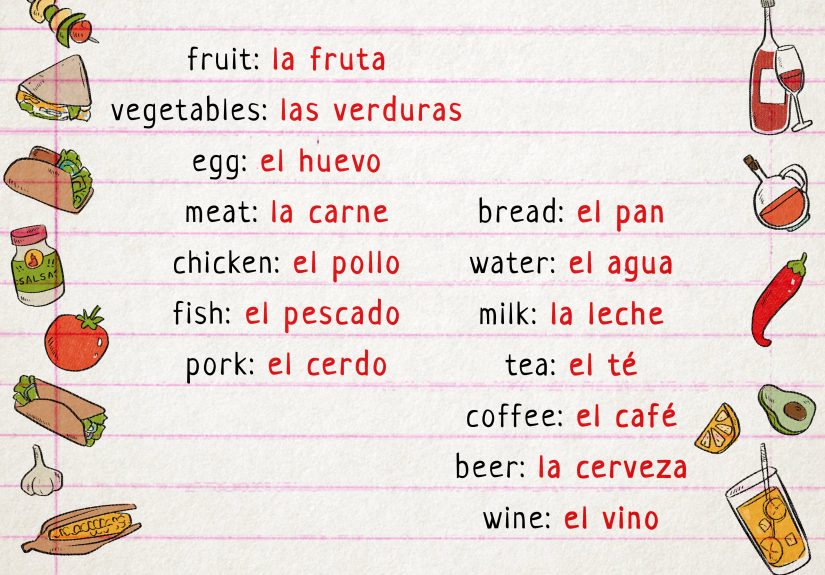
Food words you will see often
- pollo chicken
- carne meat or beef, depending on context
- cerdo pork
- pescado fish
- mariscos seafood
- arroz rice
- frijoles beans
- verduras vegetables
- queso cheese
- pan bread
Polite Tips That Make Your Spanish Sound Better
The words matter, but tone matters too. Restaurant Spanish becomes much easier when you remember a few polite habits.
Always keep “por favor” and “gracias” nearby
Por favor means please. Gracias means thank you. These two words are small but powerful. They soften direct phrases and make beginner Spanish sound friendlier.
Use “usted” style in formal situations
In many restaurants, especially nicer ones, formal language is appropriate. Phrases like ¿Me puede traer…? and ¿Me trae…? work well because they sound respectful without being stiff.
Do not panic if people answer quickly
Native speakers may respond faster than expected. That does not mean your Spanish failed. It means the conversation has begun. Use más despacio, por favor to ask someone to speak more slowly. Use no entiendo if you do not understand. These phrases are not embarrassing. They are tools.
Mini Scripts for Real Ordering Situations
Here are short scripts you can copy, practice, and adapt. They are designed for real situations, not textbook drama where everyone discusses the library for no reason.
At a casual restaurant
Server: ¿Qué desea comer?
You: Quisiera los tacos de carne, por favor.
Server: ¿Con todo?
You: Sí, pero sin cebolla, por favor.
At a café
You: Hola. Un café con leche y un pan dulce, por favor.
Cashier: ¿Para aquí o para llevar?
You: Para llevar, gracias.
Asking for a recommendation
You: ¿Qué recomienda?
Server: El pescado está muy bueno.
You: Perfecto. Para mí, el pescado, por favor.
Paying at the end
You: La cuenta, por favor.
Server: Claro.
You: ¿Puedo pagar con tarjeta?
Common Mistakes to Avoid When Ordering Food in Spanish
Beginner mistakes are normal. In fact, they are part of the meal. Still, a few quick corrections can save confusion.
Mistake 1: Using “ordenar” everywhere
In some places, especially areas influenced by English, people use ordenar for ordering food. However, pedir is often the more traditional and widely accepted verb in many Spanish-speaking regions. To stay safe, use phrases like quisiera, voy a pedir, or ¿me trae…?
Mistake 2: Forgetting gender endings with allergies
If you say “I am allergic,” Spanish changes depending on the speaker. A male speaker says soy alérgico. A female speaker says soy alérgica. The difference is small, but with allergies, clarity matters.
Mistake 3: Speaking too quietly
Many learners mumble because they are nervous. Speak slowly and clearly. You do not need a perfect accent. You need understandable words and enough volume for the server to hear you over the espresso machine, sizzling fajitas, and someone’s birthday song.
of Real-World Experiences: What Ordering Food in Spanish Actually Feels Like
The first time you order food in Spanish, your brain may suddenly forget every word it has ever learned. You walk in confidently, see the menu, and somehow “taco” becomes the only surviving vocabulary item. This is completely normal. Restaurant pressure is real because there is a line behind you, the cashier is waiting, and your stomach is making decisions your mouth cannot translate yet.
One helpful experience is starting small at a bakery or café. Instead of attempting a full dinner conversation, order one item: un café, por favor or una empanada para llevar. The interaction lasts less than a minute, but it gives you a quick confidence boost. You learn how people actually respond, how fast they speak, and what follow-up questions appear. Often, the follow-up is simple: ¿algo más?, meaning “anything else?” Once you recognize that phrase, the whole situation feels less scary.
Another useful experience is ordering something you already know. If you love chicken tacos, practice quisiera los tacos de pollo, por favor before you arrive. Familiar food reduces stress. You are not translating the entire menu while hungry. You are simply delivering a sentence you prepared. This is the language-learning equivalent of bringing snacks on a road trip: practical and emotionally wise.
It also helps to listen for repeated restaurant questions. Servers often ask ¿para aquí o para llevar?, ¿con todo?, ¿qué desea?, or ¿algo de tomar?. At first, these may sound like one long musical blur. After a few meals, they become familiar. You start to hear patterns instead of noise. That is when Spanish begins to feel less like a wall and more like a doorway.
One of the funniest parts of ordering in Spanish is learning that mistakes rarely ruin anything. You might ask for salsa aparte and pronounce it strangely. You might say gracias three times in one sentence like a polite robot. You might accidentally use English word order. Most servers will still understand, especially when you point, smile, and stay respectful. The goal is communication, not winning a grammar trophy.
The best experience comes when you stop translating every word and start using chunks. Instead of building a sentence from scratch, memorize useful blocks: para mí, sin cebolla, la cuenta, para llevar, ¿qué recomienda?. These chunks are fast, flexible, and reliable. They help you sound natural even as a beginner.
Over time, ordering food in Spanish becomes more than a travel skill. It becomes a small act of connection. You notice regional dishes, local expressions, and the warmth that appears when you try someone else’s language. Even a simple order can open a friendly conversation. And yes, it can also open the door to better tacos. That is what experts call motivation.
Conclusion
Learning how to order food in Spanish is one of the fastest ways to build practical confidence. Start with greetings, ask for the menu, use polite ordering phrases, customize with con and sin, request food para llevar, and finish with la cuenta, por favor. These six easy steps cover most restaurant situations you will face.
You do not need flawless Spanish to enjoy a meal. You need a few dependable phrases, a polite attitude, and the willingness to practice. Every order teaches you something new: a word, a sound, a menu item, or a cultural habit. The next time you visit a Spanish-speaking restaurant, try one phrase from this guide. Then try two. Before long, you will be ordering confidentlyand possibly asking for extra guacamole like a professional.