Table of Contents >> Show >> Hide
- Why children’s eye exams matter (even when nobody is complaining)
- Vision screening vs. a comprehensive eye exam: what’s the difference?
- When should kids have their eyes checked?
- What happens during a child’s eye exam?
- Dilation: why the drops happen (and how to survive them)
- How to prepare your child for the appointment
- Common outcomes: what the results might mean
- Myopia is rising: what parents can do (without panicking)
- Frequently asked questions (because parents are practical people)
- Experiences from the exam room (the “what it’s really like” section)
- Wrap-up
Your child’s eyes are doing a lot of heavy lifting: learning letters, catching balls, spotting you in a crowded
school pickup line, and locating the one crumb of cookie they swore they didn’t eat. An eye exam (or vision
screening) isn’t just about “Can you read the chart?”it’s about making sure your child’s visual system is
developing the way it should, and catching problems early while treatment works best.
This guide explains when kids typically need their vision checked, what happens during an eye exam, how a
screening differs from a full exam, and how to prep your child without turning the appointment into a reality
show episode titled “Tiny Human vs. Eye Drops.”
Why children’s eye exams matter (even when nobody is complaining)
Kids are wildly adaptable. If one eye is doing more work than the other, a child may not realize anything is
“off”because to them, that’s just how the world looks. That’s why some of the most important childhood vision
problems can be “silent” at home.
Early detection protects vision development
Childhood is when the brain learns how to see. If the brain isn’t getting a clear, balanced image from both eyes,
it may start favoring one eye and ignoring the other. Over time, that can lead to amblyopia (often called “lazy
eye”), which is much easier to treat when found early.
Vision can affect school, sports, and behavior
Uncorrected vision problems can show up as headaches, squinting, avoiding reading, losing place on a page, or
“not paying attention.” Sometimes it’s not attitudeit’s eyesight. And yes, it’s possible for a child to pass a
basic school screening and still struggle with other visual skills needed for reading and learning.
Vision screening vs. a comprehensive eye exam: what’s the difference?
These two get mixed up all the time, so let’s clear it up:
Vision screening
- Where it happens: pediatrician’s office, school, community programs.
- What it does: quickly checks for signs a child might have a vision problem.
- What it doesn’t do: diagnose the full “why,” measure a precise glasses prescription, or thoroughly evaluate eye health.
Comprehensive eye exam
- Where it happens: optometrist (OD) or ophthalmologist (MD), often a pediatric specialist for younger kids or complex issues.
- What it does: evaluates how each eye sees, how the eyes work together, and the health of the eyesoften including tests that don’t show up in screenings.
- When it’s needed: if a screening is abnormal, symptoms are present, risk factors exist, or you want a full baseline assessment.
Think of a screening like a metal detector at a concert: useful, fast, and designed to flag potential problems.
A comprehensive exam is the full security checkslower, more detailed, and much more informative.
When should kids have their eyes checked?
Recommendations vary slightly across organizations, but the big theme is consistent: check early, screen regularly,
and get a full exam when needed. Your pediatrician will typically perform eye and vision checks at well-child visits,
and many children will also benefit from a comprehensive exam with an eye doctor at key agesespecially if they’re
at higher risk.
| Age | What’s commonly recommended | What it looks like in real life |
|---|---|---|
| Newborn to 6 months | Eye health checks (including red reflex) during newborn care and well visits. | Your pediatrician checks for obvious issues like cataracts, eye structure concerns, and unusual reflections. |
| 6–12 months | Ongoing vision/eye health screening; some families choose a baseline comprehensive exam. | Great time for a “how are things developing?” lookespecially if premature birth or family history exists. |
| 1–2 years | Instrument-based screening may be used (photoscreeners/autorefractors), plus routine pediatric screening. | This is often “look at the blinking light” technologyhelpful when toddlers refuse charts on principle. |
| 3–5 years | Vision screening is strongly recommended (at least once in this window) to detect amblyopia risk. | Many kids can do symbol/letter matching tests. If not, the office may use kid-friendly alternatives. |
| 5+ years | Regular screening (often every 1–2 years) and comprehensive exams as needed (or more often with glasses/medical concerns). | School screenings help, but a full exam is best for persistent symptoms, learning concerns, or progressing myopia. |
Kids who should be seen sooner (or more often)
Your child may need an earlier or more frequent comprehensive eye exam if any of the following apply:
- Premature birth or significant medical history (including certain genetic conditions).
- Family history of amblyopia, strabismus (eye misalignment), severe childhood nearsightedness, or eye disease.
- Eyes that cross/turn in or out (even “only when tired”).
- One eye that seems to wander, a consistent head tilt, or closing one eye to see better.
- Frequent headaches, squinting, sitting very close to screens, or avoiding near work.
- Teacher concerns about tracking, copying from the board, or reading stamina.
What happens during a child’s eye exam?
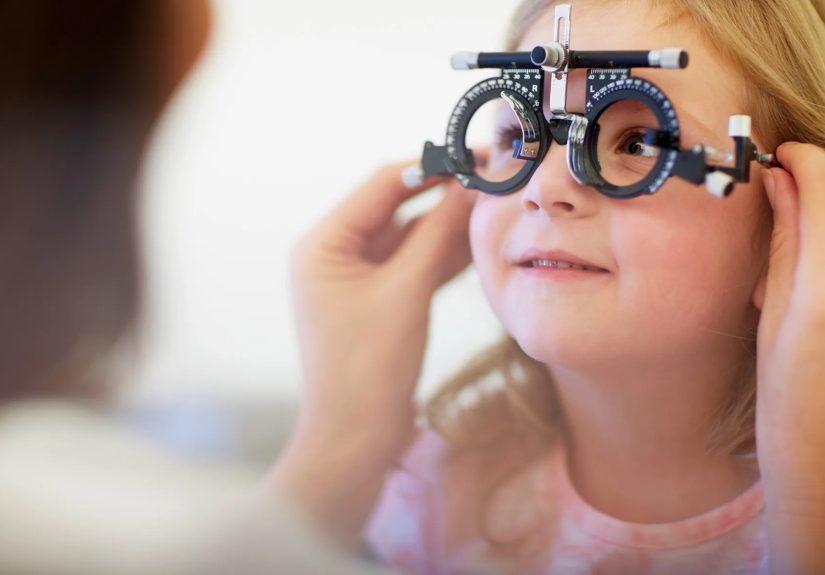
A pediatric eye exam isn’t a miniature adult exam. Eye doctors use age-appropriate toolsbecause asking a
two-year-old to “read the smallest line you can” is like asking a cat to file your taxes.
1) History and “real-world” questions
Expect questions like: Does your child rub their eyes? Squint? Complain of blurry vision? Have headaches?
Any family eye history? How’s school going? Are there coordination issues? These answers guide what tests
matter most.
2) Visual acuity (how clearly each eye sees)
Depending on age, this might be letters, shapes, or matching games. The goal is to see how each eye performs
on its ownnot just how they do together.
3) Refraction (do they need glasses?)
Refraction estimates whether the eye is nearsighted (myopia), farsighted (hyperopia), or has astigmatism.
In children, the doctor may use special drops to temporarily relax focusing so the measurement is more accurate.
This is especially useful when deciding if a prescription is truly needed.
4) Eye alignment and teamwork
Seeing clearly is only part of the story. The doctor also checks whether the eyes line up, track smoothly, and
work together. Misalignment (strabismus) can increase the risk of amblyopia, and subtle teaming problems can
make reading feel like running a marathon in flip-flops.
5) Eye health evaluation
The exam may include checking the front of the eye and, when appropriate, looking at the back of the eye
(retina and optic nerve). This is one reason comprehensive exams can uncover issues a screening might miss.
Dilation: why the drops happen (and how to survive them)
Dilation helps the doctor examine the inside of the eye more thoroughly. For many children, dilating drops also
help with getting a more accurate prescription measurement because kids can “power through” focusing in ways
adults can’t.
What dilation can feel like:
- Temporary light sensitivity: sunglasses or a hat can help.
- Blurry near vision for a few hours: reading up close may be annoying right after.
- Big pupils: your child may look like they’re auditioning for a music video. This is normal.
Pro tip: plan a “low near-vision demand” afternoon. Think: playground, audiobooks, big-picture activities.
Avoid: tiny crafts that require microscopic precision.
How to prepare your child for the appointment
Set expectations without scaring them
Simple explanations work best: “The doctor will use lights and pictures to see how your eyes are working.”
Skip the dramatic trailer voiceover (“Then… the drops…”). You can mention “special medicine drops” calmly if
dilation is likely.
Bring the right stuff
- Any current glasses (and old pairs if you have them).
- A list of medications and relevant medical history.
- Sunglasses or a brimmed hat for after dilation.
- A snack and a small comfort item for younger kids.
Time it well
For little kids, schedule around naps and meals. A tired, hungry toddler is not the ideal candidate for
“cooperate with a vision test.” (Frankly, neither is a tired, hungry adult.)
Common outcomes: what the results might mean
Eye exams don’t always end with glassesand that’s good news. Many children have normal findings. When an issue
is found, the “next step” depends on what it is and how severe it is.
Refractive errors (glasses prescriptions)
- Myopia (nearsightedness): distance is blurry; kids may sit close to the TV or struggle seeing the board.
- Hyperopia (farsightedness): can be normal in younger kids; sometimes causes eyestrain or crossing.
- Astigmatism: vision can be blurry or distorted at all distances; may contribute to headaches or squinting.
If glasses are prescribed, the doctor will explain when to wear them (all day vs. schoolwork vs. distance only)
and what changes to watch for. Many kids adapt quicklyespecially when you hype them up like they’re getting
superhero gear.
Amblyopia (“lazy eye”)
Amblyopia means one eye isn’t seeing as well as it should because the brain is favoring the other eye. Treatment
often focuses on making the weaker eye do more workcommonly through glasses plus patching or medicated drops,
depending on the situation. Consistency matters more than perfection; a plan you can actually follow wins.
Strabismus (eye misalignment)
Strabismus is when the eyes don’t point in the same direction. Treatment can include glasses, patching, drops,
and sometimes surgeryespecially when alignment affects vision development or causes double vision. The key is
professional evaluation: “They’ll grow out of it” isn’t a strategy.
Myopia is rising: what parents can do (without panicking)
Nearsightedness (myopia) has become more common in children, and researchers have linked the trend to modern
visual habitsmore near work and screens, less outdoor time. The good news: there are practical ways to support
healthy vision and, in some cases, options to slow myopia progression.
Everyday habits that help
- More outdoor time: daylight exposure has been associated with a lower risk of developing myopia.
- Breaks during near work: encourage your child to look up and far away regularly during reading or screens.
- Comfort matters: good lighting, a reasonable working distance, and not doing homework nose-to-page.
Myopia control options (doctor-guided)
If your child’s myopia is progressing, your eye doctor may discuss approaches such as low-dose atropine eye drops
or specialized contact lens options. These decisions depend on age, prescription changes over time, eye health,
and family preferencesand they should be supervised by an eye care professional experienced in pediatric care.
Frequently asked questions (because parents are practical people)
“My child passed the school screening. Do we still need an eye exam?”
A passed screening is reassuring, but it doesn’t guarantee everything is perfect. Screenings are designed to flag
major concerns, not fully evaluate eye health or every visual skill. If your child has symptoms, risk factors, or
school concerns, a comprehensive exam is a smart next step.
“What if my child refuses the tests?”
Eye doctors are used to this. Pediatric exams are built around flexible methodsmatching games, pictures, and
instrument-based testing. Let the staff know your child’s age and temperament when scheduling; they can plan
accordingly.
“How often should my child have a comprehensive eye exam?”
It depends. Many children do well with routine vision screenings plus eye exams as needed. Children who wear
glasses, have medical eye conditions, or have progressing myopia often need more frequent follow-up. Your eye
doctor will recommend the interval that fits your child’s situation.
Experiences from the exam room (the “what it’s really like” section)
Parents often imagine a child’s eye exam as a tiny version of their own: a chart, a few lenses, done. In real
life, it’s more like a carefully choreographed kids’ showlights, targets, friendly coaching, and occasional
negotiation. Here are common experiences families report, and what you can learn from them.
Experience #1: “My toddler wouldn’t look at the chart… because there was no chart.”
Many parents arrive bracing for a battle over letters, only to find the doctor uses instrument-based screening
or pictures and lights for younger kids. One common surprise is how fast some parts of the exam can be when the
tools match the child’s developmental stage. The takeaway: if your child can’t reliably identify letters or
shapes, that doesn’t mean the visit is pointless. It means the doctor will use different methods to gather the
same informationoften more accurately than a forced chart attempt.
Experience #2: The “eye drops drama” that wasn’t (or was, but ended quickly).
Dilation is the moment parents worry about most. Some kids barely react; others react like they’ve been asked to
drink a smoothie made of broccoli and betrayal. What helps? Calm adults, simple language (“special medicine
drops”), and a distraction plan: a favorite video, a story, or counting games. Parents also learn that the
waiting period after dilation can feel longso scheduling with extra buffer time is wise. The takeaway: if you
treat it like a normal step, your child is more likely to follow your lead.
Experience #3: “My child got glasses and now refuses to take them off.”
This happens more than you’d thinkespecially when the prescription makes a clear difference. Parents describe a
sudden improvement in confidence: fewer squints, fewer headaches, less frustration with reading. Kids often love
seeing the world more sharply. The takeaway: if glasses are prescribed, consistency early on builds the habit.
Pair glasses with something positive (choosing frames, showing family, “glasses high-five”) instead of making it
feel like a punishment.
Experience #4: Patching negotiations and the power of routines.
When amblyopia treatment includes patching, families quickly realize that willpower isn’t the best toolroutine
is. Parents describe better success when patching happens during a predictable activity (cartoons after school,
a game, reading time) rather than randomly. Sticker charts, timers, and letting kids pick the patch design can
turn a daily argument into a “this is just what we do.” The takeaway: the best plan is one your family can
actually maintain. A slightly less-than-perfect routine done consistently often beats a perfect plan that no one
follows.
Experience #5: The “myopia talk” and the outdoor time reset.
Families are increasingly hearing that nearsightedness can progress as kids grow. Parents often describe the
visit as a wake-up call: more breaks during homework, more time outside, and a more thoughtful approach to
screens. Some families also talk with their doctor about myopia control options when prescriptions change
quickly. The takeaway: you don’t have to become the Screen Time Sheriff, but small shiftsoutdoor play, regular
breaks, good lightingcan support eye comfort and healthy habits.
In almost every story, the most important “win” is the same: clarity. Whether the exam confirms everything is
normal or identifies a treatable issue, families leave with a planand fewer unknowns. And in parenting, fewer
unknowns is basically luxury.
Wrap-up
Your child’s eye exam is one of those preventive steps that pays off quietly: better learning, safer play,
fewer headaches, and peace of mind. Start with regular screenings, don’t ignore symptoms, and don’t hesitate to
get a comprehensive exam when something feels off. Vision problems are common, but with early detection and
appropriate treatment, many are highly manageable.