Table of Contents >> Show >> Hide
- China’s New Tank in One Sentence
- Why the Type 100 Tank Got So Much Attention
- Key Features of China’s New Tank
- The Type 100 Support Vehicle: The Tank’s Battle Buddy
- What We Still Do Not Know
- How China’s New Tank Fits Into “Intelligentized Warfare”
- Comparison With Western and Russian Tank Trends
- Is the Type 100 a Main Battle Tank or a Medium Tank?
- Why the Type 100 Matters for the United States and Allies
- The Hype Filter: What to Believe and What to Question
- Practical Experiences: How to Understand China’s New Tank Without Falling for the Hype
- Conclusion: The Type 100 Is a Signal, Not Just a Tank
China’s new tank has arrived with the kind of dramatic entrance usually reserved for blockbuster villains, luxury electric cars, or a cat walking across a freshly cleaned countertop. Officially known in open-source reporting as the Type 100 tank, also called the ZTZ-100, it appeared publicly during China’s 2025 Victory Day military parade and immediately triggered a wave of questions: Is it a true fourth-generation main battle tank? Is it a medium tank with big ambitions? Is it a rolling computer with a cannon? The answer, annoyingly but honestly, is: yes, maybe, and more or less.
The Type 100 matters because it shows where the People’s Liberation Army appears to be taking armored warfare. This is not simply a heavier tank with thicker armor and a louder gun. Instead, China’s new tank emphasizes hybrid-electric propulsion, an unmanned turret, active protection, sensors, data links, drone cooperation, and what Chinese military thinkers often describe as “intelligentized” warfare. In plain English: the tank is designed to see more, share more, hide better, and survive in a battlefield crowded with drones, missiles, electronic warfare, and long-range precision fires.
That does not mean it is invincible. Tanks have a long history of being declared obsolete five minutes before someone finds another use for them. The Type 100 should not be treated as a magic dragon on tracks. But it does represent a serious design signal from China: future tanks may be judged less by raw tonnage and more by how well they connect to the battlefield network around them.
China’s New Tank in One Sentence
The Type 100 is best understood as a next-generation Chinese armored platform that trades the old “bigger gun, thicker armor” formula for a more digital recipe: lighter weight, hybrid power, advanced sensors, active defenses, an unmanned turret, and networked combat capability.
That sentence sounds like it escaped from a defense contractor brochure, so let’s unpack it. Traditional main battle tanks such as the American M1 Abrams, German Leopard 2, Russian T-90, and Chinese Type 99A were built around the holy trinity of armor, firepower, and mobility. The Type 100 still needs all three, of course. A tank without protection is just an expensive target, and a tank without firepower is a parade float with anxiety. But China appears to be adding a fourth pillar: information dominance.
In modern warfare, the first vehicle to detect, identify, share, and act often has the advantage. A tank that sees drones, receives targeting data, coordinates with artillery, and uses electronic systems to confuse incoming threats is more than a metal box with attitude. It becomes a node in a wider combat web.
Why the Type 100 Tank Got So Much Attention
The Type 100 was not introduced in a quiet factory newsletter. It rolled through Beijing during a major military parade, surrounded by other symbols of Chinese power, including missiles, drones, air-defense systems, and electronic warfare equipment. That setting matters. Military parades are not just equipment shows. They are strategic theater. They tell domestic audiences, rivals, neighbors, and potential buyers: “Look what we can build.”
For China, the Type 100 fits into a larger modernization story. The PLA has spent years moving away from a massive but uneven force toward a more technologically advanced military. Public U.S. defense assessments have repeatedly described China’s investments in conventional capabilities, space, cyber, electronic warfare, amphibious operations, missiles, and joint operations. The tank is only one piece of that puzzle, but it is a flashy piece. Think of it as the armored equivalent of a smartphone launch event, except the phone weighs dozens of tons and the “camera upgrade” may involve targeting drones.
Key Features of China’s New Tank
1. An Unmanned Turret
One of the most talked-about features of the Type 100 is its unmanned turret. In a conventional tank, crew members may occupy the turret to load, aim, command, or operate weapons. In an unmanned turret design, the crew can be placed lower in the hull, potentially improving survivability by keeping people away from the most exposed part of the vehicle.
This concept is not brand new. Russia’s T-14 Armata famously uses an unmanned turret design. But Russia struggled to field the Armata in large numbers, which is a useful reminder: advanced design is one thing; mass production, reliability, training, maintenance, and doctrine are the real exam. The Type 100’s unmanned turret may offer benefits, but those benefits depend on sensors, automation, autoloading systems, software, and crew training working reliably under stress.
2. A Smaller Main Gun Than Many Expected
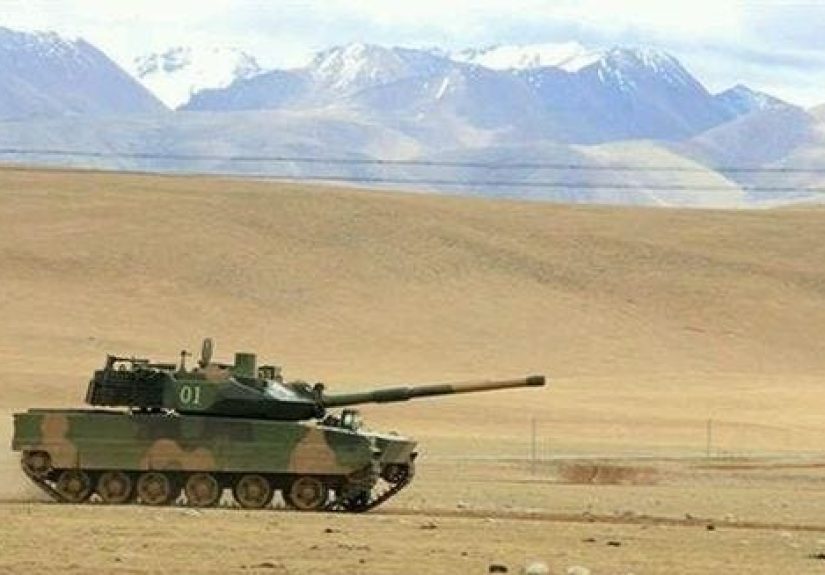
Open reporting has described the Type 100 as carrying a 105mm main gun rather than the 120mm or 125mm guns common on many modern main battle tanks. At first glance, that sounds like bringing a medium coffee to a cannon fight. But caliber alone does not tell the full story. Ammunition design, fire-control quality, barrel technology, muzzle velocity, targeting data, and tactical employment all matter.
A smaller gun can reduce weight, free internal space, simplify handling, and support a different concept of operations. The tank may be designed less for old-school slugging matches and more for fast detection, precision engagement, drone-assisted targeting, and cooperation with artillery or other platforms. In other words, the Type 100 may not be trying to win by shouting the loudest. It may be trying to spot first, shoot smart, and let the network do some of the heavy lifting.
3. Hybrid-Electric Propulsion
The Type 100’s reported hybrid-electric power system may be one of its most important features. Hybrid propulsion can offer several advantages for armored vehicles. It can provide more onboard electrical power for sensors, electronic warfare systems, active protection, communications, and future energy-hungry equipment. It can also enable quieter movement or silent watch modes, where the vehicle reduces engine noise and heat signature while stationary or moving slowly.
This does not turn a tank into a ninja. A tank is still large, heavy, and not exactly subtle. But on a battlefield where thermal cameras, acoustic sensors, drones, and satellites are everywhere, even small reductions in noise and heat can matter. Hybrid propulsion may also help in high-altitude environments where traditional diesel engines struggle because of lower oxygen levels. That matters for China because some of its land-security concerns involve mountainous terrain and border regions.
4. Active Protection Systems
Modern tanks face a brutal reality: anti-tank guided missiles, top-attack weapons, loitering munitions, and cheap drones have made the battlefield extremely unfriendly to heavy armor. In response, many tank designers are focusing on active protection systems, or APS. These systems detect incoming threats and attempt to disrupt, jam, or physically intercept them before impact.
The Type 100 is reported to include active protection and 360-degree threat detection. If effective, that could improve survivability against missiles, rockets, and drone attacks. But APS is not a force field. It can be overwhelmed, fooled, depleted, damaged, or limited by terrain and sensor blind spots. The important point is that China appears to be treating active protection as a core design feature rather than an accessory bolted on later like an afterthought with screws.
5. Sensors, Augmented Reality, and Battlefield Networking
The Type 100 has been described as having advanced radar, optical sensors, infrared systems, multiple cameras, and augmented-reality tools for crew awareness. The goal is to let crew members see and understand the battlefield without sticking their heads out of the vehicle, which is generally bad for one’s long-term career plans.
More importantly, these sensors may allow the tank to work with drones, artillery, electronic warfare assets, command networks, and other armored vehicles. That is where the Type 100 becomes strategically interesting. The tank is not just a shooter; it may also serve as a sensor platform, command node, and data-sharing vehicle. If that works in practice, it could support beyond-line-of-sight engagements, where the tank helps identify or coordinate attacks on targets it cannot directly see.
The Type 100 Support Vehicle: The Tank’s Battle Buddy
Reports also describe a Type 100 support vehicle associated with the new tank. This matters because modern armored combat is rarely about one heroic vehicle charging into glory while orchestral music plays. Tanks need infantry, reconnaissance, air defense, engineering support, logistics, drones, artillery, and electronic warfare. A support vehicle can help suppress lighter threats, protect the tank from infantry anti-armor teams, and contribute additional sensors or weapons.
In practical terms, China may be designing not just a new tank, but a new armored team. The tank handles heavy armored threats and command functions; the support vehicle helps deal with drones, troops, light vehicles, and battlefield clutter. That is a sensible response to modern combat, where the danger is often not another tank politely lining up across a field. It may be a quadcopter, a hidden missile team, a loitering munition, or a sensor feeding coordinates to artillery.
What We Still Do Not Know
There is a giant caution label attached to the Type 100: many details are unconfirmed. Public reporting can identify visible features, compare official claims, and analyze design trends, but it cannot prove how the tank performs under battlefield conditions. We do not know its true armor composition, production numbers, cost, reliability, electronic warfare resilience, crew workload, ammunition performance, software maturity, or maintenance burden.
That last point is less glamorous than an unmanned turret, but it is crucial. Advanced vehicles can become maintenance monsters. Hybrid systems, sensors, processors, cooling systems, high-voltage components, and active protection radars all demand training, spare parts, diagnostics, and disciplined logistics. A tank that looks futuristic on parade can still become cranky in mud, cold, dust, mountains, or combat damage. Machines, like people, are often most impressive before Monday morning.
Another unknown is doctrine. A tank’s value depends on how it is used. If the PLA integrates the Type 100 into realistic combined-arms formations with drones, artillery, air defense, and electronic warfare, it could be a meaningful leap. If it is used like an older tank with prettier screens, its advantages shrink quickly.
How China’s New Tank Fits Into “Intelligentized Warfare”
The phrase intelligentized warfare appears often in analysis of Chinese military modernization. It refers broadly to the use of artificial intelligence, autonomy, data processing, sensors, networks, and faster decision-making across military operations. The Type 100 seems to fit that direction. It is not merely about armor. It is about the relationship between humans, machines, sensors, and command systems.
In this vision, a tank crew may receive information from drones, satellites, headquarters, nearby vehicles, and electronic sensors. The system may help prioritize threats, suggest targets, display terrain, and share data with artillery or aircraft. The dream is faster decisions and more coordinated fires. The nightmare is information overload, software glitches, cyber vulnerability, jammed communications, or crews trusting a screen that is wrong. Every digital battlefield has a delete key somewhere.
For U.S. and allied observers, the Type 100 is important because it highlights China’s ambition to move beyond platform-by-platform competition. The future contest is not just Abrams versus Type 100 or tank versus tank. It is network versus network, sensor versus sensor, drone swarm versus counter-drone system, and logistics chain versus logistics chain.
Comparison With Western and Russian Tank Trends
The Type 100 is not appearing in a vacuum. Around the world, armored vehicle designers are rethinking what tanks should be. The U.S. AbramsX concept has explored hybrid-electric propulsion, reduced crew requirements, lower signatures, and more onboard power. Germany’s KF51 Panther concept emphasizes advanced sensors, automation, and potential drone integration. South Korea is exploring future tank concepts with new propulsion ideas. Russia’s T-14 Armata showed an unmanned turret but struggled to become a widely fielded force.
The shared lesson is clear: future tanks are becoming more electronic, more networked, and more defensive against top-attack and drone threats. Armor still matters, but armor alone cannot solve the problem. A tank that cannot detect a cheap drone may be defeated by something that costs less than its coffee machine. That is why the Type 100’s sensors and active protection may be as important as its gun.
Is the Type 100 a Main Battle Tank or a Medium Tank?
Some open sources describe the Type 100 as a fourth-generation main battle tank, while others frame it more as a lighter or medium-weight design. This classification debate is not just nerdy label-polishing, although there is definitely some of that. It reflects a real design tradeoff.
A lighter tank can be easier to move, better suited for difficult terrain, and less demanding on bridges, roads, and transport systems. A heavier tank may carry more armor and a larger gun but can be harder to deploy and sustain. China may be seeking a balance: enough protection and firepower to matter, but not so much mass that the vehicle becomes a steel rhinoceros with travel restrictions.
If the Type 100 is roughly in the 40-ton class, as some reporting suggests, it would be lighter than many Western main battle tanks. That could help mobility but raises questions about armor protection. China may be betting that active protection, sensors, lower signatures, and networked operations can compensate for reduced passive armor. Whether that bet pays off is something only rigorous testing and real operational experience can answer.
Why the Type 100 Matters for the United States and Allies
For the United States, the Type 100 is less about panic and more about priorities. It suggests that China is investing in armored forces that can operate in a high-tech battlespace, not just in missile forces, ships, aircraft, and cyber tools. It also reinforces the need for U.S. and allied militaries to improve counter-drone defenses, electronic warfare, resilient communications, long-range precision fires, and armored vehicle survivability.
The tank also matters for Taiwan and the broader Indo-Pacific, although geography complicates everything. Taiwan is separated from mainland China by water, and any large-scale invasion scenario would involve ships, aircraft, missiles, logistics, air defense, and amphibious forces long before tanks became decisive. Still, if armored vehicles reached a contested landing zone, a networked tank like the Type 100 could support follow-on ground operations, urban combat, or rapid exploitation.
That said, tanks do not swim across straits by themselves. The Type 100 should be viewed as one capability inside a much larger military system. The bigger question is how China connects armor with drones, missiles, command networks, electronic warfare, logistics, and joint operations.
The Hype Filter: What to Believe and What to Question
When a new weapon appears, headlines often sprint faster than facts. The Type 100 has been called revolutionary, intelligent, advanced, and potentially game-changing. Some of that may be fair. Some of it may be parade smoke, marketing glitter, or optimistic translation. A healthy reader should keep three questions in mind.
First, is the feature real, or merely claimed? Second, is it fielded at scale, or only displayed in small numbers? Third, does it work under battlefield stress, or only in controlled demonstrations? These questions separate serious analysis from military fan fiction, which is fun until someone mistakes it for procurement strategy.
The Type 100’s design choices are genuinely interesting. Hybrid power, active protection, unmanned turrets, drone integration, and augmented reality are all plausible directions for armored warfare. But the difference between a promising design and a combat-proven system is enormous. History is full of beautiful weapons that met mud, maintenance, and reality, then quietly asked to go home.
Practical Experiences: How to Understand China’s New Tank Without Falling for the Hype
One useful way to experience the Type 100 story is to treat it like reading a car review, a tech launch, and a military assessment at the same time. The car-review part asks: how fast is it, how heavy is it, how efficient is the engine, and can it handle rough terrain without sounding like a washing machine full of bricks? The tech-launch part asks: what sensors does it have, how good is the interface, can the software process information quickly, and does the system still work when the connection gets messy? The military-assessment part asks the least glamorous but most important questions: can crews train on it, can mechanics fix it, can commanders use it correctly, and can the supply chain keep it alive?
Readers who follow defense news often learn that the first public appearance of a weapon is rarely the full story. A parade shows confidence, but not endurance. A spec sheet shows ambition, but not reliability. A dramatic video shows motion, but not maintainability. With China’s new tank, the best experience is to watch patterns rather than chase every rumored detail. The pattern is clear: China is moving toward armored vehicles that are more connected, more electronic, more sensor-heavy, and more integrated with drones and information systems.
Another helpful experience is to compare the Type 100 with lessons from recent conflicts. In Ukraine, tanks did not disappear, but they became more vulnerable when operating without infantry, air defense, electronic warfare, reconnaissance, and drone protection. The battlefield punished vehicles that were visible, isolated, or predictable. That does not prove the tank is dead. It proves the lonely tank is in trouble. The Type 100 appears designed with that lesson in mind: survive by seeing more, hiding better, defending actively, and working with other systems.
For casual readers, the biggest mistake is to imagine tank warfare as a video game duel where two vehicles meet in a field and trade shots until one explodes. Real combat is messier. A tank may be found by a drone, jammed by electronic warfare, targeted by artillery, blocked by mines, delayed by a broken bridge, or saved by nearby infantry. The Type 100’s value will depend on the entire ecosystem around it.
For defense watchers, the Type 100 is a reminder to avoid both panic and dismissal. Panic says China has built an unstoppable super tank. Dismissal says no tank matters anymore because drones exist. Both are lazy. The smarter view is that China has revealed a serious armored concept that deserves careful study. It may influence how other countries design future tanks, especially in areas like hybrid power, active protection, crew survivability, sensor fusion, and drone coordination.
In short, the experience of studying China’s new tank is an exercise in disciplined curiosity. Be impressed by what is plausible. Be skeptical of what is unproven. Watch production numbers. Watch training. Watch logistics. Watch how the PLA pairs the vehicle with drones, artillery, air defense, and electronic warfare. The Type 100 is not just a tank story. It is a window into how China thinks future ground combat may work.
Conclusion: The Type 100 Is a Signal, Not Just a Tank
China’s new Type 100 tank deserves attention because it signals a shift in armored warfare. The most important question is not whether it has the thickest armor or the largest cannon. The better question is whether it can survive and fight inside a battlefield where sensors, drones, electronic warfare, precision fires, and rapid data sharing dominate.
If the Type 100 performs as advertised, it may represent a meaningful step toward the next generation of armored combat. If its systems prove fragile, expensive, or difficult to maintain, it may become another reminder that futuristic hardware is easy to admire and hard to field. Either way, the Type 100 shows that China is taking the lessons of modern war seriously and trying to build tanks for a battlefield where seeing first may matter as much as shooting first.
The bottom line: China’s new tank is not a miracle machine, but it is not a gimmick either. It is a serious, sensor-rich, hybrid-powered armored platform that reflects the PLA’s broader push toward networked, intelligentized warfare. For the United States, allies, and anyone who follows defense technology, that makes it worth watching closelywith clear eyes, a skeptical mind, and maybe a small cup of coffee, because the future of tank warfare has a lot of acronyms.