Table of Contents >> Show >> Hide
- Why That Week Mattered So Much
- What the NASA-Russia Lunar Station Was Supposed to Be
- Why Russia Was Such a Big Deal in the Plan
- Then the Future Took a Hard Left Turn
- What Gateway Means Now
- The Future of Spaceflight Is Bigger Than One Station
- Why That Week Still Echoes
- Experience: What Following This Story Feels Like in Real Time
- Conclusion
Some weeks in spaceflight feel like fireworks. Others feel like paperwork wearing a blazer. The week that NASA, Roscosmos, and other International Space Station partners gathered in Tokyo in January 2018 managed to be both. On the surface, it looked like a familiar round of agency meetings, diplomatic statements, and PowerPoint decks with enough arrows to frighten a geometry teacher. Underneath, though, it was a serious argument about what would come after the ISS and who would get to shape humanity’s next address in space.
At the center of the conversation was the lunar outpost then known as the Deep Space Gateway, the project that would later become simply Gateway. The concept sounded bold and a little sci-fi in the best way: a small station orbiting the Moon, supporting crews, science, logistics, and future missions deeper into the solar system. NASA saw it as a bridge from low Earth orbit to the Moon and, eventually, Mars. Russia saw opportunity, prestige, and risk. The rest of the world saw a giant architectural sketch for the next era of exploration.
That is why this was such a huge week. It was not just about whether NASA and Russia could cooperate on a lunar station. It was about whether the ISS model of partnership could survive the jump into deep space. It was about whether the future of human exploration would be shared, fragmented, commercialized, militarized, or all of the above at once. In hindsight, those Tokyo discussions now look less like a routine meeting and more like a hinge moment.
Why That Week Mattered So Much
The Tokyo talks did not emerge out of nowhere. A few months earlier, NASA and Roscosmos had signed a joint statement on cooperation for human exploration around the Moon and into deep space. That agreement was important because it signaled that the post-ISS future might still be built on a multinational framework. Instead of treating lunar exploration as a national sprint with flags and chest-thumping, the agencies were at least publicly discussing a shared architecture.
In early 2018, officials met in Japan to continue those conversations. The timing mattered. The ISS was already aging, even if it still had years of life left. NASA needed a compelling follow-up to justify long-term investment in human spaceflight. Roscosmos wanted a role that looked like partnership, not just polite attendance. JAXA and other international players were also trying to figure out where they fit in a cislunar future that suddenly looked more real than hypothetical.
That made the week feel enormous because it forced a transition in public thinking. The question was no longer, “Should humans go back to the Moon?” It was becoming, “What infrastructure do we need if we plan to stay busy there for decades?” That is a much bigger question. It shifts the conversation from heroic one-off missions to transportation systems, habitation modules, power, docking standards, logistics chains, and long-term science. In other words, it shifts spaceflight from a stunt to an ecosystem.
What the NASA-Russia Lunar Station Was Supposed to Be
The proposed station was never meant to be a giant floating city. Think less “space suburb” and more “smart orbital base camp.” Gateway was designed as a compact outpost in lunar orbit, small compared with the ISS but strategically located for missions to the lunar surface and beyond. NASA envisioned it as a place where astronauts could dock, transfer cargo, test life-support systems, conduct science, and prepare for surface expeditions.
Its orbit was part of the appeal. By flying in a highly elliptical path around the Moon, the station could support access to areas of growing interest, especially the lunar south pole. That region has become one of the hottest neighborhoods in space exploration because of its suspected water ice, difficult lighting conditions, and scientific value. Gateway was supposed to help turn those distant ambitions into repeatable operations.
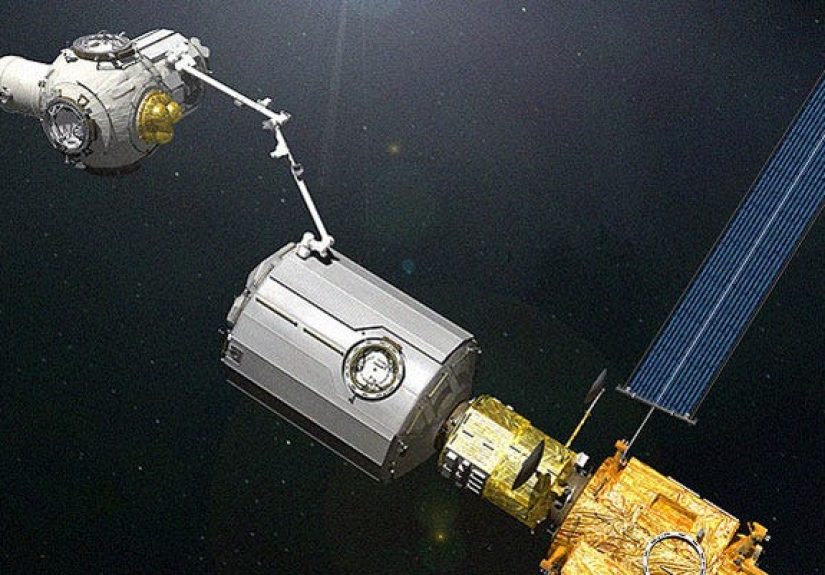
Over time, the architecture became more detailed. The first elements would be the Power and Propulsion Element, or PPE, and the Habitation and Logistics Outpost, better known as HALO. Those modules would provide the station’s electrical power, solar-electric propulsion, communications, command systems, and crew living space. Later additions from international partners would expand Gateway’s capabilities, including habitation, refueling, viewing ports, and science support.
NASA’s pitch was elegant: use Gateway as both proving ground and pit stop. Astronauts could learn how to live farther from Earth, operate in the deep-space radiation environment, and rehearse the kinds of logistics required for Mars missions. Gateway would also let international partners contribute major hardware in meaningful ways, which matters because giant space programs rarely survive on engineering brilliance alone. They survive on coalitions, budget votes, and the ability to convince multiple governments that they have real skin in the game.
Why Russia Was Such a Big Deal in the Plan
Russia was not just another invitee. Roscosmos brought decades of experience in long-duration human spaceflight, station operations, docking systems, propulsion, and orbital living. If the ISS taught the world anything, it is that no one gets to keep a giant international station alive without mastering the unglamorous stuff. Tanks, thrusters, ports, procedures, maintenance, attitude control, crew routines, redundancythis is the plumbing of exploration, and Russia has deep heritage there.
There was also a symbolic reason NASA wanted Russia involved. The ISS had become one of the few long-running examples of sustained U.S.-Russian cooperation after the Cold War. Carrying that partnership forward into lunar exploration would have signaled continuity, stability, and a kind of geopolitical maturity. It would have said that the next great leap in space would be multinational by design, not merely international when convenient.
But symbolism is not structure. Behind the diplomatic language, Russia had concerns about being relegated to a secondary role. Moscow wanted real influence over program design and operations, not a decorative seat at the table. That tension surfaced more clearly later in 2018, when Russian officials publicly voiced doubts about participating in a lunar station architecture dominated by NASA. In plain English: if you invite a major space power to the moon party, do not be shocked when it asks who picked the playlist.
Then the Future Took a Hard Left Turn
If you freeze the story in January 2018, the future looks almost straightforward. The ISS model evolves into Gateway. NASA and Russia continue cooperating. International modules begin taking shape. Lunar exploration becomes the next great team project. It is a nice story. Reality, however, barged in wearing steel-toed boots.
First, the politics changed. Russia’s enthusiasm for NASA’s lunar architecture cooled. Public disagreements grew over governance, standards, and how the program would be managed. NASA later folded Gateway into the broader Artemis program, which expanded the political and legal framework around lunar exploration through the Artemis Accords. Russia was not enthusiastic about that U.S.-led approach, especially as relations with the West deteriorated.
Then came the bigger break. After Russia’s 2022 invasion of Ukraine, cooperation between Russia and Western partners across multiple space projects collapsed or was suspended. Europe backed away from Russian lunar and Mars partnerships. Roscosmos, increasingly isolated from Western exploration programs, deepened its alignment with China. Instead of helping build NASA’s Gateway, Russia became a partner in the China-led International Lunar Research Station, or ILRS.
That pivot changed the meaning of the original Tokyo moment. What once looked like the foundation of a shared lunar future now reads more like the last serious attempt to preserve an ISS-style coalition before geopolitics cracked the architecture. The dream did not vanish, but it split into competing tracks. Artemis became one camp. The China-Russia ILRS became another. Space exploration did not stop being international; it just stopped being comfortably unified.
What Gateway Means Now
Gateway is still central to NASA’s long-term lunar strategy, at least in program design. NASA describes it as humanity’s first space station around the Moon and ties it directly to Artemis missions, deep-space science, and preparation for Mars. The current plan calls for astronauts to visit Gateway for the first time on Artemis IV, with later missions adding more modules and capabilities.
The project is no longer just a sketch, either. HALO hardware has progressed, partner modules are under development, and the first two core elements are slated to launch together on a Falcon Heavy ahead of Artemis IV. That matters because for years critics treated Gateway as a concept with fancy renderings and suspiciously confident captions. Now it has become a more tangible piece of the Moon-to-Mars architecture.
Still, Gateway remains controversial. Some critics argue NASA would be better off pursuing more direct lunar surface operations rather than building an orbital waypoint first. Others question whether the station adds enough value to justify its cost and complexity. Watchdog reports have highlighted technical and schedule challenges, including mass growth and integration issues with the early elements. In Washington, the program has repeatedly had to defend itself against shifting political priorities and budget proposals that would rather skip the orbital middleman.
That debate is not a sign of failure. It is a sign that Gateway sits at the center of a real strategic question: how do you build a sustainable lunar transportation system? If the answer is “just land and leave,” then a station looks like overhead. If the answer is “operate regularly, involve partners, support science, pre-position hardware, and learn how to live beyond Earth,” then an orbital outpost starts to make more sense.
The Future of Spaceflight Is Bigger Than One Station
The biggest lesson from that huge week is not simply that NASA and Russia almost built a lunar station together. It is that human spaceflight is changing from a bilateral prestige contest into a layered competition involving governments, alliances, and private industry all at once.
Look at the landscape now. NASA’s Artemis program depends on a mix of traditional contractors, international agencies, and commercial providers. SpaceX is central to multiple layers of lunar planning, from launch services to landing systems. Blue Origin is in the mix for future lunar landers. International partners are not just attaching flags; they are building key hardware. Meanwhile, China and Russia are advancing their own lunar station framework with long-term ambitions that include surface infrastructure and nuclear power concepts.
That means the future of spaceflight will likely be defined by three forces working together and against each other. The first is infrastructure: stations, landers, logistics vehicles, power systems, and communications networks. The second is coalition-building: who signs on, who sets the rules, and who gets access. The third is commercial acceleration: private companies moving faster than the old government-only model, sometimes brilliantly, sometimes chaotically, often expensively.
And then there is the quiet truth that makes all of this harder: space stations are not destinations anymore. They are nodes. They are part of a transportation and operations network. The ISS taught us how to live in orbit. Gateway, if fully realized, is supposed to teach us how to work across the Earth-Moon system. That is a more complicated mission and a more realistic one.
Why That Week Still Echoes
The Tokyo discussions now feel important not because they produced a neat ending, but because they exposed the future before the future fully arrived. They revealed how much of modern spaceflight depends on political trust. They showed that lunar exploration would be shaped by architecture, alliances, and institutional ego just as much as by rockets. And they hinted that the era after the ISS would not be one clean handoff, but a messy, fascinating realignment.
In March 2026, NASA is preparing Artemis II for launch as the first crewed lunar flyby mission of the Artemis era, while the broader lunar program continues to evolve. That alone tells you how much the dream has matured. We are no longer talking only about abstract concepts. We are talking about crews, launch dates, modules in production, rival lunar strategies, and serious questions about how humanity should organize itself beyond low Earth orbit.
So yes, that really was a huge week. It was one of those rare moments when a meeting room full of agency leaders ended up representing something much larger: the handoff from the ISS era to the cislunar age. The NASA-Russia lunar station idea did not unfold exactly as once imagined. In fact, it fractured. But the central issue it raised remains absolutely alive today. The future of spaceflight belongs to whoever can build durable systems, durable alliances, and durable reasons to keep going.
Experience: What Following This Story Feels Like in Real Time
There is also a very human experience wrapped inside this story, and it is part of why the topic continues to grab people long after the headlines fade. Following the NASA-Russia lunar station saga does not feel like watching a simple engineering project. It feels more like standing near a train yard at night, hearing giant machines move in the dark, and trying to figure out which tracks lead to the future.
For space enthusiasts, this kind of week creates a strange mix of excitement and whiplash. One minute you are reading about modules, docking ports, propulsion systems, and international meetings. The next minute you realize the real drama is not just technical. It is political, cultural, and emotional. You start out thinking you are following hardware and end up following human ambition in its most complicated form. That is the real hook. A lunar station is never just metal in orbit. It is a statement about what kind of species we think we are becoming.
There is wonder in that, of course. The idea that people from different countries could build an outpost around the Moon still has the power to stop you in your tracks. It taps into the same part of the brain that once looked at Apollo footage and thought, “Wait, we can actually do this?” Even when the politics get ugly, the hardware still inspires. A habitation module crossing an ocean, a power system being tested, a launch date penciled onto a calendarthese details make the future feel less imaginary and more scheduled.
But there is frustration, too. Anyone who follows spaceflight seriously learns that progress rarely moves in a straight line. Plans change. Administrations change. budgets wobble. Partnerships bloom and then explode like overinflated balloons at a bad birthday party. One year a lunar station is the elegant centerpiece of international cooperation. A few years later it is a contested symbol, a target for critics, or a line item fighting for survival. Watching that happen can be exhausting, especially if you love the big idea and hate seeing it dragged through bureaucracy.
And yet that tension is part of the experience. It reminds us that space exploration is not separate from Earth. It carries all our rivalries, hopes, compromises, insecurities, and brilliance with it. The Moon is far away, but the arguments about how to get there are unmistakably human. Maybe that is why stories like this linger. They are not just about astronauts eventually floating through a lunar outpost. They are about whether people who disagree on nearly everything can still cooperate on something breathtaking.
That is what makes this topic feel bigger than rockets and station modules. It invites readers to imagine not only where humanity might travel, but how we might choose to travel together. Even if the original NASA-Russia version of that dream did not hold, the emotional core of it still matters. We are watching the first sketches of a permanent human presence beyond Earth take shape in real time. That is messy, uneven, and occasionally maddening. It is also extraordinary. You do not get many chances to witness the blueprint stage of a new era.
And that may be the deepest experience of all: realizing that history in space no longer arrives only as a single giant leap. Sometimes it arrives as meetings, arguments, revised schedules, awkward alliances, half-built modules, and bold plans that refuse to die. Sometimes the future does not descend dramatically from the heavens. Sometimes it is assembled piece by piece, in public, while the rest of us watch with coffee in hand, equal parts skeptical and amazed.
Conclusion
The week NASA, Roscosmos, and their partners talked seriously about a lunar station was a genuine turning point because it framed the post-ISS future in concrete terms. It asked who would build the next outpost, how exploration would be organized, and whether deep-space cooperation could survive rising geopolitical strain. The answers turned out to be messier than anyone hoped, but also more revealing. Gateway remains one of the clearest symbols of where human spaceflight is trying to go next: toward a future that is international, commercial, contested, and still gloriously ambitious.