Table of Contents >> Show >> Hide
- Why old American homes hit so hard on social media
- Here are 40 of the prettiest picks
- What these 40 homes reveal about American architecture
- The romance is real, but so is the to-do list
- The experience of falling for historic homes, one scroll at a time
- A longer reflection on why these homes stay with us
- Conclusion
There are two kinds of people on Instagram: the ones posting lunch, and the ones quietly saving photos of a haunted-looking Victorian with a turret, stained glass, and the kind of wraparound porch that makes you want to drink lemonade while discussing wallpaper restoration like it is a matter of national importance. If you belong to the second group, the Historical Homes Of America rabbit hole is dangerously delightful.
The appeal is obvious. Historic homes are not just pretty buildings with good angles. They are mood, memory, craftsmanship, and a tiny bit of ghost-adjacent drama all rolled into one. Scroll through enough old-house photos and you start noticing the things modern builds often skip: carved millwork, bold staircases, leaded glass, daring paint colors, soaring ceilings, pocket doors, and exteriors that seem personally offended by the concept of blandness.
That is why the fascination with historical homes of America keeps growing. These houses are snapshots of changing American taste, ambition, wealth, regional style, and preservation work. Some are pristine. Some are glamorous wrecks. Some are so perfect they look made up by a novelist who wanted to overdo it and then accidentally succeeded.
Why old American homes hit so hard on social media
Historic houses perform beautifully online because they do two things at once. First, they feed escapism. Second, they give people something real to admire. Preservation experts and historic-home publications have made the same point in different ways for years: old places carry identity, beauty, and continuity. In plain English, they feel like they matter. That emotional pull is exactly what turns a random Queen Anne, Gothic Revival cottage, or Beaux-Arts mansion into a viral favorite.
Architecture helps too. Queen Anne homes, for example, are famous for asymmetry, wraparound porches, towers, mixed materials, and decorative trim. Victorian houses, meanwhile, rarely met an extra detail they did not like. That is why so many homes featured by this account look unapologetically theatrical. They were designed to impress before “curb appeal” became a real-estate cliché.
Of course, beauty is only half the story. Historic homes also come with reality checks: outdated wiring, foundation concerns, lead paint, inefficient windows, and renovation costs that can move from “manageable” to “please hold while I scream into a throw pillow.” That tension is part of the fun, too. We are not just admiring these houses. We are imagining what it would feel like to rescue one, live in one, or at the very least brag about one.
Here are 40 of the prettiest picks
1–10: The homes that make you want to buy a velvet armchair immediately
- Weinhardt Mansion, Chicago, Illinois Built in 1888, this one has the kind of big-city grandeur that makes modern luxury homes look a little too eager. It is stately, ornate, and absolutely aware of it.
- Wisteria-draped Victorian townhouse, San Francisco, California A historic townhouse covered in blooms is basically the architectural version of a mic drop. It is soft, romantic, and absurdly photogenic.
- The Armour-Stiner House, New York The famous octagonal showstopper looks like a Victorian fever dream in the best possible way. It is one of those houses that does not merely stand there; it performs.
- Bair House, Arcata, California A classic Queen Anne beauty from 1888, complete with the layered detailing and commanding presence that define why people still obsess over the style.
- Historic residence on St. Charles Avenue, New Orleans, Louisiana New Orleans has a talent for making elegance look effortless, and this porch-heavy beauty proves the point.
- Victorian house in San Francisco, California Bright color, sharp personality, and zero interest in being subtle. A house like this does not blend in; it starts conversations.
- Galloway House, Fond du Lac, Wisconsin Built in 1846, this is the sort of house that reminds you the Midwest has been quietly hoarding architectural gems for a very long time.
- Fall-decorated Victorian, Muncie, Indiana Add autumn styling to a late-19th-century home and suddenly the internet remembers what seasonal joy feels like.
- Bishop’s Palace, Galveston, Texas Also known as Gresham’s Castle, this landmark is not merely pretty. It is one of those houses that makes the word “ornate” feel like an understatement.
- Beautiful mansion in New Orleans, Louisiana More proof that New Orleans understands drama, color, and porch architecture on a level the rest of the country can only admire respectfully.
11–20: Maximum whimsy, mystery, and “who lives like this?” energy
- The Castle House A 1931 home inspired by a Normandy castle. Because apparently some people go on vacation and come back with souvenirs, while others come back and build a fortress.
- Davenport House, Saline, Michigan Dark, moody, and loaded with character. The kind of place that could host either a literary salon or a supernatural subplot.
- Colonial Apartments, Detroit, Michigan A reminder that apartment buildings can be just as thrilling as mansions when preservation is done right.
- Migliavacca Mansion, Napa, California Built in 1890, this mansion is gloriously strange in the way only ambitious old architecture can be. A little grand, a little eccentric, very memorable.
- Boldt Castle, Thousand Islands, New York Technically a castle, emotionally a full-on old-house fantasy. It is impossible to dislike a home sitting on Heart Island with that much flair.
- Stone Victorian just north of Quebec Not American, but close enough to make the account’s audience collectively gasp. Heavy stone plus Victorian styling equals instant storybook mood.
- Camden Farm, Rappahannock River estate An 1859 Italianate property with river views, a long porch, and enough atmosphere to make you start planning a garden you do not currently own.
- Black Victorian, San Francisco, California Proof that old houses can be dramatic without losing their historic soul. Black paint on the right Victorian looks less gloomy than gloriously confident.
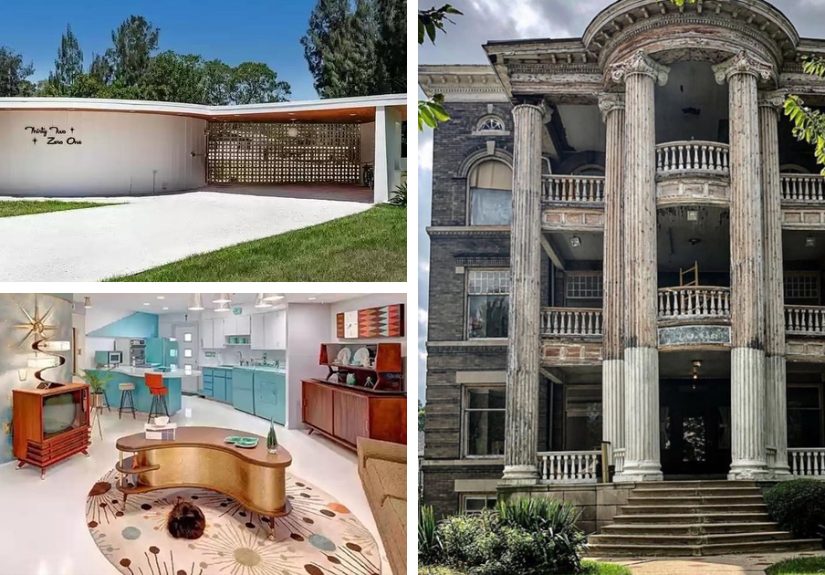
- Circular mid-century marvel, Sarasota, Florida A different era, same obsession factor. Its unusual layout and restored details show that historic charm did not retire after the Victorian age.
- Hidden staircase leading to a secret room Is it technically “a house”? Yes. Is the staircase doing most of the heavy lifting for our collective imagination? Also yes.
21–30: American styles showing off a little
- Silas W. Robbins House, Wethersfield, Connecticut A glorious Second Empire home with that unmistakable mansard-roof swagger. If rooflines could wink, this one would.
- Olde Towne East, Columbus, Ohio Sometimes a single streetscape says more than one house ever could. Historic neighborhoods are often the real stars.
- The “Jewel of Escondido,” California Formal gardens, Victorian fencing, period-appropriate interiors, and a whole lot of devotion. This is old-house love taken seriously.
- Queen Anne Victorian, St. Clair, Michigan Another example of why the Queen Anne style keeps winning beauty contests more than a century later.
- Roseland Cottage, Woodstock, Connecticut One of the nation’s most beloved Gothic Revival houses, and for good reason. It looks like it wandered out of a very stylish fairy tale.
- Twin Victorians, San Francisco, California Twice the trim, twice the stairs, twice the reason pedestrians slow down and stare.
- Gamwell House, Bellingham, Washington A distinguished late-Victorian residence that proves the Pacific Northwest can absolutely compete in the old-house beauty pageant.
- Overcliff Castle, Yonkers, New York A stone-heavy, castle-like mansion with enough gravitas to make “cozy” feel wildly insufficient.
- Ransom Gillis House, Detroit, Michigan One of the best restoration comeback stories in the bunch. It is beautiful, yes, but also a poster child for why preservation matters.
- Victorian kitchen with leaded-glass cabinet doors, Southport, Connecticut A useful reminder that in historic homes, sometimes the prettiest “house” is actually one room refusing to be ignored.
31–40: The grand finale, with mansions, pink facades, and one gorgeous ruin
- Burrage Mansion, Boston, Massachusetts Built in 1899, it is all grand rooms, serious craftsmanship, and old-money confidence without the need to shout.
- Schofield Building, Cleveland, Ohio Not a single-family home, but absolutely part of the account’s appeal: beautiful restoration, urban history, and proof that old buildings can age in reverse.
- Phillips House, Salem, Massachusetts Salem knows how to do atmosphere, and this elegant 1821 house delivers it with historic polish rather than Halloween gimmicks.
- Edwin Hall House, “The Pink House,” Wellsville, New York Pink is risky until an old house wears it like this. Then it becomes destiny.
- Sinjter House, Quincy, Illinois A lovely 1876 entry that captures the rich detailing and calm confidence of Midwestern historic architecture.
- Grand staircase of the Marsh Mansion, Plainfield, New Jersey Sometimes the staircase is the star, and honestly, fair enough. This one deserves its own fan club.
- James F. D. Lanier House, Manhattan, New York Beaux-Arts opulence at full volume. Grand, layered, and utterly uninterested in minimalist restraint.
- Adam Schuster House, St. Joseph, Missouri Built in 1881, and still serving all the asymmetrical, decorative, old-house charisma anyone could reasonably request.
- The Marsh Mansion, Plainfield, New Jersey Porch, scale, and Gilded Age energy in one package. It is the sort of house that makes “fixer-upper” sound wildly glamorous.
- Halcyon Hall, Millbrook, New York A before-and-after favorite and one of the most hauntingly beautiful entries. Even in decline, it has the dignity of a place that once expected chandeliers, trunks, and arriving carriages.
What these 40 homes reveal about American architecture
One reason this collection works so well is variety. It is not just a parade of one style or one region. You get Queen Anne exuberance in California and Michigan, Gothic Revival magic in Connecticut, Italianate elegance near the Rappahannock, Beaux-Arts luxury in Manhattan, and richly ornamented urban and small-town buildings from Detroit to Salem. The result feels like a cross-country tour of what American home design looked like before builders became allergic to ornament.
And that is the real keyword here: ornament. Historic homes invite your eye to wander. There is always another carved bracket, gable detail, bay window, iron fence, mantel, or stained-glass flourish waiting nearby. These homes were often built to impress, but they were also built to last. That helps explain why historic-home lovers are so passionate about keeping original fireplaces, millwork, staircases, floors, and brickwork whenever possible. Those details are not filler. They are the story.
The romance is real, but so is the to-do list
Anyone fantasizing about buying a historic property should remember one important truth: charm does not replace inspections. Older homes may need electrical updates, foundation repairs, careful paint work, specialized windows, roof attention, or expensive restoration choices. The prettier the staircase, the more likely your brain may briefly forget that gravity, moisture, and deferred maintenance have also been very busy.
Still, that challenge is part of why people care so deeply. Preservation is not about freezing a house in amber. It is about letting the best parts survive while making the place livable. The smartest renovations respect scale, materials, and original character instead of bulldozing everything into a beige open-concept shrug.
The experience of falling for historic homes, one scroll at a time
There is something weirdly comforting about spending time with photos like these. Even if you are not shopping for a house, and even if your current home has exactly zero turrets and no secret staircase unless you count the attic ladder, these old homes still offer a kind of emotional vacation. They remind you that houses can be expressive. They can be funny, moody, romantic, over-the-top, and wonderfully specific.
That may be the biggest reason accounts like this take off. They give people permission to love detail again. To admire patina. To appreciate a front door with personality. To look at a stained-glass transom and think, “Yes, this is dramatically extra, and yes, I deserve it.” Historic homes are not just buildings. They are evidence that daily life can happen in places with texture, memory, and a point of view.
A longer reflection on why these homes stay with us
Spending time with collections like this does something curious to your brain. At first, you are just looking. Then you are comparing porches. Then you are zooming in on cornices like a detective. Then, before you know it, you are emotionally invested in whether a 19th-century stained-glass window survives the next renovation. It escalates quickly.
Part of that experience is pure visual pleasure. Historic homes reward attention. A modern house might give you one clean impression in three seconds. An old house keeps unfolding. First you notice the turret, then the spindlework, then the carved newel post, then the ridiculous excellence of the doorknob. The more you look, the more the house keeps saying, “Actually, I have more.” That layered feeling is hard to fake, and social media is perfectly built for it. Every swipe becomes another little architectural reveal.
But the deeper pull is emotional. These homes feel lived through. Even when they are polished for sale, they still carry the suggestion of former owners, long dinners, repairs, reinventions, holiday decorations, and changing neighborhoods outside the front gate. They remind people that a home can age without becoming irrelevant. In a culture obsessed with the new, that is surprisingly moving.
There is also an element of fantasy that makes this genre irresistible. Historic-home daydreaming lets people imagine a bigger, richer version of everyday life. You picture writing at a window seat, hosting a dinner in a room with a fireplace taller than you are, or dramatically descending a staircase for no reason except that the staircase exists and would frankly be insulted if you did not. These houses make ordinary routines seem a little more cinematic. Coffee tastes different when the kitchen has original cabinetry. Rain sounds better on a slate roof. Even folding laundry feels more dignified if the hallway has carved trim.
Of course, anyone who actually owns an old house will tell you the romance comes bundled with invoices. Historic homes ask for patience, curiosity, money, and the ability to become weirdly knowledgeable about mortar, plaster, drainage, and wood species. That does not kill the magic; it just makes the love story more believable. The beauty of these homes is not that they are perfect. It is that they have survived long enough to be imperfect in interesting ways.
And maybe that is what makes an account like Historical Homes Of America feel bigger than a simple architecture feed. It is not just serving up pretty real estate. It is giving people a way to connect with craftsmanship, regional identity, and the pleasure of buildings that still dare to look distinctive. In a world of copy-paste design, these homes have accents, opinions, and excellent bones.
So yes, admire the pink mansions, the black Victorians, the castles, the porches, the weird circular floor plans, and the suspiciously dramatic staircases. Save the posts. Send them to your friends. Argue over paint colors you will never personally apply. Dream irresponsibly. Historic homes are one of the internet’s best reminders that beauty does not have to be sleek to be timeless. Sometimes it can be creaky, ornate, a little moody, and absolutely unforgettable.
Conclusion
The best homes on Historical Homes Of America do more than look gorgeous in a square crop. They tell a bigger story about historic houses in America: how they were built, why they still matter, and why people keep fighting to restore them instead of flattening them into sameness. From turreted Queen Anne stunners and Gothic Revival gems to elegant city mansions and dramatic restorations, these 40 picks prove one thing clearly: old houses are not just surviving. They are still stealing the show.