Table of Contents >> Show >> Hide
- Quick Snapshot: What Makes WPY 2020 a Big Deal
- The Headliners: The Two Images Everyone Remembered
- 15 Pics: The Wildlife Photographer of the Year 2020 Winners and Standout Images
- The Themes Under the Beauty (Yes, Even the Pretty Ones)
- How to “Read” Award-Winning Wildlife Photos Like a Judge
- Want to Shoot Wildlife Photos Like This? Steal These Tips (Ethically)
- of Experiences: Chasing Your Own “WPY Moment”
- Conclusion
If you needed proof that nature can be equal parts breathtaking and brutally honest, Wildlife Photographer of the Year 2020 delivered itagain. The annual competition (run by London’s Natural History Museum) didn’t just crown a winner; it served up a full-course meal of wonder: tender moments, microscopic drama, underwater glitter, and a few scenes that make you whisper, “Wait… that’s real?”
Below, you’ll find a practical, story-first breakdown of the Wildlife Photographer of the Year 2020 winners, built around 15 standout images that captured judges’ attention and the internet’s collective gasp. Along the way, we’ll unpack what makes these award-winning wildlife photos work: timing, craft, patience, ethics, and that rare photographic superpowerbeing ready when the wild decides to be theatrical.
Quick Snapshot: What Makes WPY 2020 a Big Deal
Wildlife Photographer of the Year isn’t a random “nice pic!” contest. It’s one of the most recognized nature photography awards in the world, and 2020’s selection drew tens of thousands of entries. That matters because it means the winners didn’t just beat “your friend with a decent zoom lens.” They beat a global crowd of deeply obsessed, wildly talented photographerspros and young photographers alike.
- It’s story-driven: winning images are judged on impact, originality, technique, and narrativenot just sharp whiskers.
- It spans categories: behavior, underwater, urban wildlife, environments, and youth brackets.
- It’s conservation-adjacent: many finalists highlight habitat loss, climate stress, and human-wildlife collisionssometimes literally.
The Headliners: The Two Images Everyone Remembered
Grand Title Winner: “The Embrace” (Sergey Gorshkov)
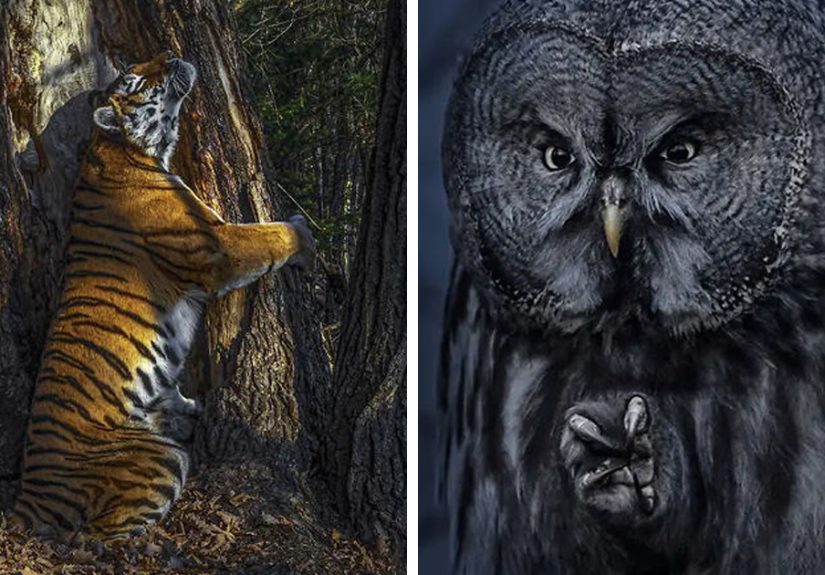
An Amur (Siberian) tigress wraps herself around an ancient Manchurian fir like she’s auditioning for the world’s most intimidating tree-hugger. But this isn’t a “cute cat” momentit’s behavior. Big cats often rub against trees to leave scent markings, and this image captured that action with an intimacy that feels almost impossible for a wild tiger.
What makes it unforgettable is the contradiction: power and softness in the same frame. You see muscle, but also tenderness. You see wilderness, but also fragilitythe kind that comes from poaching pressure, habitat disruption, and the domino effect that follows when forests and prey populations are stressed.
Young Grand Title Winner: “The Fox that Got the Goose” (Liina Heikkinen)
A young fox drags a barnacle goose while siblings swarm like a furry, chaotic sports team arguing over the ball. Feathers fly, rivalry flares, and the fox’s body language screams, “This is mine, and I will defend it with the confidence of someone who has never paid rent.”
It’s dramatic, messy, and perfectly composedproof that youth categories aren’t “practice rounds.” They’re where some of the boldest storytelling happens.
15 Pics: The Wildlife Photographer of the Year 2020 Winners and Standout Images
This list spotlights 15 winning and highly commended photographs associated with WPY 2020. Think of it as a guided tourless “scroll and forget,” more “pause and actually see what’s happening.”
-
“The Embrace” Sergey Gorshkov (Grand Title Winner; Animals in Their Environment Winner)
A tigress presses her cheek to bark, leaving scent behind. The pose reads like affection, but it’s communicationterritory, identity, and survival. The composition feels intimate because the subject is close, centered, and emotionally legible even if you don’t know tiger behavior.
-
“A Tale of Two Wasps” Frank Deschandol (Behavior Winner)
Two wasps, two nest holes, and a split-second story about survival strategies: one building a future, one hijacking it. The photo turns insect life into a suspense scenetiny bodies, huge stakes.
-
“A Fox for All Seasons” John Blumenkamp (Animal Portraits, Highly Commended)
An American red fox hunts in snow while a gust parts its winter coatlike nature itself lifted a curtain to show the insulation underneath. The image works because it’s both portrait and narrative: you can practically hear the quiet, and then the wind.
-
“A Mean Mouthful” Sam Sloss (11–14 Years Winner)
A clownfish holds something in its mouth… and then you realize it’s not lunch. It’s a parasite: the tongue-eating louse. This is the kind of wildlife photo that teaches you something you didn’t ask to learnbut now you can’t un-know it.
-
“Watching You Watching Them” Alex Badyaev (Urban Wildlife Winner)
A Cordilleran flycatcher nests near a window while a scientist records observations inside. The image flips the usual script: the human becomes background, and the bird becomes the starright where people live, work, and think they’re “separate” from nature.
-
“When Mother Says Run” Shanyuan Li (Behavior, Mammals Winner)
A family of Pallas’s cats (manuls) is caught in a rare, expressive moment as kittens respond to a warning. The story here is time: years of effort condensed into one frame where everythinglight, posture, tensionaligns.
-
“The Golden Moment” Songda Cai (Under Water Winner)
A tiny squid larva flashes gold in a beam of light during a night dive. Underwater images often feel like alien documentaries, and this one earns that vibe: weightless, luminous, and impossibly delicate.
-
“The Pose” Mogens Trolle (Animal Portraits Winner)
A proboscis monkey tilts its head, eyes closed, eyelids pale bluelike it’s mid-meditation or silently judging your life choices. It’s humorous without being anthropomorphic, because the expression is realcaptured, not invented.
-
“The Last Bite” Ripan Biswas (Portfolio Award Winner)
A tiger beetle and a weaver ant collide in a high-stakes struggle. The frame is sharp and intimate, emphasizing scale and consequence. It’s a reminder that wildlife behavior isn’t always majesticit’s often urgent.
-
“Making Belugas Play Ball” Kirsten Luce (Wildlife Photojournalism Single Image, Highly Commended)
Beluga whales perform in a traveling showan image that’s hard to look at for exactly the reason it matters. This is wildlife photography as accountability: showing how animals are treated when “entertainment” wins the argument.
-
“When the Rain Came Rolling In” Zack Clothier (Earth’s Environments, Highly Commended)
Cracked mud, a shrunken lake, and thenrain sweeping in like a curtain. It’s landscape as evidence, capturing drought stress and relief in the same scene. The contrast is the subject.
-
“Late Delivery” Catherine Dobbins d’Alessio (Behavior, Birds, Highly Commended)
An Atlantic puffin arrives with a beak full of krill, late in the day. The light makes the moment feel cinematic, but the story is simple: feeding a chick is relentless work.
-
“The Fox that Got the Goose” Liina Heikkinen (Young Grand Title Winner; 15–17 Years Winner)
Chaos, competition, and a young fox protecting a hard-won meal. The frame is energetic without being messyan action photo that still reads clearly.
-
“Great Crested Sunrise” Jose Luis Ruiz Jiménez (Behavior, Birds Winner)
A great crested grebe family at dawn: chicks ride on a parent’s back, and a feeding moment becomes a portrait of care. The photograph turns “behavior” into emotion without forcing it.
-
“Life in the Balance” Jaime Culebras (Behavior, Amphibians & Reptiles Winner)
A glass frog eats a spider in Ecuadorpredation, balance, and ecosystem roles in one tight scene. It’s a reminder that “cute” and “crucial” are often the same thing in nature.
The Themes Under the Beauty (Yes, Even the Pretty Ones)
1) Behavior Is the New Portrait
WPY 2020 leaned into moments that explain how animals livenot just what they look like. A tiger scent-marking, a grebe feeding a chick, a parasite turning a fish’s mouth into a horror plot twist. These images reward curiosity. They don’t just say, “Look at this animal.” They say, “Watch what it’s doing… and ask why.”
2) The Human Footprint Isn’t a Background Detail
“Watching You Watching Them” is literally wildlife at the window, and “Making Belugas Play Ball” challenges viewers to question captivity. Even when humans aren’t in the frame, human decisions are: habitat fragmentation, climate stress, and the pressures that push animals into smaller, riskier spaces.
3) Climate and Habitat Stories Can Be Photographed Without a Lecture
The drought-and-rain landscape image works because it doesn’t need a caption to be understood. Cracked earth, receding water, dramatic weather the visual evidence is the narrative. That’s the power of environmental photography when it’s done well: it informs first, scolds never.
How to “Read” Award-Winning Wildlife Photos Like a Judge
Ask These 5 Questions
- What’s the story? If you can summarize it in one sentence, you’re on the right track.
- What’s the subject doing? Behavior often matters more than species rarity.
- Is the moment earned? Patience beats luck; preparation beats patience; ethics beat everything.
- Does the composition help the message? Framing, light, and background should amplify meaning, not compete with it.
- What does it make you feeland why? Emotion is valid, but it has to be grounded in reality, not gimmicks.
Want to Shoot Wildlife Photos Like This? Steal These Tips (Ethically)
Practice the Skills WPY Winners Quietly Master
- Study behavior before you bring a camera. Knowing “what happens next” is a cheat code for timing.
- Learn to love waiting. The wild runs on its schedule, not yoursplan for boredom and celebrate it.
- Use distance, not disruption. Long lenses, remote triggers, and respectful spacing protect animals and improve authenticity.
- Simplify backgrounds. A clean frame makes behavior legible. Chaos is rarely “natural”it’s often just messy photography.
- Photograph with a conscience. Don’t bait, don’t harass, don’t corner. If you’re changing the animal’s behavior, you’re not documenting it.
of Experiences: Chasing Your Own “WPY Moment”
Even if you never submit a frame to a major wildlife photography awards competition, the WPY 2020 winners are basically a master class in what it feels like to earn a photograph. You start with the romantic ideamisty sunrise, noble animal, perfect lightand then reality shows up, wearing muddy boots and asking if you packed snacks.
The first experience most wildlife photographers share is the long, awkward silence of waiting. You learn the difference between “quiet” and “nothing.” Quiet is a forest breathing; nothing is your brain spiraling because you’ve been staring at the same branch for 40 minutes and you’re starting to suspect the branch is staring back. But that’s where the work happens: noticing patterns, listening, recognizing the tiny shifts that say, “Something’s about to move.”
Then there’s weathernature’s favorite practical joke. Your best plans get rearranged by wind, rain, heat, fog, or that special cold that makes your camera battery panic and your fingertips negotiate for early retirement. The irony is that the “bad” conditions often make the best frames: a gust that parts a fox’s coat, a storm cloud rolling in over cracked earth, a low sun catching a puffin mid-flight. Wildlife photography is basically the art of showing up when it’s inconvenient and staying when it’s uncomfortable.
You also experience the moral gymnastics of doing it right. The temptation is always there: get closer, move faster, “just one step,” “just one more.” WPY-level work is a reminder that the goal isn’t conquestit’s witness. Your best moment is never worth stressing an animal, damaging habitat, or forcing a behavior that wouldn’t happen naturally. Ethical wildlife photography doesn’t reduce your chances; it improves your story. Because a real momentearned honestlyreads differently. Viewers can feel it.
Another experience is realizing the “subject” isn’t always the animal. Sometimes it’s relationship: parent and chick, predator and prey, parasite and host, wildness and city, drought and rain. Once you start seeing those relationships, you stop hunting for “rare species” and start hunting for meaningful scenes. That’s when your photos changeless checklist, more narrative.
Finally, there’s the afterglow: reviewing images and realizing the best frame isn’t always the sharpest or the most dramatic. Sometimes it’s the one that shows a gesturean embrace, a warning glance, a split-second pausethat makes the wild feel close without making it small. And if you’re lucky, you get that quiet satisfaction that says, “I didn’t take something from this placeI brought back a story.”
Conclusion
The Wildlife Photographer of the Year 2020 winners remind us why award-winning wildlife photography matters: it compresses patience, craft, and truth into images that can change how people see the natural world. Some frames make you laugh, some make you wince, and somelike that tiger and the tree do the rarest thing of all: they make you feel tenderness for something powerful.