Table of Contents >> Show >> Hide
- A Tiny Tool with a Huge Story
- How a Box of Old Artifacts Changed Tattoo History
- How Researchers Knew It Was a Tattoo Tool
- Why Tattooing Matters in Ancient Societies
- The Basketmaker II Context: A World Taking Shape
- Not Just Body Art, but Human Storytelling
- Why the Cactus Spine Still Feels Modern
- Experiences Related to the Topic: How This Discovery Still Feels Alive Today
- Conclusion
Leave it to archaeology to prove that human beings have always been gloriously committed to decorating themselves. Long before electric tattoo machines buzzed in sleek studios, long before flash sheets covered walls, and long before someone explained the meaning of their tattoo with the phrase “it’s a long story,” people in what is now the American Southwest were already putting permanent marks into skin. One of the most fascinating clues is a small tool made from cactus spines, yucca binding, and a wooden handle. It looks humble, almost suspiciously humble, like the kind of object you might overlook in a dusty storage box. But that little tool helped rewrite the history of tattooing in the United States.
The artifact, recovered decades ago in southeastern Utah, has become famous because it appears to be the oldest known tattooing tool yet identified from the U.S. Southwest. In pop-history headlines, it has been called the oldest tattoo needle in the United States, and while archaeologists use more careful wording, the excitement is justified. This was not a decorative trinket or a random pointy object. Scientific analysis showed it was a purpose-built tattooing implement, and its age places tattooing in the region roughly a thousand years earlier than previous archaeological evidence had suggested. That is a big deal in a field where one tiny object can quietly kick over an entire timeline.
A Tiny Tool with a Huge Story
The tattoo tool was found at the Turkey Pen site in the Greater Cedar Mesa area of southeastern Utah, a landscape rich in archaeological remains and cultural history. The site dates to the Basketmaker II period, an era associated with early Ancestral Pueblo peoples. This was a time when communities in the region were becoming increasingly tied to agriculture, especially corn, and were shifting toward more settled ways of life. In other words, these were not random wanderers doodling in the desert. They were members of organized communities adapting, building, farming, storing food, and shaping identities in ways that would matter for generations.
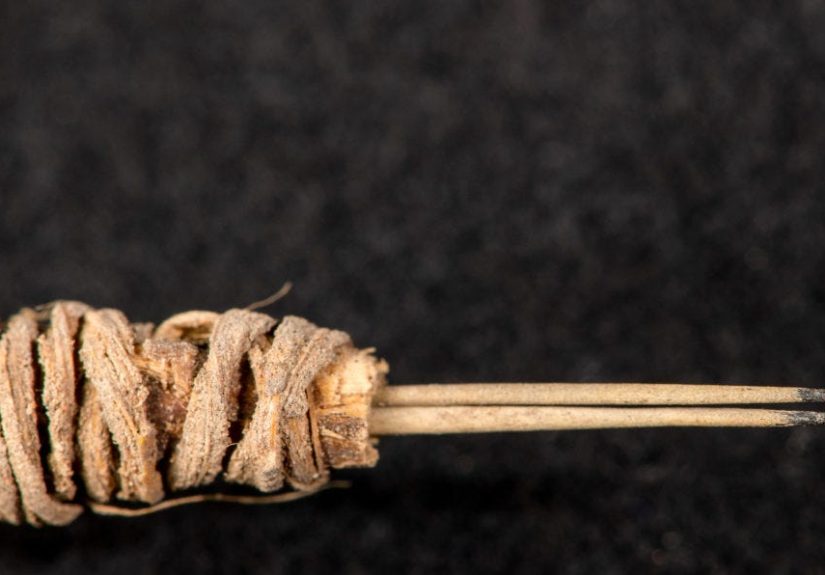
What makes the tool so memorable is its construction. Researchers identified a short wooden handle made from sumac, wrapped with yucca leaves, with two prickly pear cactus spines fixed at one end. The tips were stained dark with pigment. That detail mattered immediately. In archaeology, a stain is sometimes just a stain. But sometimes it is a neon sign from the past saying, “Yes, this thing did exactly what you think it did.”
By itself, the object is simple. Together, though, its materials tell a story of practical intelligence. Cactus spines are naturally sharp. Yucca fibers are durable and flexible. Sumac provides a workable handle. This was a lightweight hand-poking instrument assembled from materials available in the surrounding environment. It was efficient, portable, and, in the most literal sense, handmade. There is something wonderfully human about that. The earliest tattoo tool in this case was not a luxury object. It was a smart solution.
How a Box of Old Artifacts Changed Tattoo History
One of the best parts of this story is that the artifact was not freshly unearthed by a dramatic expedition with cinematic music playing in the background. It had actually been excavated in 1972 and then stored with other materials for decades. Like many finds from older digs, it sat in museum curation space waiting for someone to look at it with new questions. That someone was archaeologist Andrew Gillreath-Brown, who noticed the unusual object while inventorying legacy collections.
This is a good reminder that archaeology is not just about digging. Sometimes it is about rethinking. Sometimes it is about opening a box, seeing an “odd-looking little artifact,” and realizing the past has been patiently waiting for better eyesight. When Gillreath-Brown recognized that the object resembled known tattooing tools, he and a team of researchers began a more rigorous investigation. Their work transformed the artifact from a curious museum piece into a landmark discovery in the archaeology of body modification.
How Researchers Knew It Was a Tattoo Tool
Archaeologists did not simply point at the cactus spines and say, “Looks tattoo-y to me.” They tested the idea. The team used microscopy and chemical analyses to study the pigment staining and the use-wear on the spine tips. They also compared the object with ethnographic descriptions of cactus-spine tattooing tools used by Indigenous peoples in the Southwest. That comparison mattered because archaeologists rarely get tidy labels from the past. Instead, they build cases through material evidence, historical parallels, and experimental work.
Perhaps the most vivid part of the investigation involved making replicas and using them in experimental tattooing on pig skin. That sounds like the sort of detail that makes everyone lean in at a dinner party, and for good reason. The replicas created wear patterns similar to those observed on the original spines, including rounding, striations, and pigment embedding. Even the break pattern on one spine matched what might happen during actual use. In short, the tool behaved like a tattooing tool because it was one.
The dating was equally important. Researchers tied the artifact to a context that placed it roughly between A.D. 79 and 130. Before this discovery, the earliest known tattooing tools from the region were later examples from Arizona and New Mexico, dating roughly to A.D. 1100 to 1280. That means the Utah artifact pushed direct archaeological evidence for tattooing in the U.S. Southwest back by around a thousand years. Not a minor correction. More like a full historical plot twist.
Why Tattooing Matters in Ancient Societies
Tattoos are easy to treat as fashion, rebellion, or autobiography. In ancient societies, they could be all of those things and much more. Across the world, tattooing has served as a marker of identity, status, healing, adulthood, spiritual protection, mourning, and group belonging. Indigenous North American tattoo traditions were widespread, diverse, and meaningful long before outsiders began documenting them. The problem is not that tattooing was absent from the past. The problem is that tattoos are hard to preserve archaeologically, and the tools used to make them are often perishable.
That is why this cactus-spine implement matters so much. It gives archaeologists something direct to work with. In the American Southwest, scholars have long suspected tattooing based on iconography, oral traditions, ethnographic records, and comparisons with later Indigenous practices. But suspicion and proof are not the same thing. This artifact provided rare material evidence that body marking was part of life in the region much earlier than previously demonstrated.
At the same time, caution is essential. The tool cannot tell us exactly what designs were tattooed, who wore them, or what each mark meant. Archaeology is powerful, but it is not a time machine with subtitles. What the artifact does tell us is that tattooing was technologically feasible, culturally meaningful enough to warrant specialized tools, and embedded in a society that already had complex relationships to identity, labor, community, and symbolism.
The Basketmaker II Context: A World Taking Shape
To understand why the tool matters, it helps to understand the people connected to it. The Basketmaker II period, generally spanning 500 B.C. to A.D. 500, was a transformative era in the broader Pueblo world. Communities were becoming more dependent on farming, especially maize, while still hunting and gathering. They built more permanent homes, including pithouses and rock-shelter dwellings, created storage pits for surplus food, and left behind the material traces of increasingly settled life.
That shift toward permanence probably changed social life in profound ways. When people live in one place longer, relationships become denser, boundaries become more visible, and identity markers can carry more weight. Body modification in that setting may have helped communicate adulthood, kinship, ritual participation, healing, community membership, or personal achievement. Tattoos are not just decoration in these contexts. They are social technology. They say something about who a person is, where they belong, and what they have lived through.
Seen this way, the cactus-spine tattoo tool is not merely evidence of ancient style. It is evidence of ancient social communication. It sits at the crossroads of art, pain, ritual, memory, and everyday life. That is what makes it so rich as a topic. A small object opens a giant door.
Not Just Body Art, but Human Storytelling
Modern readers often connect with tattoos because they understand the emotional logic behind them. A tattoo can commemorate loss, celebrate survival, announce love, honor ancestry, or mark a transition. Ancient tattooing likely operated in equally layered ways. Some traditions in North America involved tattoos for puberty, some for healing, some for protection, some for war honors, and some for mourning. Even where exact meanings differed by community, the broader point stays the same: tattooing was social expression written directly on the body.
That makes the Utah artifact feel surprisingly intimate. We do not know the tattooist’s name. We do not know who sat still while the cactus spines punctured skin. We do not know whether the design was tiny or bold, ceremonial or personal. But we do know a moment happened. Someone prepared pigment. Someone held this tool. Someone trusted the process. Someone walked away marked in a way meant to last. For archaeology, that is an extraordinary closeness.
Why the Cactus Spine Still Feels Modern
There is also a strange charm in the fact that the oldest known tattooing implement from this region looks so low-tech. In an age of polished machines and disposable cartridges, the cactus-spine tool reminds us that innovation does not always arrive wearing chrome. Ancient makers understood materials deeply. They knew which plants could cut, bind, hold, and endure. They created elegant tools from what the landscape offered. The result was not primitive in the dismissive sense of the word. It was precise, local, and effective.
That matters because too many conversations about ancient technology assume that older means cruder. But this tool suggests the opposite. It was tailored to its purpose. It used renewable organic materials. It fit a specific bodily technique. It belonged to a cultural system that knew exactly what it was doing. If anything, the cactus-spine tattoo implement is a lesson in design discipline. It did not need a power cord. It had a job.
Experiences Related to the Topic: How This Discovery Still Feels Alive Today
The story of the cactus-spine tattoo tool resonates because it taps into experiences modern people still understand. Anyone who has gotten a hand-poked tattoo, watched an artist set up their tools, or felt that first sharp sting knows tattooing is never just visual. It is tactile, emotional, and memorable. The ancient tool from Utah brings that sensory world into focus. Suddenly, archaeology is not just about dates and site reports. It is about pressure against skin, the preparation of pigment, the steadiness of a practiced hand, and the trust between the person making the mark and the person receiving it.
Museum experiences become richer because of discoveries like this one. Visitors often walk past ancient artifacts thinking of them as remote, silent, and a little abstract. But a tattoo tool changes that mood immediately. It is easy to imagine how it was held. Easy to imagine the concentration involved. Easy to imagine the human body at the center of the story. That kind of artifact shortens the distance between then and now. It tells people that ancient communities were not frozen symbols in a textbook. They were individuals making choices about appearance, identity, belonging, and meaning.
There is also an experience of rediscovery built into this artifact’s history. For researchers, one of the most exciting feelings in archaeology is not always uncovering something brand new in the field. Sometimes it is recognizing significance in something that has been overlooked. That kind of moment feels almost electric. A box is opened. An object is handled. A stain, a shape, a fiber wrapping suddenly clicks into place. The old collection becomes new evidence. That experience matters because it shows how knowledge evolves. The past does not change, but our ability to understand it absolutely does.
For tattoo artists and enthusiasts today, the Utah tool can also inspire a different kind of respect. Modern tattoo culture often celebrates innovation, custom design, and technical mastery. This artifact adds time depth to that appreciation. It reminds us that tattooing in North America is not some recent fad or imported novelty. It is part of a much older human story, including Indigenous traditions with deep cultural roots. That recognition can shift the experience of modern tattooing from trend-based self-expression toward a broader awareness of continuity, craft, and history.
Even travel experiences connect to the topic. People who visit the canyon country of the Southwest often talk about the feeling of scale, dryness, silence, and endurance in the landscape. Knowing that a tattoo tool survived there for nearly two millennia makes the place feel even more charged. Cedar Mesa is not just scenic. It is layered with evidence of lived lives, daily labor, artistic choices, and social worlds. The desert preserved more than objects. It preserved possibilities for understanding human experience.
In the end, the cactus spine matters because it turns history from something we read into something we can almost feel. The discovery carries the sensation of pain, care, ritual, memory, and design across two thousand years. That is no small feat for a tool smaller than a pencil. It is ancient, yes, but it does not feel dead. It feels startlingly alive.
Conclusion
The United States’ so-called oldest tattoo needle may be tiny, but its significance is huge. Made from cactus spines, yucca, and wood, the Utah artifact pushed direct evidence of tattooing in the U.S. Southwest back to the first century A.D. More importantly, it reminded us that ancient body art was never trivial. It was part of how communities expressed identity, memory, adulthood, healing, and belonging. The discovery also showed the value of revisiting museum collections with fresh eyes. Sometimes history does not shout. Sometimes it waits in a box, holding still, until someone notices the ink.
Note: This article is based on published archaeological research and historical reporting intended for general readers. It avoids unsupported speculation while using a lively editorial style suitable for web publication.