Table of Contents >> Show >> Hide
- The Parking Plot Twist That Started It All
- Why Neighbor Parking Disputes Get So Ugly, So Fast
- Street Parking vs. Driveway Rights: Where the “Mine” Line Actually Is
- The Towing Reality Check: You Can’t Just Summon a Tow Truck Anywhere
- The Smart Playbook for a Neighbor Parking Dispute
- What Not to Do (Even If Your Group Chat Votes Yes)
- HOA Parking Rules: The Paperwork Boss Level
- How to Keep the Peace After the Tow
- FAQ: Quick Answers for a Blocked Driveway and Parking Hijack
- Conclusion: Boundaries Beat Blowups
- Real-Life Parking Experiences That Feel Exactly Like This (And What Usually Works)
Parking is one of America’s most popular contact sports. Not the kind with helmetsmore like the kind with passive-aggressive notes, dramatic sighs, and the occasional “Who raised you?” whispered into a steering wheel. And nothing ignites a neighborhood faster than someone treating your driveway like it’s a public suggestion.
The story you’re about to read (and the lessons hiding inside it) is a perfect example of how a “small” parking problem can turn into a full-blown driveway disputecomplete with entitlement, consequences, and the kind of regret that shows up after the tow truck leaves.
The Parking Plot Twist That Started It All
Here’s the setup: a neighbor decides that your driveway is basically an “overflow lot” for his guests. When you push backpolitely, reasonably, like a normal humanhe doesn’t apologize. He doubles down.
In the viral version of this tale, the neighbor’s attitude can be summarized as: “Just park on the street. It’s not a big deal.” Which is a bold statement coming from a guy who apparently can’t convince his own visitors to do the exact same thing.
So the homeowner takes him at his word. If it’s “not a big deal,” then it’s not a big deal to treat it like any other parking violation: document it, call it in, andwhen appropriatehave the unauthorized vehicle towed.
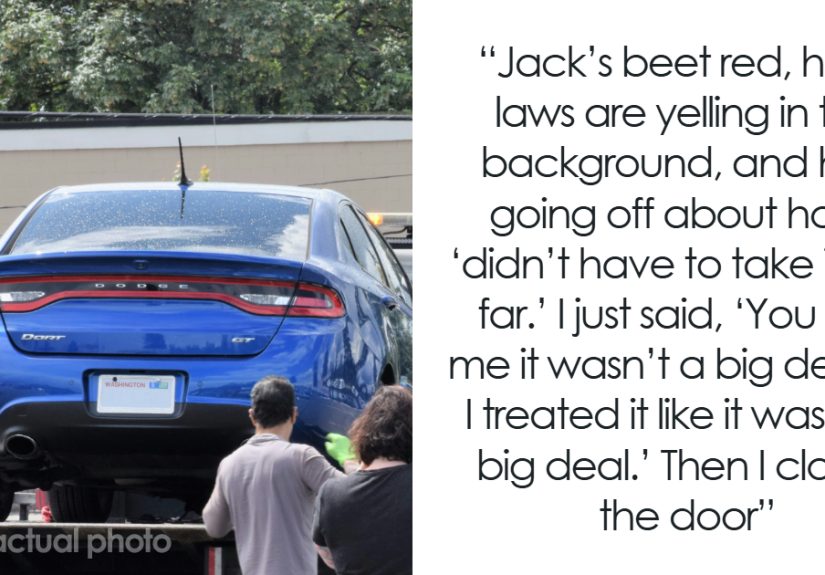
The punchline lands fast. The neighbor shows up furious, insisting, “You didn’t have to take it that far,” right after he took it that far by hijacking someone else’s parking and issuing street-parking commandments from the comfort of someone else’s driveway. In other words: he wanted the benefits of boundaries without the inconvenience of respecting them.
Why Neighbor Parking Disputes Get So Ugly, So Fast
1) Parking feels personaleven when it’s technically not
Your driveway isn’t just concrete. It’s convenience, routine, safety, and “I pay for this” all rolled into one slab. When someone blocks it or takes it over, it feels less like a minor annoyance and more like a daily reminder that your neighbor thinks your space is optional.
2) People confuse “I’ve always done this” with “I’m allowed to do this”
A lot of neighborhood drama is powered by a simple misunderstanding: habit isn’t permission. Just because someone has been parking a certain way for months doesn’t make it legal, fair, or even logicalespecially if the person whose access is being blocked never agreed to it.
3) The street-parking argument is the oldest trick in the book
“Just park on the street” sounds practical until you realize it’s usually coming from the one person who refuses to ask their own guests to do that. It’s not advice. It’s outsourcing inconvenience.
Street Parking vs. Driveway Rights: Where the “Mine” Line Actually Is
Let’s clear up a few things that cause endless confusion in parking wars: public streets and private driveways are not the same universe, and the rules are very different. (Also: none of this is legal advicelocal rules vary, and your city may have its own extra layers of “fun.”)
Public street parking is usually publicno matter whose house it’s in front of
In many U.S. neighborhoods, if a car is parked legally on a public street (not blocking anything, not in a restricted zone), the space is generally first-come, first-served. You might feel like the curb in front of your home is “your spot,” but the law often doesn’t agree.
That said, public street rules still have teeth: fire hydrants, crosswalk corners, permit zones, street-cleaning schedules, time limits, snow emergencies, and “no parking” signage can all turn a “quick stop” into a ticket or tow.
Blocking a driveway is a different categoryoften illegal, often towable
A vehicle that blocks a driveway can prevent you from leaving, prevent you from getting in, and in some cases interfere with emergency access. Many cities treat driveway blocking as a violation that can be ticketed and may lead to towing.
For example, California’s vehicle code explicitly prohibits stopping/parking in front of a public or private driveway (with narrow exceptions). Other states and cities have similar rules even if the exact wording differs.
If the car is on your driveway, that’s typically private property territory
When someone parks in your driveway without permission, it’s not “parking drama”it’s closer to trespass or unauthorized use, depending on the situation and local law. That’s why many police departments and municipal services tell residents to use non-emergency channels for blocked access, and to document the violation.
The Towing Reality Check: You Can’t Just Summon a Tow Truck Anywhere
Here’s where people get themselves into trouble: towing rules are highly state- and city-specific, and “I’m mad” is not a legal towing permit. But there are common patterns across the U.S.:
- Public street: towing is usually handled by city parking enforcement or police authorization, typically when there’s a violation.
- Private property (like a driveway, apartment lot, or HOA-controlled area): towing may be allowed, but it often requires clear notice/signage, proper authorization, and compliance with state rules.
- Bad tow = expensive headache: if a tow is done improperly, the vehicle owner may challenge it, and you could end up in a messy dispute.
Some states are very specific about signage and notice before non-consensual towing from private property. Texas, for example, has detailed tow-away signage requirements for parking facilities. Florida statutes also spell out how “tow-away zone” notice must be posted before towing from private property in many situations. The point isn’t to memorize every ruleit’s to understand that “tow it” is not a magical button you can press without procedure.
The Smart Playbook for a Neighbor Parking Dispute
If someone hijacks your driveway or blocks your access, the goal is simple: get your space back without accidentally turning yourself into the headline. Here’s a practical, escalation-friendly approach that works in most places:
Step 1: Confirm what’s actually yours
Sounds obvious, but it matters. In some neighborhoods, the “line” between driveways, curb cuts, and shared aprons can be confusing. If it’s a shared driveway, a duplex situation, or a multi-unit property, check your lease, deed, HOA documents, or property lines.
Step 2: Start with one calm, clear boundary
When it’s safe to do so, a short message can solve it: “Please don’t park in my driveway or block it. I need access at all times.” No lecture. No sarcasm. No ten-paragraph history of driveway trauma. Just a boundary that can be screenshotted later if needed.
Step 3: Document like you’re building a tiny case file
Take photos that show the license plate and the way the car is blocking access. Note the date/time. If you have a doorbell cam, even better. Documentation is useful whether you call parking enforcement, request a tow, or need to involve an HOA.
Step 4: Use the right channelusually non-emergency
Many cities provide 311 or a local parking enforcement line for illegal parking complaints. Some places treat driveway-blocking as a priority; others are slower. If you can’t get out, or access is truly obstructed, follow your city’s guidance. The key is to stay in “official process” mode, not “parking vigilante” mode.
Step 5: Towing is the last step, not the first flex
If warnings and official channels don’t workand the vehicle is clearly unauthorized or blocking accesstowing can be the cleanest reset. But do it correctly: verify local rules, follow required notice procedures, and use properly authorized towing services. In many cases, law enforcement or parking enforcement is the safest route to initiate a tow.
What Not to Do (Even If Your Group Chat Votes Yes)
- Don’t tow it yourself. DIY towing can damage vehicles, create safety risks, and invite liability.
- Don’t block them in “to teach a lesson.” Escalation often backfires, especially if emergency access is affected.
- Don’t touch the car. That includes “creative” ideas involving tire valves, sticky notes, or anything else that looks fun in theory and expensive in court.
- Don’t turn it into a shouting match. Your goal is access and peace, not an Oscar for Best Neighborhood Meltdown.
HOA Parking Rules: The Paperwork Boss Level
In HOA communities and apartment complexes, parking disputes often come with extra layers: assigned spots, guest rules, overnight restrictions, commercial vehicle bans, and enforcement procedures.
The tricky part: an HOA might have authority over certain areas (like private roads or shared lots), while public streets remain under city rules. And sometimes state law limits what an HOA can restrict. Florida’s 2024 HOA legislation (HB 1203), for instance, introduced changes affecting certain parking restrictions, including how some communities treat pickup trucks and driveway parking.
Translation: if you’re in an HOA, your best weapon is not a louder voiceit’s your governing documents, plus local ordinances, plus the state rules that may override HOA policies.
How to Keep the Peace After the Tow
Let’s be real: even when a tow is justified, it can poison the neighbor relationship. If you plan to live next to this person for years, it’s worth trying to de-escalate after your access is restored.
Use “interests,” not insults
Negotiation and mediation experts often focus on the underlying interests: safety, access, predictability, and respect. “I need my driveway clear so I can leave for work and get emergency access if needed” lands better than “Your family parks like raccoons.” (Even if the raccoon comparison is emotionally accurate.)
Offer a simple future plan
You’re not asking for a friendship bracelet. You’re setting a rule: “Please keep all vehicles off my driveway. If you have guests, they’ll need to use street parking or your own space.”
Consider mediation if it’s chronic
If this is part of a larger neighbor disputenoise, property lines, shared accesslocal mediation programs can help keep it civil. Mediation is often faster and cheaper than legal escalation, and it’s designed to create workable agreements rather than “winners and losers.”
FAQ: Quick Answers for a Blocked Driveway and Parking Hijack
Can I tow a car parked in front of my house?
Usually not just because it’s in front of your homeif it’s legally parked on a public street. If it violates a rule (blocks a driveway, hydrant, or is in a restricted zone), parking enforcement or police can often take action.
What if someone parks in my driveway without permission?
That’s typically a private property issue. Many places allow towing of unauthorized vehicles from private property, but the process may require proper authorization and notice/signage. Check your state and local rules before acting.
Who should I call if my driveway is blocked?
In many cities, start with 311 or a local non-emergency police/parking enforcement line. If you’re fully blocked and it’s urgent, follow your city’s guidance for escalation. Always prioritize safety.
Conclusion: Boundaries Beat Blowups
The moral of the story isn’t “tow first, ask questions later.” It’s this: your driveway isn’t a community suggestion box. If someone hijacks your parking, tells you to “just park on the street,” and acts shocked when you use official channels, they’re not upset about the towthey’re upset that the free ride ended.
Handle neighbor parking disputes with a calm boundary, good documentation, and the correct local process. Save the drama for reality TV. Keep the driveway for your car.
Real-Life Parking Experiences That Feel Exactly Like This (And What Usually Works)
Parking conflicts rarely start as “war.” They start as tiny boundary tests: a visitor who “just needs a minute,” a neighbor who thinks your curb cut is a convenient turnaround, or a friend-of-a-friend who treats the driveway like a temporary loading dock. Most homeowners can name the exact moment their patience expiredusually the third time they had to squeeze past a bumper to get into their own garage.
One common scenario: the “party problem.” A neighbor hosts gatherings and their guests spill into nearby driveways because it’s easier than parallel parking. The host may not even notice at first, because the inconvenience is happening next door. The fix that tends to work? A direct, boring message: “When you have guests, please tell them not to use my driveway.” Boring is good. Boring is enforceable. When the host refuses or shrugs, that’s when documenting and using official channels becomes less about being petty and more about being functional.
Another frequent issue is the “contractor carousel.” Landscapers, cleaners, and delivery drivers sometimes block driveways while they work, especially in tight cul-de-sacs. In many cases, they’ll move immediately if askedbecause they’re trying to do a job, not start a feud. The trick is to approach it as logistics, not accusation: “Hey, I need to get out in ten minutescan you keep the driveway clear?” When it’s a repeat company, a quick call to the office often solves the problem faster than confronting the same truck every Tuesday.
Then there’s the “new neighbor confusion” phase. People move in, don’t understand property lines, assume an apron is shared, or think an unmarked section of concrete is fair game. This is where signage can helpnot the aggressive kind, but something simple: “Private DrivewayDo Not Park.” It feels silly until the day you don’t have to explain it for the tenth time.
HOA communities add their own flavor of chaos. Some residents think the HOA will handle everything; others assume the HOA is powerless. In reality, HOAs often have procedureswarnings, fines, towing authorizationbut they also have limits, especially when public streets are involved or when state law restricts certain rules. The “winning” move is paperwork: keep screenshots, keep emails, and keep the relevant sections of the rules. A calm complaint with photos and timestamps is harder to ignore than a frustrated rant (even if the rant is emotionally justified).
Lastly, the most relatable experience of all: the neighbor who treats your inconvenience like it’s “not a big deal.” That phrase is a tell. If it’s truly not a big deal, it shouldn’t be hard for them to stop doing it. When they won’t stop, they’re admittingwithout meaning to that it’s only “not a big deal” because you’re the one paying the price. The best outcomes usually come from a predictable sequence: one clear warning, one documentation step, and then official enforcement if it continues. Not because you love conflict, but because you love leaving your house without negotiating with someone else’s bumper.
Parking peace isn’t built on who’s the nicest. It’s built on clear expectationsand consistent consequences when someone ignores them. That’s not “taking it too far.” That’s taking it seriously enough to end it.