Table of Contents >> Show >> Hide
- The Mystery Photo and the Big Reveal
- Why That Faucet Looks So Good in a Black-and-White Bathroom
- The Faucet Itself: Chicago Faucets 540 Series (A Workhorse in Disguise)
- De-Plating: The Budget Unlacquered Brass Hack (Done Safely)
- Designing the Rest of the Black-and-White Bath Around a Brass Wall Faucet
- Wall-Mounted Faucets: The Glamour, the Math, and the Tiny Panic Attack
- Performance Matters: Flow Rate, Splash, and the “Wait, Why Is This Dribbling?” Moment
- Finish Reality Check: Keeping Brass Brass-y and Black Black-y
- A Mini “Recon” Guide: How to Identify a Faucet from One Photo
- Conclusion: The Secret Isn’t a BrandIt’s a Strategy
- +: Real-World Lessons from the “Black-and-White Bath Faucet” Rabbit Hole
- SEO Tags
Black-and-white bathrooms are the little black dress of home design: classic, flattering, and somehow always in style even when everything else is doing the most.
But there’s a particular kind of black-and-white bath that stops you mid-scrollthe one where the palette is crisp, the tile lines are obedient, and the faucet looks
like it was salvaged from a 1920s Paris hotel (in a good way) and polished by angels (who apparently moonlight as plumbers).
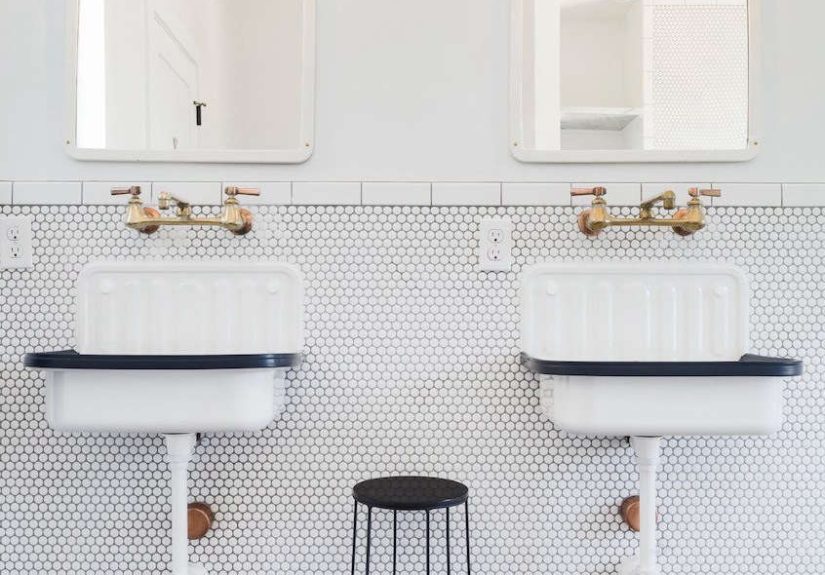
That’s the vibe behind a Remodelista “Reconnaissance” mystery: a reader spotted an unfamiliar wall-mounted faucet in a striking black-and-white bath and asked,
“What is that thing?” The answer is deliciously practical: it’s not a rare unicorn faucet at all. It’s a workhorsespecifically a Chicago Faucets wall-mountwearing a clever disguise.
The “secret” is that the chrome plating was professionally stripped to reveal unlacquered brass underneath, delivering a high-end look for a fraction of the expected price.
The Mystery Photo and the Big Reveal
Remodelista’s Reconnaissance series is basically design detective work with better lighting. In this case, the “sighting” was a black-and-white bathroom in Austin, Texas (the Bear Creek Bovidae Bath),
and the faucet didn’t match the usual suspects. Not Waterworks. Not the spendy British classics. Not the “I saw it in a boutique hotel and now I’m emotionally attached” category.
The verdict: Chicago Faucetsoriginally chromehad the plating removed to expose raw, unlacquered brass. The designers behind the bathroom said they followed an earlier Remodelista idea:
de-plate a “trusty” Chicago faucet rather than spending around $1,500 on a specialty unlacquered brass model. Same warm brass look, wildly different receipt.
Why That Faucet Looks So Good in a Black-and-White Bathroom
Brass is the “third color” that makes monochrome feel alive
Black and white can read as sharp and graphicor, if you’re unlucky, like a chessboard that’s judging your life choices. The difference is usually texture and warmth.
Many designers lean on natural materials (wood, stone) or a warm metal accent (brass, bronze) to keep the scheme from feeling flat.
It’s why you’ll see black-and-white baths paired with brass mirrors, brass sconces, or a single standout brass fixture to soften the contrast.
A utilitarian silhouette adds credibility
Here’s the twist: the faucet’s shape matters as much as its finish. Commercial-style faucets have a purposeful profileclean bends, sturdy handles, no fussy ornament.
In a black-and-white bath, that functional silhouette reads as “intentional,” not “random plumbing aisle decision.”
Wall-mounted placement adds to the effect by clearing the countertop and making the whole sink zone feel more architectural.
The Faucet Itself: Chicago Faucets 540 Series (A Workhorse in Disguise)
Chicago Faucets are known for commercial durabilitythink schools, restaurants, public buildingsplaces where a faucet has to survive real life (and whatever chaos a Tuesday can bring).
The wall-mounted models in the 540 family are built around an adjustable setup that fits common spacing and includes components made to take daily use.
- Wall-mounted body with adjustable arms (designed to fit a range of center-to-center measurements).
- Lever handles commonly used for quick control and durability.
- Swing spout options (useful when you want the stream centered but also need a little flexibility).
- Aerator and flow choices vary by modelalways check the spec for your exact configuration.
In the Remodelista example, the “magic” wasn’t a rare modelit was the finish transformation. Start with chrome, remove the plating, and suddenly a familiar commercial faucet becomes
that “perfectly aged brass” moment designers love to specify.
De-Plating: The Budget Unlacquered Brass Hack (Done Safely)
Let’s say it plainly: removing chrome plating is not a cute weekend DIY. Chrome finishes are typically layered systems, and stripping them can involve industrial processes and hazardous materials.
Remodelista’s own recommendation is to have a professional handle the de-platingbecause the goal is “beautiful brass,” not “how I accidentally invented a new household emergency.”
A reputable plating or metal finishing shop can strip chrome (and underlying layers, if present) back to brass. After stripping, the brass can be left unlacquered to develop a natural patina,
which is exactly the point: it will darken, warm, and change over time in a way that looks authenticnot “factory distressed,” but genuinely lived-in.
Translation: the secret isn’t just “buy this faucet.” The secret is “buy a well-made faucet with the right bones, then commission a finish journey.”
Designing the Rest of the Black-and-White Bath Around a Brass Wall Faucet
Let the tile do some of the styling (and behave around the faucet)
Wall-mounted faucets don’t just sit on the wall; they become part of the wall composition. Tile shape, grout lines, and symmetry suddenly matter more.
If your bathroom has a strong gridsubway tile, stacked rectangles, or crisp stone slabscenter the faucet so it feels “locked in” to the geometry.
If you’re working with tile, it’s worth planning so grout lines align neatly with the faucet and sink placement.
Mix metals like you meant it
In a black-and-white bathroom, you’re already dealing with contrast. That’s good news: mixed metals can look especially intentional here.
The trick is to choose a “main metal” and a “supporting metal,” then repeat each a few times so nothing feels accidental.
For example: brass faucet + brass mirror frame, then chrome on lighting or hardware; or brass faucet + matte black accessories, with a small chrome cameo (like a towel hook) for sparkle.
- Make it obvious. If two metals are too similar, it can look like you bought the wrong finish by mistake.
- Repeat with purpose. Two to three hits of your accent metal usually reads as “designed,” not “mixed-up.”
- Use black as a neutral buffer. Black frames, black pulls, and black details help different metal tones coexist.
Wall-Mounted Faucets: The Glamour, the Math, and the Tiny Panic Attack
Wall-mounted bathroom faucets are a shortcut to a clean look and an easier-to-wipe sink deck. But they’re also a “measure twice, tile once” situation.
Once the plumbing is roughed into the wall, moving it is not impossiblebut it’s the kind of “possible” that arrives with invoices.
What you gain
- Less gunk behind the faucet. With no deck-mounted hardware, the backsplash area is easier to keep clean.
- A more architectural sink zone. The faucet reads like part of the wall design rather than countertop clutter.
- Flexibility for vessel sinks and custom setups. You’re not limited by pre-drilled sink holes.
What you have to plan
- Height: Many designers aim for enough clearance so your hands fit comfortably under the spout without splashing everywhere.
- Reach: The spout needs to project far enough so you’re not washing your hands against the back wall of the basin.
- Alignment: Faucet centered over the basin, and if you’re tiling, centered within the tile layout so the grout lines don’t look “slightly annoyed.”
Another practical note: some pros warn that wall-mount faucets can get tricky with standard-depth vanities because the valve location is set inside the wall early.
If the spout ends up too short (or too long), you get splash city or hand-banging misery. This is where mockups and professional guidance pay for themselves.
Performance Matters: Flow Rate, Splash, and the “Wait, Why Is This Dribbling?” Moment
A faucet can be gorgeous and still drive you nuts if the performance doesn’t match the room’s real life. Two numbers matter more than people admit:
flow rate and spout geometry.
In the U.S., standard bathroom faucet flow has historically been up to 2.2 gallons per minute, while water-efficiency programs and newer specs push lower rates (often 1.5 gpm or even 1.2 gpm).
Many modern, well-reviewed bathroom faucets are designed around these lower flows, so you still get a satisfying stream without wasting water.
Here’s why this matters for the Remodelista “secret” faucet: commercial models may ship with higher-flow aerators, depending on application.
If you love the look but want better water efficiency (or need to meet local requirements), talk to your plumber about compatible aerator swaps or selecting a lower-flow variant.
The goal is to keep the drama in the tilenot in your water bill.
Finish Reality Check: Keeping Brass Brass-y and Black Black-y
Unlacquered brass will changeand that’s the feature, not a bug
Unlacquered brass develops patina. It darkens where it’s touched, it lightens where it’s polished, and it generally behaves like a material that’s alive.
If you polish it, you’ll brighten itbut the patina will return with time. If you prefer the aged look, gentle cleaning and a soft cloth are your friends.
Black fixtures and high-contrast baths show spots faster
High-contrast bathrooms are honest. They show dust. They show water spots. They show toothpaste splatter with the clarity of an HD documentary.
The secret weapon is boring consistency: quick wipe-downs and non-abrasive cleaners. Always follow the manufacturer’s finish-care guidance so you don’t dull, scratch, or void warranties.
A Mini “Recon” Guide: How to Identify a Faucet from One Photo
If you want to play Remodelista detective in your own scrolling habits, here’s what to look for before you fall in love with a faucet you can’t name:
- Mounting style: deck-mounted, widespread, single-hole, or wall-mounted?
- Handle language: cross handles, levers, knurled knobs, or minimalist pins?
- Spout silhouette: goose-neck, straight tube, bridge, swing spout, or articulated arm?
- Backplate and escutcheon clues: commercial faucets often have distinctive base geometry and spacing.
- Finish “tells”: unlacquered brass shows uneven warmth and darkening; lacquered brass stays more uniform.
And if the faucet looks like “expensive vintage brass” but the shape screams “commercial classic,” you may have just found your own de-plating opportunity.
(Professionally. With adults. With ventilation. You get the idea.)
Conclusion: The Secret Isn’t a BrandIt’s a Strategy
The Remodelista Reconnaissance “secret faucet” is a perfect reminder that great bathrooms aren’t only about buying the most expensive fixture on the internet.
They’re about choosing the right form, placing it thoughtfully, and letting materials do what they do best. In a black-and-white bath, a warm brass wall-mounted faucet adds depth,
breaks up the graphic contrast, and delivers that “considered” lookespecially when it comes from an unexpected, hard-working source.
Want to copy the vibe without copying the exact bathroom? Steal the principles: pick a strong faucet silhouette, plan wall placement carefully, keep flow rate and splash in mind,
and choose a finish that will age with a little personality. Your bathroom should feel like it has a point of viewnot like it’s trying to win an argument with a showroom.
+: Real-World Lessons from the “Black-and-White Bath Faucet” Rabbit Hole
When people get obsessed with a black-and-white bathroom, it usually starts innocently: “I just want something clean and timeless.”
Two weeks later they’re debating grout undertones like it’s a courtroom drama and zooming in on faucets the way birders zoom in on rare owls.
The faucet fixation makes sense, because in a monochrome space, fixtures do a lot of emotional heavy lifting.
One common pattern: homeowners fall for wall-mounted faucets because they look so crisp in photosthen discover that real life includes handwashing, splashing, and people who don’t aim.
The biggest “wish we’d known” moment is that spout reach and spout height matter more than the finish. A perfect brass tone won’t save you if the stream hits too close to the rim and
your countertop is permanently damp. That’s why designers obsess over where the water lands in the basin, and why mockups (even cardboard ones) can be weirdly heroic.
Another recurring lesson: black-and-white bathrooms amplify maintenance habits. A matte black faucet can look modern and moodyuntil hard water leaves its calling card.
Chrome is forgiving but can feel clinical if everything is chrome. Unlacquered brass is romantic but changes daily, like a mood ring that only cares about soap and oxygen.
The happiest households aren’t the ones who found the “perfect” finish; they’re the ones who chose a finish whose upkeep matches their personality.
If you love patina, unlacquered brass is a joy. If patina makes you itch, pick a more stable finish and let your “warmth” come from lighting and textures instead.
The de-plating story adds a third lesson: budgets don’t have to kill character. People assume a vintage-feeling brass faucet must cost luxury-hotel money.
But there are other routeslike using a sturdy commercial faucet as the base and commissioning a professional to strip the chrome.
That approach doesn’t just save money; it can also create a look that feels more authentic than some “pre-aged” finishes.
Real brass ages in a way that’s hard to fake, and black-and-white bathrooms benefit from anything that feels genuinely material.
Finally, mixed metals are less scary in black-and-white bathrooms than anywhere else. The palette is already doing contrast, so metals can play supporting roles:
a brass faucet can be the warm punctuation mark; a chrome sconce can add sparkle; a black-framed mirror can tie everything back to the scheme.
The key is repetitionecho the brass once or twice elsewhere so it feels intentional, and don’t mix metals that look almost the same unless you enjoy explaining yourself to every guest.
If you take only one practical takeaway from this whole faucet saga, make it this: in a black-and-white bath, the “secret” isn’t copying a specific product.
It’s designing like a detectivenotice proportions, placement, and materials first, then choose the fixture strategy that gets you the look with the least regret.
That’s the kind of reconnaissance that pays off every single morning.