Table of Contents >> Show >> Hide
- What Is a Social-Emotional Herb Garden?
- Why Herbs Work So Well for SEL
- Design Your Social-Emotional Herb Garden (With Intention)
- Pick Herbs That Match Your Space (and Your People)
- Create a Playful “Herb-to-Emotion” Map
- Planting Day: Make It a Social-Emotional Event
- Care Routines That Build Self-Management
- SEL Activities You Can Do in (and With) the Herb Garden
- Safety, Inclusion, and “Real Life” Considerations
- Troubleshooting Without Losing Your Cool
- Wrap-Up: Your Garden Is a Skill-Building Machine (Disguised as a Snack Bar)
- Experiences From the Garden (500+ Words of Real-World Style Lessons)
- SEO Tags
If you’ve ever smelled fresh basil and suddenly remembered every pasta dinner you’ve ever loved, congrats: your nervous system just got a tiny bouquet of support.
That’s the idea behind a social-emotional herb gardena small (or not-so-small) growing space designed to help people practice emotional skills
while they grow something delicious. It’s part gardening, part mindfulness, part “Wow, we kept a plant alive. We are unstoppable.”
In this guide, you’ll learn how to build an herb garden that doesn’t just season your foodit strengthens self-awareness, self-management, empathy, teamwork,
and responsible decision-making. Whether you’re a parent, teacher, counselor, or a grown adult trying to stop doom-scrolling at midnight, this is a practical,
feel-good project with real-world payoff.
What Is a Social-Emotional Herb Garden?
A social-emotional herb garden is a garden planned with SEL (Social-Emotional Learning) in mind. Instead of planting herbs “because Pinterest,”
you plant them with intention: to create moments for noticing feelings, practicing patience, collaborating, handling frustration, and celebrating progress.
Think of it as a living classroom (or living room) for the skills that help humans human better:
- Self-awareness: noticing emotions, naming them, and recognizing patterns.
- Self-management: regulating stress, controlling impulses, and staying motivated.
- Social awareness: empathy, perspective-taking, and respect for others.
- Relationship skills: communication, teamwork, and conflict resolution.
- Responsible decision-making: safe choices, ethical thinking, and problem-solving.
Herbs are perfect for this because they’re sensory-rich (smell! texture! flavor!), often beginner-friendly, and they reward consistency.
Also, they’re not nearly as judgmental as houseplants that dramatically faint the second you miss one watering.
Why Herbs Work So Well for SEL
1) Herbs invite your senses to the meeting
SEL isn’t just a brain thingit’s a whole-body thing. The scent of mint, the fuzzy leaves of sage, the snap of chives: sensory input helps people slow down
and tune in, which is step one for emotional regulation.
2) Herbs give quick wins (and useful “oops” moments)
Many herbs sprout fast, bounce back after harvesting, and work well in containers. That means learners see cause-and-effect quickly:
water = perkier plant; neglect = droop; trim = bushier growth. It’s a gentle feedback systemlike life, but with fewer taxes.
3) Gardening supports well-being in the real world
A growing body of research links gardening and horticultural activities with improved well-being and reduced stress. A social-emotional herb garden doesn’t
replace professional support when needed, but it can be a meaningful, low-cost, accessible tool in a broader wellness toolkit.
Design Your Social-Emotional Herb Garden (With Intention)
Start by choosing your “format.” You can go big (raised bed), compact (containers), vertical (wall planters), or classroom-friendly (windowsill pots).
The best design is the one you’ll actually use consistently.
Option A: The “Feelings Spiral” (small space, big variety)
An herb spiral is a stacked, circular bed that creates mini-climatesdrier at the top, moister at the bottom. It’s also visually awesome and makes you look
like you know what you’re doing, even if you’re Googling “why is my thyme dramatic” at 10 p.m.
Option B: The “Mood Pots” (containers with personality)
Assign each container a social-emotional theme. Label them with an emotion or skill, then plant herbs that match the vibe (more on that below).
Great for patios, balconies, and classrooms.
Option C: The “Team Garden” (for groups and classes)
Create shared beds with rotating roles: Water Captain, Weed Detective, Harvest Host, and Compost Coach. Rotations teach responsibility, fairness,
and how to say, “I need help” without melting into the soil.
Pick Herbs That Match Your Space (and Your People)
Most culinary herbs prefer bright light and well-drained soil. If your garden gets at least several hours of sun, you’re in business. If not, choose shade-tolerant
options or go indoors with a sunny window or grow light.
Beginner-friendly herbs for a social-emotional herb garden
- Basil: fast-growing, fragrant, and forgiving (likes warmth).
- Mint: vigorous and cheerfulbest in its own pot unless you want “Mint: The Franchise.”
- Chives: hardy, easy, and fun to snip (tiny scissors feel empowering).
- Parsley: steady grower; great for patience practice.
- Thyme: drought-tolerant; excellent for “less is more” watering lessons.
- Rosemary: aromatic, woody, and a long-term relationship (slow growth, big payoff).
- Sage: textured leaves; good for sensory exploration.
- Lemon balm: bright scent; spreads if happy (containers help).
Group herbs by watering needs (tiny strategy, huge success)
One of the fastest ways to create garden stress (the bad kind) is to mix thirsty herbs with drought-lovers in the same tight space.
Grouping by similar watering needs reduces conflictbetween plants and between humans.
Create a Playful “Herb-to-Emotion” Map
This is not medical advice and herbs are not magical mood switches. But metaphors are powerful SEL tools. A “herb-to-emotion” map turns ordinary garden care
into emotional language practice.
- Lavender or lemon balm → Calm: use as a cue for slow breathing and quiet reflection.
- Mint → Focus: pair with short attention-reset routines (“smell, sip water, choose next step”).
- Rosemary → Remembering: link to recalling helpful coping strategies that worked before.
- Thyme → Courage: “I’m trying,” “try-me,” and other pun-powered bravery.
- Basil → Confidence: bold aroma, bold choicespractice positive self-talk while harvesting.
- Sage → Wisdom: reflect on consequences and responsible decisions (“what happens if we overwater?”).
- Chives → Joy: quick harvest for instant wins and gratitude moments.
Label your garden with these themes, or create your own. The point is to make feelings talk normal and usable, not awkward and “please don’t make me share.”
Planting Day: Make It a Social-Emotional Event
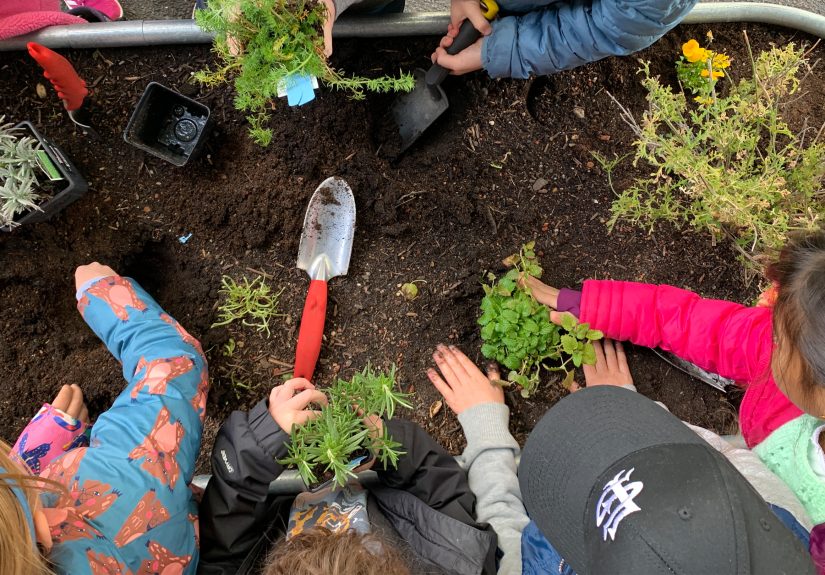
Planting an herb garden can be a full SEL lesson without calling it a lesson. Build routines into the process:
Step-by-step planting checklist
- Choose the spot: aim for sunlight and easy access (if it’s annoying to reach, it won’t get cared for).
- Prep the container/bed: use potting mix for containers; ensure drainage holes exist.
- Decide seeds vs. starts: starts give quicker results; seeds teach patience and planning.
- Plant with spacing: crowding creates competitiongreat metaphor, bad horticulture.
- Water gently: moisten soil, don’t swamp it. Create a “check first” habit with a finger-test.
- Label everything: names, dates, and “garden roles” for shared spaces.
SEL “micro-moments” to sprinkle in
- Emotion check-in: “What feeling did you bring to planting today?” (One word is enough.)
- Team agreements: “How do we handle mistakes?” “How do we ask for help?”
- Goal-setting: “What’s one small thing we can do twice a week for this garden?”
Care Routines That Build Self-Management
Gardens thrive on consistency, which makes them ideal for practicing self-management. Keep routines simple enough that success is likely.
The goal is steady care, not a perfection Olympics.
Weekly rhythm (works for families, classrooms, and teams)
- 2–3 quick check-ins: look for dry soil, wilting, pests, or leggy growth.
- Water as needed: containers dry faster than beds; hot weeks may require more frequent watering.
- Harvest lightly: regular snipping encourages many herbs to branch and grow fuller.
- Reflect briefly: “What did we notice?” “What worked?” “What needs adjusting?”
Make care visible (and kind)
Use a simple chart: Date / Watered / Observations / Next step. It’s not a guilt spreadsheet; it’s a pattern-finder.
If the garden struggles, treat it like data, not failure.
SEL Activities You Can Do in (and With) the Herb Garden
1) The “Scent Pause” (60 seconds)
Pick one herb. Smell it. Name three details (sweet, sharp, earthy). Then name one feeling you notice. This builds self-awareness and calming skills fast.
2) The “Problem-Solving Patch Note”
When something goes wrongyellow leaves, droopiness, chewed edgesturn it into a structured SEL activity:
- Observe: What do we see?
- Hypothesize: What might be causing it (water, light, pests, soil)?
- Choose: What’s one safe action we can try?
- Review: What changed after a week?
3) The “Herb Gratitude Harvest”
Harvest a small handful of herbs and pair it with a gratitude round:
“I’m grateful for…” (a person), “I’m proud of…” (an effort), “I’m looking forward to…” (a next step).
Then use the herbs in foodbecause gratitude is great, but pesto is also a strong argument.
4) The “Friendship Recipe”
In groups, have people pick one herb that represents what they bring to a team (mint = fresh ideas, thyme = persistence).
Combine “ingredients” into a pretend recipe for a healthy group dynamic. This builds social awareness and relationship skills with zero lecturing.
5) The “Conflict-to-Compromise Garden Plan”
When people disagree about what to plant, use it as a real-time SEL practice:
each person gets one “must-have,” one “nice-to-have,” and one “willing-to-skip.” Negotiate until you have a shared plan.
Then write the compromise downbecause memory is great, but paper is undefeated.
Safety, Inclusion, and “Real Life” Considerations
Allergies and sensitivities
Some people are sensitive to strong scents or pollen. Offer scent-light options and keep activities flexible (touch and sight can be just as grounding as smell).
Always wash hands after gardening and before eating anything harvested.
Accessibility matters
Use raised beds, wide paths, and container heights that work for the people using the garden. Adaptive tools and seated workstations can make the space welcoming
for more bodies and abilities.
Cultural relevance makes it stick
Invite families or participants to suggest herbs from their cooking traditions. When the garden reflects people’s lives, engagement increasesand SEL becomes more
meaningful because it’s connected to identity and community.
Troubleshooting Without Losing Your Cool
A social-emotional herb garden is not a “perfect plant” garden. It’s a “practice being human while plants do plant things” garden. Common issues:
- Wilting: often water stress (too little or too much). Check soil before reacting.
- Leggy growth: not enough lightmove closer to sun or add a grow light indoors.
- Slow growth: temperature, light, or crowded roots. Sometimes the plant is simply on its own timeline (rude, but valid).
- Pests: start with gentle optionshand-pick, rinse, or prune affected parts; avoid harsh chemicals near edible plants.
The SEL win is how you respond: pause, observe, make a plan, try again. That’s emotional regulation in a sunhat.
Wrap-Up: Your Garden Is a Skill-Building Machine (Disguised as a Snack Bar)
Planting a social-emotional herb garden is a surprisingly powerful way to practice skills that many of us were never directly taughthow to notice emotions,
manage frustration, collaborate, and make thoughtful decisions. The herbs are the hook. The habits are the treasure.
Start small. Label it with meaning. Build simple routines. Celebrate tiny wins. And when something dies (because something will), treat it as information,
not a verdict on your character. Then plant againbecause resilience loves a sequel.
Experiences From the Garden (500+ Words of Real-World Style Lessons)
People often expect a “social-emotional herb garden” to feel like a structured programclipboards, lesson plans, perhaps an inspirational poster featuring a
tomato that overcame adversity. In practice, the most memorable SEL moments tend to be smaller, messier, and oddly funny.
One common experience in classrooms and youth gardens is the “Mint Incident.” Someone plants mint in the ground because it smells amazing and seems harmless.
A few weeks later, mint is everywhere, like it signed a lease. Instead of treating it as a disaster, educators turn it into a relationship skills lesson:
boundaries and consent, but for plants. The group negotiates a plandig some up, move it into containers, share cuttings with families. Students learn that
strong things can be wonderful and still need limits. It’s a surprisingly gentle way to practice conflict resolution: “We’re not mad at mint. We’re making a plan.”
Another frequent pattern is the “first harvest confidence boost.” A student who rarely volunteers is suddenly the expert because they noticed tiny basil leaves
earlier than anyone else. They get to teach the group how to pinch above a node so the plant branches. That small momentbeing seen, being helpful, being
competentcan shift how they show up in other tasks. Adults sometimes underestimate how powerful it is to be trusted with a real job that has real results.
A basil plant doesn’t care about your test score. It responds to care and attention. That can feel like relief.
Families often report that the garden becomes a “side-door conversation starter.” Some kids don’t want to talk about their day directly. But they will talk
about a droopy plant. While checking soil moisture, a parent might say, “This one looks stressed. What does it need?” The child answers, “Water.” Then the
parent asks, “When you feel stressed, what helps you?” The conversation stays light, but the skill transfer happens. The herb garden gives feelings a safe
metaphorless intense than “Tell me everything right now,” more practical than “Just calm down” (which never works and should be composted as a phrase).
In community gardens, a typical experience is the “shared responsibility wobble.” Early on, everyone is excited. Then the novelty fades, a hot week arrives,
and someone forgets to water. Instead of blame, successful groups build a repair routine: notice, name, fix, adjust. They add a visible schedule and a backup
buddy system. The SEL lesson becomes: systems beat willpower. People learn to design for reality, not for the fantasy version of themselves who wakes up at 5 a.m.
to meditate and water rosemary while journaling in perfect handwriting.
And then there’s the sensory experience itselfoften the fastest emotional reset. A counselor running a small group might begin with a “scent pause” using
rosemary or lemon balm. Participants describe the smell, then name a feeling without pressure to explain it. Over time, the garden becomes a cue for regulation:
“I’m overwhelmed” turns into “I need a minute in the herb corner.” That’s self-management in actionrecognizing signals and choosing a coping strategy that
doesn’t harm anyone and doesn’t require a Wi-Fi connection.
The biggest takeaway from these experiences is simple: the garden doesn’t teach SEL by lecturing. It teaches SEL by creating repeated, low-stakes chances to
practice real skillspatience, responsibility, communication, repair, and pride. The herbs don’t judge. They just grow (or don’t), and either way, they give you
another chance to learn.