Table of Contents >> Show >> Hide
- What Makes a Hypersonic Weapon Different?
- The Navy’s Conventional Prompt Strike Program
- Why the Zumwalt-Class Destroyers Are First in Line
- Submarines Could Take the Capability Even Further
- Why “Anywhere in an Hour” Is Both Powerful and Complicated
- The Strategic Value: Speed, Survivability, and Deterrence
- The Cost and Engineering Challenges
- How the Navy’s Tests Fit Into Global Competition
- What Happens Next?
- Experience and Perspective: What Watching Navy Hypersonics Teaches Us
- Conclusion
Imagine ordering a pizza, tracking it across town, and realizing that a U.S. Navy hypersonic weapon could theoretically cross entire regions of the globe before the pepperoni cools. That is the headline-grabbing promise behind America’s push for sea-based hypersonic strike: weapons moving faster than Mach 5, designed to travel long distances, maneuver unpredictably, and reach time-sensitive targets before an adversary has much time to blink.
The phrase “hit anywhere on Earth in an hour” has been attached for years to the broader idea of Conventional Prompt Strike, sometimes called prompt global strike. The Navy’s current effort does not mean sailors are casually pressing a button to zap any point on the map like a video game cheat code. It means the United States is developing a conventional, nonnuclear capability that could give national leaders a rapid option against urgent, heavily defended threats when slower aircraft, cruise missiles, or forward-deployed forces may not be fast enough.
At the center of the Navy’s work is the Conventional Prompt Strike program, often shortened to CPS. It is a sea-based hypersonic weapon system being developed alongside the Army’s Long-Range Hypersonic Weapon, known as Dark Eagle. The services share major missile technology, including a common hypersonic glide body and an all-up round concept. The Navy’s version is intended for launch from surface ships and, later, submarines. In plain English: the Navy wants a very fast, very long-range conventional strike tool that can operate from the ocean, where U.S. forces already have global reach.
What Makes a Hypersonic Weapon Different?
Hypersonic weapons are commonly defined as systems that travel at least five times the speed of sound, or Mach 5. Speed alone, however, is not the whole story. Ballistic missiles have exceeded hypersonic speeds for decades. What makes modern hypersonic glide weapons especially interesting is their combination of speed, atmospheric flight, maneuverability, and lower, less predictable trajectories compared with traditional ballistic missiles.
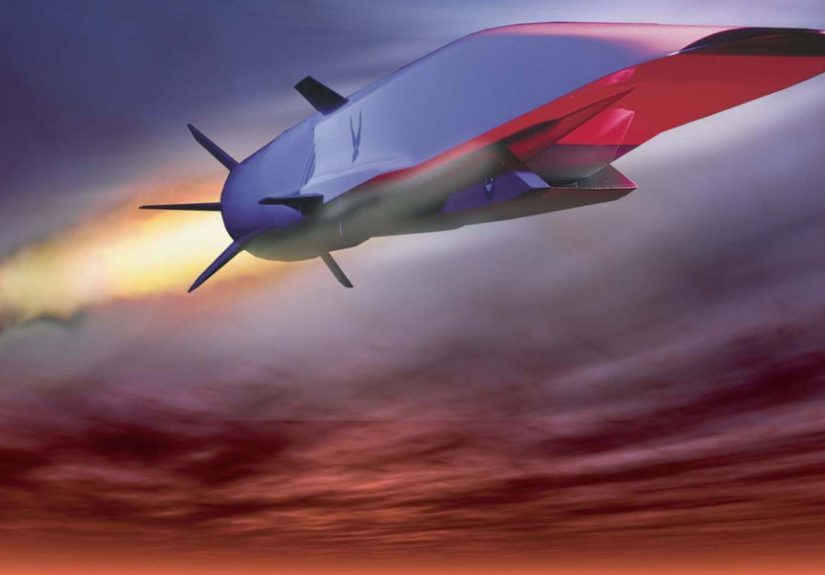
A boost-glide weapon works in two broad stages. First, a rocket booster accelerates the payload to extreme speed. Then the glide body separates and travels unpowered through the atmosphere toward its target. That glide phase can include maneuvering, which complicates tracking and interception. If a ballistic missile is like a long, arcing football pass, a hypersonic glide vehicle is more like a hyperactive frisbee thrown by someone who has studied chaos theory.
For military planners, this matters because modern adversaries are building anti-access and area-denial networks. These include long-range radars, air defenses, missile batteries, sensors, and command centers designed to keep U.S. forces far away from contested regions. A long-range hypersonic weapon could be launched from outside many of those defensive bubbles and still arrive quickly enough to strike a mobile launcher, command node, or other high-value target before it moves or disappears.
The Navy’s Conventional Prompt Strike Program
The Navy’s CPS program is not a science fair experiment with a dramatic smoke trail. It is a major strategic modernization effort involving the Navy Strategic Systems Programs office, the Army Rapid Capabilities and Critical Technologies Office, national laboratories, and defense contractors. The system uses a common missile approach with the Army, which helps reduce duplication and accelerate development across services.
Recent public tests have focused on end-to-end performance: launch, booster operation, glide body behavior, flight data collection, and eventual integration into operational platforms. In December 2024, the Army and Navy completed a successful end-to-end flight test of a conventional hypersonic missile from Cape Canaveral Space Force Station. In May 2025, the Navy announced another important test that demonstrated the cold-gas launch approach planned for future sea-based deployment. This is significant because launching a large hypersonic missile from a ship is not as simple as lighting a rocket and hoping the deck has good insurance.
Why Cold-Gas Launch Matters
The cold-gas launch concept ejects the missile from its launch tube before the first-stage rocket motor ignites. That creates a safer distance between the missile and the ship before the booster lights. For a surface combatant carrying powerful missiles, this is a serious engineering requirement. It helps protect the vessel, crew, launch system, and surrounding equipment from heat, blast, and pressure effects.
The Navy’s successful demonstration of this method was a major step toward sea-based fielding. It showed that CPS is not merely a missile problem; it is a full platform-integration problem. The weapon must work with ship structures, launch tubes, fire control systems, safety procedures, crew training, logistics, maintenance, and operational doctrine. In other words, the missile has to fit into the Navy’s real world, not just into a PowerPoint slide with lightning bolts.
Why the Zumwalt-Class Destroyers Are First in Line
The first expected Navy surface platform for CPS is the Zumwalt-class destroyer. These ships were originally built around stealth features, advanced sensors, and large 155mm gun systems. But the gun ammunition became famously expensive, turning the ship’s original land-attack concept into a budgetary headache with a hull number. The Navy has since moved to repurpose the class as long-range strike platforms.
USS Zumwalt has undergone work to install large missile tubes for the Conventional Prompt Strike weapon. Public reporting has described the installation of four large tubes, each expected to carry multiple CPS rounds, potentially giving the ship a powerful long-range strike loadout. The result is a major identity shift: from futuristic gun destroyer to hypersonic strike vessel.
This refit is more than a hardware swap. It represents a broader Navy lesson: modern warships must adapt to changing technology and threats. A ship designed for one mission can become more valuable when reconfigured for another. For the Zumwalt class, CPS may turn an often-debated shipbuilding program into a strategically useful launch platform in the Indo-Pacific and beyond.
Submarines Could Take the Capability Even Further
While Zumwalt-class destroyers are the near-term sea-based focus, the Navy also plans to integrate hypersonic weapons into Virginia-class attack submarines equipped with the Virginia Payload Module. Submarines bring a different kind of advantage: stealth. A surface ship can be tracked, shadowed, photographed, and politely menaced by foreign aircraft. A submarine, ideally, is the guest nobody knows has entered the room.
A submarine-launched hypersonic weapon could give commanders a survivable, forward-positioned conventional strike option. That matters in a crisis where access to regional bases may be limited or politically sensitive. A Virginia-class submarine carrying CPS could operate closer to contested areas while remaining difficult to detect, potentially reducing flight time and increasing uncertainty for an adversary.
However, underwater launch is technically demanding. The Navy must prove not only that the missile flies, but that it can be safely launched from a submarine environment. That requires specialized test infrastructure, careful engineering, and extensive validation. Hypersonic weapons may be fast, but the acquisition process still wears sensible shoes.
Why “Anywhere in an Hour” Is Both Powerful and Complicated
The “anywhere on Earth in an hour” idea is useful as a headline because it captures the ambition of prompt global strike. But it should be understood carefully. Range, basing, trajectory, target location, command approval, intelligence quality, and political risk all shape whether such a rapid strike is realistic in any given scenario.
A hypersonic missile is not magic. It needs accurate targeting data. It needs permission to launch. It needs a platform in the right location. It needs to avoid escalation risks, especially because long-range fast weapons can look alarming on early-warning systems. The faster a weapon moves, the less time everyone else has to interpret what is happening. That is useful in combat and nerve-racking in diplomacy.
The United States emphasizes that CPS is conventional, meaning nonnuclear. That distinction is central to the program’s purpose. It is designed to give leaders an option below the nuclear threshold for urgent threats. Still, strategic stability concerns remain. If another country sees a high-speed launch, can it quickly determine whether the weapon is conventional or nuclear? Can crisis communication keep pace with Mach 5-plus flight? These are not academic questions; they are the grown-up homework behind the shiny missile photo.
The Strategic Value: Speed, Survivability, and Deterrence
The Navy’s interest in hypersonic weapons is tied to deterrence. A credible CPS capability could signal to adversaries that high-value assets are not safe simply because they sit behind dense air defenses or far inland. Mobile missile launchers, command-and-control nodes, air-defense hubs, and other time-sensitive targets could become more vulnerable.
This does not mean hypersonic weapons replace aircraft carriers, submarines, Tomahawk missiles, bombers, or cyber tools. They would add another arrow to the quiver. The most realistic role is niche but important: rapid conventional strikes against heavily defended targets where minutes matter. If a target is not urgent, a cheaper cruise missile may do the job. If a target is urgent but not well defended, other ballistic or air-launched options may be enough. Hypersonics make the most sense when speed, range, maneuverability, and survivability all matter at the same time.
The Cost and Engineering Challenges
Hypersonic weapons are expensive because they live in a brutal physical environment. At extreme speeds, air does not behave like the friendly breeze that ruins your picnic. It compresses, heats, and punishes the vehicle. Materials may face thousands of degrees of thermal stress. Electronics must survive vibration, acceleration, and heat. Guidance systems must remain precise while the vehicle is traveling at astonishing speed.
Testing is also difficult. The United States needs specialized wind tunnels, flight ranges, telemetry systems, sensors, modeling tools, and manufacturing capacity. A failed test can be valuable if it produces data, but it still delays schedules and tests congressional patience. The Government Accountability Office has warned that hypersonic programs face cost, schedule, test, and digital-engineering challenges. Translation: building a missile that screams through the atmosphere while steering accurately is hard. Who knew?
The Congressional Budget Office has also noted that hypersonic weapons may cost significantly more than ballistic alternatives with similar range and accuracy. That does not make them useless. It means the Pentagon must be disciplined about where they are most valuable. Hypersonic missiles should not become golden hammers looking for very expensive nails.
How the Navy’s Tests Fit Into Global Competition
The U.S. Navy is not developing hypersonic weapons in a vacuum. China and Russia have both invested heavily in hypersonic systems. Russia has publicized weapons such as Avangard, Kinzhal, and Zircon. China has demonstrated advanced missile and glide-vehicle capabilities and continues building long-range strike systems designed to threaten U.S. bases and ships in the Indo-Pacific.
For the United States, the competition is not only about having a fast weapon. It is about maintaining operational flexibility. U.S. forces often rely on the ability to move through oceans, use airbases, protect allies, and respond quickly to crises. If adversaries can threaten bases, ports, carriers, and command centers, the United States needs ways to hold their critical assets at risk in return. CPS is one answer to that problem.
At the same time, hypersonic defense is becoming its own race. Tracking and intercepting maneuvering glide vehicles requires better sensors, space-based tracking, advanced radars, and new interceptors. The missile-defense side of the equation may prove just as important as the offensive side. If hypersonic weapons are the sword, hypersonic defense is the shieldand both are still being forged.
What Happens Next?
The next phase for Navy hypersonics is likely to involve continued flight tests, Zumwalt-class integration work, refinement of launch systems, and preparation for eventual operational deployment. The Navy must prove reliability, safety, and military usefulness. It must also build enough missiles, train crews, integrate command systems, and develop doctrine for when and how such weapons should be used.
Fleet-wide expansion remains an open question. CPS requires large launch tubes, which means it cannot simply be dropped into every existing destroyer’s standard vertical launch system. Future large surface combatants could be designed with hypersonic capacity from the beginning. Virginia-class submarines with payload modules may also become key carriers. Over time, the Navy may explore smaller or different hypersonic weapons that fit more common launch cells, but CPS itself is a big-missile solution for big-missile problems.
Experience and Perspective: What Watching Navy Hypersonics Teaches Us
Following the Navy’s hypersonic testing story feels a bit like watching a high-stakes engineering marathon disguised as a sprint. The public sees the dramatic moment: a missile launches, a plume rises, officials announce success, and headlines talk about hitting targets around the world in an hour. But behind that brief spectacle are years of design reviews, canceled assumptions, budget debates, failed components, reworked schedules, and people in windowless rooms arguing about thermal protection margins.
One practical lesson is that advanced military technology rarely moves in a straight line. Programs like CPS are built through iteration. A successful end-to-end test does not instantly create an operational weapon. A delay does not automatically mean failure. Defense development is full of unglamorous steps: proving a launch tube, validating a booster, collecting telemetry, testing software, transporting hardware, training crews, and making sure a sailor can maintain the system at sea without a team of PhDs hovering nearby with clipboards.
Another experience-related takeaway is that context matters more than hype. Hypersonic weapons sound unstoppable when described in isolation. Yet every weapon exists inside a system of intelligence, surveillance, command authority, logistics, targeting, politics, and countermeasures. A missile that can fly incredibly fast still depends on knowing where the target is. If the target moves, hides, decoys, or jams sensors, speed alone does not solve the problem. In modern warfare, the kill chain is often as important as the missile itself.
There is also a human dimension. Sailors aboard a future CPS-equipped ship would not experience hypersonic warfare as a sci-fi montage. They would experience it through checklists, alarms, secure communications, maintenance cycles, watch rotations, and the enormous responsibility of operating a strategic conventional weapon. A system that can affect global security in minutes demands a culture of precision. The technology may be futuristic, but the professionalism required is old-fashioned: training, discipline, accountability, and calm under pressure.
From a policy perspective, the Navy’s tests also remind us that speed can compress decision-making. A weapon that reaches a target quickly gives leaders options, but it also reduces time for reconsideration. That makes clear doctrine, reliable intelligence, and strong civilian control essential. The point of a conventional prompt strike weapon is not to make conflict more casual. It is to deter conflict by convincing adversaries that certain aggressive moves could be answered quickly and precisely.
Finally, the Navy hypersonic story shows why defense innovation is never just about a single breakthrough. The missile matters, but so do shipyards, supply chains, test ranges, congressional funding, software, sensors, and allies. A hypersonic weapon is not one invention; it is an ecosystem. If that ecosystem works, the Navy gains a new form of reach. If it does not, the result is an expensive museum of impressive parts. The coming years will determine whether CPS becomes a real operational capability or remains one of those defense programs that looked fantastic in artist renderings but had trouble escaping the gravity well of acquisition reality.
Conclusion
The Navy’s hypersonic weapons testing marks a major step in the evolution of U.S. conventional strike power. Conventional Prompt Strike is designed to give the United States a fast, long-range, nonnuclear option against urgent and heavily defended threats. Its promise is dramatic: sea-based weapons that can travel at hypersonic speed and potentially reach critical targets across vast distances in minutes rather than hours.
But the reality is more complex than the headline. CPS must overcome serious engineering, cost, testing, integration, and strategic-stability challenges. The Zumwalt-class destroyers are the first major sea-based path, with Virginia-class submarines expected to follow. If the Navy can make the system reliable, affordable enough, and operationally useful, hypersonic weapons could become a defining feature of future maritime deterrence. If not, they will still teach valuable lessons about speed, technology, and the limits of even the most dazzling military hardware.
Note: This article is written for public informational and SEO publishing purposes. It discusses publicly reported defense technology at a high level and does not provide operational instructions, classified details, or technical guidance for weapon construction.