Table of Contents >> Show >> Hide
- What Makes a Shirvan Rug Different?
- Why the Mid-19th Century Matters
- Design Language: Geometry With a Pulse
- Materials, Dyes, and Weaving Quality
- How to Read Condition Like a Collector
- Decorating With a Mid-19th-Century Shirvan Rug
- Care and Preservation
- The Experience of Living With a Mid-19th-Century Shirvan Antique Rug
- Conclusion
A mid-19th-century Shirvan antique rug is the kind of object that makes a room look smarter without saying a word. It does not need neon colors, oversized branding, or a dramatic speech about “timeless luxury.” It just shows up with razor-sharp geometry, wonderfully saturated color, and the quiet confidence of something that has already survived more history than your entire furniture set combined.
Woven in the historic Shirvan region of the southern Caucasus, these rugs are celebrated for crisp drawing, fine knotting, and a visual language built from medallions, hooks, stars, rosettes, and borders that feel both disciplined and delightfully alive. A great Shirvan does not look messy or timid. It looks intentional. Even when the pattern is packed with detail, the composition stays readable from across the room and rewarding up close. That balance is a big reason collectors, designers, and museum curators keep circling back to Shirvan weavings like moths to a very stylish, very old flame.
If you are shopping for one, decorating with one, or just trying to understand why antique rug people suddenly become poets when the word “Shirvan” appears, this guide will walk you through what makes a mid-19th-century example so special. We will look at design, materials, age, condition, collecting value, styling ideas, and the lived experience of owning a piece that is equal parts floor covering and cultural artifact.
What Makes a Shirvan Rug Different?
Shirvan rugs belong to the broader family of Caucasian rugs, and within that family they are often considered among the most refined. That reputation comes from several traits working together at once: fine weaving, strong geometry, clear borders, rich color, and a sense of order that never slips into boredom. These are not rugs that wander around looking for a design identity. They know exactly who they are.
Many antique Shirvan pieces appear in runner or prayer-rug formats, though room-size examples also exist. Their proportions often feel elegant rather than bulky, which is one reason they work so well in modern interiors. A Shirvan can energize a hallway, sharpen a study, or give a neutral bedroom enough personality to stop it from looking like a furniture catalog forgot to smile.
Another hallmark is clarity. The lines are usually crisp. The motifs are legible. The negative space does real work. Even when the field contains repeating elements, the composition tends to feel architectural rather than crowded. That is part of the magic: a Shirvan rug can be highly decorative while still feeling disciplined.
Why the Mid-19th Century Matters
The phrase mid-19th-century Shirvan antique rug matters because it places the piece in a sweet spot collectors love. Rugs from this period are old enough to preserve early, highly individual weaving traditions, but often still coherent enough in color and structure to function beautifully in present-day rooms. In plain English: old, yes; exhausted, not necessarily.
Mid-19th-century examples also tend to sit before the later shift toward more commercialized production. In the antique rug world, that distinction matters. Earlier Caucasian rugs are often associated with hand-spun wool, natural dyes, and stronger artistic individuality. Later production can still be attractive, but the mid-19th century often carries more spontaneity, more expressive drawing, and more of that coveted “this could not have been mass-produced by a committee” energy.
Age alone, of course, does not guarantee greatness. A mediocre old rug is still a mediocre rug that simply had a very long time to think about it. What collectors really want is the combination of age, quality, drawing, color, and condition. Mid-19th-century Shirvan rugs often hit that combination in a way that feels especially compelling.
Design Language: Geometry With a Pulse
Medallions That Organize the Entire Composition
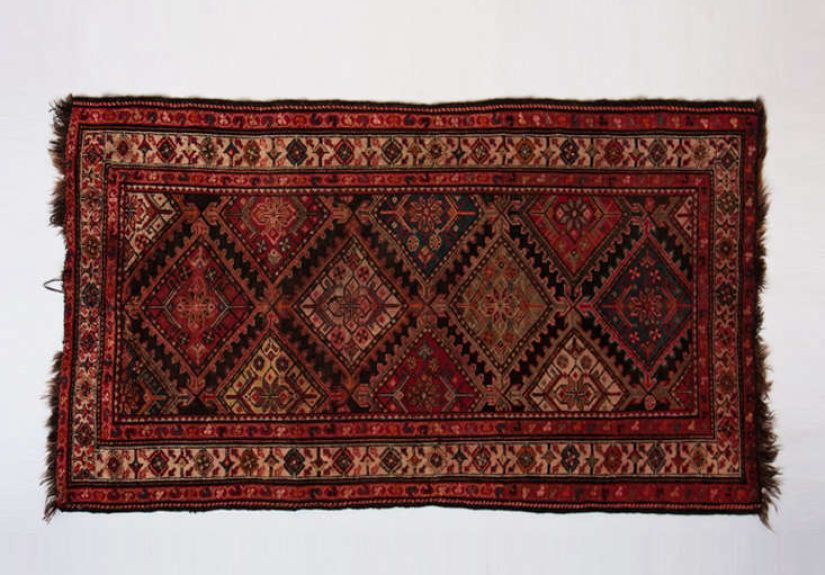
Many Shirvan rugs feature striking central medallions or repeating diamond forms that establish rhythm across the field. Some examples use stepped medallions with rosette-like centers. Others feature Lesghi-style star medallions or hooked diamond arrangements that create movement without turning the surface into chaos. The effect is graphic, balanced, and surprisingly modern.
This is one reason designers love antique Shirvans in contemporary homes. Their geometry reads almost like abstract art. Put one under a clean-lined sofa or beside a minimalist wood table and suddenly the room has tension, contrast, and actual character. The rug becomes the sentence with punctuation, not just the background mumble.
Prayer Rug Variants Add Architectural Drama
Prayer-rug layouts are another important Shirvan category. These often include a mihrab-like niche, creating a directional composition with a clear top and bottom. In antique examples, the niche may be outlined with hooks, comb forms, latch-hook motifs, floral devices, or symbolic elements arranged with astonishing control. Even people who know nothing about rugs tend to recognize that something visually serious is happening there.
A prayer-format Shirvan is especially effective when displayed in a smaller room, entry, alcove, or as a carefully mounted wall piece in low light. It carries a ceremonial quality without becoming heavy-handed. The composition feels focused, almost architectural, as though the rug is framing its own internal doorway.
Borders That Refuse to Be Boring
Shirvan borders are often where the fun really starts. You may see hooked vines, rosettes, stylized blossoms, kufic-inspired forms, or so-called Marsali-type border arrangements. In high-quality examples, the border is not an afterthought. It is a structural partner to the field, containing the energy while adding its own rhythm.
The best borders do what excellent picture frames do: they intensify the art inside them. A broad ivory border can make a dark indigo field feel brighter. A narrow chain of small motifs can keep a bold central design from feeling too heavy. It is a master class in visual control, woven in wool instead of taught in a design seminar.
Materials, Dyes, and Weaving Quality
Mid-19th-century Shirvan rugs are typically wool rugs, and that matters more than it sounds. Good wool gives the surface resilience, sheen, and warmth. In earlier Caucasian pieces, hand-spun wool is especially prized because it tends to create a subtle, lively texture rather than a flat, machine-regular finish. That tactile richness is part of the reason antique rugs feel so different from decorative reproductions.
Natural dyes are another major part of the appeal. Blues, reds, camel tones, ivory, soft greens, and earthy accents often mellow beautifully with age, developing the kind of patina people spend absurd amounts of money trying to fake in new products. A well-aged Shirvan does not look faded in the sad sense. It looks edited by time.
Construction quality also deserves attention. Shirvan rugs are known for fine knotting and durable structure, and many museum and trade references describe examples with symmetrically knotted pile. That technical discipline supports the crisp design language the group is famous for. When collectors say a Shirvan has “good drawing,” they are responding not just to pattern, but to the technical precision that allows pattern to stay sharp.
Some later Caucasian rugs shifted toward cotton foundations and synthetic dyes, but mid-19th-century pieces are valued precisely because they often preserve the earlier look and material character: hand-spun fibers, richer color behavior, and stronger visual individuality.
How to Read Condition Like a Collector
Condition is where romance meets reality. Antique rugs are old textiles, not superheroes. Even a beautiful mid-19th-century Shirvan may show wear, lower pile, edge restoration, selvage work, minor repairs, or color variation from age and use. That is normal. The goal is not fantasy perfection. The goal is honest condition that still preserves the rug’s beauty, structure, and character.
Here are the first things worth checking:
- Field clarity: Are the main motifs still readable, or has wear blurred the design into a polite confusion?
- Pile and foundation: Is there enough pile left to enjoy the color and pattern, and is the structure stable?
- Edges and ends: Shiraz this is not. If the selvages and ends are weak, problems tend to spread.
- Repairs: Good restoration can be acceptable. Sneaky restoration is the antique-rug equivalent of a suspicious résumé.
Dark brown areas in antique rugs sometimes show more corrosion or wear than other colors, so uneven aging there is not unusual. In prayer-rug formats, the mihrab area should also be examined closely. If the rug has been used, folded, or displayed for a long time, stress often shows up in those visually important zones first.
A well-bought Shirvan does not need to be flawless. It needs to be authentic, structurally sound, and visually rewarding. Small signs of age can even enhance the charm. The secret is learning the difference between graceful aging and a rug that is quietly asking for a rescue mission.
Decorating With a Mid-19th-Century Shirvan Rug
One of the best things about a mid-19th-century Shirvan antique rug is how easily it bridges styles. In a traditional room, it adds depth and pedigree. In a modern room, it supplies contrast and texture. In an eclectic room, it looks as though it was invited first and everybody else had to dress around it.
Because many Shirvan rugs have strong geometry and relatively manageable scale, they work especially well in entries, studies, libraries, bedrooms, and hallways. A narrower piece can pull a long corridor together. A compact prayer-format rug can bring shape to a reading corner. A medallion design under a simple table can do more for a room than three decorative pillows and a motivational candle ever could.
The key is restraint. Let the rug speak. If the field is rich in indigo, ivory, brick red, and camel, repeat one or two of those tones elsewhere in the room and stop there. A great antique Shirvan does not want decorating competition. It wants thoughtful supporting actors.
Care and Preservation
If you own a mid-19th-century Shirvan rug, basic stewardship matters. Use a pad underneath. Vacuum with suction only, not a beater bar. Rotate the rug periodically so wear and fading do not concentrate in one zone. If something spills, blot rather than rub, and resist the heroic urge to invent chemistry under pressure.
For major cleaning, antique rugs deserve professional handling. Steam cleaning is a bad idea. A knowledgeable cleaner should hand-wash the rug with an appropriate detergent and test for colorfastness first, especially with older dyes. This is not the moment for bargain shortcuts. Saving fifty dollars while risking a century and a half of history is not a clever life hack.
Storage is equally important. Antique textiles are best stored flat when possible, with minimal abrasion and pressure. If folding is unavoidable, the folds should be padded to avoid sharp creases. Avoid airtight plastic contact, trapped moisture, and spaces with poor airflow. And yes, light matters. Prolonged light exposure can damage textile dyes, and that damage is not something your rug simply “walks off.”
The Experience of Living With a Mid-19th-Century Shirvan Antique Rug
Living with a mid-19th-century Shirvan antique rug is different from living with an ordinary decorative rug, and the difference shows up in surprisingly everyday moments. At first, you notice the pattern. Then you notice the color. Then, somewhere around the third or fourth week, you realize the rug has changed the way the room feels. It has more gravity. More warmth. More point of view. It is no longer just something underfoot. It becomes part of the room’s emotional weather.
Morning light is often the first daily revelation. A Shirvan that looked cool and controlled the night before can suddenly glow with deep blue, ember red, soft ivory, and earthy camel notes that seem to wake up in layers. The colors do not scream. They shimmer. A good antique rug rewards slowness, which is a rare quality in modern interiors. Most things in a room reveal themselves immediately. A Shirvan makes you earn it a little, and that is part of the pleasure.
Then there is the texture. Even when the pile is reduced by age, an old Shirvan usually feels more nuanced than a new mass-market rug. The wool has life in it. The surface may not be perfectly even, and that is exactly why it feels human. You sense the hand of the weaver, the tension of the loom, the tiny irregularities that prove the piece was made rather than manufactured into numb perfection. In an era obsessed with “flawless” finishes, that kind of authenticity is weirdly relaxing.
There is also a psychological side to owning one. A mid-19th-century rug carries visible time. You know, every time you pass it, that this object existed before your house, your neighborhood, your favorite coffee order, and probably the invention of several things you now treat as essential to survival. That perspective can be grounding. It gives the room a sense of continuity. Not in a museum-ish, do-not-breathe-near-it way, but in a lived, daily way.
Guests respond to that presence too. Even people who cannot identify a Shirvan rug from across the room usually react to it. They ask what it is. They crouch down to look at the motifs. They notice that the design feels both old and unexpectedly current. That is one of the great joys of this kind of textile: it creates conversation without performing for attention. It has charisma, but not the exhausting kind.
There is, of course, responsibility attached. You become more aware of sunlight, shoes, chair legs, accidental spills, and the alarming confidence of houseplants sitting in damp pots. You stop treating the floor as a lawless zone. Oddly enough, this does not make the rug stressful to own. It makes the room feel more intentional. You care for the object, and in return it teaches you to care about the space around it.
Over time, the rug starts to anchor routines. You read on the chair beside it. You cross it every morning. You see it when you come home tired. The design becomes familiar, but it does not become invisible. That is rare. Most household objects eventually disappear into background utility. A strong Shirvan keeps its visual charge. Months later, you still catch a border detail or a small hooked motif and think, “How did I miss that before?”
That ongoing discovery is probably the best argument for owning a mid-19th-century Shirvan antique rug. It is beautiful, yes. It is collectible, yes. It may even be a smart design investment. But beyond all of that, it makes daily life more visually interesting. It turns an ordinary room into a room with memory, structure, and soul. And for a piece of woven wool made more than a century and a half ago, that is a pretty impressive career arc.
Conclusion
A mid-19th-century Shirvan antique rug earns its reputation through more than age. It combines fine weaving, expressive geometry, rich natural color, and a remarkable ability to feel both historical and fresh. The best examples have crisp drawing, confident proportions, and the sort of lived patina that cannot be manufactured on demand. Whether you approach it as a collector, a designer, or simply someone who wants a home with more intelligence and less blandness, a good Shirvan offers something rare: beauty with backbone.
Choose one for honesty of condition, strength of design, and quality of color. Care for it like the textile history it is. Then let it do what great antique rugs do best: transform a room without ever looking like it is trying too hard.