Table of Contents >> Show >> Hide
- The Night Notre-Dame Burnedand Why the Inside Became a No-Go Zone
- So…What Exactly Was “Colossus”?
- What Colossus Did Inside Notre-Dame
- The Team Behind the Machine: Firefighters and Engineers, Not Sci-Fi Wizards
- Robots and Drones: The Notre-Dame Response Was a Technology Team-Up
- What Colossus Could Doand What It Couldn’t
- Why This Matters Beyond Paris: The Case for Firefighting Robots in the Real World
- The Design Lessons Notre-Dame Taught the World
- Where Firefighting Robots Go From Here
- Experience: What It Feels Like to Watch a Robot Firefighter Earn Its Keep
- Conclusion
- SEO Tags
When Notre-Dame de Paris caught fire on April 15, 2019, the world watched in a shared, horrified silencelike someone had hit “mute” on humanity.
Flames tore through the cathedral’s attic and roof structure, the spire collapsed, and even seasoned firefighters faced a brutal truth: some parts of that
inferno were simply too dangerous for human bodies to occupy.
That’s when an unlikely “first responder” rolled into the story: a squat, tank-like robot called Colossus. It didn’t deliver a stirring speech.
It didn’t dramatically rip off a helmet to reveal it was actually three brave raccoons in a trench coat. It did something more useful: it went where people
couldn’t, pushed cooling water where it mattered, and helped firefighters keep fighting without sacrificing lives.
This is the story of the robot firefighter that battled the Notre-Dame blazewhat it was, what it did, and why it matters far beyond a single night in Paris.
The Night Notre-Dame Burnedand Why the Inside Became a No-Go Zone
Notre-Dame wasn’t just “a building on fire.” It was a historic structure with a massive interior volume, high vaulted ceilings, and a roof system packed with
old timberoften described as dense, dry, and extremely flammable once the fire took hold. Fighting a fire like that is part engineering problem, part chess match,
and part “try not to get crushed by the thing you’re trying to save.”
Fire commanders had to make rapid decisions with limited visibility. Smoke, falling debris, and the risk of structural collapse can turn interior firefighting into
a deadly gamble. At points during the Notre-Dame response, conditions became so hazardous that firefighters pulled back from certain interior areasespecially when
the roof above was actively burning and shedding material into the nave below.
That retreat wasn’t surrender. It was strategy: preserve personnel, regroup, and keep attacking the fire in ways that reduce risk while still protecting the
building’s most critical elements.
So…What Exactly Was “Colossus”?
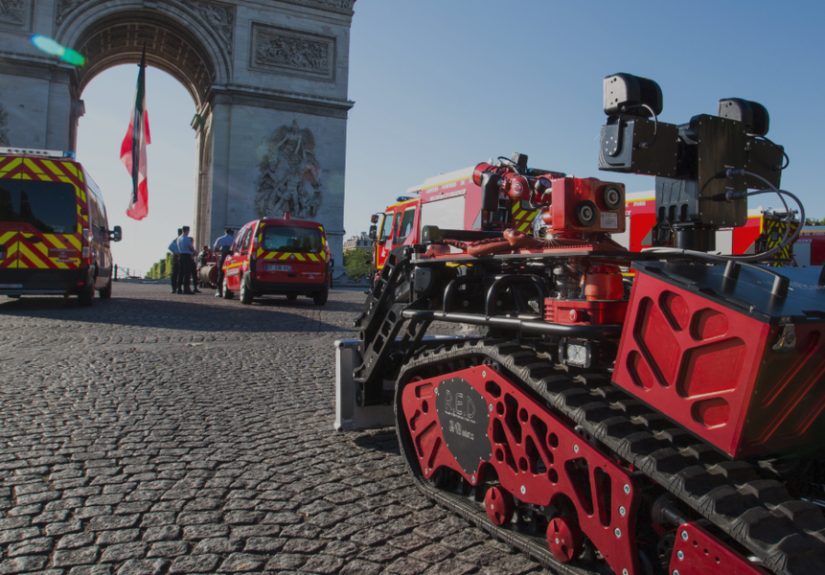
Colossus is a heavy-duty, remote-controlled firefighting robot built for high-risk environments. Think of it as a rugged, tracked platform
that can haul gear, carry a hose line, and act as a mobile water cannonall while sending back video and thermal information to its operators.
The robot was designed specifically to help firefighters operate in places that are too hot, unstable, smoky, or otherwise dangerous for humans. The “secret sauce”
isn’t that it’s flashy. It’s that it’s practical: tracks for traction, modular payloads, cameras for situational awareness, and enough durability to withstand
punishing conditions.
Key features that made it more than a cool gadget
Tracked mobility: Colossus moves on caterpillar-style treads, which helps it climb over debris and maintain traction on slick or uneven surfaces.
That matters when the floor is wet, visibility is low, and the environment is actively trying to turn your equipment into modern art.
High-flow firefighting capability: Colossus can deliver a substantial stream of water (or firefighting agent, depending on configuration) to cool
hot zones and suppress flames. In a structure fire that’s radiating intense heat, cooling isn’t just “helpful”it’s the difference between firefighters re-entering
a space and staying out because the temperature is too extreme.
Remote operation: Operators can control the robot from a safer position. This isn’t about replacing firefighters; it’s about giving them a tool
that extends reach and buys time.
Cameras and sensors: Video feeds and thermal imaging help firefighters make decisions when smoke and darkness make human vision unreliable. A robot
that can “see” (and share what it sees) becomes a rolling scout, not just a rolling hose mount.
What Colossus Did Inside Notre-Dame
During the Notre-Dame fire, Colossus was deployed to operate in areas deemed too dangerous for human firefightersparticularly in the cathedral’s interior where
falling debris and extreme heat threatened crews.
Its job was not glamorous in the Hollywood sense. It didn’t “fight the fire” alone like an action hero with a soundtrack. It did the kind of work that wins
real incidents: it helped deliver water into critical interior spaces, cooled hot zones, and reduced the overall temperature so humans could continue operating
more safely.
Cooling the nave: the underrated superpower
One of the most important reported contributions was cooling the navethe large central interior space. Lowering temperature inside a structure
can slow fire spread, reduce the chance of heat-driven structural failure, and protect vulnerable interior elements. It also helps prevent a “domino effect,” where
heat intensifies, materials fail, and suddenly you’re not just putting out a fireyou’re managing a collapse.
In practical terms, Colossus helped deliver a sustained stream of water where firefighters couldn’t safely stand for long. That allowed responders to keep pushing
back against the fire while limiting direct exposure of crews to extreme conditions.
Staying power when humans had to step back
Fires in large, historic buildings can require long-duration suppression. A robot that can remain in a dangerous zonecontinuing to apply water and providing
ongoing situational awarenesscan function like a stubborn teammate who never needs an air bottle change. (Also, it doesn’t complain about overtime.)
Reports about the Notre-Dame response describe Colossus operating for hours during the effort, supporting firefighters during critical phases of the battle.
The robot’s value wasn’t just that it workedit’s that it worked when conditions were at their worst.
The Team Behind the Machine: Firefighters and Engineers, Not Sci-Fi Wizards
Colossus didn’t show up because someone said, “You know what this 850-year-old cathedral needs? More robotics.” It showed up because firefighting robots have been
evolving for years as a response to the same old problem: some environments are too dangerous for people, but the mission still has to continue.
The most successful emergency robots are built with direct input from responders. Firefighters don’t need a robot that can do parkour. They need a robot that:
(1) turns on reliably, (2) moves where it needs to move, (3) does a specific job well, and (4) doesn’t create a brand-new problem that has to be rescued by humans.
In the case of Colossus, the robot’s real-world design prioritiesdurability, modularity, remote control, heavy payload capacityreflect the needs of emergency
operations rather than consumer tech aesthetics.
Robots and Drones: The Notre-Dame Response Was a Technology Team-Up
Colossus gets the headlines because it’s a photogenic little tank-bot, but it wasn’t the only technology that mattered. During the response, aerial tools like drones
were also used to provide visual and thermal perspectives. That kind of overhead intelligence can help incident commanders understand fire spread and hotspots without
putting more people in harm’s way.
Think of it like this: drones can help answer, “Where is the fire going?” and robots can help answer, “How do we safely push back from the inside?”
Together, they give commanders more options, better information, and safer tactics.
What Colossus Could Doand What It Couldn’t
It’s tempting to frame Colossus as “the robot that saved Notre-Dame.” The reality is more accurateand honestly more impressive: it was a tool that helped human
firefighters do their jobs more safely and effectively under extreme conditions.
Strengths
Risk reduction: Colossus can operate in zones where heat, smoke, or collapse risk is unacceptably high for humans.
Endurance: It can keep working while crews rotate, rehab, and reposition.
Heavy handling: It can haul equipment and support hose operations without exhausting a team of firefighters.
Information: Cameras and thermal imaging give commanders additional eyes where they need them most.
Limits
Robots still have mobility constraints: stairs, tight corners, rubble piles, and fragile historical interiors can limit where a tracked robot can go.
Communication challenges: thick stone, smoke, and complex layouts can interfere with signals and visibility.
Not a replacement for skilled crews: Fireground decisionsventilation strategy, water supply management, salvage prioritiesstill require experienced humans.
In other words: robots can extend human capability, but they don’t replace human judgment. (Also, a robot has never once calmed down a panicked crowd with a steady voice
and a reassuring presence. It mostly just beeps and exists.)
Why This Matters Beyond Paris: The Case for Firefighting Robots in the Real World
The Notre-Dame fire became a global demonstration of what emergency robots can do in extreme conditions. But the need isn’t limited to historic cathedrals.
Many environments pose similar risks:
- Industrial facilities with hazardous materials and high heat loads
- Tunnels and underground structures with limited ventilation and difficult access
- Warehouses and big-box spaces with large fuel packages and rapid fire spread potential
- Wildland-urban interface incidents where conditions shift quickly and access is dangerous
- Collapse zones where debris and instability make human entry risky
In the United States, fire departments have explored and adopted various forms of roboticsranging from bomb-squad-style platforms adapted for firefighting tasks to
specialized suppression robots. The logic is consistent: keep firefighters out of the worst danger while still applying water, gathering intelligence, and advancing operations.
The Design Lessons Notre-Dame Taught the World
If you want a robot to be useful on a fireground, it can’t be delicate. It can’t be “almost-ready.” It must be built for chaos.
The Notre-Dame response highlights several design and deployment lessons:
1) Make it modular, because every fire is weird
Fires don’t follow scripts. A robot that can switch rolessuppression, reconnaissance, equipment transporthas more chances to be useful across different incidents.
Modularity also makes maintenance and upgrades more practical over time.
2) Make the controls intuitive
During an emergency, nobody wants a 47-step startup sequence. Effective robots are operable under stress, with clear feedback and simple controlsbecause “I’m trying to
stop a roof from collapsing” is not the moment to troubleshoot a complicated user interface.
3) Make it compatible with firefighter reality
Hoses, nozzles, water supplies, incident command structurerobots need to plug into existing practices. The more a robot requires responders to reinvent their workflow,
the less likely it is to be deployed when it matters.
4) Make it resilient enough to be boring
In emergency services, “boring” is the highest compliment. It means the tool works every time. Colossus became noteworthy because it performed reliably in a place that
was absolutely not friendly to electronics, motors, or anything else that prefers to remain un-melted.
Where Firefighting Robots Go From Here
The Notre-Dame blaze didn’t magically turn every fire department into a robotics lab. But it did accelerate public awareness of a trend already underway:
robots are becoming a practical part of emergency response.
As technology improvesbetter batteries, stronger communications, smarter sensorsrobots will likely become more common on complex incidents. Expect the biggest growth
in missions where human entry is clearly high-risk: hazmat environments, extreme-heat interior operations, and reconnaissance in unstable structures.
The most realistic future isn’t “robot firefighters replace firefighters.” It’s “robot firefighters give firefighters a safer way to do the most dangerous tasks.”
In that role, they don’t need to be heroes. They just need to be dependable.
Experience: What It Feels Like to Watch a Robot Firefighter Earn Its Keep
Even if you’ve never been anywhere near a major fire, you probably know the feeling of watching something historic or beloved in dangeryour stomach drops, your brain
starts doing that anxious math, and suddenly you’re invested in the outcome like you have a personal stake in the laws of physics.
Now imagine you’re standing at the edge of a controlled perimeter. You can’t see everything, but you can see enough: flashing lights, heavy hoses, firefighters moving
with urgent purpose, and a building that looks like it’s fighting back with heat and smoke. The air has that sharp, mineral smell that lingers after water hits hot
surfaces. Radios crackle. People point. Nobody jokes the way they do when the situation is routinebecause it isn’t routine.
Then the robot arrives.
It’s not dramatic in the cinematic way. It doesn’t sprint. It doesn’t leap into action. It just rolls in on treads with the calm confidence of a device that was built
for one job: go forward when humans can’t.
The first surprising thing, if you’ve never seen a response robot up close, is how much it changes the emotional temperature of the scene. People visibly react to it.
Some are curiouslike, “What is that?” Others look relieved, because the message is clear even without explanation: We’re not sending another person into that zone
right now. The robot becomes a symbol of restraint and strategy, not just tech.
The second surprising thing is how “team-like” it feels. A robot is a machine, yes, but its presence creates a new rhythm for the crew. Operators and commanders treat it
like a working partner: reposition it, adjust the stream, confirm what its cameras show, and coordinate its movements with hose teams and interior/exterior tactics.
It’s less like watching a gadget and more like watching a specialized tool become part of an orchestraone that’s trying to keep a structure standing.
If you’re a firefighter, the experience is probably even more specific. You know what it costs to advance a hose line into brutal heat. You know the weight of gear,
the strain of hauling equipment, and the mental load of making decisions when visibility is poor and time is tight. A robot that can take on a portion of that risk
doesn’t just save energyit can change the calculation of what’s possible. It can buy minutes. It can cool a space enough to make it survivable. It can provide a view
that turns a guess into an informed decision.
And if you’re just a bystanderone of the millions who watched Notre-Dame burn from afarthe experience is something else: it’s a tiny burst of optimism in a grim moment.
The robot doesn’t erase the loss. It doesn’t rebuild what’s already burning. But it represents a very human idea: when the problem is bigger than us, we build tools that
help us keep going anyway.
That’s the real takeaway from Colossus at Notre-Dame. Not that a robot “saved the day” on its own, but that technologywhen it’s built around real needscan help people
protect what matters without paying the highest price.
Conclusion
Colossus didn’t become famous because it looked cool (though, yes, it absolutely looks like it could star in a Pixar spin-off called Hose & Order).
It became famous because it proved something under the harshest spotlight: robotics can reduce risk, extend capability, and support firefighters in environments where
seconds and safety margins disappear fast.
The Notre-Dame fire was a tragedybut it also became a case study in modern emergency response. Human courage and expertise led the effort. Technology like Colossus
helped make that courage sustainable.