Table of Contents >> Show >> Hide
- Why Japanese Chef’s Knives Became World Famous
- The Great Knife-Making Regions of Japan
- From Steel Bar to Chef’s Knife: The Forging Process
- Popular Japanese Knife Types and What They Do Best
- Why Steel Matters So Much
- How Japanese Knives Differ From Western Chef’s Knives
- Care Tips for a Forged Japanese Chef’s Knife
- Why Chefs Love Them
- Experience Section: From the Forge to the Cutting Board
- Conclusion
- SEO Tags
Some kitchen tools whisper. Japanese chef’s knives do not. They glide through a tomato so cleanly the tomato seems mildly embarrassed. They turn a pile of onions into neat little cubes without the usual emotional support tissues. They make chefs speak in reverent tones usually reserved for vintage wine, championship barbecue smokers, and grandmothers who never measure anything but somehow cook perfectly.
But the real story of a Japanese chef’s knife begins long before it lands on a magnetic knife strip or flashes across a cooking video. It begins in places like Sakai, Seki, Sanjo, and Echizen, where fire, steel, water, stone, patience, and generations of hand skill come together. These regions did not simply wake up one morning and decide to become famous for knives. Their reputations were forged, quite literally, over centuries.
Today, Japanese chef’s knives are prized by professional cooks and serious home chefs for their thin geometry, hard steels, precise edges, and almost poetic balance. A great gyuto, santoku, yanagiba, deba, or nakiri is not just sharp; it feels intentional. Every line of the blade tells you something about how it was made and what it wants to do. And yes, what it wants to do is probably slice scallions thinner than your patience on a Monday morning.
Why Japanese Chef’s Knives Became World Famous
The global admiration for Japanese chef’s knives is not built on hype alone. It comes from a rare blend of metallurgy, regional specialization, food culture, and hand finishing. Japanese cooking has long valued clean cuts because texture, appearance, and freshness matter deeply. A poorly cut piece of fish is not just unattractive; it can affect mouthfeel, moisture loss, and the eating experience.
That culinary philosophy shaped the tools. Traditional Japanese knives were often designed for specific jobs: the yanagiba for sashimi, the deba for fish butchery, the usuba for vegetables, and the nakiri for straight, efficient vegetable prep. As Japanese food culture expanded and Western ingredients became more common, hybrid knives such as the gyuto and santoku rose in popularity. These all-purpose blades gave cooks Japanese precision with everyday flexibility.
The result is a knife culture where performance and beauty are not enemies. A Japanese blade may show a hammered tsuchime finish, a cloudy kasumi polish, a dark kurouchi forge scale, or layered Damascus-style cladding. These finishes are not just decoration. They reflect construction, finishing methods, food-release goals, and the maker’s identity.
The Great Knife-Making Regions of Japan
Sakai: The Specialist’s City
Sakai, in Osaka Prefecture, is one of Japan’s most respected knife-making centers. Its blade history stretches back hundreds of years, with roots in sword making, tobacco knives, and professional kitchen cutlery. Sakai is especially famous for traditional forged knives used by chefs, particularly single-bevel blades for Japanese cuisine.
What makes Sakai fascinating is its division of labor. In many workshops, one artisan forges the blade, another sharpens and polishes it, and another fits the handle. That may sound like a group project, but unlike the ones from school, everyone here actually does their part. The system allows each craftsperson to become deeply specialized. Forging, grinding, sharpening, polishing, and handle fitting are treated as separate disciplines, each demanding years of practice.
The result is a knife with a sense of refinement that can be hard to explain until you use one. A Sakai yanagiba, for example, may look simple at first glance, but its edge geometry, hollow-ground back, bevel polish, and balance are tuned for long, clean slicing strokes. It is not made to smash through frozen bones. It is made to cut with grace.
Seki: The City of Blades
Seki, in Gifu Prefecture, is another legendary name in Japanese cutlery. Its blade-making history is tied to the age of swordsmiths, when geography helped the craft flourish: access to water, clay, charcoal, and trade routes all mattered. As Japan modernized and sword demand declined, Seki makers adapted their skill to knives, scissors, razors, and other cutting tools.
Modern Seki is home to many globally recognized Japanese knife brands. It is known for combining traditional craft knowledge with advanced production, consistent quality control, and export-ready design. Many popular Japanese-style chef’s knives sold in the United States come from Seki or are inspired by Seki’s approach: sharp, elegant, reliable, and polished enough to make your old drawer knife look like it has given up on life.
Echizen and Takefu: Fire, Hammer, and Endurance
Echizen, in Fukui Prefecture, is famous for forged blades with a history often described in terms of centuries rather than decades. Takefu Knife Village is one of the best-known modern centers of this tradition, bringing together blacksmiths, workshops, a showroom, and educational experiences.
Echizen makers are associated with distinctive forging methods, including techniques that help keep hot metal workable while improving blade consistency. The region’s knives are admired for being thin, light, sharp, and durable. In practical kitchen language, that means less wedging in dense vegetables, cleaner slicing, and fewer moments where you have to wrestle a sweet potato like it owes you money.
From Steel Bar to Chef’s Knife: The Forging Process
A forged Japanese chef’s knife begins with steel selection. Makers may use carbon steels such as White steel or Blue steel, stainless steels such as VG-10 or powdered stainless alloys, or laminated constructions that combine a hard cutting core with softer outer cladding. The choice affects sharpness, edge retention, toughness, corrosion resistance, sharpening feel, and maintenance.
Carbon steel can take an extremely keen edge and is loved by many professionals, but it demands care. Leave it wet or acidic for too long and it may discolor or rust. Stainless steel is easier to live with and more forgiving in a busy home kitchen. Stainless-clad carbon knives try to split the difference: a reactive carbon core for cutting performance, protected by stainless outer layers for easier care.
1. Heating and Forge Welding
In traditional laminated knives, the smith heats iron and steel until they are ready to join. The hard steel becomes the cutting edge, while softer iron or stainless cladding supports it. Under heat and hammer pressure, the metals bond. This step requires precise temperature control. Too cool, and the bond may fail. Too hot, and the steel can suffer. The forge is not a place for casual vibes.
2. Hammering and Shaping
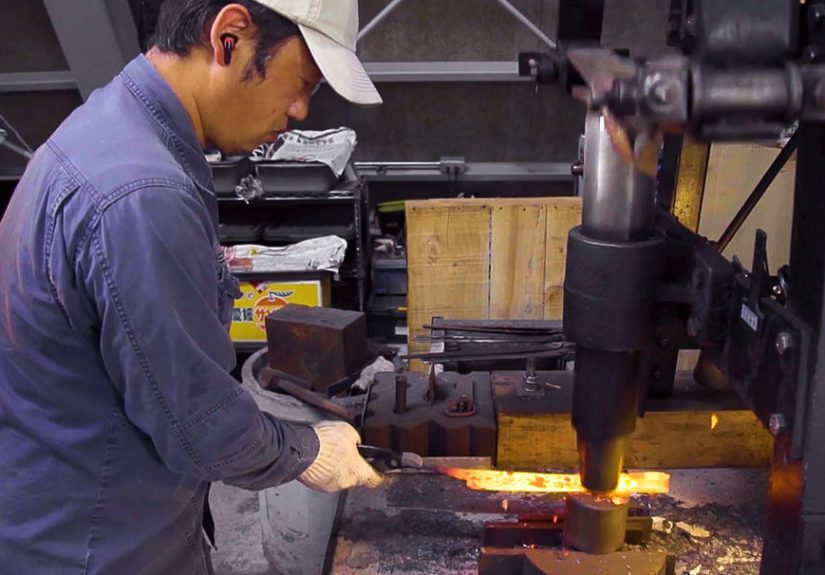
The heated billet is hammered into shape. Hammering stretches, compresses, and refines the metal. Depending on the knife type, the smith establishes the blade profile, tang, thickness, and general geometry. Even when power hammers are used, hand judgment remains essential. The smith watches color, listens to the steel, and adjusts pressure and timing.
This is where a knife begins to gain personality. A gyuto needs a versatile profile with enough curve for light rocking and enough flat area for push cuts. A nakiri needs a straighter edge for vegetable work. A deba needs strength and thickness. A yanagiba needs length and elegance for single-stroke slicing.
3. Annealing, Quenching, and Tempering
Heat treatment is where metallurgy gets dramatic. The blade is heated, then quenched to harden the steel. Quenching may involve water or oil depending on the steel and maker’s method. After hardening, the blade is usually tempered to reduce brittleness and improve toughness.
This balance is crucial. A knife that is too soft will lose its edge quickly. A knife that is too hard may chip if abused. Japanese chef’s knives often run harder than many Western chef’s knives, which helps them hold sharper, thinner edges. The tradeoff is that they should be used with respect: no twisting through bones, no scraping with the edge, no tossing into the sink like a fork with delusions of grandeur.
4. Grinding the Geometry
After forging and heat treatment, grinding gives the blade its cutting character. A knife can be made from excellent steel and still perform poorly if the geometry is wrong. The thickness behind the edge, the angle of the bevel, the taper from spine to edge, and the curve toward the tip all affect how the knife moves through food.
Japanese knives are often praised because they feel thin and efficient behind the edge. That does not mean every blade is fragile. It means the maker has removed steel in the right places. A well-ground gyuto can pass through onions with little resistance. A good santoku can chop herbs without bruising them into green confetti. A polished yanagiba can slice fish so cleanly the surface looks almost glossy.
5. Sharpening and Polishing
Sharpening is not an afterthought; it is a defining stage. Many high-end Japanese knives are finished on whetstones, with progressive refinement to create a keen, controlled edge. On traditional single-bevel knives, sharpening also shapes the wide bevel and maintains the hollow back. This requires experience, patience, and a steady hand.
Polishing may reveal the layered structure of the blade. A kasumi finish creates a soft misty contrast between hard steel and softer cladding. Damascus-style layers create flowing patterns. A hammered finish can reduce the surface contact between blade and food, sometimes helping ingredients release more easily. It also looks fantastic, which is not illegal and should be celebrated.
6. Handle Fitting and Final Inspection
The handle changes how a knife feels as much as the blade changes how it cuts. Traditional Japanese wa handles are often made from woods such as ho wood, magnolia, chestnut, ebony, or walnut, sometimes with buffalo horn or synthetic ferrules. They are usually lighter than Western full-tang handles, which can shift the balance forward toward the blade.
Western-style handles, common on many Japanese export knives, may use pakkawood, resin, stainless steel, or composite materials. They often feel familiar to American cooks who grew up using German or French-style chef’s knives. Neither style is automatically better. The best handle is the one that helps the cook cut confidently, safely, and comfortably.
Popular Japanese Knife Types and What They Do Best
Gyuto: The Japanese Chef’s Knife
The gyuto is the Japanese answer to the Western chef’s knife. It is versatile, nimble, and suited to meat, fish, vegetables, herbs, and general prep. Compared with many Western chef’s knives, a gyuto is often thinner, lighter, and harder. It excels at push cutting, slicing, trimming, and detail work.
For many home cooks, a 210mm gyuto is the sweet spot. It is long enough for serious prep but not so large that it feels like you are fencing with a zucchini. Professional cooks may prefer 240mm or longer for speed and board coverage.
Santoku: The Friendly All-Rounder
The santoku is shorter, wider, and often less intimidating than a full-length chef’s knife. Its name is commonly associated with “three virtues” or three uses: slicing, dicing, and mincing. It is especially popular with home cooks because it feels controlled and practical.
A santoku is excellent for vegetables, boneless proteins, and everyday meals. Its flatter edge encourages up-and-down or push-cut motions rather than heavy rocking. If your cooking involves weeknight stir-fries, salads, chicken breasts, herbs, and fruit, a santoku may become your most-used knife.
Nakiri: The Vegetable Specialist
The nakiri looks like a small rectangular cleaver, but it is not designed for bones. Its straight edge is made for clean vegetable cuts. It shines with cabbage, cucumbers, carrots, eggplant, herbs, and leafy greens. The blade’s height also helps guide the knuckles and move chopped ingredients.
If you cook a lot of vegetables, a nakiri can make prep feel faster and more satisfying. It is the knife equivalent of finally organizing your desktop: everything suddenly feels calmer.
Yanagiba and Deba: Traditional Precision Tools
The yanagiba is a long, single-bevel slicer used for sashimi and delicate proteins. It is designed for pulling cuts in one smooth motion. The deba is thicker and heavier, traditionally used in fish butchery. These knives are more specialized and require better technique, but in the right hands they are extraordinary.
Why Steel Matters So Much
Knife people talk about steel the way coffee people talk about beans: passionately, specifically, and sometimes at a level that frightens guests. But steel really does matter.
Carbon steel offers excellent sharpness and sharpening feedback. It can form a patina over time, which many cooks find beautiful. However, it should be washed and dried promptly.
Stainless steel resists rust and staining, making it easier for busy kitchens and newer knife owners. Modern Japanese stainless steels can still be impressively sharp and durable.
Powdered steels and advanced alloys can provide excellent edge retention, though they may be harder to sharpen. Laminated construction, including san mai and Damascus-style cladding, allows makers to combine a hard core with outer layers that add toughness, corrosion resistance, or visual character.
The best steel depends on the cook. A sushi chef may want a highly responsive carbon blade. A parent making dinner while answering homework questions may prefer stainless. Both choices are valid. Dinner is hard enough without turning knife ownership into a personality test.
How Japanese Knives Differ From Western Chef’s Knives
Western chef’s knives, especially German-style knives, are often heavier, softer, thicker, and more curved. They are excellent for rocking cuts, durable enough for rougher use, and easy to maintain with regular honing. Japanese knives are often harder, thinner, and more precise, with edges that benefit from whetstone sharpening rather than frequent honing rods.
This difference affects technique. With many Japanese knives, push cutting, pull cutting, and tap chopping work beautifully. Aggressive rock chopping can be less ideal, especially on very hard, thin edges. Scraping food across the board with the sharp edge is also a bad habit. Use the spine or a bench scraper instead. Your knife will thank you silently, because knives are classy like that.
Care Tips for a Forged Japanese Chef’s Knife
A great Japanese knife is not difficult to care for, but it does ask for basic respect. Hand-wash it. Dry it right away. Store it in a saya, knife block, drawer insert, or on a magnetic strip. Use a wooden or quality synthetic cutting board. Avoid glass boards, marble counters, frozen foods, bones, and anything that makes the blade sound like it is having a terrible day.
Sharpen with whetstones or use a professional sharpener who understands Japanese blade geometry. Pull-through sharpeners can remove too much metal and damage the edge. A fine ceramic honing rod can be useful for some stainless Japanese knives, but many hard carbon blades respond better to stone touch-ups.
Why Chefs Love Them
Professional chefs care about speed, consistency, fatigue, and results. A well-made Japanese chef’s knife helps with all four. Less resistance means faster prep. Cleaner cuts mean better presentation. Lighter weight can reduce fatigue during long shifts. Better edge retention means fewer interruptions.
There is also an emotional side. A handmade knife carries visible evidence of the maker. The hammer marks, polish lines, handle fit, and balance create a sense of connection. In a commercial kitchen, where the work is hot, repetitive, loud, and occasionally filled with someone yelling “behind,” that connection matters. A chef’s knife becomes less like equipment and more like a trusted coworker who never calls in sick.
Experience Section: From the Forge to the Cutting Board
The experience of encountering a Japanese chef’s knife often begins with sound. In a forge, the sound is rhythmic and physical: hammer on hot steel, fire breathing through the furnace, water hissing during cooling, grinding wheels singing against metal. Nothing about it feels rushed. Even when a workshop uses modern tools, the pace is governed by judgment. The smith is not simply forcing steel into shape; the smith is reading it.
Watching a blade take form can be surprisingly emotional. At first, it looks like a glowing strip of metal, more industrial than elegant. Then the hammer falls again and again. The profile appears. The tang stretches out. The spine and edge begin to suggest purpose. A future knife is hiding in the steel, and the craftsperson’s job is to remove everything that does not belong.
For travelers who visit places such as Sakai, Seki, or Takefu, the most memorable part is often the human skill behind the object. A finished knife in a shop case is beautiful, but seeing the process changes how you understand the price, the care instructions, and the pride. Suddenly, “handmade” is not a marketing word. It is sweat, repetition, burned fingers avoided by experience, and tiny decisions made faster than most people can notice.
The cutting-board experience is just as revealing. The first time a sharp Japanese gyuto passes through an onion, the difference is obvious. There is less crushing, less slipping, and less force. Carrots cut cleanly instead of cracking. Herbs stay greener because they are sliced rather than bruised. A tomato gives way without requiring the awkward sawing motion that makes a cook question every life choice leading to that moment.
There is also a learning curve. A Japanese knife encourages better habits. You learn to let the edge do the work. You stop twisting the blade. You stop using the knife to scoop ingredients with the sharp side. You become more aware of your cutting board, your grip, and your motion. In a strange way, the knife trains the cook.
Ownership becomes a small ritual. After cooking, you rinse the blade, wipe it dry, and place it safely back in its saya or on the rack. If it is carbon steel, you may notice a blue-gray patina developing over time. That patina is not damage; it is a record. Lemons, onions, beef, herbs, and years of dinners leave their quiet signature. The knife becomes more personal the longer it is used.
That is the real magic of Japanese chef’s knives. They are world-famous because they perform beautifully, but they endure because they create relationships. Between maker and material. Between chef and tool. Between tradition and dinner. A forged Japanese knife may begin in fire, but its final purpose is wonderfully ordinary: preparing food for people. And honestly, if a tool can make chopping onions feel like a cultural experience, it has earned its reputation.
Conclusion
Japanese chef’s knives are not famous by accident. They are the result of centuries of regional craft, deep material knowledge, and a culture that respects the cut as much as the ingredient. From Sakai’s specialist workshops to Seki’s blade-making evolution and Echizen’s hammer-forged traditions, Japan has built a knife culture where performance and artistry meet at the edge.
For cooks, the appeal is practical and emotional. A well-forged Japanese knife cuts cleaner, feels lighter, holds an edge beautifully, and makes prep more enjoyable. It also reminds us that even everyday tools can carry history. The next time a Japanese chef’s knife glides through a tomato like it has a dinner reservation, remember: that effortless cut began with fire, steel, and a craftsperson who knew exactly when to strike.