Table of Contents >> Show >> Hide
- Introduction: Sometimes the Cover Is the Whole Point
- Why Funny Book Covers Work So Well
- The 21 Titles Where Judging the Cover Is Absolutely Fair
- 1. The Overthinker’s Guide to Making Decisions
- 2. How to Solve Your Own Murder
- 3. HR Approved Ways to Say Things I Can’t Say Out Loud at Work
- 4. How to Talk to Your Cat About Gun Safety
- 5. Learn a Lot While You Sit on the Pot
- 6. How to Tell If Your Cat Is Plotting to Kill You
- 7. Actual HR-Approved Ways to Tell Coworkers They’re Stupid
- 8. Can Holding In a Fart Kill You?
- 9. 50 Ways to Eat Cock
- 10. There Are Moms Way Worse Than You
- 11. How Not to Be a D**k
- 12. Moby-Duck
- 13. I Could Pee on This
- 14. Toddlers Are A**holes
- 15. So Long, and Thanks for All the Fish
- 16. Do Androids Dream of Electric Sheep?
- 17. The Man Who Mistook His Wife for a Hat
- 18. The Worst-Case Scenario Survival Handbook
- 19. Bedpans, Beeps, and Belly Laughs
- 20. Stiff: The Curious Lives of Human Cadavers
- 21. Poop and Learn
- What These Covers Teach Us About Smart Book Marketing
- Why Readers Love Books That Announce Themselves
- Experience: What It Feels Like to Judge These Books by Their Covers
- Conclusion: The Cover Is the First Punchline
Note: This article is written as an original SEO blog post based on publicly available information about book cover design, reader behavior, publishing trends, and the real titles featured in humorous book roundups and retailer listings.
Introduction: Sometimes the Cover Is the Whole Point
We have all heard the noble little proverb: “Don’t judge a book by its cover.” Lovely advice. Very mature. Also, in the case of certain books, completely impossible. Some titles walk into the bookstore wearing a neon sign, tap you on the shoulder, and say, “You know you want to pick me up.” And honestly? They are right.
Judging A Book By Its Cover Is Highly Encouraged For These 21 Titles is not just a funny headline; it is a celebration of books that understand the ancient art of first impressions. These are the kinds of books that win the browsing game before page one. Their covers are bold, absurd, clever, strange, or so hilariously specific that they feel like they were created during a late-night marketing meeting fueled by cold pizza and dangerous confidence.
Book covers matter because readers make snap decisions. A strong cover signals tone, genre, mood, and audience in seconds. A mystery cover whispers, “Someone is definitely not making it to chapter three.” A self-help parody shouts, “You are a mess, but at least you are a funny mess.” A cat book with a suspiciously judgmental feline on the front says, “The cat knows what you did.”
In today’s crowded book market, covers must work in bookstores, online thumbnails, social media feeds, gift guides, and recommendation lists. The best funny book covers do more than decorate the front of a book. They deliver the joke, frame the promise, and make the reader curious enough to click, buy, gift, or at least loudly point it out to a friend.
Why Funny Book Covers Work So Well
Humor is one of the fastest ways to create emotional connection. When a book cover makes someone laugh, it has already done something many serious covers struggle to do: it has earned attention. That tiny moment of delight can turn casual browsing into genuine interest.
Great book cover design usually depends on a few core elements: clear genre signals, strong typography, a memorable concept, and an image or title that communicates instantly. Funny books often add another layer: surprise. They take familiar categories such as parenting guides, etiquette books, workplace advice, cookbooks, pet humor, survival manuals, and literary nonfiction, then twist them just enough to make the reader stop scrolling.
The Power of a Ridiculously Specific Title
A title like The Overthinker’s Guide to Making Decisions does not need to explain its audience. The audience is already standing in the aisle, comparing seven brands of toothpaste, paralyzed by mint intensity. A title like Can Holding In a Fart Kill You? understands that curiosity is not always elegant, but it is powerful. These books succeed because they are instantly understandable and emotionally direct.
The Gift Factor
Many of these titles are also built for gifting. A funny cover can say what the buyer may not be brave enough to say out loud. Need a gift for an exhausted new parent? There is a book for that. Need a passive-aggressive office gift? Unfortunately for HR, there are several. Need something for the person who spends suspiciously long in the bathroom? The publishing industry has been preparing for that moment.
The 21 Titles Where Judging the Cover Is Absolutely Fair
Below are 21 real titles that prove a book cover can be a joke, a promise, a marketing strategy, and a tiny work of chaos all at once.
1. The Overthinker’s Guide to Making Decisions
This title understands its reader with painful accuracy. It is funny because it turns indecision into a personality portrait. The cover promise is clear: you may not become perfectly decisive, but at least you will feel seen while spiraling over lunch options.
2. How to Solve Your Own Murder
As mystery titles go, this one has a hook sharp enough to cut through a crowded bookshelf. It offers dark comedy, intrigue, and a delightfully impossible problem. The title alone makes the reader ask, “Wait, how exactly would that work?” That question is the sale.
3. HR Approved Ways to Say Things I Can’t Say Out Loud at Work
Every office has moments when the inside voice tries to escape. This book taps into workplace frustration while promising polite, corporate-safe translation. It is the perfect example of how a cover can function as both gag gift and survival tool.
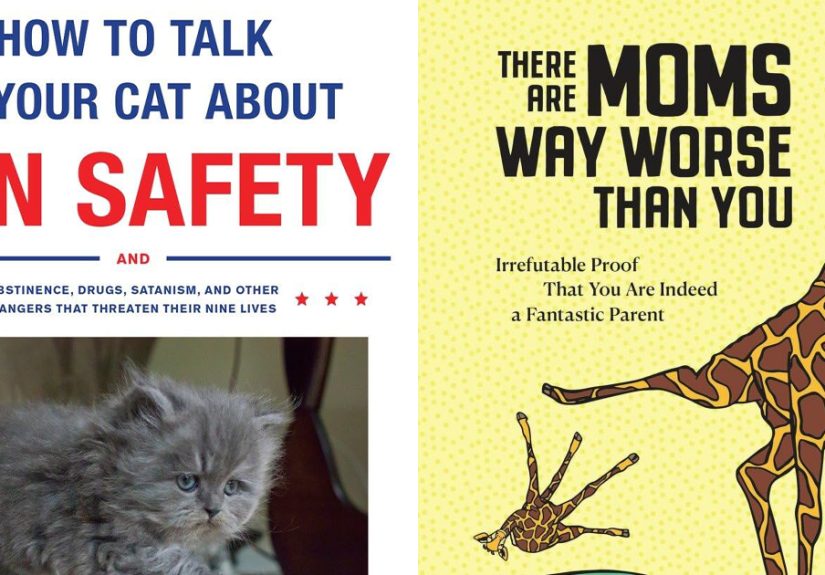
4. How to Talk to Your Cat About Gun Safety
This satirical title wins by sounding absurdly official. It mimics the tone of public safety pamphlets while applying it to the least cooperative audience imaginable: cats. The joke works because the cover likely looks serious enough to make the reader do a double take.
5. Learn a Lot While You Sit on the Pot
Bathroom books are their own strange literary kingdom, and this one knows exactly where it belongs. The title is simple, silly, and practical. It promises trivia, entertainment, and a socially acceptable excuse for staying in the bathroom longer than necessary.
6. How to Tell If Your Cat Is Plotting to Kill You
Cat humor thrives because cats already behave like tiny landlords with knives hidden in their eyes. This title takes a common pet-owner joke and turns it into a full premise. The best part is that many cat owners will look at the cover and think, “Finally, research.”
7. Actual HR-Approved Ways to Tell Coworkers They’re Stupid
This title is workplace comedy with a paper trail. It captures the dream of saying the honest thing without being escorted to a meeting with “just a quick sync” in the subject line. The cover works because it speaks to a universal office fantasy: honesty with benefits.
8. Can Holding In a Fart Kill You?
Some books aim for prestige. This one aims for the question everyone secretly wants answered. Its cover appeal is built on curiosity, embarrassment, and the ancient human love of gross facts. It is not subtle, but subtlety was never the assignment.
9. 50 Ways to Eat Cock
This is, in reality, a chicken cookbook using a very obvious pun as its marketing engine. The title is risky, cheeky, and impossible to ignore. It proves that wordplay can turn an ordinary cookbook concept into a conversation piece, though perhaps not one to leave out during dinner with your grandmother.
10. There Are Moms Way Worse Than You
This book uses humor as reassurance. The title instantly comforts parents who worry they are doing everything wrong. By comparing human parenting anxiety to wild examples from the animal kingdom, the cover says, “Relax. At least you probably did not eat your young.” That is a low bar, but sometimes a useful one.
11. How Not to Be a D**k
Etiquette books often sound dusty and formal. This one arrives with a verbal elbow to the ribs. The title is blunt, modern, and funny enough to attract readers who would never pick up a traditional manners guide. It makes self-improvement feel less like homework and more like an intervention from a sarcastic friend.
12. Moby-Duck
A title like Moby-Duck is brilliant because it sounds silly before revealing that it connects to a genuinely fascinating story about rubber ducks, ocean currents, and global shipping. The cover appeal lies in the collision between literary reference and floating bath toy. High concept, low squeak.
13. I Could Pee on This
Cat poetry should not make sense, and yet this title makes perfect sense. It captures feline behavior in one sentence. The cover invites cat lovers to imagine their pets as tiny, dramatic poets with terrible boundaries. That is not just funny; it is suspiciously accurate.
14. Toddlers Are A**holes
This title is not subtle, but neither is a toddler screaming because their banana broke. The cover works because it gives exhausted parents permission to laugh at the chaos. It is not anti-child; it is pro-parental survival.
15. So Long, and Thanks for All the Fish
Douglas Adams understood absurdity at a cosmic level. This title, part of The Hitchhiker’s Guide to the Galaxy universe, is memorable because it sounds like a polite farewell from someone leaving a dinner party, except the dinner party is Earth. The cover usually leans into that surreal comic energy.
16. Do Androids Dream of Electric Sheep?
Philip K. Dick’s famous title remains one of science fiction’s great cover hooks. It raises a philosophical question while sounding wonderfully strange. A good cover for this book can signal futuristic anxiety, artificial life, and existential dread without needing a single laser beam.
17. The Man Who Mistook His Wife for a Hat
Oliver Sacks gave nonfiction one of its most unforgettable titles. It is strange, humane, and impossible not to investigate. The cover has the advantage of beginning with a question in the reader’s mind: how can that happen? Curiosity does the heavy lifting.
18. The Worst-Case Scenario Survival Handbook
This title is perfect for anyone whose brain treats “minor inconvenience” as “training exercise for disaster.” The cover promise is practical comedy: ridiculous emergencies, clear instructions, and just enough usefulness to make the reader feel prepared for shark attacks, quicksand, and awkward dinner parties.
19. Bedpans, Beeps, and Belly Laughs
Hospital humor is tricky, but this title aims for warmth. It suggests a coloring book or joke collection designed to bring levity to uncomfortable moments. The cover’s job is to feel friendly, gentle, and cheerful rather than cynical.
20. Stiff: The Curious Lives of Human Cadavers
Mary Roach’s Stiff is a masterclass in making a taboo subject approachable. The subtitle tells readers that the book is about cadavers, but the tone promises curiosity rather than horror. The cover challenge is delicate: be witty, not ghoulish; smart, not sensational.
21. Poop and Learn
This title knows its mission. It is bathroom trivia with zero shame and maximum clarity. The cover likely does not need much persuasion. It simply needs to exist where the right reader can see it and say, “Well, that belongs in my guest bathroom immediately.”
What These Covers Teach Us About Smart Book Marketing
The funniest book covers are not random accidents. They usually combine three things: a clear audience, a strong emotional trigger, and a concept that can be understood instantly. That is why these titles work so well in online lists, social media posts, bookstore displays, and gift guides.
They also prove that a cover does not have to be beautiful in a traditional sense to be effective. Some covers are elegant. Some are mysterious. Some are proudly ridiculous. The important question is not “Would this win a design award?” but “Would the right reader stop and care?”
Clear Tone Beats Generic Polish
A generic book cover may look professional and still be forgettable. A funny, specific cover may look less “serious” but generate more attention because it knows exactly what reaction it wants. Laughter is a conversion tool. So is surprise. So is the sudden need to show your friend a book and say, “Look at this nonsense.”
Typography Carries the Joke
For many humorous books, typography is the star. Big, readable titles matter because the joke often lives in the words. If the title cannot be read in a thumbnail, half the magic disappears. That is why many modern funny book covers use bold fonts, high contrast, and simple layouts.
Genre Signals Still Matter
Even absurd books need visual structure. A mystery like How to Solve Your Own Murder should still feel like a mystery. A cat humor book should signal pet comedy. A bathroom trivia book should not accidentally look like a medical textbook, unless the goal is to terrify guests.
Why Readers Love Books That Announce Themselves
In a world full of serious branding, funny book covers feel refreshingly honest. They do not ask readers to decode vague symbolism. They announce their personality immediately. That makes them especially powerful for casual readers, gift buyers, and anyone browsing without a specific title in mind.
There is also a social element. A serious novel may be read privately, but a ridiculous title becomes a shared object. It starts conversations. It appears in group chats. It becomes the thing someone wraps for a holiday party because they know it will get passed around the room. In that sense, the cover is not just packaging; it is part of the entertainment.
Experience: What It Feels Like to Judge These Books by Their Covers
The best way to understand these titles is to imagine the real browsing experience. You walk into a bookstore with noble intentions. Maybe you plan to buy one thoughtful novel, one useful nonfiction book, and absolutely no novelty items. You are a disciplined adult. You have a tote bag and a budget. You are not here to be emotionally manipulated by a book about suspicious cats.
Then you see How to Tell If Your Cat Is Plotting to Kill You. Suddenly, discipline leaves the building. You think of your own cat staring at you from the hallway at 2:17 a.m. You remember the time it knocked a glass off the counter while maintaining eye contact. You pick up the book. The cover has won.
That is the magic of these titles. They connect instantly to lived experience. Workplace books about HR-approved insults feel funny because almost everyone has typed a professional email that began life as a scream. Parenting books about toddlers feel funny because parents know the unique terror of negotiating with a small person wearing one sock and holding a cracker like a legal document. Bathroom trivia books work because homes are full of people pretending they do not read in there.
Judging these books by their covers is not shallow; it is part of the intended experience. The cover is the handshake, the wink, and the opening joke. In many cases, the cover tells you exactly how the book wants to be used. Some are meant to be read cover to cover. Some are meant to live on a coffee table. Some are destined for guest bathrooms, office gift exchanges, hospital rooms, or the shelf where you keep books that make visitors question your taste in the best possible way.
I have also noticed that books like these are surprisingly good at lowering the pressure around reading. Not every book has to be a solemn climb up Literary Mountain while wearing tweed and thinking about symbolism. Sometimes a book can simply make you laugh after a long day. Sometimes the title is enough to make someone who “doesn’t read much” pick it up. That matters. Humor can be a doorway back into reading for people who feel intimidated by serious books or overwhelmed by endless recommendations.
These covers also make excellent reminders that design is communication. A funny title with the wrong cover could fall flat. A clever concept hidden under dull typography might never reach its reader. But when the title, cover, tone, and audience line up, the result feels effortless. You see the book, understand the joke, imagine the person who needs it, and suddenly it is in your cart.
So yes, in this case, judge the book by its cover. Judge it loudly. Judge it with appreciation. Judge it while laughing in the bookstore aisle and pretending you are coughing. These 21 titles were built for that exact moment. They prove that sometimes the cover is not a distraction from the book’s value. Sometimes the cover is the invitation that makes the whole reading experience begin.
Conclusion: The Cover Is the First Punchline
Judging A Book By Its Cover Is Highly Encouraged For These 21 Titles proves that the old rule needs a funny little exception. A great cover can be smart, strategic, emotional, and ridiculous all at once. These books use bold titles, sharp humor, clear audience targeting, and memorable concepts to stand out in a crowded market.
Whether the subject is cats, coworkers, parenting, bathroom trivia, cadavers, androids, or rubber ducks lost at sea, each title shows how powerful first impressions can be. The cover gets the laugh. The title sparks curiosity. The reader reaches for the book. That is not accidental; that is good publishing.
In the end, some books deserve to be judged by their covers because their covers are doing exactly what they were designed to do: entertain, attract, and make the reader wonder what kind of glorious chaos might be waiting inside.