Table of Contents >> Show >> Hide
- Why a Monkey Bouldering Illustration Works So Well
- The One-Hour Art Challenge: Fast, Focused, and Slightly Chaotic
- What Makes a Monkey a Great Character for Illustration?
- Why Bouldering Is Such a Fun Subject to Draw
- Creative Lessons From the Illustration Process
- How to Make Your Own Monkey Bouldering Illustration
- My Experience Spending One Hour on “I Spent 1 Hour To Make This Illustration Of A Monkey Bouldring”
- Conclusion
There are ideas that arrive politely, knock on the door, and wait to be invited in. Then there are ideas like this one: a monkey bouldering, gripping tiny holds with the confidence of a tiny furry athlete who has never once paid for a gym membership. The concept was strange, funny, and oddly perfect. A monkey already feels biologically overqualified for climbing, and bouldering already looks like a puzzle designed by someone who enjoys watching humans question their life choices. Put them together, and you get an illustration that is part sports poster, part character design exercise, and part “why did I give this monkey better footwork than myself?”
This article breaks down the creative process behind making a monkey bouldering illustration in one hour, from sketching the pose to building the story, choosing color, adding climbing details, and turning a goofy idea into a polished visual. Along the way, we will look at what makes bouldering visually exciting, why monkeys are such expressive subjects, and how a limited-time art challenge can actually sharpen creativity instead of destroying your sanity with a tiny digital brush.
Why a Monkey Bouldering Illustration Works So Well
Bouldering is a form of rock climbing done without ropes or harnesses on shorter walls or rock formations. Instead of long vertical routes, climbers solve short, intense climbing sequences called problems. That word is perfect because bouldering often looks like someone trying to solve geometry with their shoulders. The climber studies the holds, tests balance, shifts hips, reaches, slips, laughs nervously, and tries again.
A monkey brings instant personality to that world. Primates are naturally associated with climbing, gripping, hanging, swinging, and curious problem-solving. Their long limbs, expressive faces, and flexible postures make them excellent characters for motion-based illustration. A monkey can look athletic, mischievous, panicked, smug, or all four at the same time. That range of emotion gives the artist a lot to play with.
The humor comes from contrast. Bouldering is usually presented with chalk bags, climbing shoes, route grades, crash pads, and serious facial expressions. A monkey does not need any of that. It has the raw confidence of a creature that looks at a V6 overhang and thinks, “Finally, furniture.” By placing a monkey in the human world of indoor climbing, the illustration becomes instantly relatable and absurd.
The One-Hour Art Challenge: Fast, Focused, and Slightly Chaotic
Creating an illustration in one hour forces every decision to matter. There is no time for twenty alternate sketches, twelve color palettes, or a three-hour existential debate about whether the monkey should wear a headband. The clock becomes both the enemy and the creative director. It pushes the artist to simplify.
Minute 0–10: Finding the Core Idea
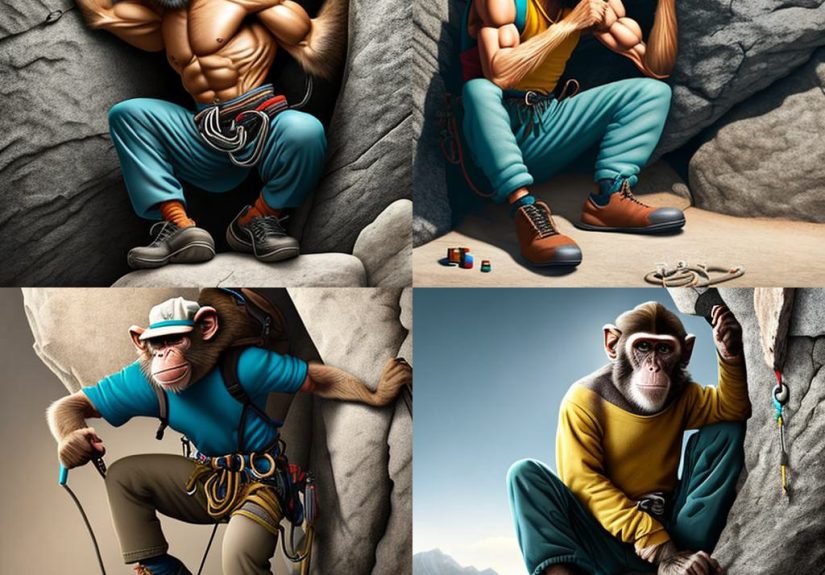
The first ten minutes are about clarity. The question is not “Can I draw the most anatomically perfect monkey in history?” The question is “Can viewers instantly understand that this monkey is bouldering?” That means the pose must do most of the storytelling. I imagined the monkey on a slightly overhanging wall, one hand stretched toward a bright hold, one foot carefully pressed on a tiny foothold, and the other leg dangling dramatically like it had just remembered gravity exists.
The face mattered too. A neutral monkey would be boring. A wildly determined monkey would be better. I wanted an expression somewhere between Olympic focus and “I definitely lied on my climbing waiver.” Raised brows, wide eyes, and a tiny open mouth helped sell the drama.
Minute 10–25: Sketching the Pose
In a bouldering illustration, body language is everything. Good climbing technique often emphasizes balance, straight arms, hip positioning, and using the legs instead of pulling wildly with the arms. Even though this was a cartoon monkey, the pose still needed to feel believable. The monkey’s hips had to stay close to the wall, the limbs needed a clear line of action, and the feet had to look like they were actually pushing rather than floating in space.
I started with simple shapes: an oval for the torso, circles for the shoulders and hips, long curved lines for the arms, and exaggerated hands and feet. Big hands were essential. They made the monkey funnier and helped show grip. The tail became a bonus design element, curling behind the body like a question mark with opinions.
The trick was avoiding stiffness. Climbing is full of diagonal energy. A good bouldering pose rarely feels symmetrical. One side stretches, the other compresses. One foot pushes, one hand reaches. The body twists. That twist gives the illustration motion, even though the image is still.
Minute 25–40: Building the Climbing Wall
The wall had to support the story without stealing attention from the monkey. I used a simple indoor climbing wall layout with colorful holds scattered across a neutral background. The holds were not random blobs. Some were large rounded jugs, some were tiny footholds, and some were awkward slopers because every climbing wall needs at least one hold that feels like gripping a dinner plate covered in bad decisions.
To make the scene clearer, I gave the monkey a route color. In many climbing gyms, routes are marked by holds of the same color or by tags. The monkey’s target route used a consistent set of bright holds, making the path readable. This also helped the viewer understand the challenge: the monkey is not just hanging around. It is solving a problem.
A crash pad at the bottom added context and safety. Outdoor and indoor bouldering both involve falls, and pads are part of the visual language of the sport. Even in a funny illustration, including a pad makes the scene feel grounded. It says, “Yes, this monkey is bold, but at least someone thought about the landing.”
Minute 40–55: Color, Shading, and Personality
With the sketch complete, the next stage was color. For a fast digital illustration, flat colors come first: warm brown fur, a lighter face and belly, bold climbing holds, and a simple background. Clean color blocking is faster than painting everything at once, and it keeps the design readable.
After the flats, I added shadows under the arms, belly, feet, and tail. Shading helped show that the monkey was close to the wall rather than pasted onto it. Highlights on the holds made them feel slightly plastic, like indoor climbing grips. A few chalk marks near the holds gave the wall texture and hinted at previous attempts by humans who were probably less graceful than the monkey.
The final personality details made the piece work: a tiny chalk bag, a determined eyebrow angle, little toe pressure on the foothold, and a tail that looked like it was trying to help but had not read the rulebook. In character illustration, small details often do the heavy lifting.
Minute 55–60: Final Polish
The last five minutes were for cleanup. I thickened the outline around the monkey to separate it from the wall, softened a few rough edges, added motion lines near the reaching hand, and adjusted contrast so the focal point stayed on the face and upper body. A one-hour illustration does not need to be flawless. It needs to feel complete.
What Makes a Monkey a Great Character for Illustration?
Monkeys are visually rich subjects because they combine animal anatomy with human-like expression. Their hands, eyes, posture, and curiosity make them easy to anthropomorphize without turning them into humans in costumes. A monkey can look clever with a simple eyebrow tilt. It can look chaotic with one foot in the wrong place. It can look heroic while doing something objectively ridiculous.
For this bouldering illustration, exaggeration was the main tool. The hands were bigger than realistic hands. The feet were extra flexible. The tail curved with graphic rhythm. The face was simplified, but the expression was pushed. This kind of stylization helps an illustration communicate quickly, especially online, where viewers may decide in half a second whether to keep scrolling.
The best character illustrations often have a clear silhouette. If the monkey were filled in as a black shape, the viewer should still understand the action: reaching, gripping, balancing, climbing. That is why the limbs were spread in different directions and the tail was used as a visual counterweight. A strong silhouette makes the image more memorable.
Why Bouldering Is Such a Fun Subject to Draw
Bouldering is not just a sport; it is physical storytelling. Every route has a beginning, a conflict, and a top-out. The climber starts low, faces a puzzle, makes risky moves, adapts, and either succeeds or falls onto a pad with the emotional soundtrack of a dropped sandwich.
From an illustration perspective, bouldering offers excellent visual ingredients: dramatic body angles, colorful holds, textured walls, chalk dust, crash pads, climbing shoes, and expressive struggle. Unlike some sports where the action is repetitive, bouldering poses can be wildly different. A climber may be stretched horizontally, compressed into a crouch, heel-hooking above their head, or staring at a hold as if it personally insulted their family.
That variety makes it perfect for character art. A monkey bouldering can be cute, intense, silly, or surprisingly inspirational. It can also be used for posters, stickers, social media posts, children’s book art, climbing gym merch, or a personal portfolio piece. The concept has enough humor to catch attention and enough movement to show skill.
Creative Lessons From the Illustration Process
1. A Simple Concept Beats a Complicated One
“Monkey bouldering” is easy to understand. That is why it works. The audience does not need a long explanation. They see the monkey, the climbing wall, the reach, the holds, and the joke lands quickly. Strong illustration concepts are often simple enough to explain in one sentence.
2. Real References Make Cartoon Art Better
Even silly artwork benefits from real information. Looking at climbing movement helps the pose feel more believable. Understanding how hands grip and how climbers shift weight makes the character more convincing. Studying primate shapes helps the monkey feel like a monkey instead of a squirrel who found a gym pass.
3. Time Limits Improve Decision-Making
A one-hour limit removes the luxury of overthinking. You have to choose the pose, commit to the colors, and finish the piece. That does not mean rushing carelessly. It means prioritizing. The face, pose, and silhouette matter more than rendering every strand of fur.
4. Humor Needs Specific Details
The idea is funny, but details make it funnier: the tiny chalk bag, the overconfident reach, the intense facial expression, the little foot pressing on a hold, the tail curling like it wants credit. Specific details make a joke feel designed rather than accidental.
How to Make Your Own Monkey Bouldering Illustration
If you want to try a similar drawing challenge, start by choosing the mood. Is your monkey a beginner, a champion, a chaotic gym menace, or a calm little Zen master? The mood will guide the pose and expression.
Next, sketch the wall as a simple angled plane. Add holds in different sizes and shapes. Then draw the monkey using basic forms before adding details. Keep the line of action dynamic. Let one arm reach, one leg push, and the tail add motion. Do not worry about perfection in the first pass. A loose sketch often has more life than a careful but stiff drawing.
When coloring, separate the character from the background. Use contrast so the monkey does not disappear among the holds. Add shadows where the hands and feet touch the wall. Include chalk dust, scuff marks, or a crash pad for context. Finally, polish the focal point: usually the face and reaching hand.
My Experience Spending One Hour on “I Spent 1 Hour To Make This Illustration Of A Monkey Bouldring”
The funniest part of this one-hour illustration challenge was realizing how quickly a ridiculous idea can become strangely serious. At first, I thought, “Great, a monkey on a climbing wall. Easy.” Then five minutes later, I was studying the angle of its hips like I was coaching it for a national final. That is the magic of drawing: even the goofiest concept demands real choices.
The first challenge was the pose. A monkey climbing sounds natural, but a monkey bouldering needs to look like it is following a route, not simply sitting on a wall. I had to give it intention. The reaching hand became the main story. The monkey was not just hanging there; it wanted the next hold. That tiny bit of ambition changed the entire drawing. Suddenly, the illustration had suspense.
The second challenge was balancing realism and comedy. If the monkey looked too realistic, the image lost its playful charm. If it looked too cartoony, the climbing movement stopped feeling believable. I solved this by keeping the anatomy flexible but recognizable. The arms were long, the fingers were expressive, and the face was simplified. The body still twisted toward the wall, which made the action feel grounded.
Coloring was where the piece started to feel alive. Before color, it was just a funny sketch. After adding warm fur, bright holds, and soft shadows, the monkey gained personality. The wall became a stage. The holds became obstacles. The crash pad became the quiet reminder that even talented monkeys should respect gravity.
The time limit also changed how I judged the work. Normally, it is easy to zoom in and fuss over tiny flaws. A line is uneven. A hand looks weird. A shadow could be softer. But with only one hour, the real goal was communication. Could someone look at the image and instantly understand the joke, the action, and the character? If yes, the illustration was doing its job.
I also learned that small accessories can make a character feel connected to a world. The chalk bag was not necessary, but it made the monkey feel like part of climbing culture. The same goes for the colored route holds and chalk marks. These details told viewers, “This is not just a monkey climbing a random wall. This monkey is bouldering.” That distinction matters for both storytelling and SEO because the subject becomes more specific and memorable.
By the end of the hour, the illustration was not perfect, but it had energy. It had a clear pose, a readable silhouette, and a silly personality. Most importantly, it made me want to keep building the world around it. Maybe this monkey has a climbing crew. Maybe it flashes every route except the slab problems. Maybe it refuses to brush holds because it believes chaos builds character. A good illustration does that: it opens the door to more stories.
Spending one hour on this monkey bouldering illustration reminded me that creativity does not always need a grand plan. Sometimes it needs a timer, a funny subject, and permission to make something weird. The result can be more engaging than a perfectly polished concept because it carries the energy of discovery. It feels spontaneous, and that spontaneity is often what viewers respond to first.
Conclusion
“I Spent 1 Hour To Make This Illustration Of A Monkey Bouldring” is more than a quirky art title. It is a reminder that strong visual ideas can come from playful combinations: an expressive animal, a dynamic sport, and a limited creative window. Bouldering gives the scene movement and structure. The monkey gives it humor and charm. The one-hour challenge gives it urgency.
Whether you are an illustrator, a climber, a character designer, or someone who simply enjoys animals doing suspiciously human things, this concept proves that creativity thrives when it has both freedom and boundaries. A monkey on a wall may sound silly, but with the right pose, expression, and storytelling details, it becomes a complete illustration with personality, motion, and a tiny bit of chalk-covered drama.
Note: This article was written from real, publicly available knowledge about bouldering basics, climbing movement, primate anatomy, digital illustration workflow, outdoor climbing ethics, and creative practice, synthesized into original web-ready content without direct source links.