Table of Contents >> Show >> Hide
- What Is a Noun Clause (In Plain English)?
- Common Words That Introduce Noun Clauses
- How to Identify a Noun Clause in 11 Steps
- Step 1: Find the “mini-sentence” (subject + verb)
- Step 2: Confirm it’s dependent (it can’t stand alone)
- Step 3: Look for an “introducer” word (but don’t panic if it’s missing)
- Step 4: Ask: “What job is this word group doing?”
- Step 5: Do the “it/something” substitution test
- Step 6: Check whether the clause answers a noun-type question
- Step 7: Watch out for the “relative clause trap” (antecedent check)
- Step 8: Identify the clause’s role (subject, object, complement, etc.)
- Step 9: Recognize common noun-clause “frames”
- Step 10: Check punctuation (noun clauses usually don’t need commas)
- Step 11: Prove it by rewriting the sentence
- Fast Practice: Spot the Noun Clause
- Common Mistakes (and How to Fix Them)
- FAQ: Quick Clarity for Common Questions
- Extra: of Real-World “Experience” With Noun Clauses (What People Actually Struggle With)
Noun clauses are the sneaky shapeshifters of English grammar: they look like mini-sentences, but they behave like nouns. Once you know what to look for, you’ll spot them fastwithout staring at a sentence like it just insulted your intelligence.
What Is a Noun Clause (In Plain English)?
A noun clause is a dependent clause (it has a subject and a verb) that functions as a noun in a larger sentence. In other words, it does the job a noun could do: it can act as a subject, an object, a complement, or the object of a preposition.
Quick gut-check: if the word group contains a subject + verb and you can swap the whole thing with “it,” “something,” or “that thing” and the sentence still works, you’re probably looking at a noun clause.
Noun clause vs. noun phrase (don’t let the names trick you)
A noun phrase can be long, but it doesn’t have its own subject-and-verb combo. A noun clause does.
- Noun phrase: the bright red bicycle (no verb inside)
- Noun clause: what she bought yesterday (subject “she” + verb “bought”)
Common Words That Introduce Noun Clauses
Noun clauses often begin with words that look like they’re asking questions or connecting ideas. Here are the usual suspects:
- That: I believe that she is right.
- If / whether: Tell me whether he called.
- Wh- words (who, whom, whose, what, which, when, where, why, how): I remember what you said.
- -ever words (whoever, whatever, whichever, wherever, whenever): She’ll eat whatever you cook.
Important: some of these same words can also introduce adjective (relative) clauses. That’s where people get tricked. Don’t worrywe’ll handle that in the steps.
How to Identify a Noun Clause in 11 Steps
Use these steps like a diagnostic checklist. You won’t need every step every time, but together they make noun clauses basically impossible to hide.
-
Step 1: Find the “mini-sentence” (subject + verb)
A clause has a subject and a verb. Start by scanning for a word group that contains both.
What she said surprised everyone.
(Subject: she, Verb: said)
-
Step 2: Confirm it’s dependent (it can’t stand alone)
Noun clauses are dependent: they don’t function as complete sentences by themselves in this context.
What she said … (feels incomplete alone)
What she said surprised everyone. (complete with the main clause)
-
Step 3: Look for an “introducer” word (but don’t panic if it’s missing)
Many noun clauses start with that, whether/if, or a wh- word. Sometimes “that” is omitted.
I think (that) he’s joking. (Still a noun clause even when “that” disappears.)
-
Step 4: Ask: “What job is this word group doing?”
Noun clauses do noun jobs. Try labeling what the clause is doing in the bigger sentence: subject, direct object, indirect object, complement, or object of a preposition.
- Subject: What you decide matters.
- Direct object: I know what you mean.
- Object of preposition: I’m worried about what he heard.
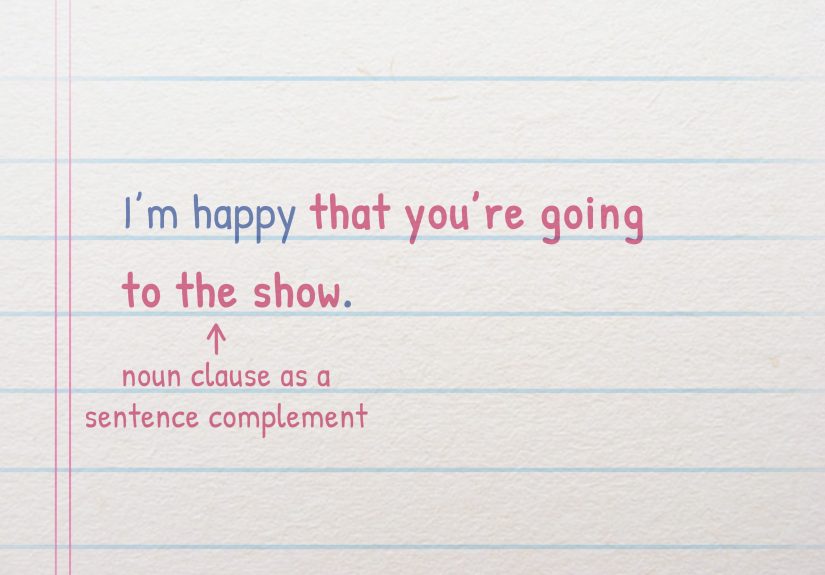
- Complement/predicate nominative: The problem is that we’re late.
-
Step 5: Do the “it/something” substitution test
Replace the entire clause with it or something. If the sentence still works, that’s strong evidence it’s a noun clause.
She understood that she needed to finish her work.
She understood it. ✅
I can’t remember where we parked.
I can’t remember it. ✅
-
Step 6: Check whether the clause answers a noun-type question
Nouns often answer who? or what? Noun clauses often answer the same.
What surprised everyone? → What she said.
She understood what? → what he meant.
-
Step 7: Watch out for the “relative clause trap” (antecedent check)
If a clause begins with who/which/that/where/when, it might be an adjective (relative) clause. Here’s the key difference:
- Adjective clause: modifies a noun that appears right before it (the antecedent).
- Noun clause: does not have an antecedent it modifies; it fills a noun slot in the sentence.
Adjective clause: The student who studied passed. (Modifies “student”)
Noun clause: I know who studied. (Answers “know what?”)
-
Step 8: Identify the clause’s role (subject, object, complement, etc.)
If you can name the role, you can stop doubting yourself.
- Subject: Whoever wins gets a trophy.
- Direct object: They discovered what caused the error.
- Indirect object: Give whoever arrives first a seat near the front.
- Prepositional object: We argued about what mattered most.
- Complement: The truth is that he forgot.
-
Step 9: Recognize common noun-clause “frames”
Certain sentence patterns almost beg for noun clauses:
- Verb + noun clause: think, know, believe, notice, explain, decide, remember…
- Adjective + noun clause: glad, sure, aware, surprised, worried… (often with “that”)
- Noun + noun clause: the fact that…, the idea that…, the claim that…
- It + linking verb + adjective/noun + noun clause: It is clear that…, It’s a shame that…
It’s amazing how quickly kids learn slang.
-
Step 10: Check punctuation (noun clauses usually don’t need commas)
Most noun clauses are not set off by commas. If you see commas, it might be a nonessential adjective clauseor just a dramatic writer.
Correct: I think that she’s right.
Usually not: I think, that she’s right. ❌
One exception: when a noun clause is part of an appositive-style structure (often after “fact,” “idea,” or “news”), punctuation depends on the sentence design.
-
Step 11: Prove it by rewriting the sentence
If you can rewrite the sentence by replacing the clause with a single noun or pronoun and the meaning still holds, you’ve confirmed it.
Original: What you choose matters.
Rewrite: Your choice matters. ✅
Original: I can’t believe that he said that.
Rewrite: I can’t believe it. ✅
Fast Practice: Spot the Noun Clause
Try identifying the noun clause in each sentence. (Answers are right belowno scrolling required to suffer.)
- What she wrote on the board confused the class.
- I wonder whether the store is still open.
- The coach explained what we needed to do next.
- They’re proud that their team improved.
- We talked about what went wrong.
Answer Key (with the “noun job”)
- What she wrote on the board = subject
- whether the store is still open = direct object of “wonder”
- what we needed to do next = direct object of “explained”
- that their team improved = complement after “proud”
- what went wrong = object of the preposition “about”
Common Mistakes (and How to Fix Them)
Mistake 1: Calling any “who/which/that” clause a noun clause
If it modifies a noun right before it, it’s an adjective clause. If it fills a noun slot (subject/object/etc.), it’s a noun clause. Always run the antecedent check.
Mistake 2: Forgetting that “that” can be optional
In many sentences, “that” is understood: I think (that) you’re right. Don’t let the missing word convince you the clause vanished into thin air.
Mistake 3: Confusing noun clauses with questions
Noun clauses can start with question words, but they aren’t direct questionsso they don’t use question word order.
Question: Where did she go?
Noun clause: I know where she went.
Mistake 4: Thinking every dependent clause is a noun clause
Dependent clauses come in different “jobs”:
- Noun clause: acts like a noun
- Adjective (relative) clause: describes a noun
- Adverb clause: modifies a verb/adjective/adverb (time, reason, condition, contrast, etc.)
Noun clause: I know what you meant.
Adjective clause: I met the person who helped you.
Adverb clause: I left early because I felt sick.
FAQ: Quick Clarity for Common Questions
Can a noun clause start with “that”?
Yes. “That” often introduces a noun clause after verbs of thinking/saying: She said that she was ready.
Can a noun clause be the subject of a sentence?
Absolutely: What you practice improves.
Can a noun clause be the object of a preposition?
Yes: We argued about what mattered.
What’s the easiest test for a noun clause?
The fastest combo is: (1) find a subject + verb, (2) see if the chunk can be replaced by it/something, and (3) name the noun job it’s doing.
Extra: of Real-World “Experience” With Noun Clauses (What People Actually Struggle With)
If you’ve ever helped a friend with homework, edited a classmate’s essay, or sat through a grammar lesson wondering why English can’t just behave, you’ve probably seen the same noun-clause problems pop up again and again. What’s interesting isn’t that people get noun clauses wrongit’s how they get tricked.
The biggest pattern is this: students learn that words like who, which, that, where, and when introduce “extra information,” so they automatically label every clause that starts with one of those words as an adjective clause. In tutoring-style settings, a simple question fixes this fast: “What noun is it describing?” If there’s no clear noun right before the clause (no antecedent), it’s probably not describing anything. Instead, it’s replacing somethingmeaning it’s doing a noun job.
Another repeat offender is the word that. Writers either overuse it (“I think that you know that I said that…”) or delete it so aggressively they delete clarity along with it. In real essays, “that” is like seasoning: you don’t need a shovel full, but sometimes you do need some so the reader doesn’t get lost. When a sentence has two clauses back-to-back, keeping “that” can prevent a moment of confusion. Compare: “She said you were late.” vs. “She said that you were late.” Both are grammatical, but the second is often easier to processespecially in academic writing.
Then there’s the “question-word word order” problem. People see where or why and want to flip the sentence like a question. But noun clauses aren’t direct questions, so they keep standard subject-verb order: “I know where he went,” not “I know where did he go.” That one mistake shows up constantly because it feels natural in speech, and our brains like patternseven when the pattern is wrong.
A surprisingly helpful “experience-based” trick is to teach noun clauses as containers. The clause contains information, but the larger sentence treats that container like a single unit. Editors often mentally replace the clause with it while reading: “I believe that the plan will work” becomes “I believe it.” If the sentence stays sturdy, the grammar is probably right. If it collapses (“The book it is on the desk”), you’re not dealing with a noun clauseyou’re dealing with a different kind of clause, usually an adjective clause.
Finally, the most practical takeaway people report after working through noun clauses isn’t “I can define them”; it’s “I can label them quickly.” That’s why the 11-step checklist matters. In the real world, you don’t want a definitionyou want a method: find the mini-sentence, run the substitution test, check for an antecedent, and name the noun job. Do that a few times, and noun clauses stop feeling like a grammar mystery and start feeling like a pattern you can control.