Table of Contents >> Show >> Hide
- Why Knowing How to Change a Tire Still Matters
- First, Know When Not to Change a Tire Yourself
- What You Need Before You Start
- How to Change a Flat Tire Step by Step
- 1. Pull over somewhere safe and stable
- 2. Find your tools and check your spare
- 3. Secure the vehicle before lifting it
- 4. Remove the hubcap and loosen the lug nuts
- 5. Position the jack correctly
- 6. Remove the lug nuts and take off the flat tire
- 7. Mount the spare tire
- 8. Lower the vehicle and tighten fully
- 9. Put everything away and check the tire
- What to Do After the Tire Change
- Common Mistakes That Ruin the Moment
- How to Be Ready Before You Ever Get a Flat
- How to Impress Your Dad Without Saying a Word
- Real-World Experiences and Lessons From Tire Changes
- Conclusion
Note: This article is formatted as clean, web-ready HTML and intentionally removes extra citation artifacts and source-link clutter for publishing.
There are few life skills more satisfying than changing a tire without turning the roadside into a live-action blooper reel. One minute you are just a driver with a problem. Ten minutes later, you are crouched beside your car, sleeves rolled up, lug wrench in hand, radiating the kind of competence that makes nearby adults nod with quiet approval. Somewhere in the distance, a dad feels proud and does not fully know why.
Jokes aside, learning how to change a tire matters. A flat tire can turn a normal day into a sweaty little crisis, especially if you are stuck on the shoulder, running late, or dressed like you absolutely did not plan to meet gravel. Knowing what to do makes the situation safer, faster, and much less dramatic. It also helps you avoid two classic mistakes: panicking and jacking the car up before loosening the lug nuts. That second one has humbled plenty of people.
This guide walks you through how to change a flat tire safely, what tools you need, when not to do it yourself, and how to handle the spare afterward. We will also cover the practical details many people skip, like jack points, temporary spare limits, tire pressure, and the difference between looking confident and actually being prepared.
Why Knowing How to Change a Tire Still Matters
Modern cars are smarter than ever, but a nail in the road still does not care about your touchscreen, your lane-keeping assist, or your playlist. In fact, many newer vehicles do not even come with a full-size spare. Some have a compact temporary spare. Others have a mobility kit with sealant and an inflator. Some rely on run-flat tires that let you drive a limited distance after losing pressure. Translation: before you ever get a flat, you should know what your own car actually carries.
That matters because the process is not one-size-fits-all. A sedan with a donut spare is one situation. An SUV with a full-size spare is another. A car with no spare and only a sealant kit is a whole different episode. The smartest move is to check your owner’s manual before you need it, not while sitting on the shoulder whispering, “Interesting… so that’s where the emergency kit lives.”
First, Know When Not to Change a Tire Yourself
Before we get into the step-by-step part, here is the most important rule: do not change a tire if the location is unsafe. If you are on a narrow shoulder, near fast traffic, on a curve, on soft dirt, in heavy rain, at night with poor visibility, or on the traffic-facing side of the vehicle, the brave move is not DIY heroics. The brave move is calling roadside assistance.
A flat tire is annoying. Getting hit by a distracted driver is catastrophic. If the setup feels sketchy, trust that feeling. Turn on your hazard lights, get yourself and passengers to a safe spot away from traffic, and wait for help. Your dad would prefer your safety over a dramatic wrenching montage.
What You Need Before You Start
Basic tire-changing tools
- A properly inflated spare tire or an approved replacement wheel
- A jack that fits your vehicle
- A lug wrench or tire iron
- Your owner’s manual for the correct jack points
- Wheel wedges, bricks, or sturdy blocks if available
- A flashlight if lighting is poor
- Gloves and a rag if you prefer less grime and more dignity
Helpful extras that make you look extremely prepared
- A reflective vest
- A portable tire inflator
- A tire pressure gauge
- A small kneeling pad or old towel
- A rain poncho, because weather loves timing
If your spare has been sitting untouched since the last presidential administration, check its air pressure. A useless spare is basically a very round disappointment.
How to Change a Flat Tire Step by Step
1. Pull over somewhere safe and stable
As soon as you realize you have a flat, slow down smoothly and look for a level, solid place away from traffic. A parking lot is ideal. A wide shoulder is acceptable if there is enough room. Avoid soft grass, sand, mud, and sloped ground. Put the car in Park if it is an automatic, or in gear if it is a manual, and engage the parking brake.
Turn on the hazard lights immediately. If passengers are with you, have them exit only if it is safe and move well away from traffic.
2. Find your tools and check your spare
Open the trunk or storage area and take out the jack, lug wrench, and spare tire. Confirm that the spare is usable. If it looks damaged, cracked, or clearly underinflated, that is your sign to stop and call for help. This is also the moment to glance at your owner’s manual for the correct lifting points. Do not guess. Putting the jack in the wrong place can damage the vehicle or make it unstable.
3. Secure the vehicle before lifting it
Place wheel wedges or sturdy blocks against the tires that are still on the ground. If the flat is in front, block a rear tire. If the flat is in back, block a front tire. This adds stability and reduces the chance of rolling. It is not glamorous, but neither is chasing your own car downhill.
4. Remove the hubcap and loosen the lug nuts
If your wheel has a hubcap or wheel cover hiding the lug nuts, remove it first. Then use the lug wrench to loosen the lug nuts before you raise the vehicle. Turn them counterclockwise. Do not remove them yet. Just break them loose about a quarter turn to a half turn.
This is the part where people discover that lug nuts can be absurdly tight. That is normal. Use controlled force. Some people step gently on the wrench for leverage, but do it carefully and only if the setup is stable. Wild flailing is not a recognized automotive technique.
5. Position the jack correctly
Place the jack under the vehicle’s designated jack point nearest the flat tire. Again, your owner’s manual is the boss here. Raise the jack until it is snug against the vehicle, then continue lifting until the flat tire is a few inches off the ground. The tire should clear the surface enough to come off cleanly.
Never put any part of your body under the vehicle while it is supported only by a jack. A roadside tire change is not the time to improvise like a mechanic in an action movie.
6. Remove the lug nuts and take off the flat tire
Now fully remove the loosened lug nuts and place them somewhere they will not roll away. A hubcap turned upside down makes a handy tray. Pull the flat tire straight toward you. It may need a little wiggle if it is stuck from corrosion or road grime, but do not yank wildly.
7. Mount the spare tire
Lift the spare onto the wheel hub and line up the holes with the lug bolts or studs. Push it on until it sits flush. Thread the lug nuts back on by hand. Tighten them snugly, but not fully, while the vehicle is still elevated.
Use a star or crisscross pattern if your wheel has five or more lugs. That helps seat the wheel evenly. Think of it as buttoning a jacket correctly instead of starting crooked and pretending nobody can tell.
8. Lower the vehicle and tighten fully
Carefully lower the vehicle until the spare touches the ground and the full weight of the car is on it. Then tighten the lug nuts firmly in a crisscross pattern. This final tightening matters. An unevenly tightened wheel can cause wobble, poor seating, or worse.
If you have a torque wrench at home, it is smart to check the torque later against the manufacturer’s spec. On the roadside, the goal is firm, even tightening with the correct tool.
9. Put everything away and check the tire
Store the flat tire, the jack, and the wrench back in the vehicle. If you have a tire pressure gauge, check the spare. Then drive carefully to a repair shop. Do not treat a temporary spare like a normal tire. It is a backup plan, not a lifestyle.
What to Do After the Tire Change
This is where a lot of people make their second-biggest mistake. They successfully install the spare, feel invincible, and continue life as if nothing happened. Bad idea. If you are using a compact spare, follow the limits in your owner’s manual. Many temporary spares are meant for short-distance, lower-speed use only. They are designed to get you to a tire shop, not carry you on a weekend road trip, a highway sprint, or an emotionally important snack run two towns over.
Get the damaged tire inspected as soon as possible. Some punctures in the tread area can be repaired. Damage to the sidewall usually means replacement. Also have the flat tire evaluated for the underlying cause. Was it a nail? A cut? An aging tire? Improper pressure? A wheel issue? Tire problems are often symptoms, not just isolated events.
Common Mistakes That Ruin the Moment
Jacking first, loosening second
If the wheel spins while you try to loosen the lug nuts, you made life harder than necessary. Loosen first, then lift.
Ignoring the owner’s manual
Every vehicle has specific jack points and tire guidance. Guesswork is for trivia night, not lifting a car.
Changing a tire in an unsafe location
If traffic is too close or visibility is poor, call roadside assistance.
Forgetting the spare needs maintenance too
A spare tire that has not been checked in years may not be ready when you need it. Check its pressure regularly.
Driving too long on a temporary spare
The donut spare is the understudy, not the lead actor.
How to Be Ready Before You Ever Get a Flat
The best time to prepare for a flat tire is when you are calm, dry, and not stuck on the shoulder. Spend ten minutes this month doing three simple things. First, verify whether your car has a full-size spare, a temporary spare, run-flat tires, or only a tire sealant kit. Second, make sure the jack and lug wrench are actually in the vehicle. Third, inspect the spare tire pressure and condition.
If you want extra credit, do a practice run in your driveway. You do not need to complete a full tire change. Just locate the tools, identify the jack points, and loosen one lug nut enough to understand the process. That little bit of familiarity pays off when the real situation arrives and your brain is busy yelling, “Why today?”
How to Impress Your Dad Without Saying a Word
Here is the truth: the impressive part is not brute strength or pretending you know everything. It is staying calm, working methodically, and respecting safety. The most competent person at the roadside is usually not the loudest one. It is the person who puts on hazard lights, checks the manual, loosens the lugs before jacking, tightens in a crisscross pattern, and knows when to call for help instead of forcing a bad situation.
That is the difference between looking handy and being handy. Anybody can say, “I got this.” The real flex is actually having it.
Real-World Experiences and Lessons From Tire Changes
Ask enough drivers about flat tires and you will hear the same themes over and over: bad timing, mild panic, dirty hands, and a surprisingly deep sense of victory once the spare is on. Flat-tire stories are small legends of modern life. Nobody wakes up hoping to spend part of the day kneeling beside a wheel well, but plenty of people remember the first time they handled it themselves.
One common experience goes like this: someone hears the thump-thump-thump of a dying tire, pulls into a gas station, opens the trunk, and realizes they have never actually looked under the trunk floor before. Suddenly it becomes an archaeological dig. There is the spare. There is the jack. There is a lug wrench that looks much smaller than expected. The lesson arrives immediately: tools that seemed mysterious in calm moments make perfect sense once you have to use them.
Another classic moment is discovering how tight lug nuts really are. In your imagination, they come off with a polite twist. In reality, they may feel welded on by destiny itself. That moment teaches patience and leverage. It also teaches humility. Plenty of people have learned that “I work out” and “I can break this lug nut loose” are not identical statements.
Then there is the spare tire reality check. Many drivers assume the spare is ready because it exists. But a spare that has sat untouched for years may be low on air. That experience tends to convert people into lifelong spare-checkers. Once you learn that even your backup plan needs a backup plan, routine maintenance stops sounding boring and starts sounding smart.
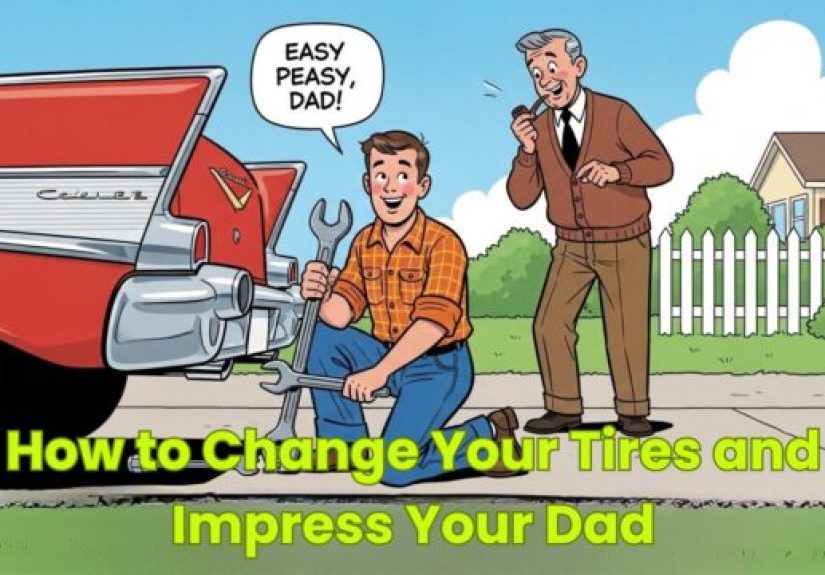
Some of the best stories involve a parent, especially a dad, hovering nearby with the energy of a man trying not to interfere while silently grading technique. He may offer one sentence, usually something like, “Loosen them before you jack it up.” That sentence contains the weight of generations. When the wheel finally goes on correctly, there may be no speech, no applause, just a nod. Somehow that nod is worth more than most awards.
There are also experiences that teach when not to continue. A driver starts the process on a narrow shoulder, feels the rush of trucks passing too close, and wisely stops to call roadside assistance. That is not failure. That is judgment. One of the most valuable lessons tied to tire changing is knowing that safety outranks pride every single time.
And finally, nearly everyone remembers the feeling after finishing the job: hands dirty, clothes slightly wrecked, confidence noticeably upgraded. You do not become a master mechanic from changing one tire, but you do gain something useful. You learn that stressful moments shrink when you have a process. You learn that preparation beats swagger. You learn that practical skills make ordinary life easier. And yes, you may also earn a little family respect, especially from the kind of dad who believes knowing how to handle a flat tire is right up there with grilling properly and owning at least one flashlight that is never where it should be.
That is why this skill sticks. It is not just about the tire. It is about composure, readiness, and solving a real problem with your own two hands. That tends to impress people, dads included.
Conclusion
Learning how to change a tire is one of those old-school skills that still earns its keep. It can save time, reduce stress, and help you stay safer during a roadside emergency. The key is to approach it the right way: stop in a safe place, secure the vehicle, use the correct jack points, loosen the lug nuts before lifting, install the spare carefully, and drive responsibly afterward. And if the situation is unsafe, skip the hero act and call for professional help.
If you can do all that calmly, you will not just impress your dad. You will impress yourself, which is honestly the better prize.