Table of Contents >> Show >> Hide
- Introduction: The Tiny Number That Started a Big Internet Argument
- What Is the “How Many 5s Are There?” Viral Math Riddle?
- Why So Many People Get the Answer Wrong
- How to Solve the Riddle Step by Step
- Example: Counting 5s from 0 to 75
- Why Viral Math Riddles Are So Addictive
- The Real Lesson: Math Is Not Always About Speed
- Tips to Beat Similar Viral Math Riddles
- Experiences Related to the “How Many 5s Are There?” Riddle
- Conclusion: So, How Many 5s Are There?
Note: This article is written for web publishing in standard American English, with a natural SEO structure, original wording, and practical analysis based on common viral math-riddle formats, visual puzzle logic, and digit-counting principles.
Introduction: The Tiny Number That Started a Big Internet Argument
Every few weeks, the internet collectively decides it is time to argue about something deeply important: a dress color, a parking-space puzzle, a “simple” math equation, or, in this case, the humble number 5. The viral question sounds harmless enough: How many 5s are there? Easy, right? Count them, brag in the comments, and go make a sandwich.
Not so fast. Viral math riddles are not famous because they are difficult in the “bring a calculator and three cups of coffee” way. They are famous because they trick your brain into moving too quickly. You see a bunch of numbers, assume the task is simple, count what jumps out first, and confidently submit an answer that may be missing the sneaky little 5 hiding in plain sight.
The beauty of the “How many 5s are there?” riddle is that it can appear in different versions. Sometimes it is a visual puzzle filled with 5s, S-shaped decoys, and small digits in unexpected places. Sometimes it asks how many times the digit 5 appears when writing numbers in a range, such as 0 through 75. Sometimes it is a trick question where the wording matters more than the arithmetic. In every version, the lesson is the same: the answer belongs to the person who slows down.
What Is the “How Many 5s Are There?” Viral Math Riddle?
The viral math riddle usually asks readers to count every appearance of the digit 5. That sounds like a kindergarten-level task, which is exactly why grown adults get ambushed by it. The challenge is rarely about advanced math. It is about attention, pattern recognition, and careful reading.
There are three common forms of this puzzle:
1. The Visual Counting Version
In this version, you see an image packed with numbers and symbols. Your job is to count all the 5s. The trick is that some 5s may be tiny, rotated, blended into other characters, placed in corners, or hidden in a clock, calculator display, watermark, caption, username, or instruction line. The puzzle is less “math test” and more “Where’s Waldo, but Waldo is a digit with attitude.”
2. The Number Range Version
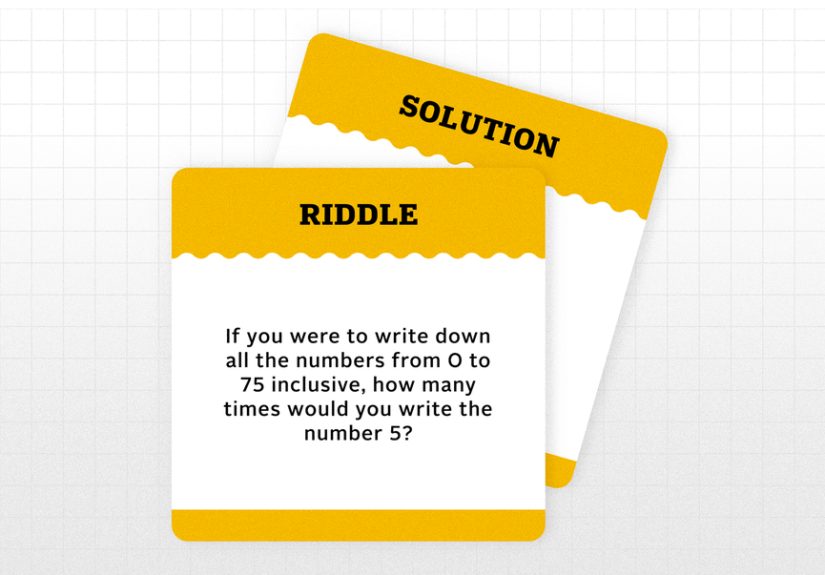
A classic version asks something like: If you write all the numbers from 0 to 75, how many times do you write the digit 5? Here, the correct approach is not guessing. You count by place value. The digit 5 appears in the ones place in 5, 15, 25, 35, 45, 55, 65, and 75. That is 8 appearances. It also appears in the tens place in 50, 51, 52, 53, 54, 55, 56, 57, 58, and 59. That is 10 more appearances. Since 55 contains two 5s, both are counted. The total is 18.
3. The Trick-Wording Version
Some versions ask “How many 5s are there?” while showing a question that includes multiple 5s in the image, title, answer choices, or even the phrase “5s” itself. In that case, the answer depends on whether the riddle asks for 5s only in the puzzle grid or in the entire screenshot. One tiny wording detail can change everything.
Why So Many People Get the Answer Wrong
Most wrong answers are not caused by bad math. They are caused by fast thinking. Your brain loves shortcuts. It sees a repeated pattern and starts filling in the blanks before your eyes have finished the job. Helpful? Usually. Perfect? Absolutely not. Your brain is basically an overconfident intern with excellent energy and questionable proofreading skills.
When solving a visual math riddle, people often make four mistakes:
They Count Only the Obvious 5s
Large, clear 5s are easy to spot. Small, faded, stylized, or partially hidden 5s are not. Puzzle creators know this. They place the hardest 5s where your eyes are least likely to travel.
They Ignore the Instructions
Sometimes the instruction line contains a 5. Sometimes the answer choices contain 5s. Sometimes the puzzle title itself contains a 5. If the question says “in the image,” you may need to count everything visible. If it says “in the grid,” the count is narrower. Reading the instruction carefully is not optional; it is the whole game.
They Count Shapes That Are Not Actually 5s
Some puzzles include letters like S, distorted 6s, or curved shapes that look suspiciously like 5s. The internet then does what the internet does best: debates with the intensity of a courtroom drama over a digit.
They Forget Double Appearances
In digit-counting riddles, numbers like 55 matter because the digit appears twice. Counting 55 as one appearance is a common mistake. The question is not asking how many numbers contain a 5. It is asking how many times the digit 5 appears.
How to Solve the Riddle Step by Step
Whether you are looking at a screenshot, a printed puzzle, or a number-range question, the best solving strategy is simple: slow down and count systematically.
Step 1: Define the Counting Area
Before counting anything, ask: Where am I supposed to look? Is the riddle asking about the entire image, only the main puzzle box, a line of numbers, or a range such as 0 to 75? This one step prevents most arguments before they begin. Unfortunately, it also removes 70% of the drama, so social media prefers to skip it.
Step 2: Scan in Rows or Sections
If the riddle is visual, do not jump around randomly. Start at the top left, move across, then go down row by row. If there are corners, borders, captions, or icons, scan those too. Treat the puzzle like a messy room: if you search randomly, you will somehow check the same sock five times and still miss the one on the chair.
Step 3: Separate Real 5s from Look-Alikes
Decide what qualifies as a 5. A standard digit 5 counts. A letter S usually does not, unless the puzzle clearly says to count anything shaped like a 5. A reversed, rotated, or stylized 5 may count if it is intentionally part of the puzzle. The key is consistency.
Step 4: Use Place Value for Number Ranges
If the riddle asks how many times 5 appears in a range, count by digit position. For example, from 0 to 75, the digit 5 appears 8 times in the ones place and 10 times in the tens place, giving a total of 18. This method is cleaner than listing every number and hoping you do not zone out halfway through.
Step 5: Check the Wording One Last Time
Before declaring victory, reread the question. Does it say “number 5” or “digit 5”? Does it say “how many numbers contain 5” or “how many 5s”? Those are not the same. The riddle often hides its trick in grammar, not math.
Example: Counting 5s from 0 to 75
Let’s walk through the classic digit-counting version because it is one of the cleanest examples.
Question: If you write every number from 0 to 75, how many times do you write the digit 5?
Start with the ones place. The numbers ending in 5 are:
5, 15, 25, 35, 45, 55, 65, 75
That gives 8 appearances of the digit 5.
Now count the tens place. The numbers from 50 through 59 all have a 5 in the tens place:
50, 51, 52, 53, 54, 55, 56, 57, 58, 59
That gives 10 appearances.
Add them together:
8 + 10 = 18
So the answer is 18, assuming the riddle is asking for every appearance of the digit 5 from 0 through 75. Notice that 55 is counted twice because it has two 5s. This is the part where many people say, “Ohhh,” followed by a quiet emotional recovery period.
Why Viral Math Riddles Are So Addictive
Viral math riddles work because they create a perfect little storm of curiosity, confidence, and conflict. The question seems easy, so people answer quickly. Then they see other answers in the comments. Suddenly, what looked obvious becomes suspicious. Was it 12? 15? 18? 20? Did someone count the 5 in the title? Is that an S or a 5? Why is Aunt Linda typing in all caps?
These puzzles also give people a quick mental reward. Solving one feels satisfying because it combines logic and discovery. You are not just calculating; you are catching a trick. That “I found it!” feeling is why people share the riddle with friends, coworkers, classmates, and unsuspecting family group chats.
Another reason these puzzles spread is that they are easy to participate in. You do not need a math degree. You do not need special software. You just need attention and a willingness to be humbled by a single-digit number. That makes the puzzle accessible, fun, and wonderfully annoying.
The Real Lesson: Math Is Not Always About Speed
Many people associate math with speed. Fast answer equals smart answer, right? Not always. In riddles like “How many 5s are there?”, the fastest answer is often the least reliable one. The better skill is accuracy.
Good problem solving means understanding what is being asked, choosing a method, checking your work, and being willing to revise your answer. Those are useful skills far beyond puzzles. They help with homework, budgeting, coding, reading contracts, planning projects, and spotting mistakes before they become expensive little gremlins.
The riddle also teaches pattern awareness. Once you know that a digit can appear in different positions, you stop treating numbers as whole blocks and start seeing their structure. That is the beginning of stronger mathematical thinking. A number like 55 is not just “fifty-five”; it is also a tens-place 5 and a ones-place 5. Tiny detail, big difference.
Tips to Beat Similar Viral Math Riddles
Read the Question Twice
The first read tells you what the puzzle appears to ask. The second read tells you what it actually asks. That second read is where the magic lives.
Do Not Trust the Comment Section Immediately
Comment sections are entertaining, but they are not peer-reviewed mathematical journals. Use them for laughs, not for final proof.
Write Down Your Count
If you are solving a visual puzzle, mark each 5 mentally or physically. If you are solving a number-range puzzle, list categories such as ones place and tens place.
Check for Hidden Areas
Look at the title, instructions, labels, answer options, small print, image corners, and repeated symbols. Viral puzzle makers love hiding important details where your eyes take a coffee break.
Ask What Would Change the Answer
If counting the whole image gives one answer and counting only the main grid gives another, mention your assumption. A clear answer with a clear method is stronger than a loud answer with no explanation.
Experiences Related to the “How Many 5s Are There?” Riddle
The funniest thing about the “How many 5s are there?” riddle is not the answer. It is watching people solve it. Give the same puzzle to five people and you may get six answers, because someone will change their mind halfway through and then blame the image quality. This is where the riddle becomes more than a puzzle. It becomes a tiny social experiment.
Imagine showing it to a group of friends. The first person answers in three seconds with the confidence of a game-show champion. The second person squints, zooms in, and says, “Wait, are we counting that one?” The third person announces that the puzzle is unfair, which is usually code for “I missed one.” By the time everyone compares answers, the room has transformed into a courtroom. People point at corners. Someone circles a suspicious shape. Someone else argues that a rotated 5 still counts. Nobody planned to spend ten minutes debating a digit, yet here we are, fully invested.
This experience is exactly why the riddle works so well online. It is quick enough to try immediately but tricky enough to start a discussion. People love sharing puzzles that make others pause, laugh, or groan. A good viral math riddle gives everyone a chance to feel clever, then gently reminds them that attention to detail is undefeated.
Teachers can use this type of riddle as a warm-up activity because it lowers the fear around math. Students who might freeze at a long equation often jump into a visual or counting puzzle without hesitation. It feels like a game, not a test. Once students explain how they counted, the conversation naturally moves into reasoning, place value, assumptions, and proof. That is a sneaky educational win. The riddle walks in wearing a party hat and somehow teaches logical thinking.
Parents can use it too. Instead of asking, “Did you do your math homework?” and receiving the traditional dramatic sigh, try asking, “How many 5s do you see?” A small puzzle can turn math into a shared challenge. The goal is not to be perfect on the first try. The goal is to explain your thinking, check your answer, and learn that mistakes are part of the process.
Even adults benefit from puzzles like this. In everyday life, we often skim emails, forms, bills, instructions, and messages. We assume we saw everything because we saw enough. Then one missed detail creates a problem. The “How many 5s are there?” riddle is a playful reminder that careful attention matters. It trains the habit of slowing down before answering, and that habit is useful whether you are solving a puzzle, reviewing a document, or trying to remember where you put your keys. Spoiler: check the weird place first.
Conclusion: So, How Many 5s Are There?
The answer depends on the exact version of the riddle. If you are solving the classic number-range version from 0 to 75, the answer is 18. If you are solving a visual version, the answer depends on what appears in the image and whether the instructions ask you to count the whole screenshot or only a specific section.
The bigger point is not just the final number. It is the method. Read carefully. Count systematically. Separate real digits from look-alikes. Check hidden areas. And never underestimate the internet’s ability to turn a simple 5 into a full-scale debate.
In the end, this viral math riddle is popular because it is short, clever, and just annoying enough to be memorable. It reminds us that math is not only about formulas. Sometimes, it is about observation, patience, and resisting the urge to shout an answer before your brain has finished loading.