Table of Contents >> Show >> Hide
- What Makes a College Bowl Upset Truly Great?
- Boise State 43, Oklahoma 42 2007 Fiesta Bowl
- Miami 31, Nebraska 30 1984 Orange Bowl
- Penn State 14, Miami 10 1987 Fiesta Bowl
- Texas 41, USC 38 2006 Rose Bowl
- Utah 31, Alabama 17 2009 Sugar Bowl
- UCF 52, Baylor 42 2014 Fiesta Bowl
- Oklahoma 45, Alabama 31 2014 Sugar Bowl
- Idaho 42, Southern Miss 35 1998 Humanitarian Bowl
- Air Force 23, Ohio State 11 1990 Liberty Bowl
- TCU 28, USC 19 1998 Sun Bowl
- Michigan 19, Alabama 13 2024 ReliaQuest Bowl
- Notre Dame 35, Houston 34 1979 Cotton Bowl
- Why Bowl Upsets Keep Happening
- Experience Notes: What Watching College Football Upsets Teaches Fans
- Conclusion
College football bowl season is where logic goes to wear a funny hat. For three months, fans study rankings, argue about strength of schedule, and speak confidently about “matchup advantages.” Then December and January arrive, a 17-point underdog starts throwing haymakers, and suddenly everyone on the couch becomes a philosopher: “That’s why they play the game.”
The biggest college bowl game upsets ever are not just surprising final scores. They are program-changing, poll-shaking, myth-busting moments. They remind us that reputation does not block a blitz, brand names do not tackle in space, and a team with nothing to lose can be terrifyingly inconvenient.
This guide looks at the greatest college football bowl upsets through a mix of historical impact, national championship consequences, scoreboard shock, and good old-fashioned “wait, did that really happen?” energy. From Boise State’s backyard trick-play magic to Miami’s Orange Bowl earthquake, these games prove that postseason football can turn giants into confused pedestrians before the marching band finishes warming up.
What Makes a College Bowl Upset Truly Great?
A bowl upset is bigger than an underdog winning a football game. Plenty of lower-ranked teams win when the matchup is closer than the logo suggests. The truly legendary upsets usually include several ingredients: a heavily favored powerhouse, national stakes, a shocking performance from an unexpected hero, and a finish dramatic enough to make neutral fans spill nachos on themselves.
Some upsets are measured by historical point spreads. Others live forever because they changed the sport’s conversation. Boise State over Oklahoma did not decide a national title, but it helped strengthen the argument that non-power-conference teams deserved a real seat at the table. Miami over Nebraska in the Orange Bowl did decide a national championship and helped launch a new dynasty. Utah over Alabama made the BCS system look like a locked club with a suspiciously flimsy door.
Boise State 43, Oklahoma 42 2007 Fiesta Bowl
The Night the Statue of Liberty Moved to Idaho
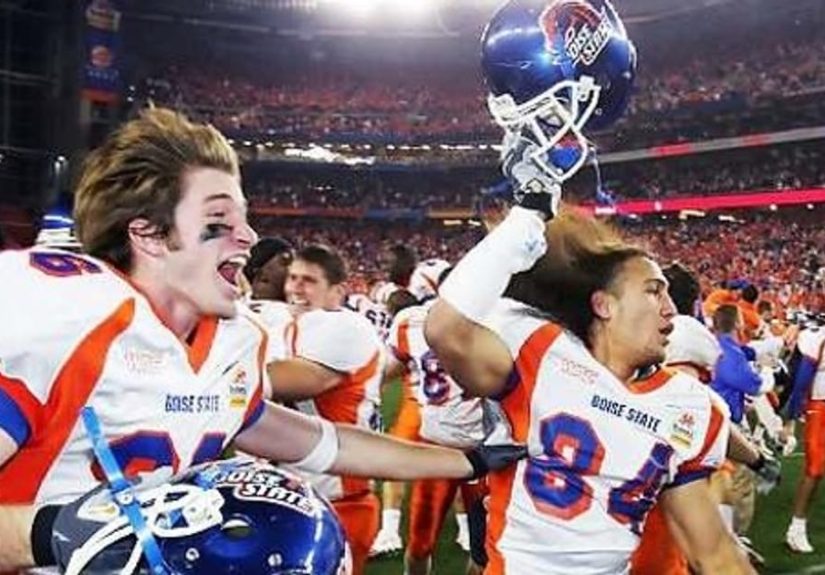
No list of the biggest college bowl game upsets ever can begin anywhere else. The 2007 Fiesta Bowl was not merely a game; it was a movie that somehow escaped the editing room. Boise State, the unbeaten Western Athletic Conference champion, faced Oklahoma, a Big 12 champion with national titles, NFL talent, and a helmet that practically introduced itself with a résumé.
The Broncos were not supposed to win. They were supposed to smile politely, enjoy the big stage, and let Oklahoma remind everyone how the food chain worked. Instead, Boise State punched first, built a 28-10 lead, survived a furious Sooners comeback, and then turned the final minutes into college football theater.
There was a hook-and-lateral touchdown to force overtime. There was a wide receiver pass for another touchdown. Then came the Statue of Liberty two-point conversion, with quarterback Jared Zabransky faking a throw and handing the ball behind his back to Ian Johnson, who ran untouched into history. Boise State won 43-42, Johnson proposed to his girlfriend after the game, and every fan watching learned that trick plays are only “gimmicks” when they fail.
Miami 31, Nebraska 30 1984 Orange Bowl
The Two-Point Decision That Built a Dynasty
The 1984 Orange Bowl remains one of the most consequential bowl upsets in college football history. Nebraska entered as the undefeated No. 1 team, powered by a devastating offense and positioned to win the national championship. Miami, playing close to home, was dangerous but not yet the intimidating machine it would become.
The Hurricanes played fearless football and led 31-17 before Nebraska rallied. With 48 seconds left, the Cornhuskers scored to make it 31-30. A conventional extra point likely would have given Nebraska enough to claim the national title. Instead, coach Tom Osborne chose to go for two and the win. The conversion failed when Miami broke up the pass, and the Hurricanes captured a 31-30 victory.
That decision has been debated for decades, but it also became a monument to competitive courage. Miami’s win announced the Hurricanes as a national power, while Nebraska’s loss became one of the most famous “what if” moments in bowl history.
Penn State 14, Miami 10 1987 Fiesta Bowl
When Defense Turned Swagger Into Static
The 1987 Fiesta Bowl had everything: unbeaten teams, national championship stakes, clashing personalities, and a Miami team that looked like it had arrived from the future wearing fatigues and confidence. The Hurricanes had Heisman Trophy-winning quarterback Vinny Testaverde and a roster loaded with speed. Penn State had discipline, patience, and a defense that treated turnovers like holiday gifts.
Miami moved the ball, but Penn State controlled the scoreboard. Testaverde threw five interceptions, including a late pick near the goal line that sealed the Nittany Lions’ 14-10 victory. The upset showed that explosive talent can still be dragged into a rock fight if the opponent refuses to panic.
In terms of style, this was the opposite of Boise State-Oklahoma. There were no fireworks finales or cute trick plays. Penn State won by squeezing the game until Miami made the mistakes. It was not glamorous, but neither is a padlock.
Texas 41, USC 38 2006 Rose Bowl
Vince Young Refuses to Follow the Script
Calling Texas over USC an “upset” can start arguments, because the Longhorns were unbeaten and elite. Still, USC entered the 2006 Rose Bowl as the defending powerhouse, riding a massive winning streak and carrying the aura of a team already being discussed among the greatest ever. Texas was respected. USC was mythologized.
Then Vince Young happened. The Texas quarterback produced one of the greatest individual performances in bowl history, piling up yards through the air and on the ground. With 19 seconds left, facing fourth-and-five, Young sprinted into the corner of the end zone to give Texas a 41-38 lead and the national championship.
This upset was not about a tiny underdog slaying a giant. It was about one elite team cracking the legend of another. USC’s dynasty aura took a hit, Texas won its first consensus national title in decades, and Young’s final dash became one of the sport’s signature images.
Utah 31, Alabama 17 2009 Sugar Bowl
The BCS Buster With Teeth
Before Utah joined a power conference, the Utes were the kind of undefeated outsider the BCS era never quite knew what to do with. They entered the 2009 Sugar Bowl unbeaten, fast, disciplined, and tired of hearing why Alabama’s SEC pedigree should settle the matter before kickoff.
Utah opened the game like it had a plane to catch, scoring three first-quarter touchdowns and jumping ahead 21-0. Alabama settled down, but the Crimson Tide never fully solved Utah’s pressure, tempo, or confidence. The Utes won 31-17 and finished 13-0, delivering one of the loudest statements ever made by a non-power-conference program.
This was not a fluky bounce-and-pray upset. Utah controlled large stretches of the game. The win helped push the national conversation toward broader postseason access, because the Utes looked less like party crashers and more like guests who should have been invited in the first place.
UCF 52, Baylor 42 2014 Fiesta Bowl
The Knights Bring a Track Meet to the Desert
Baylor arrived at the 2014 Fiesta Bowl with one of the most explosive offenses in the country. UCF arrived with Blake Bortles, a physical defense, and apparently no interest in playing the role of background scenery.
The Knights beat Baylor 52-42 in a game that felt like someone accidentally leaned on the fast-forward button. UCF’s offense matched Baylor shot for shot, and Bortles accounted for four touchdowns. The Knights were not intimidated by the stage or the Bears’ scoring reputation. They attacked, adjusted, and kept answering.
For UCF, this was a program-defining victory. It proved the Knights could beat a top-tier opponent in a major bowl and helped establish them as one of the strongest rising brands outside the traditional blue-blood circle.
Oklahoma 45, Alabama 31 2014 Sugar Bowl
Trevor Knight Picks the Best Possible Night to Become Unstoppable
Alabama under Nick Saban rarely entered bowl games looking vulnerable. The Crimson Tide were physical, disciplined, and generally allergic to embarrassment. Oklahoma, meanwhile, entered the 2014 Sugar Bowl as a talented but inconsistent team facing a defense filled with future professionals.
Then Trevor Knight played the game of his life. The Sooners quarterback completed 32 passes for 348 yards and four touchdowns, outdueling Alabama’s AJ McCarron and turning the Sugar Bowl into a crimson-colored headache for the favorite. Oklahoma won 45-31, forcing turnovers and repeatedly stretching Alabama’s defense.
The upset became a reminder that bowl season can create one-night legends. Knight never needed to become a permanent superstar for that performance to matter. For one night in New Orleans, he looked like the answer to every question Alabama asked.
Idaho 42, Southern Miss 35 1998 Humanitarian Bowl
The Vandals Pull Off a Point-Spread Shocker
Not every great bowl upset comes wrapped in national championship glitter. The 1998 Humanitarian Bowl deserves a place here because Idaho, a sizable underdog, defeated Southern Miss 42-35 in Boise. The Vandals had been overlooked entering the season, but they won the Big West and finished with a bowl victory that still stands as one of the largest postseason surprises of the modern era.
Freshman quarterback John Welsh threw four touchdown passes, and Idaho forced six turnovers. That is the underdog manual in one sentence: protect your nerve, steal extra possessions, and make the favorite play from discomfort.
Air Force 23, Ohio State 11 1990 Liberty Bowl
Option Football Ruins a Big Ten Holiday
Air Force beating Ohio State in the 1990 Liberty Bowl remains one of those results that looks strange even years later. Ohio State had the brand, the ranking, and the expectation. Air Force had the option offense, quarterback Rob Perez, and no desire to be politely dismissed.
The Falcons won 23-11, with Perez rushing for two touchdowns and Air Force forcing the Buckeyes into a game they did not want to play. Upsets often happen when the underdog controls tempo. Air Force did exactly that, turning the Liberty Bowl into a test of patience and assignment discipline.
TCU 28, USC 19 1998 Sun Bowl
Before TCU Was Cool, TCU Was Annoying
The 1998 Sun Bowl gave TCU a major statement win over USC, long before the Horned Frogs became a familiar name in national conversations. TCU won 28-19 behind a rugged rushing attack led by Basil Mitchell, while the defense held USC’s running game in check.
The Trojans had the famous helmet and the future star power. TCU had a plan. That is often how bowl upsets work. The favorite walks in with the poster; the underdog walks in with a crowbar.
Michigan 19, Alabama 13 2024 ReliaQuest Bowl
The Rainy Reminder That Defense Still Travels
Michigan’s 19-13 win over Alabama in the 2024 ReliaQuest Bowl was a modern reminder that bowl upsets are not extinct. Alabama entered as a heavy favorite, while Michigan was finishing a transition season after winning the national championship the year before.
The Wolverines forced early turnovers, built a 16-0 first-quarter lead, and then held on with defense and field goals. It was not elegant. It was wet, tense, and occasionally chaotic, which is exactly the kind of environment where upsets grow like mushrooms.
Notre Dame 35, Houston 34 1979 Cotton Bowl
The Chicken Soup Game
The 1979 Cotton Bowl is one of the most unforgettable comeback-upset hybrids in college football history. Houston led 34-12 in brutal winter conditions, while Notre Dame quarterback Joe Montana battled illness and cold. After warming up with chicken soup, Montana returned and helped lead the Irish to a stunning 35-34 win.
The game-winning score came as time expired, adding another chapter to Montana’s growing legend. Years before he became known for NFL comebacks, he was already making defensive coordinators question their life choices in bowl games.
Why Bowl Upsets Keep Happening
College bowl games create strange conditions. Teams have long layoffs. Coaches leave for new jobs. Star players may sit out. Younger players get bigger roles. Motivation varies wildly. One team may view the bowl as a reward; the other may view it as a referendum on respect.
That emotional gap is where upsets live. A favorite can be more talented and still lose if it is sloppy, distracted, or surprised by tempo. An underdog can win by shortening the game, forcing turnovers, winning special teams, or simply playing with the dangerous freedom of a team that has already been told it should lose.
The biggest college bowl game upsets ever also show that style matters. Option teams can frustrate bigger defenses. Fast passing attacks can neutralize size. Aggressive defenses can turn star quarterbacks into hurried decision-makers. Bowl season rewards preparation, but it also rewards imagination.
Experience Notes: What Watching College Football Upsets Teaches Fans
Watching a college football bowl upset is a special kind of fan experience. It begins with mild curiosity. Maybe you turn on the game because it is on TV while leftovers are being reheated. Maybe you expect the favorite to pull away by halftime. Then the underdog scores first, the favorite goes three-and-out, and suddenly the room gets quieter. Everyone has the same thought but nobody wants to say it too early: “Hold on… this could get weird.”
The best bowl upsets teach patience. At first, the favorite usually has time to recover. A 10-point lead in the first quarter is interesting, not historic. But as the game moves into the second half, the pressure changes jerseys. The underdog starts believing. The favorite starts pressing. Fans can feel the energy tilt, even through a television screen. Every third down becomes heavier. Every missed tackle feels like a plot twist.
There is also something wonderfully democratic about bowl upsets. College football can be obsessed with hierarchy: blue bloods, recruiting rankings, conference strength, television brands, and playoff arguments. Then a team like Boise State, Utah, UCF, Idaho, Air Force, or TCU walks onto a neutral field and says, “That’s adorable. Please block our edge rusher.” For fans, that is the thrill. The sport’s structure may be unequal, but the field still has 100 yards, two end zones, and a scoreboard that does not care how many national titles your media guide mentions.
Upsets also create memories that outlive ordinary wins. Fans may forget a 34-17 favorite handling business, but they remember trick plays, goal-line stands, impossible comebacks, and quarterbacks having the night of their lives. They remember where they were when Boise State ran the Statue of Liberty. They remember Vince Young gliding into the end zone. They remember Utah punching Alabama in the mouth early and never apologizing. Great upsets become emotional bookmarks.
For writers, bloggers, and sports fans, these games are useful reminders not to reduce football to predictions. Analysis matters. Talent matters. Coaching matters. But belief, timing, preparation, health, weather, matchups, and plain human weirdness matter too. Bowl games are played by college athletes, not spreadsheets wearing shoulder pads.
The next great bowl upset may not announce itself. It may appear in a mid-tier bowl with a strange sponsor name, a rainy field, and a quarterback most casual fans have never seen. That is the beauty of the postseason. Somewhere, a favorite is assuming the script is already written. Somewhere else, an underdog is quietly sharpening an eraser.
Conclusion
The biggest college bowl game upsets ever survive because they do more than surprise us. They challenge the sport’s assumptions. Boise State proved that creativity could rattle tradition. Miami proved that one bold stop could change a dynasty’s direction. Penn State proved that defense can humble swagger. Utah and UCF proved that outsiders can be more than cute stories. Texas proved that even a giant can upset another giant when the moment demands greatness.
Bowl season remains college football’s annual reminder that certainty is a dangerous hobby. The favorite may have the ranking, the roster, and the national spotlight. But the underdog has a helmet tooand sometimes, tucked behind its back, a Statue of Liberty play waiting to ruin everybody’s bracket of expectations.