Table of Contents >> Show >> Hide
- Why Monday Night’s Aurora Was Such a Big Deal
- Where the Southern Lights Were Seen Across Australia
- The Science Behind the Glow
- Why This Event Matters Beyond Pretty Photos
- How to Catch the Next Aurora Australis in Australia
- Australia’s Monday Night Aurora Was a Reminder to Look Up
- What It Actually Feels Like to Stand Under the Southern Lights
Note: This web-ready article is intentionally presented without source links or placeholder citation artifacts.
For a few unforgettable hours on Monday night, Australia looked like it had quietly upgraded its atmosphere. The southern sky glowed in ribbons of green, pink, red, and violet, and suddenly the aurora australis was not just a thing for hardcore sky nerds in parkas. It was a national spectacle. Cameras clicked, social feeds exploded, and plenty of people who had stepped outside for “just a minute” ended up standing in the dark whispering variations of, “Well, that escalated beautifully.”
The event was tied to a severe geomagnetic storm that slammed into Earth after a powerful burst of solar activity. In plain English: the sun threw a cosmic tantrum, Earth’s magnetic field absorbed the hit, and Australia got the light show. While the southern lights are not unheard of in Australia, what made Monday night special was the intensity, the color, and the reach. This was not a faint smear near the horizon that only a long-exposure camera could love. In many places, it was vivid, dramatic, and unmistakably theatrical.
And that is why this night stood out. Australia did not just get a southern lights sighting. It got a genuinely stunning aurora eventone that reminded everyone that the night sky still knows how to steal the show without even charging a ticket fee.
Why Monday Night’s Aurora Was Such a Big Deal
A severe solar storm arrived with excellent timing
The southern lights appear when charged particles from the sun interact with Earth’s magnetic field and atmosphere. Normally, that action stays closer to the poles, which is why auroras are most often associated with places like Antarctica, Iceland, or northern Canada. But when a strong coronal mass ejection reaches Earth and triggers a major geomagnetic storm, the auroral oval expands. That means the lights can be seen much farther from the poles than usual.
That is exactly what happened here. The storm reached severe levels, which is the kind of space-weather language that tends to make scientists perk up and photographers cancel their evening plans in the best possible way. The result was a broader and brighter auroral display, visible across much of southern Australia and, according to some reports, even farther north than many people expected. In other words, this was not your average “maybe, if you squint” aurora night.
Dark skies made the colors pop
Australia got lucky in another way: the timing around the lunar cycle helped. Darker skies always improve aurora visibility, and when you combine that with a strong storm, the odds shift dramatically in favor of ordinary people actually seeing something extraordinary. Add clean southern horizons, lower light pollution, and the naturally aurora-friendly geography of places like Tasmania, coastal Victoria, and parts of South Australia, and you have the recipe for a night sky flex.
This matters because auroras are often a little misunderstood. People imagine them as giant neon curtains guaranteed to appear on command. In reality, they are moody, timing-sensitive, cloud-hating performers. Monday night, though, the conditions lined up almost suspiciously well.
Where the Southern Lights Were Seen Across Australia
Tasmania once again played the role of overachiever
If Australia had a permanent VIP section for aurora viewing, Tasmania would be running it. The island state’s southerly latitude, relatively dark skies, and open views toward the Antarctic region make it one of the best places in the country to catch the aurora australis. Monday night was no exception. Tasmania delivered the kind of photos that make people immediately search “cheap flights Hobart” and reconsider every life choice that led them to spend the night indoors.
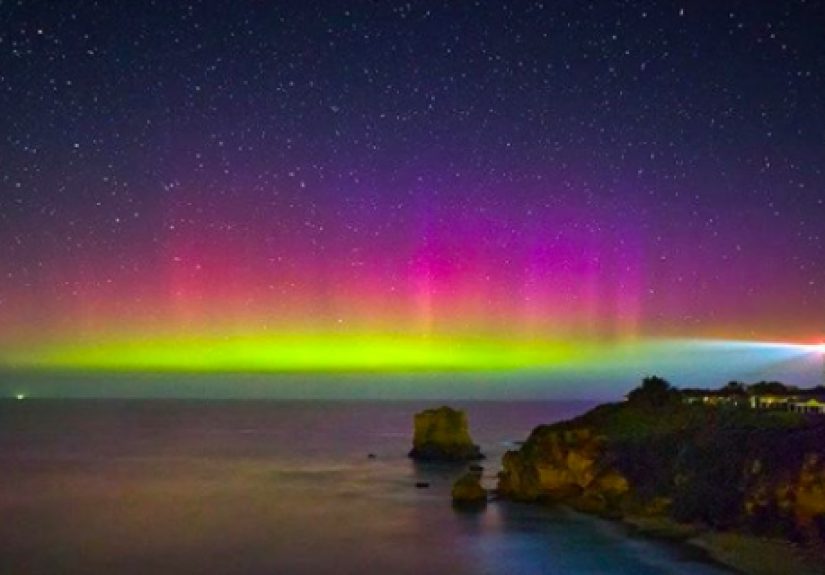
Bright arcs of color, soft red glows, and layered bands of green appeared across familiar southern lights hotspots. In some places, the display looked painterly and serene. In others, it looked like the sky had decided to try abstract expressionism.
The mainland got its moment too
This was not just a Tasmania story. Reports and photographs poured in from Victoria, New South Wales, South Australia, and Western Australia. That broader geographic spread is one reason the event felt so massive. People who do not normally expect to see the southern lights suddenly had a real shot.
Some observers reported bright red and pink glows near the horizon, while others captured more structured curtains and vertical rays. There were also reports that the aurora reached unusually far north, which is exactly the kind of sentence that makes space-weather fans grin like they have been waiting all year to say, “Told you the sun was still active.”
When an aurora reaches beyond its usual range, it changes the vibe entirely. It stops being a niche astronomy event and becomes a shared national moment. The sky is suddenly part science lesson, part public art installation, and part cosmic jump scarethough a very pretty one.
The Science Behind the Glow
It starts at the sun, not in the clouds
Auroras begin with solar activity. The sun constantly releases charged particles in the solar wind, but major eruptions such as solar flares and coronal mass ejections can send far more energy toward Earth. When that energy collides with Earth’s magnetosphere, particles are funneled toward the polar regions. Once they slam into gases in the upper atmosphere, those gases release energy as light. Cue the celestial drama.
Think of Earth’s magnetic field as a giant shield that also doubles as a traffic director. During a strong storm, it sends incoming particles toward the poles, where they interact with oxygen and nitrogen high above the surface. That interaction is what creates the moving glow we call the northern and southern lights.
Why the colors looked so intense
Color depends on which atmospheric gases are getting energized and at what altitude. Green is the most common aurora color, usually produced by oxygen at lower altitudes. Red can appear when oxygen is excited higher up, and blues or purples can come from nitrogen. Pink often shows up when several colors blend together in a bright display, which is one reason photographs from Monday night looked so ridiculously good.
That vivid palette also explains why this aurora felt more dramatic than a typical faint horizon glow. When people talk about a “stunning” southern lights event, they usually mean one with strong color contrast, visible structure, and enough brightness to be seen without specialized equipment. Monday night checked all three boxes.
Why This Event Matters Beyond Pretty Photos
It is easy to reduce an aurora to Instagram bait. To be fair, it is elite Instagram bait. But strong auroral events also tell us something important about the sun-Earth relationship. A storm powerful enough to push auroras far beyond their normal range is also a reminder that space weather is real weather. It can affect satellites, radio communications, navigation systems, and, in extreme cases, power infrastructure.
That does not mean every colorful sky is a technological disaster in disguise. It does mean that beautiful auroras are often the most visible public sign of a much larger geophysical event. The same solar activity that creates those gorgeous colors can create headaches for the systems modern life relies on. So while photographers were celebrating on beaches and headlands, forecasters were also tracking a legitimate space-weather event with serious technical relevance.
There is also a timing angle here. Even though solar activity is beginning to ease from the peak of Solar Cycle 25, experts have made it clear that strong auroras are still very possible in 2026. Solar cycles do not shut off like a bedroom lamp. They wind down, wobble, surge, and occasionally toss in one last memorable performance. Monday night was a strong argument for staying alert, even if the cycle is no longer at its absolute peak.
How to Catch the Next Aurora Australis in Australia
Go south, go dark, and go patient
If Monday night gave you aurora envy, the basic strategy for future viewing is simple. Get as far south as practical. Find a dark location with a clear view of the southern horizon. Check cloud cover. Then bring patience, snacks, and maybe a jacket, because the universe is majestic but not always warm.
Tasmania remains the gold standard, but parts of Victoria, South Australia, and southern Western Australia can also deliver strong views during big geomagnetic storms. Coastal lookouts, elevated viewpoints, and places away from city light pollution are especially helpful.
Your phone can help more than your eyeballs
Modern smartphones have become surprisingly good aurora assistants. Even when the display looks faint to the naked eye, a phone in night mode or pro mode can often pull out color and structure. That is not cheating. That is technology kindly stepping in to confirm that, yes, the weird pink smear above the ocean is in fact a cosmic masterpiece.
A tripod helps, but even bracing your phone against a railing or rock can improve results. Use a long exposure if possible, keep the lens steady, and resist the urge to wave your device around like a glow stick at a concert.
Australia’s Monday Night Aurora Was a Reminder to Look Up
There are few natural phenomena that can make a grown adult forget about notifications, deadlines, and whether they replied to that email. The southern lights are one of them. Monday night’s display was not just visually impressive; it felt communal. People across different states looked at the same sky and, for a moment, had the same reaction: complete awe.
That is part of the magic. Auroras are ancient, physical, measurable events, but they still feel almost mythic when you are under them. They move like smoke and silk. They shift too fast to fully describe and too slowly to feel like lightning. They are science you can feel in your chest.
So yes, Australia experienced the most stunning southern lights on Monday nightor at the very least, one of the most memorable aurora displays in recent memory. And if the photos were spectacular, the real experience was even better: colder, darker, quieter, and somehow bigger than a screen can hold.
What It Actually Feels Like to Stand Under the Southern Lights
The practical explanation of an aurora is satisfying, but the emotional explanation is something else entirely. Standing under the southern lights does not feel like watching weather. It feels like watching the atmosphere think out loud. First there is uncertainty. You stare at the horizon wondering whether that pale blush is cloud, city glow, camera artifact, or wishful thinking. Then it sharpens. The color deepens. A faint band becomes a curtain, a smear becomes structure, and suddenly everyone around you starts speaking in the same hushed tone people use in churches, museums, and wildlife encounters.
That hush is part of the experience. Auroras do not arrive with thunder. They do not announce themselves like fireworks. They creep in. They gather. They build. The sky goes from ordinary to impossible so slowly that your brain keeps trying to file a complaint. It is one of the few moments in modern life when people instinctively stop performing for the camera and just stare. Even the most dedicated content machine can end up holding a phone at chest height, forgetting to press record.
In Australia, the setting makes the experience even more surreal. You are often facing a dark ocean, a windswept beach, a quiet headland, or an inland lookout with almost no noise except the weather and the occasional startled person saying, “There it is again.” That contrast is powerful. The land feels still, grounded, and ancient. The sky above it behaves like liquid electricity. You become very aware of scale in the best possible way. The coastline is large. The atmosphere is larger. Space, apparently, was in a creative mood.
There is also a strange emotional sequence that tends to happen during a big aurora event. First comes skepticism. Then excitement. Then a brief logistical panic about camera settings. Then, if the display strengthens, a kind of surrender. You stop trying to optimize the experience and just let it happen. That is usually the point where people realize the southern lights are not merely beautiful. They are intimate. They make the sky feel close enough to touch, even though the whole thing is unfolding high above the planet in a collision of solar energy and atmospheric gas.
And afterward, there is the walk back to normal life, which feels mildly ridiculous. You check the time. You notice your hands are cold. Someone asks whether the photos worked. Cars start, doors slam, and the universe returns you to regular programming. But the feeling lingers. You have seen something both scientific and emotional, something predictable in theory and astonishing in practice. That is why big aurora nights live on far beyond the forecast window. People do not just remember the colors. They remember the stillness, the surprise, and the weirdly comforting realization that Earth is part of a much bigger system that occasionally sends us a light show instead of a memo.
Maybe that is the real reason Monday night felt so special. Australia did not just witness a rare aurora. It experienced one of those increasingly uncommon moments when the natural world interrupted the algorithm and won.