Table of Contents >> Show >> Hide
- Why Seeing Massive Star Formation Is So Rare
- The “Caught in the Act” Protostar: A Baby Giant with a Serious Appetite
- How Astronomers See Through the Cosmic Dust: Radio and Submillimeter Sleight of Hand
- Massive Stars vs. Physics: How They Grow Despite Their Own Power
- The New Supporting Evidence: Bursts, Jets, and Cosmic “Highways” of Gas
- Why This Matters: Massive Stars Are the Universe’s “Influencers”
- What Astronomers Actually Measure (And What They Still Argue About)
- FAQ: Quick Answers About Massive Star Formation
- Conclusion: A Baby Giant, a Spinning Disk, and a Front-Row Seat to Stellar Chaos
- Experiences: What It’s Like to Chase the Birth of a Monster Star (and Why It Hooks People)
- 1) The astronomer’s experience: remote nights, real-time suspense
- 2) The “aha” experience: seeing the invisible become a picture
- 3) The observer’s experience: your night sky changes after you learn this
- 4) The community experience: shared excitement over rare events
- 5) The emotional experience: cosmic perspective with a side of humility
Catching a massive star in the act of forming is a little like trying to photograph a lightning bolt
as it’s being invented. The biggest stars are rare, they grow up absurdly fast, and they do it while wrapped in
enough dust to make a blackout curtain jealous. And yetevery so oftenastronomers get lucky, point the right instruments
at the right patch of sky, and snag a genuine baby giant: a protostar already dozens of times more massive than the Sun,
still actively “eating” its way toward adulthood.
This is the story of what it means to witness the formation of an incredibly massive star, what astronomers actually
observed, and why the details (disks, jets, bursts, and a few cosmic “highways”) are reshaping how we think the universe
manufactures its most dramatic overachievers.
Why Seeing Massive Star Formation Is So Rare
Astronomers don’t struggle to find stars. The Milky Way is basically an over-decorated holiday tree. The problem is
finding massive stars at the exact moment they’re being assembled.
They’re uncommon by nature
Massive starsoften defined as those above about eight times the Sun’s massmake up a tiny fraction of all stars. That’s
not just trivia; it’s a logistical nightmare. If only a sliver of the stellar population grows into high-mass monsters,
then a sliver of that sliver will be caught in its earliest, messiest phase.
They form fast, and they form hidden
A Sun-like star can take millions of years to settle down. A truly massive star forms on a cosmic sprint, on the order
of roughly a hundred thousand years for the main growth phaseblink-and-you-miss-it by astronomy standards. Meanwhile,
these stars are born in dense, cold molecular clouds where dust blocks visible light. If you only look with optical
telescopes, you’ll mostly see… dust. Lots of dust. Congratulations: you’ve discovered “the inside of a cosmic pillow.”
They fight their own construction crew
Massive stars produce intense radiation and powerful outflows. In plain terms: as they gain mass, they also generate
enough energy to push back on the very gas that’s trying to feed them. It’s like trying to fill a balloon while someone
is simultaneously turning on a leaf blower aimed directly at your hands.
The “Caught in the Act” Protostar: A Baby Giant with a Serious Appetite
One of the most attention-grabbing “caught in the act” cases involves a massive protostar in our galaxy about
11,000 light-years away, already roughly 30 times the mass of the Sunand still growing.
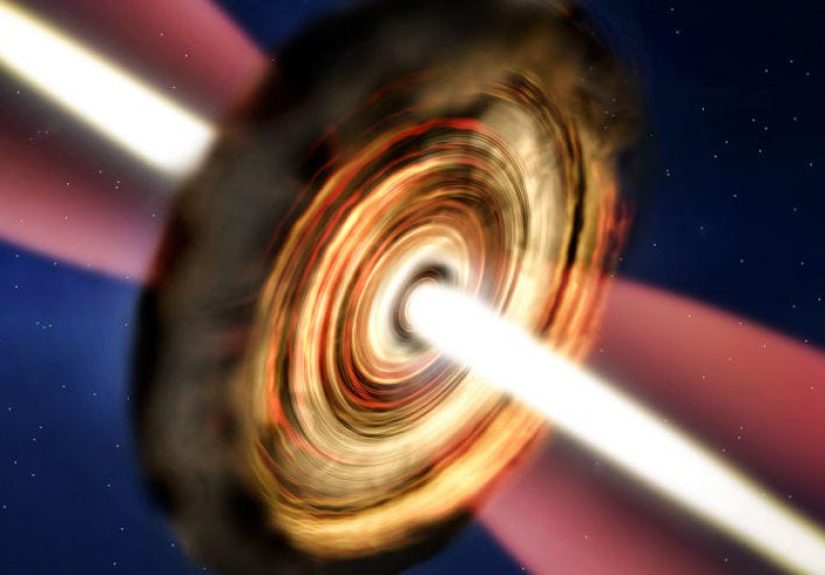
The sheer scale is the headline, but the real science comes from the anatomy: astronomers found compelling evidence that
this heavyweight is forming from a rotating accretion disk, the same basic blueprint that builds stars
like our Sun.
That point matters because massive stars have long been the subject of a debate that can be summarized as:
“Do they form like normal stars, just turned up to 11, or do they require chaotic collisions and mergers?”
When you detect a structured, rotating disk feeding a massive protostar, it strengthens the case that at least some
massive stars can grow via disk accretion rather than needing a demolition derby of smaller stars.
A disk so hefty it may make its own companions
The surrounding disk isn’t just “present.” It’s massive enough that researchers have suggested it could become unstable
and fragmentpotentially forming additional companion protostars. In other words, the “parent” star could end up with
smaller sibling stars born from the same disk. It’s a stellar family plan, assembled at wholesale scale.
How Astronomers See Through the Cosmic Dust: Radio and Submillimeter Sleight of Hand
If visible light is the worst possible flashlight for a dusty stellar nursery, radio and submillimeter wavelengths are
the cheat code. They can pierce through dust that blocks optical views and reveal the glow of cold materialthe very raw
ingredients of star formation.
The telescope tag-team: SMA + VLA
In this case, astronomers relied on a powerful combo:
the Submillimeter Array (SMA) in Hawai‘i and the Karl G. Jansky Very Large Array (VLA) in
New Mexico. These aren’t single “big dishes” so much as carefully synchronized networks of antennas. Working together as
interferometers, they can achieve sharp detailmore like turning many instruments into one virtual telescope.
Why it helps: submillimeter observations trace dust emission and key molecules, while radio observations can track
additional signatures from gas and compact structures. Together, they let astronomers map both the material around the
protostar and how it moves.
The crucial clue: “Keplerian” rotation
A strong hallmark of an accretion disk is how rotation speed changes with distance: material closer in orbits faster
than material farther out, following the kind of gravity-driven behavior we see in planetary systems. Detecting that
pattern in the gas and dust around a massive protostar is like finding the fingerprints of disk-fed growth.
Massive Stars vs. Physics: How They Grow Despite Their Own Power
If massive stars blast out radiation strong enough to push gas away, how do they keep gaining mass? The best modern
answer is: they don’t grow in a neat, steady trickle. Growth can be lopsided, channelized, and
shockingly variable.
Jets and outflows: the surprisingly helpful “exhaust system”
Protostars often launch jetsnarrow, high-speed streams of material shooting from the poles. It sounds counterproductive
(why throw away material you could eat?), but jets can solve a key problem: angular momentum. Gas can’t fall straight in
if it’s spinning too fast. Jets and disk winds can help carry away that excess spin, letting more material accrete.
Recent observations with facilities like ALMA and the James Webb Space Telescope have helped pin down where jets launch
and how they carry rotationsupporting models where magnetic fields help fling material outward while allowing the star
to keep feeding.
Radiation pressure doesn’t always win
For decades, the fear was that radiation from a growing massive star would create a “hard stop” for accretion. But
simulations and observations increasingly show that disks, outflow cavities, and asymmetric inflows can create pathways
where gas still makes it to the protostar. The universe, it turns out, is very good at finding loopholes.
The New Supporting Evidence: Bursts, Jets, and Cosmic “Highways” of Gas
The rare sighting of a disk-fed massive protostar doesn’t stand alone anymore. Over the last few years, astronomers have
stacked up complementary clues that massive star formation is a dynamic, sometimes chaotic process.
1) Growth spurts: when a protostar suddenly flares
Observations with ALMA have revealed dramatic outbursts where a massive protostar brightens sharplyconsistent with a
sudden surge of material crashing onto the star. Think “avalanche feeding.” These events support the idea that young
starsespecially massive onescan grow in bursts rather than by perfectly steady accretion.
2) Giant jets from monster babies
NASA’s Webb Space Telescope has captured striking images of immense jets associated with rapidly growing massive stars,
showing that outflows can be enormous and rare at the highest masses. Meanwhile, Hubble observations have highlighted
massive protostars launching exceptionally long jets and lighting up Herbig-Haro shock regionsdramatic evidence that
jets aren’t just a low-mass-star phenomenon.
3) Streamers: the “cosmic highways” feeding the disk
A newer idea gaining traction is that some massive protostars don’t rely only on a tidy disk. They may also be fed by
larger-scale streamersextended flows of gas funneling material from far out toward the inner regions.
If radiation pressure is the bouncer at the club door, streamers are the friends who show up with a VIP wristband.
High-resolution ALMA work has begun to map these kinds of inflows, suggesting massive stars can be supplied by structures
spanning thousands of astronomical unitshelping them outpace the feedback that would otherwise starve them.
Why This Matters: Massive Stars Are the Universe’s “Influencers”
Massive stars are few in number but loud in impact. They shape galaxies and star-forming regions disproportionately,
thanks to their radiation, winds, and eventual supernova explosions.
-
They sculpt stellar nurseries: outflows and radiation can compress or disperse nearby gas, influencing
the next generation of stars. -
They seed the cosmos: supernovae spread heavy elements that later become planetsand, eventually,
biology’s favorite building blocks. -
They create exotic systems: massive stars often form in clusters and frequently end up in binaries or
multiples, which can later produce X-ray binaries, neutron stars, and black holes.
So when astronomers capture the formation of a massive star with a disk, jets, and potential fragmentation, they’re not
just writing a biography for one object. They’re calibrating how galaxies build the short-lived stars that drive
evolution on grand scales.
What Astronomers Actually Measure (And What They Still Argue About)
Mass estimates aren’t pulled from a hat
The mass of a forming star is typically inferred from how surrounding gas moves (its velocity field), how much dust
emission is present, and what molecular lines reveal about temperature and density. Disk rotation can provide a handle
on the central massif you can resolve it well enough.
Disks can hide complexity
A disk may look smooth at one resolution and lumpy at another. Higher-resolution follow-up (often with ALMA) can reveal
substructure: spiral arms, fragmentation, or inflows that aren’t perfectly symmetric. In massive star formation, that
messiness isn’t a nuisance; it’s the point.
The big open questions
- How common is disk-fed formation for the most massive stars?
- When does a disk fragment into companions versus staying intact?
- How do magnetic fields shape jets and regulate accretion at the highest masses?
- Do streamers dominate the feeding process in some environments?
FAQ: Quick Answers About Massive Star Formation
How massive is “massive,” really?
In star-formation talk, “massive” often starts around eight solar masses (the threshold where stars typically end their
lives as core-collapse supernovae). The “incredibly massive” category includes objects tens of solar masses and beyond.
Can planets form around massive stars?
In principle, disks are where planets form. In practice, massive stars evolve quickly and blast their surroundings with
intense radiation, making long-term, stable planet formation more challenging. But disks can also form companionsother
starsif they become gravitationally unstable.
Why not just use a bigger optical telescope?
Dust is the villain here. Optical light gets scattered and absorbed. Radio and infrared observationsespecially with
facilities like ALMA, JWST, SMA, and the VLAcan see deeper into dusty regions where massive stars are born.
What’s next?
The next steps are usually higher resolution and broader wavelength coverage: ALMA to sharpen disk structure, JWST to
characterize warm dust and outflows, and next-generation radio facilities to trace gas kinematics even closer to the
protostar.
Conclusion: A Baby Giant, a Spinning Disk, and a Front-Row Seat to Stellar Chaos
Astronomers rarely get to watch the universe build its most massive stars in real timebecause those stars form quickly,
form far away, and form behind thick curtains of dust. That’s why a massive protostar tens of solar masses deep in its
growth phase is such a prize: it offers direct evidence that even the biggest stellar “influencers” can form through a
rotating accretion disk, with jets and outflows helping manage the physics of growth.
The emerging picture is not a single tidy method, but a toolkit: disks that feed, jets that vent, bursts that accelerate,
and streamers that deliver fresh fuel from far beyond the immediate neighborhood. Massive star formation is less like a
calm bake-off and more like a high-speed cooking show where the kitchen occasionally catches fireyet dinner still gets
served.
Experiences: What It’s Like to Chase the Birth of a Monster Star (and Why It Hooks People)
This is the part that doesn’t always come through in the headlines: massive star formation isn’t just a topicit’s an
experience. Not because anyone is floating next to a protostar with a clipboard (space is surprisingly strict
about “no visitors”), but because the work of catching these objects has a distinct rhythm, full of equal parts awe,
patience, and occasional “Wait… did the universe just do that?”
1) The astronomer’s experience: remote nights, real-time suspense
Much of modern observing is remote. You can be sitting at a deskcoffee in hand, hoodie on, lights dimwhile a telescope
array on a mountaintop or in a desert quietly collects faint signals from a dusty cloud 11,000 light-years away. The
vibe is part mission control, part quiet chess match. You don’t “see” the star directly; you watch data arrive, numbers
and spectra and calibration scans, and you try to tell whether you’re measuring a disk, a jet, or an overachieving
collection of noise pretending to be science.
Interferometers add a special flavor: you’re not working with one dish but a synchronized team. That means there are
extra stepscalibrators, phase corrections, weather checks, and the kind of problem-solving that makes you feel like
you’re doing astrophysics and advanced emotional regulation at the same time. When the data finally clickswhen the
velocity gradient lines up and the disk rotation looks realit’s not just “interesting.” It’s a small, personal victory
over the universe’s insistence on being complicated.
2) The “aha” experience: seeing the invisible become a picture
People often imagine astronomy as taking a pretty photo. A lot of it is actually turning invisible signals into
something interpretable. That’s its own kind of thrill. Submillimeter and radio maps don’t look like postcards at first.
They look like contours and blobs and color scales that resemble abstract art made by a sensible printer. Then you learn
what they mean: the bright patch is dust, the line emission traces a specific molecule, and the shift in frequency tells
you how fast the gas is moving. Suddenly, you’re not looking at “a blob.” You’re looking at a disk feeding a star that’s
going to end as a supernova. That mental flip is addictive.
3) The observer’s experience: your night sky changes after you learn this
Even for non-astronomers, learning how massive stars form changes how you look at the sky. The next time you see the Milky
Way (or even a photo of it), you start thinking in layers: somewhere in those dark lanes are cold molecular clouds; in
some of those clouds are infrared dark regions; inside those, stars are being built behind curtains of dust. The visible
sky becomes the surface of a deeper story, like realizing your city has an entire subway system underneath it.
4) The community experience: shared excitement over rare events
When a massive protostar flares or a jet is imaged in unprecedented detail, it’s not just another paperit’s an event.
Researchers share plots, compare notes, and debate what’s “real structure” versus “instrumental artifact.” Students get
pulled into emergency reading groups. Social feeds fill with side-by-side comparisons of models and observations.
Someone inevitably says, “This is either the coolest disk ever or the universe is trolling us.” Both are plausible.
5) The emotional experience: cosmic perspective with a side of humility
There’s something uniquely humbling about massive star formation. These stars live fast and die young, yet they reshape
entire regions of space and seed the cosmos with the raw materials for future worlds. And the “rare sight” astronomers
catch is usually not a clean, cinematic momentit’s a careful reconstruction from faint signals, teased out with physics,
math, and persistence. That combinationgigantic phenomena revealed through tiny measurementsgives people a particular
kind of awe: the feeling that the universe is both understandable and endlessly capable of surprise.
If you want a personal takeaway, it’s this: massive star formation is a reminder that nature doesn’t wait for perfect
conditions. It builds giants inside chaos, behind dust, under pressure, with feedback blasting in every directionand
still manages to assemble something brilliant. Honestly, it’s a little inspirational. (And, unlike motivational posters,
it also occasionally explodes.)