Table of Contents >> Show >> Hide
- Why Build a Gothic Monastery in the 21st Century?
- The Real-World Project: New Mount Carmel in Wyoming
- What CAD/CAM Means in This Monastery
- Why CNC Stone Carving Makes Gothic Architecture Possible Again
- The Stone: Why Material Still Matters
- Gothic Architecture Is Already Engineering
- The Design Challenge: Beauty Without Guesswork
- Human Craft Has Not Disappeared
- Why This Project Matters Beyond Religion
- Specific Examples of CAD/CAM in the Monastery Workflow
- The Experience of Seeing Old and New Work Together
- Experience-Based Reflections: What This Topic Teaches Makers, Designers, and Builders
- Conclusion
At first, the idea sounds like a joke told by an architect after too much coffee: a group of cloistered monks in the mountains of Wyoming decide to build a medieval Gothic monastery, not with a giant army of stone carvers from the 1200s, but with CAD/CAM software, CNC machines, diamond-tipped tools, and a level of patience that would make most modern project managers quietly leave the room.
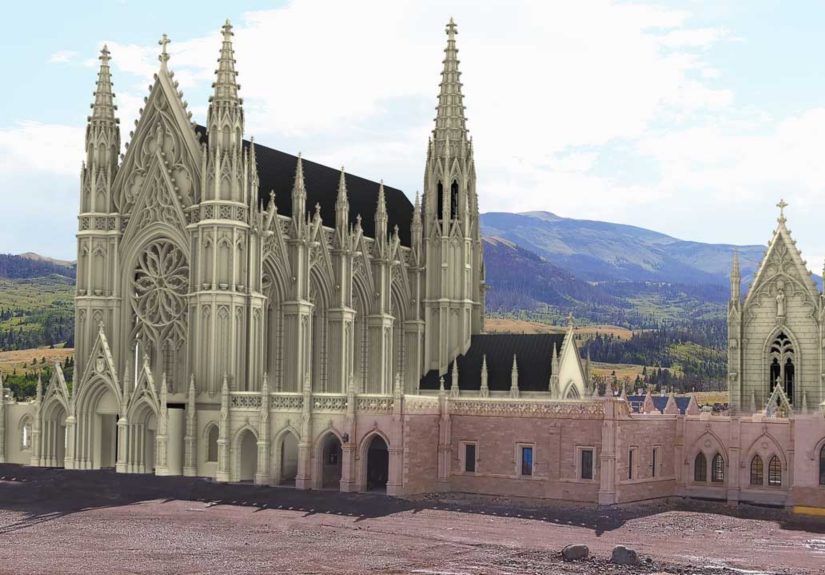
Yet that is exactly what makes the story so fascinating. The Carmelite Monks of Wyoming, based near Meeteetse in the Rocky Mountains, have been building the New Mount Carmel monastery in a traditional Gothic style using a surprising mix of ancient architectural principles and modern digital manufacturing. The result is not a fake castle, not a theme-park chapel, and not a “medieval-ish” building wearing a Halloween costume. It is a serious stone monastery designed to last for generations, with pointed arches, carved capitals, tracery, vaulted forms, and ornamental details shaped through a workflow that belongs as much to aerospace manufacturing as to medieval masonry.
In other words: if the Middle Ages had a software license, a 5-axis CNC machine, and a good dust collection system, this might be what it looked like.
Why Build a Gothic Monastery in the 21st Century?
Gothic architecture has always been about more than style. It is an architectural language of height, light, rhythm, and structure. Medieval builders used pointed arches, rib vaults, flying buttresses, pinnacles, tracery, and stained glass to create spaces that pulled the eye upward. In a church or monastery, that upward movement was not accidental. The architecture was meant to lift the mind from ordinary concerns toward contemplation.
For the Carmelite monks, the Gothic style fits their purpose because monastic life is built around prayer, silence, manual labor, and spiritual discipline. A monastery is not simply a dormitory with better stonework. It is a complete environment: chapel, refectory, cloister, chapter house, library, workspaces, hermitages, and quiet places where daily life follows a sacred rhythm. Gothic architecture gives that rhythm a visible form.
The New Mount Carmel project also reflects a long tradition of monasteries being built by the communities that live in them. Medieval monasteries were not merely commissioned objects; they were often the result of generations of labor, local materials, and accumulated craft knowledge. The Wyoming project updates that tradition with a modern twist: the monks are not only setting stones and carving details, but also learning the digital tools needed to make highly complex stone architecture possible today.
The Real-World Project: New Mount Carmel in Wyoming
The New Mount Carmel monastery is being built in the mountains near Meeteetse, Wyoming, a remote setting that supports the Carmelite ideal of solitude. The New Mount Carmel Foundation began construction of the monastery in 2014, and the buildings have been constructed in a traditional Gothic style using stone and masonry intended to stand for centuries.
The scale of the work is ambitious. The monastery is not a small chapel dropped into the wilderness like a postcard. It includes major monastic buildings, with the chapel at the heart of the design. Recent construction updates have described thousands of individual stones prepared for the chapel, including carefully numbered pieces so each one can be set in its exact place. That detail matters. Gothic architecture may look poetic, but behind the poetry is a stern, mathematical boss. Put the wrong stone in the wrong spot and the building does not say, “Nice try.” It says, “Please enjoy your structural problem.”
The monks chose to take much of the stonework into their own hands after outside bids made the project financially unrealistic. Stone carving was one of the most expensive parts of the plan, especially because Gothic architecture requires complex profiles, repeated ornamental patterns, sculptural details, and tight coordination between design and construction. Rather than abandon the vision or simplify it into blandness, the monks learned the tools.
What CAD/CAM Means in This Monastery
CAD/CAM stands for computer-aided design and computer-aided manufacturing. CAD is used to create digital models, drawings, and design information. CAM takes those digital models and turns them into instructions that machines can follow. In the case of stone carving, those instructions guide CNC equipment as it cuts, mills, profiles, and shapes stone.
A simple way to understand the workflow is this: the idea begins as architecture, becomes a 3D model, turns into toolpaths, and then becomes carved limestone. The computer does not replace the artist or the builder. It translates their decisions into precise movements that a machine can repeat without getting tired, distracted, or suddenly deciding it would rather become a lifestyle influencer.
For the monastery, this means that ornamental elements such as foliage, window tracery, capitals, pinnacles, moldings, arches, and sculptural details can be modeled digitally before stone is touched. The design team can visualize how parts fit into the larger building, make adjustments, and reduce guesswork. Once the model is ready, CAM software generates the toolpaths that tell the CNC machine where to cut, how deep to go, what tool to use, and how to avoid crashing into the stone like a very expensive mechanical goat.
Why CNC Stone Carving Makes Gothic Architecture Possible Again
Traditional hand carving is beautiful, but it is also slow, expensive, and dependent on highly specialized artisans. Gothic architecture demands repetition and complexity: moldings around windows, ribs for vaulting, carved capitals, tracery patterns, decorative foliage, and symbolic figures. In the medieval period, workshops trained generations of masons and sculptors to produce those forms. Today, that labor ecosystem is rare.
CNC stone carving changes the equation. A skilled digital artist or programmer can model a piece, test it virtually, and prepare it for machining. A 5-axis CNC machine can then approach the stone from different angles, shaping forms that would be extremely difficult with simpler equipment. Diamond-tipped tools grind away the stone while water cools the tool and washes away stone slurry. The process still requires human judgment, setup, checking, finishing, and stone-setting skill, but it dramatically reduces the time needed for many repetitive or highly detailed pieces.
That does not mean the machine magically creates Gothic beauty. CNC equipment is powerful, but it is not inspired. It has no opinion about proportion, symbolism, or whether a carved leaf looks graceful or like a nervous cabbage. The quality of the final stone depends on the quality of the design, the programming, the tooling strategy, the material, and the finishing work. In this project, the technology is best understood as a new kind of workshop assistant: tireless, precise, loud, and very bad at Gregorian chant.
The Stone: Why Material Still Matters
A Gothic monastery cannot be built from software alone. At some point, the digital model must meet stone, gravity, weather, and time. The monks selected Kansas Silverdale limestone for much of the cut stone work, a material valued for architectural use and durability. Limestone has a long history in ecclesiastical and civic buildings because it can be shaped, carved, and set into masonry with a balance of strength and workability.
Stone selection is not a decorative afterthought. A monastery in the Wyoming mountains faces cold weather, wind, freeze-thaw cycles, handling challenges, and the sheer physical weight of the material. Large blocks must be cut into manageable pieces, moved safely, machined accurately, labeled, stored, and eventually set into the building. Every carved element has to survive not just the romance of a rendering but the less glamorous realities of cranes, mud, scaffolding, and winter.
This is where CAD/CAM becomes more than a clever headline. Digital planning helps coordinate thousands of individual stones. Each piece has a location, orientation, profile, and relationship to neighboring stones. In Gothic construction, where arches, vaults, windows, and decorative elements depend on precise geometry, that coordination is essential.
Gothic Architecture Is Already Engineering
One reason this project feels surprisingly natural is that Gothic architecture was never anti-technology. Medieval Gothic builders were innovators. They used the best structural knowledge available to make taller, brighter, more expressive buildings. Pointed arches reduced certain lateral forces compared with round arches. Rib vaults organized loads through stone ribs. Flying buttresses moved thrust outward and downward. Tracery allowed walls to open into patterned windows. Pinnacles added weight and visual drama at the same time.
So, while CAD/CAM may seem modern, the spirit behind it is not completely foreign to Gothic architecture. Gothic has always been a style of problem-solving. The medieval mason’s tracing floor, compass, square, template, and plumb line were technologies of their time. Today, the digital model, CAM toolpath, and CNC machine are part of the same long story: people using available tools to make stone do something difficult, meaningful, and beautiful.
The Design Challenge: Beauty Without Guesswork
One of the biggest advantages of digital design is visualization. Gothic buildings are systems of parts. A capital is not just a pretty stone at the top of a column. It relates to the column shaft below it, the arch springing above it, the wall surface behind it, the light falling across it, and the rhythm of surrounding details. When those parts are modeled in a digital environment, builders can see relationships before committing material and labor.
This is especially useful for sculptural decoration. Foliage, vines, flowers, angels, gargoyles, and other Gothic motifs can be shaped in 3D software, reviewed from multiple angles, scaled correctly, and adjusted to fit the exact location. The “undo” button may not sound spiritual, but any sculptor who has ever removed too much stone knows it is practically a miracle in miniature.
After modeling, CAM programming determines how the stone will actually be carved. Roughing passes remove large amounts of material. Finer passes add detail. Tool selection affects texture, time, and accuracy. The programmer must consider tool reach, collision risks, clamping, stone movement, cutting speed, surface finish, and whether the machine can physically do what the model asks. A fantasy on screen becomes real only when the tool can safely reach the geometry.
Human Craft Has Not Disappeared
It is tempting to frame this story as “monks versus machines,” but that misses the point. The monastery is not being built by machines alone. The monks still cut stone, prepare blocks, operate equipment, monitor carving, finish surfaces, set masonry, reinforce delicate details, and solve problems on site. CNC machines can carve, but they do not decide how a chapel should feel when morning light passes through stained glass. They do not understand silence, prayer, proportion, or patience.
Hand finishing remains important because stone rarely comes off a machine as a fully completed architectural object. Edges may need refinement. Details may need softening. Surfaces may need texture. Joints must be checked. Pieces must be handled and installed with care. In traditional building, craft lives in the final inches: the way a line catches light, the way a joint disappears, the way a carved form feels alive rather than mechanically perfect.
That combination of digital precision and human correction is one of the most interesting lessons of the project. Technology is not replacing craft; it is changing where craft happens. Some craftsmanship moves upstream into modeling and programming. Some remains in the hands, chisels, cranes, and decisions on the construction site.
Why This Project Matters Beyond Religion
Even for readers who are not especially interested in monasteries, the New Mount Carmel project raises a larger question: why did we stop building beautiful, durable, ornament-rich buildings so often? The usual answer is cost. Ornament is expensive. Stone is expensive. Skilled labor is expensive. Complex coordination is expensive. Modern construction favors speed, standardization, and easily repeatable assemblies.
CAD/CAM and CNC machining do not eliminate cost, but they make certain forms of complexity more achievable. If a carved detail can be modeled once, refined, and produced accurately, then ornament becomes less impossible. If stone profiles can be cut with repeatable precision, then traditional architecture can return without pretending the last 800 years never happened. This has implications for churches, universities, civic buildings, memorials, custom homes, restoration projects, and high-end public architecture.
The monastery also challenges the lazy assumption that technology always leads to ugliness or that tradition requires rejecting modern tools. Here, advanced manufacturing is being used in service of an ancient aesthetic. The lesson is not “everything should be Gothic.” The lesson is better: technology takes the shape of the values guiding it. Use it only for speed and profit, and it may produce forgettable boxes. Use it for permanence, symbolism, and beauty, and it can help carve stone flowers in the mountains.
Specific Examples of CAD/CAM in the Monastery Workflow
1. Digital Sculpting of Gothic Ornament
Complex decorations such as foliage, flowers, vines, and sculptural figures can begin as digital models. This allows artists to explore proportions, modify details, and fit ornament into the larger architectural composition before stone is cut.
2. CAM Toolpath Programming
Once a model is approved, CAM software creates machining instructions. These toolpaths determine how the CNC machine removes stone in stages, from rough shaping to finer detail work. Good programming saves time, protects tools, and helps prevent expensive mistakes.
3. CNC Cutting and Carving
Stone blocks are prepared and placed on CNC equipment. Diamond-tipped tools carve the forms according to the programmed paths. Because many Gothic elements include curves, deep profiles, and angled surfaces, multi-axis machining is especially useful.
4. Numbering and Stone Setting
Thousands of stones may be cut for a single major portion of the chapel. Numbering pieces helps ensure that each stone is installed where it belongs. This is practical, not fussy. Gothic construction is not a jigsaw puzzle you want to solve while standing on scaffolding in Wyoming wind.
5. Hand Finishing and Installation
After machining, human skill returns in finishing, inspection, and masonry. The monks set the stones into the building, combining digital fabrication with traditional construction methods.
The Experience of Seeing Old and New Work Together
There is something deeply satisfying about watching a modern machine carve a form that looks medieval. The contrast feels almost theatrical. On one side, there is the cold logic of coordinates, feeds, speeds, tooling, and digital geometry. On the other, there is warm stone, shadow, religious symbolism, and ornament that looks as if it belongs in a manuscript margin. Somehow the two do not cancel each other out. They cooperate.
That cooperation is the heart of the experience. Imagine standing in a stone workshop where a CNC machine is slowly shaping a Gothic pinnacle. The machine does not hurry. It follows its path, pass after pass, removing tiny amounts of material until the block begins to confess what it was meant to become. At first, the stone looks like a stubborn rectangle. Then a profile appears. Then a curve. Then a leaf. Then the object begins to feel architectural. Suddenly, the digital file has weight, texture, and dust.
The experience also changes how we think about medieval builders. We often romanticize the past as if beautiful buildings emerged from pure handwork and candlelight. In reality, medieval construction sites were full of tools, systems, templates, geometry, logistics, and hard practical intelligence. The Wyoming monastery makes that visible in a new way. It reminds us that tradition is not the opposite of innovation. Tradition survives because each generation finds a way to carry it forward.
There is also a lesson in patience. Modern culture loves instant results, but stone does not care about our deadlines. A monastery built from carved limestone asks everyone involved to slow down. Design must be tested. Blocks must be prepared. Machines must be programmed. Stones must be moved. Winter may interrupt the building season. A single mistake can waste material and time. This kind of project has no interest in the “good enough, ship it” mentality. The building is intended to outlast its builders, which changes the moral weight of every decision.
For architects, designers, and makers, the project is inspiring because it shows that digital tools can serve a more humane built environment. CAD/CAM is often associated with industrial production, automotive parts, molds, prototypes, and sleek contemporary surfaces. Here, the same logic supports carved stone, sacred space, and historical continuity. That should make designers curious. If CNC machines can help revive Gothic stonework, what else can they help revive? Better civic ornament? More durable buildings? Custom details that do not require billionaire budgets? Perhaps even neighborhoods with character, instead of endless boxes wearing gray siding like a bad mood.
For everyday observers, the experience is simpler: the project is beautiful because it feels improbable. Monks in a remote mountain setting are using advanced software and machinery to build something that looks ancient, not because they are nostalgic for costume drama, but because they believe beauty matters. That is refreshing. In a world where many buildings seem designed to be ignored, a stone monastery announces that attention is still worthwhile.
Experience-Based Reflections: What This Topic Teaches Makers, Designers, and Builders
Thinking about a medieval Gothic monastery built with CAD/CAM is a bit like holding two tools in your hands: a chisel in one and a computer mouse in the other. At first, they seem to belong to different worlds. The chisel suggests apprenticeship, dust, aching shoulders, and the slow confidence of hand skill. The mouse suggests modeling software, toolpath previews, version control, and the quiet terror of clicking the wrong setting before sending a file to a machine that can chew through stone. But the more you study this project, the more those worlds begin to overlap.
One practical experience this topic highlights is the importance of designing for the real material, not just the screen. Anyone who has worked with digital fabrication knows the trap: the model looks perfect, the render glows like a movie trailer, and then reality arrives wearing steel-toed boots. Stone has grain, weight, weak points, surface variation, and handling limits. A sharp undercut that looks dramatic in a model may be fragile in limestone. A decorative element that seems easy to carve may require a tool too short to reach it. A piece that looks manageable on a monitor may weigh more than a compact car’s bad attitude.
Another experience is the value of iteration. Medieval builders used full-scale drawings, templates, and mockups. Modern CAD/CAM users use models, simulations, toolpath previews, and test cuts. The principle is the same: do not gamble the whole project on an untested assumption. The Wyoming monastery demonstrates that careful repetition can be a form of creativity. Every stone teaches the next stone. Every programming mistake becomes a rule. Every successful cut becomes part of a growing workshop language.
The project also teaches humility. CAD/CAM can make impossible-looking work possible, but it does not make difficult work easy. It simply moves the difficulty around. Instead of spending six months carving one gargoyle entirely by hand, a team may spend days or weeks refining a digital model, selecting tools, preparing stock, testing toolpaths, monitoring machine behavior, and finishing details. The labor changes form, but it does not vanish. That is a useful reminder for anyone tempted to describe technology as a magic wand. It is not a magic wand. It is a very demanding apprentice with motors.
For writers, designers, architects, and builders, the most inspiring part may be the project’s refusal to accept the false choice between beauty and modernity. Too often, contemporary construction treats ornament as waste and tradition as imitation. This monastery suggests another path. A building can use modern tools without looking disposable. It can respect historical forms without becoming a museum prop. It can be practical, digital, durable, symbolic, and deeply handmade in the broadest sense of the word.
There is also an emotional experience in the topic: the pleasure of seeing technology used with restraint. The CNC machine is not the star of the monastery; it is a servant of the design. The software is not there to show off. It is there to help stone become architecture. That hierarchy matters. When tools serve meaning, the final result has depth. When meaning serves tools, the final result often feels like a demo reel with plumbing.
Finally, this story encourages patience with ambitious work. A Gothic monastery is not a weekend DIY project. It is not a “10 easy steps” tutorial, unless step 7 is “develop monastic discipline” and step 8 is “learn advanced stone fabrication.” But that is exactly why the project is worth attention. It reminds us that some things still deserve long effort: buildings meant to last, crafts worth relearning, and beauty that asks more from us than a quick glance.
Conclusion
A medieval Gothic monastery built using CAD/CAM sounds impossible only if we imagine tradition and technology as enemies. The New Mount Carmel project shows that they can be partners. Gothic architecture was born from innovation, geometry, and bold engineering. CAD/CAM continues that spirit by giving modern builders a way to model, machine, refine, and install intricate stonework that would otherwise be financially or practically out of reach.
The Carmelite Monks of Wyoming are not merely copying the past. They are translating it. Their monastery combines prayer, stone, software, machinery, manual labor, and architectural ambition into a project that feels both ancient and startlingly current. It is a reminder that beauty does not have to be abandoned just because the calendar says we live in the 21st century. Sometimes the future arrives wearing a habit, operating a CNC machine, and carving a Gothic capital out of limestone.
Note: This article is written in original editorial language and synthesized from publicly available information about the Carmelite Monks of Wyoming, New Mount Carmel, Gothic architecture, CAD/CAM workflows, CNC stone carving, limestone construction, and modern digital fabrication. Source links are intentionally not included in the body for clean web publication.