Table of Contents >> Show >> Hide
- What “Completely Real” Means (No, They Didn’t Just Yolo It)
- 25 Craziest Real Stunts That Still Make Our Knees Feel Weird
- Mission: Impossible – Rogue Nation (2015): Tom Cruise Clings to a Real Plane
- Mission: Impossible – Fallout (2018): The HALO Jump That Redefined “Commitment”
- Mission: Impossible – Ghost Protocol (2011): The Burj Khalifa Climb
- Mission: Impossible – Fallout (2018): The Rooftop Jump That Broke an Ankle
- Mission: Impossible – Fallout (2018): Learning to Fly a Helicopter (Then Actually Flying It)
- Mission: Impossible – Dead Reckoning (2023): Motorcycle Off a Cliff
- Mission: Impossible 2 (2000): The Moab Free-Climb Opener
- Police Story (1985): Jackie Chan’s Mall Pole Slide Through “Glass Story” Chaos
- Project A (1983): Jackie Chan’s Clock Tower Fall
- Armour of God (1986): The Accident That Nearly Killed Jackie Chan
- Who Am I? (1998): Jackie Chan’s Rooftop Slide
- Mad Max: Fury Road (2015): Practical Mayhem on Wheels
- Mad Max: Fury Road (2015): The “Pole Cat” Swings
- The Dark Knight (2008): The Semi-Truck Flip
- Cliffhanger (1993): The Midair Plane-to-Plane Transfer
- The French Connection (1971): The Reckless Car Chase Under the Train
- Bullitt (1968): The San Francisco Car Chase That Set the Standard
- Ronin (1998): High-Speed Precision Driving (No “Fake Fast”)
- Raiders of the Lost Ark (1981): Indy Gets Dragged Under the Truck
- The Great Escape (1963): The Motorcycle Fence Jump
- Casino Royale (2006): The Parkour Construction-Site Chase
- Skyfall (2012): The Train Fight Setpiece
- Ong-Bak (2003): Tony Jaa’s Barbed-Wire Jump
- John Wick (Franchise): Keanu Reeves’ Physical, Practical Commitment
- Ben-Hur (1959): The Chariot Race “Crash” Moment
- How to Spot Real Stunts (Without Becoming “That Person”)
- Extra: The Real-Stunt Experience (500+ Words of “Why This Hits Different”)
- Final Take
If your palms sweat during action movies, congratulationsyou still possess a functioning nervous system.
And sometimes that nervous system is reacting to something even crazier than the plot: a stunt that was
actually performed for real (usually with a safety rig, a stunt team, and a prayer to the insurance gods).
In an era where a computer can “do the flip,” audiences still light up when a movie proves it can
earn the flip. Real stunts don’t just look differentthey feel different. The weight is right.
The timing is messy in the best way. And your brain, which has watched approximately 10,000 digital explosions,
quietly whispers: “Okay… that one was real.”
What “Completely Real” Means (No, They Didn’t Just Yolo It)
“Completely real” doesn’t mean “no planning” or “no safety.” It usually means the moment you’re seeing is
grounded in practical execution: real heights, real vehicles, real human bodies moving through real space.
There may be wires, harnesses, ramps, and clever camera placementbecause stunts are engineering, not chaos.
But the action itself isn’t a digital invention. The risk is managed, not imaginary.
Also: sometimes the actor does it; sometimes a stunt performer does it; and sometimes the “actor does it”
means “the actor did it enough for the close-up and wisely let a professional do the part where gravity
tries to press the unsubscribe button on life.”
25 Craziest Real Stunts That Still Make Our Knees Feel Weird
-
Mission: Impossible – Rogue Nation (2015): Tom Cruise Clings to a Real Plane
Ethan Hunt doesn’t politely board aircrafthe aggressively becomes aircraft décor. Cruise was strapped in
and clung to the side of a real plane during takeoff. The “how is this allowed?” energy is part of the thrill.Why it’s wild: Wind force plus altitude plus “please don’t blink wrong” is not a vibeit’s a stunt.
-
Mission: Impossible – Fallout (2018): The HALO Jump That Redefined “Commitment”
The film’s HALO (high altitude, low opening) jump sequence wasn’t a CGI flexit was executed practically,
with tight timing, specialized training, and repeated jumps to capture the shot.Why it’s wild: Night skydiving is already intense. Doing it for a movie while hitting marks is athletic math.
-
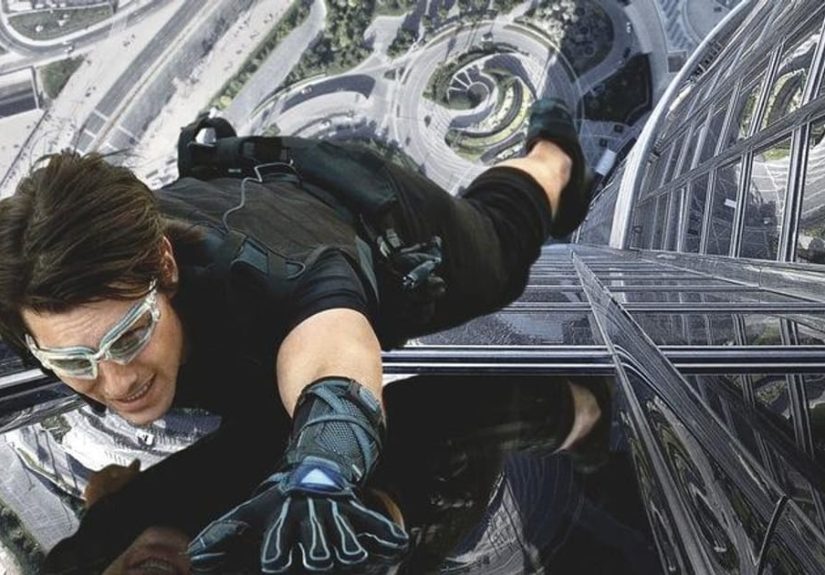
Mission: Impossible – Ghost Protocol (2011): The Burj Khalifa Climb
Scaling the world’s tallest building is the kind of thing most of us attempt only in dreams where our legs don’t work.
Cruise performed the climb sequences on the actual Burj Khalifawith safety systems, yes, but still very much on the real building.Why it’s wild: Heights are scary. Heights with glass and wind are scarier. Heights with “roll camera” are villainous.
-
Mission: Impossible – Fallout (2018): The Rooftop Jump That Broke an Ankle
Sometimes the body says “no” even when the script says “go.” Cruise’s rooftop leap went wrong, resulting in a broken ankle
and the footage still made the final film because it’s painfully, unmistakably real.Why it’s wild: The moment is memorable because your brain clocks the impact as authentic before you do.
-
Mission: Impossible – Fallout (2018): Learning to Fly a Helicopter (Then Actually Flying It)
The helicopter work in Fallout isn’t just “actor sits while the pilot does magic.” Cruise trained extensively and
flew the helicopter for filming, turning the chase into a practical, high-skill stunt sequence.Why it’s wild: Flying is hard. Flying while filming is harder. Flying while acting is basically a résumé crime.
-
Mission: Impossible – Dead Reckoning (2023): Motorcycle Off a Cliff
This one arrived like a cinematic dare: a motorcycle launch into empty space, followed by a base jump.
The sequence was built around real execution, not “we’ll fix it in post.”Why it’s wild: The cliff doesn’t care about your franchise. The cliff is neutral and therefore terrifying.
-
Mission: Impossible 2 (2000): The Moab Free-Climb Opener
That iconic rock-climbing intro wasn’t a studio wall pretending to be Utah. It was filmed on real rock formations,
with real exposure and real physical strain.Why it’s wild: Free-climbing looks cool until you remember humans are basically fancy water balloons.
-
Police Story (1985): Jackie Chan’s Mall Pole Slide Through “Glass Story” Chaos
Chan slides down a pole wrapped in hot lights, crashes through glass, and turns a shopping mall into a demolition derby for display cases.
It’s one of the most famous “yes, he actually did that” stunts ever put on film.Why it’s wild: It’s a stunt that contains multiple stunts… and none of them look comfortable.
-
Project A (1983): Jackie Chan’s Clock Tower Fall
Chan pays homage to silent-era daredevils with a brutal clock tower falldown through awnings and into the ground.
It’s a masterclass in “comedy timing meets physical risk.”Why it’s wild: The landing is the kind of thing your spine watches and immediately files a complaint.
-
Armour of God (1986): The Accident That Nearly Killed Jackie Chan
Not every “real stunt” story ends with applause. During production, Chan suffered a serious head injury on a seemingly simple fall,
a reminder that practical action has real consequences even with planning.Why it’s wild: It underlines why stunt work is respected: it’s controlled danger, not pretend danger.
-
Who Am I? (1998): Jackie Chan’s Rooftop Slide
Chan slides down the steep face of a building like gravity personally offended him. The shot works because it’s not “perfect.”
It’s human and alarming and therefore unforgettable.Why it’s wild: Your inner voice screams “nope” every secondand that’s the point.
-
Mad Max: Fury Road (2015): Practical Mayhem on Wheels
The film’s action feels tactile because so much of it was built from real vehicles, real rigs, real dust, and real stunt coordination.
Even when digital tools appear, the movie’s identity is grounded in practical execution.Why it’s wild: It’s not “one stunt.” It’s a whole ecosystem of moving metal and controlled chaos.
-
Mad Max: Fury Road (2015): The “Pole Cat” Swings
Those warriors swinging on long flexible poles aren’t animated action figuresthey’re stunt performers on physical rigs, timing their swings
with moving vehicles and camera choreography.Why it’s wild: It’s like Cirque du Soleil… if Cirque du Soleil was chased by flamethrowers.
-
The Dark Knight (2008): The Semi-Truck Flip
Christopher Nolan’s team executed a real 18-wheeler flip using practical effectsbecause why simulate a truck flipping
when you can simply flip a truck in the middle of a city street?Why it’s wild: Practical stunts at this scale feel like watching physics do live theater.
-
Cliffhanger (1993): The Midair Plane-to-Plane Transfer
The opening sequence features a jaw-dropping aerial transfer performed practicallyan “I can’t believe that’s real” moment that became legendary.
Why it’s wild: The sky is not a forgiving workplace environment.
-
The French Connection (1971): The Reckless Car Chase Under the Train
The chase is famous partly because it was filmed in ways that feel dangerously close to real traffic and real unpredictability.
It’s raw, fast, and uncomfortably authentic.Why it’s wild: You can feel the lack of “clean” controllike the city itself is an extra in the scene.
-
Bullitt (1968): The San Francisco Car Chase That Set the Standard
Long before modern shaky-cam and digital enhancement, Bullitt delivered a location-driven chase that looks and sounds real because it was
with serious driving and stunt coordination on actual streets.Why it’s wild: It’s not just speedit’s weight, suspension, and asphalt talking back.
-
Ronin (1998): High-Speed Precision Driving (No “Fake Fast”)
Ronin is a car-chase clinic: aggressive lines, tight streets, and a commitment to not “cheat” speed with camera tricks.
It feels real because it largely is.Why it’s wild: The chase has that rare quality of looking fast without looking fake.
-
Raiders of the Lost Ark (1981): Indy Gets Dragged Under the Truck
One of the all-time great stunt gags: Indiana Jones slipping beneath a moving truck and surviving.
The moment was executed with stunt expertise and practical planningbecause it had to be.Why it’s wild: It’s the kind of stunt your brain watches once and then refuses to forget… for safety reasons.
-
The Great Escape (1963): The Motorcycle Fence Jump
The iconic motorcycle jump isn’t “movie magic”it’s stunt work that became film history.
The jump lands as mythic because it’s grounded in real mechanics and real risk.Why it’s wild: The arc of the jump is so clean it feels fictional… until you remember it isn’t.
-
Casino Royale (2006): The Parkour Construction-Site Chase
Bond went full parkour, chasing a freerunning specialist through a construction site with leaps, climbs, and rapid movement that reads as physically real
because it was built around real freerunning ability.Why it’s wild: It’s not just speedit’s body control under pressure, captured with minimal “cheating.”
-
Skyfall (2012): The Train Fight Setpiece
The pre-title sequence includes a brutal fight built around practical staging, real motion, and stunt choreography that sells danger through believable momentum.
Why it’s wild: When the environment is moving, every punch becomes a balancing act.
-
Ong-Bak (2003): Tony Jaa’s Barbed-Wire Jump
Ong-Bak helped reintroduce audiences to visceral, practical martial-arts actionand Tony Jaa’s stunts became a calling card for “no, seriously, he did it.”
Why it’s wild: The “how is that skin intact?” factor is doing a lot of heavy lifting here.
-
John Wick (Franchise): Keanu Reeves’ Physical, Practical Commitment
The John Wick films lean on choreography and practical performanceespecially in close-quarters action
and Reeves’ willingness to grind through demanding stunt work helps sell the impact.Why it’s wild: It’s not one death-defying leapit’s sustained precision, take after take, until it looks effortless.
-
Ben-Hur (1959): The Chariot Race “Crash” Moment
The chariot race remains legendary because so much of it is physical performance, stunt coordination, and real danger managed in-camera.
It’s old-school spectacle with real stakeseven when rumors exaggerate what happened on set.Why it’s wild: The chaos has texture: dust, speed, bodies, horses, and the unmistakable feel of reality.
How to Spot Real Stunts (Without Becoming “That Person”)
1) Look for imperfect timing
CGI tends to be too smooth. Real stunts have micro-wobbles: a shoe slips half an inch, a landing adjusts, a hand grabs for balance. Your brain trusts flaws.
2) Watch what the camera avoids
Practical stunts often use wider angles and longer takes to prove authenticity. If you see a sustained shot that seems almost rude in its confidence,
you’re probably looking at real work.
3) Listen for “weight”
When a vehicle hits a surface or a body collides with something, real impacts have a specific sound-and-motion relationship.
It’s not louderit’s more honest.
Extra: The Real-Stunt Experience (500+ Words of “Why This Hits Different”)
Watching real stunts is a specific kind of joy: the thrilling kind that makes you laugh a little afterward, like your body is trying to talk itself down.
It’s not just excitementit’s recognition. Even if you’ve never climbed a skyscraper, jumped a motorcycle, or been dragged under a truck
(and please keep it that way), you know what real gravity looks like. You know what momentum does. You know the difference between
“a person moved through space” and “a person was composited into space.”
That’s why practical stunts often feel more immersive than even the most expensive visual effects. The camera captures tiny truths:
the way fabric snaps in wind, how a vehicle’s suspension compresses, how a performer’s breathing changes when the risk ramps up.
Those details aren’t just “realism.” They’re emotional cues. They tell your brain, “Pay attentionthis matters.”
And suddenly you’re sitting forward on the couch like you’re personally responsible for the landing.
There’s also an odd kind of respect baked into the experience. When you know a stunt is real, your reaction changes from
“cool shot” to “that took skill.” It becomes less about the character being invincible and more about the humans behind the scene
being incredibly prepared. You’re not just watching actionyou’re watching choreography, planning, and teamwork under extreme constraints.
That’s why behind-the-scenes footage is so addictive: it reveals the brains behind the bravado.
And yes, real stunts can make you nervous in a way that’s almost comical. You’ll catch yourself muttering things like,
“Oh no… oh no… he’s too close to the edge,” as if the performer can hear you through the screen and will take your advice.
Your eyes track the environment: the curb, the railing, the gap between vehicles, the glass you’re certain someone is about to meet personally.
In a practical sequence, the setting stops being wallpaper and starts being a threat. That’s not a bugit’s a feature.
Finally, real stunts carry stories. When an actor trains for months, when a stunt team engineers a one-shot gag, when a performer repeats a dangerous fall
until it’s “right,” the final image contains that effort. It’s why certain sequences get talked about for decades.
A practical stunt is a moment where cinema stops being purely illusion and becomes a documented human accomplishment.
Not every production should chase danger for bragging rightsbut when it’s done thoughtfully, it creates a kind of movie magic that CGI can’t duplicate:
the magic of something that truly happened, captured forever, with the audience invited to hold their breath along with it.