Table of Contents >> Show >> Hide
- Why “Funny + Depressing” Comics Hit So Hard
- 20 Comic Strips That Nail the “Hilarious but Ouch” Vibe
- Peanuts
- Calvin and Hobbes
- Doonesbury
- For Better or For Worse
- The Boondocks
- xkcd
- Saturday Morning Breakfast Cereal (SMBC)
- Cyanide & Happiness
- Poorly Drawn Lines
- Strange Planet
- Sarah’s Scribbles
- Hyperbole and a Half
- The Oatmeal
- The Awkward Yeti (especially “Heart and Brain”)
- The Perry Bible Fellowship
- A Softer World
- Dinosaur Comics
- Gunshow (home of “This is fine”)
- Existential Comics
- Robot Hugs
- False Knees
- How to Read These Comics Without Spiraling
- Reader Experiences With Funny-Depressing Comics (500+ Words)
- Conclusion: The Joke and the Truth Can Coexist
- SEO Tags
Some comics are pure sugar: punchline, chuckle, done. Others are pure pain: heavy, earnest, and best consumed with a blanket and a dramatic sigh.
But the real emotional overachieversthe ones that make you laugh and then immediately stare into the middle distancelive in the funny-sad sweet spot.
They crack jokes about loneliness, failure, anxiety, and the bizarre mechanics of being human… and somehow that makes it feel a little more survivable.
This list isn’t about “sad for sad’s sake.” It’s about comic strips that weaponize humor in the name of emotional honesty. The laugh lands first,
then the truth quietly taps your shoulder like, “Hey. So… we’re going to talk now.”
Why “Funny + Depressing” Comics Hit So Hard
Funny-depressing comic strips work because they’re basically tiny therapy sessions that forgot to charge you a copay. In a handful of panels,
they can show the inside of a thought spiral, the awkwardness of needing people, or the strange comedy of trying to be a functional adult
while your brain runs fourteen background tabs labeled WORRY.
They also do something surprisingly generous: they let readers feel seen without forcing a grand speech. A character fails. Another overthinks.
Someone says the wrong thing. A dinosaur debates free will. You laugh because it’s absurdand then wince because it’s familiar.
20 Comic Strips That Nail the “Hilarious but Ouch” Vibe
-
Peanuts
Peanuts can look like gentle childhood nostalgiauntil you realize it’s also a long-running study of insecurity, rejection, and trying anyway.
Charlie Brown’s optimism is funny, but it’s also bruised. The jokes are clean, the feelings aren’t. It’s the original “I’m fine” energy,
drawn with a deceptively simple line and an emotional depth that sneaks up on you. -
Calvin and Hobbes
On the surface, it’s a kid and his tiger going on epic adventures. Underneath, it’s about loneliness, imagination as a survival tool, and the
bittersweet friction between childhood wonder and the adult world’s rules. The humor is wild, but the quiet panelssnowy woods, long talks,
endings that feel like growing upcan land like a soft punch to the heart. -
Doonesbury
Political satire ages like milk… unless it’s sharp enough to become history. Doonesbury is funny, yes, but it’s also a record of war,
hypocrisy, social change, and the exhaustion of watching the news keep repeating itself with different hairstyles. The laughs are often followed by:
“Oh. We’re still doing this, huh?” -
For Better or For Worse
Family strips can be cozyuntil they decide to tell the truth. For Better or For Worse earned its reputation by letting characters age,
struggle, and face real life: illness, grief, conflict, and the messiness of relationships. The humor comes from everyday chaos; the heaviness
comes from recognizing that “everyday” includes hard seasons, too. -
The Boondocks
The Boondocks makes you laugh because it’s fearlessand then it makes you uncomfortable because it’s often right. The strip’s humor is
sharp social critique, and the depressing part is how many jokes still apply. When satire starts feeling like a documentary, the punchline gets darker. -
xkcd
Stick figures shouldn’t be able to ruin your dayyet here we are. xkcd turns math, science, romance, and modern life into quick jokes that
frequently detour into loneliness, mortality, and the existential terror of sending a text and immediately regretting your entire personality.
It’s brainy humor with occasional emotional trapdoors. -
Saturday Morning Breakfast Cereal (SMBC)
SMBC is the comic equivalent of laughing while your internal monologue screams. It loves big themesreligion, meaning, relationships,
scienceand it often lands on the uncomfortable question: “What if none of this makes sense, and we’re doing our best anyway?”
It’s hilarious in the way philosophy can be hilarious right before it’s terrifying. -
Cyanide & Happiness
Bright colors, simple art, and punchlines that sometimes feel like they were written by an over-caffeinated nihilist.
Cyanide & Happiness thrives on dark humormortality, awkwardness, terrible impulsesthen makes you laugh before you can decide
if you’re allowed to. The depressing part is the recognition: these jokes work because the anxieties are real. -
Poorly Drawn Lines
The drawings are charmingly simple; the emotional subtext is not. Poorly Drawn Lines builds absurd little worldsanimals, weird roommates,
surreal conversationsthen threads in loneliness, disappointment, and the ache of wanting connection but not knowing how to ask for it.
It’s gentle weirdness with occasional heartbreak. -
Strange Planet
Blue aliens describing human behavior in formal language shouldn’t make you emotional… but it does. Strange Planet is funny because it’s
literal and awkward; it’s depressing because it highlights how fragile we are. Under the jokes about “social bonding” is the quiet truth:
we’re all just trying to be understood, and sometimes we fail in adorable ways. -
Sarah’s Scribbles
These comics capture modern anxiety with the precision of a laser and the vibe of a tired group chat. Sarah’s Scribbles is funny because
it’s painfully relatable: social exhaustion, self-criticism, adulting fails. It’s depressing because it names the constant low-grade pressure
so many people carryand makes it look normal, because for many readers, it is. -
Hyperbole and a Half
Hyperbole and a Half can be pure comedic chaosthen suddenly it’s describing depression so clearly you feel caught. The humor is exaggerated,
childish, and brilliant; the sadness is honest and blunt. It’s one of the best examples of a comic that doesn’t “fix” painit just shows it,
and somehow that helps. -
The Oatmeal
The Oatmeal is famous for loud comedyrant energy, bold drawings, big opinionsbut it also dips into anxiety, frustration, and the exhausting
side of being a human with a brain that won’t shut up. The laughs are big; the depressing parts often hide in the quieter admissions:
“Yes, I’m joking… and yes, I mean it.” -
The Awkward Yeti (especially “Heart and Brain”)
Few comics capture internal conflict as literally as Heart and Brain. It’s funny because it turns your impulses into bickering roommates.
It’s depressing because you recognize the pattern: logic says one thing, emotion says another, and youpoor youhave to live with both.
The best strips feel like seeing your own thoughts externalized. -
The Perry Bible Fellowship
This one is a masterclass in misdirection: beautiful art, clean setups, and endings that can be hilarious, disturbing, or both.
The comedy often comes from shock and absurdity; the depressing part is the underlying sense that the universe is chaotic and indifferent,
and we’re just improvising meaning with whatever props we can find. -
A Softer World
Photo-based panels with short text that feels like poetry wrote a joke and then immediately regretted it. A Softer World is funny in a
dry, surreal waybut it’s also deeply melancholy. It doesn’t just wink at sadness; it lingers there, then makes you laugh anyway,
like a friend cracking a joke at the worst possible time because silence would be worse. -
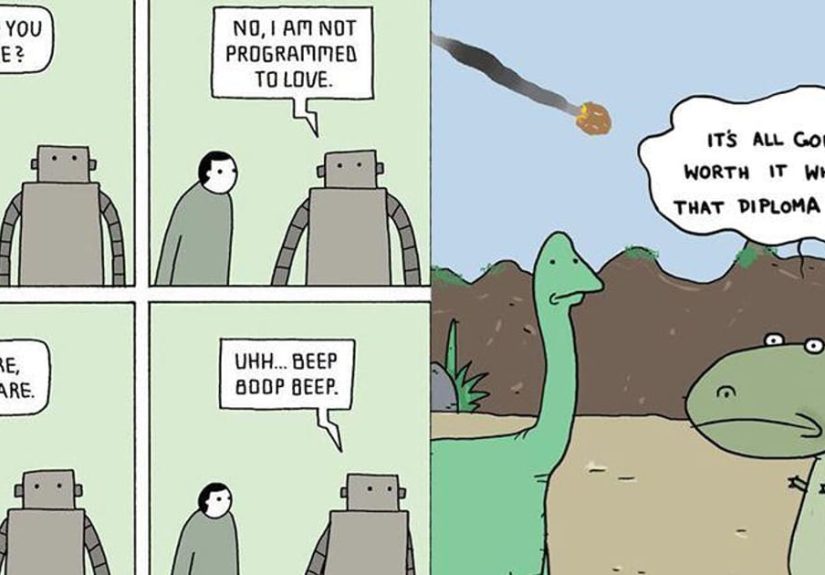
Dinosaur Comics
Same drawings, different dialogueyet it can still ambush you emotionally. Dinosaur Comics uses constraint to amplify ideas:
identity, choice, regret, relationships, meaning. It’s hilarious because dinosaurs debate everything like grad students with feelings.
It’s depressing because sometimes the “meaning of life” conversation ends with: “Yep. Still complicated.” -
Gunshow (home of “This is fine”)
Gunshow can be goofy one day and emotionally devastating the next. Its most famous moment became a meme because it captured a universal,
grimly funny coping skill: smiling while the room burns. The strip’s humor is casual and weird; the depressing part is how many people instantly
recognized themselves in that calm denial. -
Existential Comics
Philosophers walk into a bar… and you end up questioning your entire life. Existential Comics makes big ideas approachablefree will,
absurdism, ethicsthen reminds you that humans are tiny creatures trying to reason our way out of feelings. The humor is nerdy and sharp;
the depressing part is realizing the questions don’t come with refunds. -
Robot Hugs
Robot Hugs often talks directly about mental health, identity, and the exhausting experience of being misunderstoodand it still manages to
be funny, often through blunt honesty and the occasional cat. The depressing part isn’t “sadness for drama”; it’s the realism of living with
anxiety or depression while people offer unhelpful advice and expect you to “just be okay.” -
False Knees
Animals in nature having existential conversations shouldn’t be this relatable, but here we are again. False Knees is gorgeous and silly
and quietly haunting. It’s funny because it’s absurd; it’s depressing because it’s gentle about big truthstime passing, loneliness, fear,
and the weird comfort of being small in a large world.
How to Read These Comics Without Spiraling
A quick pro tip: funny-depressing comics are best consumed like hot sauce. A little enhances the meal; too much at midnight and you’ll be
lying awake wondering if you’ve wasted your whole life because you forgot to reply to a text in 2019.
- Pair them with something grounding (music, tea, a walk, a pet who does not care about your existential dread).
- Notice which themes hit hardestthat’s not a flaw, it’s information.
- If a strip feels too close, step away. Humor is helpful, not mandatory.
Reader Experiences With Funny-Depressing Comics (500+ Words)
People don’t usually seek out “hilarious and depressing” on purpose. It happens accidentally: you’re scrolling during lunch, someone sends a comic
in a group chat, or you click one panel because the art looks cute. Then you laughand immediately feel that strange, sharp recognition.
Not “this is sad,” exactly. More like: “Oh. Someone else’s brain does that too.”
For a lot of readers, these comic strips become tiny emotional checkpoints throughout the day. You might read Strange Planet and suddenly notice
how strange it is that humans apologize for existing in doorways. You might read Sarah’s Scribbles and feel seen for the first time all week,
because the comic admits what you’ve been trying to joke away: that social energy is real, and sometimes it runs out. The laugh is a release valve.
The depressing part is the reminder that you needed a release valve in the first place.
There’s also a very specific late-night experience many people recognize: the “one more strip” loop. You read one xkcd and it’s clever.
Then another, and it’s oddly tender. Then a third, and it suddenly brushes against loneliness, or mortality, or the feeling that time moves too fast.
The tone shift can be subtlealmost polite. You don’t realize you’ve wandered into the emotional deep end until you’re already there, laughing quietly
because the comic is right and you don’t want it to be.
Sharing these comics is its own ritual. People rarely text, “I’m struggling today” (because that’s vulnerable and we’re all very brave until it’s time
to be honest). Instead, they send a Heart and Brain panel that basically translates to: “My emotions and logic are fighting againplease
understand me without making me explain.” Or they drop a “This is fine” reference when work is chaotic, because it communicates stress with a wink
that feels safer than saying, “I can’t do this anymore.”
Many readers describe these strips as a form of emotional language. Hyperbole and a Half gave people a way to describe depression that didn’t
sound like a clinical brochure. Robot Hugs has been shared because it puts words and pictures to experiences people struggle to articulate:
medication stigma, identity stress, the fatigue of constant misunderstanding. Even the “lighter” comicslike Peanutsbecome touchstones.
Charlie Brown doesn’t “win,” but he keeps showing up. That’s funny, and it’s heartbreaking, and it’s comforting in a way that’s hard to explain unless
you’ve ever needed a reason to keep trying.
The best part of the funny-depressing genre is that it doesn’t demand a perfect mood. You can be fine-ish, not fine, or somewhere in between.
The comic meets you there. It says: life is ridiculous, and sometimes it hurts, and you’re not weird for noticing both at once. For many readers,
that’s the real giftnot the joke, not the sadness, but the permission to hold two truths in the same hand.
Conclusion: The Joke and the Truth Can Coexist
The reason these comic strips stick isn’t just that they’re funny. It’s that they’re honestabout anxiety, loneliness, meaning, relationships,
aging, and the chaos of being alive. They prove you can laugh without pretending everything’s great, and you can feel heavy things without drowning
in them. In a world that often pressures people to be either “fine” or “broken,” funny-depressing comics offer a third option: human.