Table of Contents >> Show >> Hide
- 1. Start With a Clear Purpose
- 2. Add a Mirror to Bounce Light
- 3. Use a Runner Rug for Warmth and Direction
- 4. Create a Gallery Wall
- 5. Install Wall Sconces or Picture Lights
- 6. Paint the Walls With Intention
- 7. Try Wallpaper for Instant Personality
- 8. Add Wall Paneling or Molding
- 9. Use Hooks That Look Good Even When Empty
- 10. Bring in a Slim Console Table
- 11. Choose a Storage Bench
- 12. Decorate the End of the Hallway
- 13. Add Plants or Greenery
- 14. Use Floating Shelves or Picture Ledges
- 15. Upgrade Doors, Trim, and Hardware
- 16. Make Storage Look Built-In
- 17. Add One Bold, Memorable Moment
- Practical Experience: What Actually Works When Decorating a Hallway
- Conclusion
A hallway is the home’s most underrated runway. It is where backpacks land, guests pause, shoes mysteriously multiply, and everyone decides whether your home feels calm, stylish, chaotic, or “we meant to decorate this in 2017.” The good news? You do not need a huge budget or a mansion-sized foyer to make a hallway beautiful. With smart hallway decorating ideas, even a narrow pass-through can become a polished, practical, personality-filled space.
Whether you are working with a tiny apartment entry, a long corridor, a dark upstairs hallway, or a busy family drop zone, the right mix of color, lighting, storage, texture, and wall decor can completely change the mood. The goal is not to cram the hallway with stuff. The goal is to make it feel intentional. Think of it as the handshake of your home: quick, memorable, and ideally not covered in clutter.
Below are 17 stylish and realistic ways to decorate a hallway, including ideas for narrow hallway decor, small hallway storage, lighting, rugs, artwork, mirrors, paint, and those awkward blank walls that seem to stare back at you.
1. Start With a Clear Purpose
Before buying anything, decide what your hallway needs to do. Is it mainly decorative? Does it function as an entryway? Does it need to hold shoes, bags, dog leashes, mail, umbrellas, or sports gear? A hallway near the front door usually needs a “landing zone,” while an upstairs hallway may work better as a gallery wall or linen-storage moment.
Once you know the job, decorating becomes easier. A hallway that needs function may benefit from hooks, baskets, a slim console, or a storage bench. A purely transitional hallway may only need lighting, art, and a runner rug. Defining the purpose prevents the classic hallway mistake: adding random decor until the space looks like a yard sale politely trying its best.
2. Add a Mirror to Bounce Light
A mirror is one of the best hallway decor ideas because it works hard without taking up floor space. In a narrow or dark hallway, a mirror reflects available light and can make the area feel wider, brighter, and more open. Place one opposite a window, near a doorway, or at the end of the hall to create the illusion of depth.
For a traditional look, choose a framed mirror in brass, wood, or black metal. For modern hallway decor, try a round mirror, arched mirror, or frameless design. If the hallway is very tight, skip bulky leaning mirrors and use a wall-mounted option. Bonus: it gives you one last chance to check your hair before answering the door, which is basically a public service.
3. Use a Runner Rug for Warmth and Direction
A runner rug instantly makes a hallway feel finished. It softens footsteps, adds color, and visually guides the eye through a long space. For narrow hallway decor, choose a runner that leaves a few inches of visible flooring on each side. This keeps the hallway from feeling squeezed.
Patterned runners are especially useful in high-traffic areas because they disguise everyday dirt better than flat solid colors. Vintage-style rugs, washable runners, jute, wool blends, and low-pile options are practical choices. If the hallway connects to an entryway, use a rug pad to keep the runner from sliding. No one wants their grand entrance to include accidental hallway surfing.
4. Create a Gallery Wall
A hallway is a natural place for a gallery wall because people move through it slowly enough to notice details but not so slowly that every frame has to be museum-perfect. Mix family photos, small prints, sketches, travel memories, and abstract pieces for a collected look.
To keep the gallery wall cohesive, repeat one element: frame color, mat style, image tone, or spacing. For a classic hallway wall decor idea, use black or wood frames in a neat grid. For a relaxed look, mix sizes and shapes while keeping the center line roughly consistent. If you rent, picture ledges are a flexible alternative because you can swap art without making new holes every time your taste changes.
5. Install Wall Sconces or Picture Lights
Lighting can make or break hallway design. Many hallways have one sad ceiling fixture doing the emotional labor of an entire corridor. Wall sconces, picture lights, or a row of small pendant fixtures can turn the space into something much more intentional.
Sconces work beautifully in narrow hallways because they add style without using floor space. Choose slim fixtures so they do not bump shoulders or bags. Picture lights above artwork can make a hallway feel like a tiny gallery. If hardwiring is not possible, consider plug-in or battery-operated sconces. They are renter-friendly and do not require calling an electrician every time inspiration strikes.
6. Paint the Walls With Intention
Paint is one of the most affordable ways to decorate a hallway. Light colors such as soft white, warm beige, pale gray, or creamy taupe can brighten a dark passage. But do not assume small hallways must always be pale. Deep navy, charcoal, olive, terracotta, and moody green can make a hallway feel cozy, dramatic, and expensive.
If you are nervous about bold color, paint only the end wall, the doors, or the lower half of the walls. A darker color can also help a long hallway feel less endless. The trick is to balance strong paint with good lighting, simple artwork, and a rug that ties everything together.
7. Try Wallpaper for Instant Personality
Wallpaper is perfect for hallways because the space is usually small enough to handle pattern without overwhelming the entire home. Floral wallpaper, grasscloth, stripes, geometric prints, and mural-style designs can all work depending on your style.
For a narrow hallway, vertical patterns can make the ceiling feel taller, while small-scale prints add texture without shouting. Peel-and-stick wallpaper is a great option for renters or commitment-shy decorators. Use it on one accent wall, above paneling, or at the end of the hallway for a surprise moment. A hallway is not a room where you binge-watch TV for four hours, so it can handle a little drama.
8. Add Wall Paneling or Molding
Wall paneling, board and batten, beadboard, picture-frame molding, or a simple chair rail can give a hallway architectural character. This is especially helpful in newer homes where the hallway may feel plain or boxy.
Paneling also protects walls in busy spaces. Painted in a semi-gloss or satin finish, it can stand up better to fingerprints, bags, and the occasional “who dragged a suitcase into the wall?” incident. For a timeless look, paint paneling the same color as the trim. For a modern approach, use a tone-on-tone color scheme or paint the lower half darker than the upper wall.
9. Use Hooks That Look Good Even When Empty
Hooks are practical, but they can also be decorative. A row of brass hooks, matte black pegs, wood knobs, or sculptural wall hooks can hold coats, hats, bags, and dog leashes while adding rhythm to the wall.
The key is placement. Install hooks high enough for coats but low enough for kids if the hallway serves a family entry. Leave breathing room between hooks so the wall does not become a mountain of outerwear. If clutter builds quickly, pair hooks with baskets below for shoes and accessories. Function first, but make it cute.
10. Bring in a Slim Console Table
A console table gives a hallway structure and purpose. It creates a place for keys, mail, a small lamp, a bowl, flowers, books, or seasonal decor. In a narrow hallway, choose a slim table with open legs or a wall-mounted shelf so the space still feels airy.
Style the console in layers: a mirror or art above, a tray for small items, one lamp or vase, and a basket underneath if you need storage. Avoid overloading the surface. A hallway console should not become the retirement home for receipts, dead batteries, and mystery screws. A decorative tray helps corral small items and makes cleanup easier.
11. Choose a Storage Bench
If your hallway is wide enough, a bench adds comfort and function. It gives people a place to sit while putting on shoes, and it can visually anchor the space. A bench with drawers, cubbies, or a lift-up seat is especially useful in small homes.
For narrow hallway decorating, choose a bench with a low profile and simple lines. Add a cushion or two pillows for softness, but do not pile on so many accessories that nobody can actually sit down. The best hallway furniture earns its keep. If it looks good and hides shoes, it deserves applause.
12. Decorate the End of the Hallway
The end of a hallway is prime design real estate. Instead of leaving it blank, turn it into a focal point. Hang a large piece of art, place a mirror, add a small chair, display a plant, or use wallpaper to create a destination for the eye.
This works especially well in long hallways because the end wall naturally attracts attention. A bold focal point keeps the corridor from feeling like a tunnel. If the hallway is dark, a mirror or light-colored artwork can brighten the view. If the hallway is plain, a dramatic painting or patterned wallpaper can make the whole area feel more designed.
13. Add Plants or Greenery
Plants bring life to hallway decor, but you need to choose carefully. Many hallways have low light, so use low-light-friendly plants or high-quality faux greenery. A snake plant, pothos, ZZ plant, or preserved stems can add freshness without demanding a sunny window.
If floor space is limited, use wall planters, a hanging planter, or a small plant on a floating shelf. For entryway hallway decor, a tall plant in a corner can soften hard edges and make the home feel more welcoming. Just be honest about your plant-care personality. If every fern you touch becomes a historical artifact, faux greenery is not cheating; it is emotional maturity.
14. Use Floating Shelves or Picture Ledges
Floating shelves and picture ledges are ideal for small hallway ideas because they add display space without bulky furniture. Use them for framed art, small plants, candles, ceramics, books, or seasonal accents.
Picture ledges are especially useful because they allow you to change the look without rehanging frames. You can rotate family photos, holiday decor, or small artwork as your mood changes. Keep shelf styling simple in a narrow hallway. A few well-chosen pieces will look intentional; too many tiny objects can start to resemble a gift shop that lost its manager.
15. Upgrade Doors, Trim, and Hardware
Sometimes the best hallway makeover is not about adding decor but improving what is already there. Painting interior doors, refreshing trim, replacing doorknobs, or upgrading switch plates can make the hallway feel polished.
Black doors create drama. Soft greige doors feel calm and custom. Brass hardware adds warmth, while matte black hardware brings a modern edge. Even replacing dated light switch covers with cleaner versions can make the hallway look more finished. These details are small, but they add up. Design often lives in the things people notice without realizing why.
16. Make Storage Look Built-In
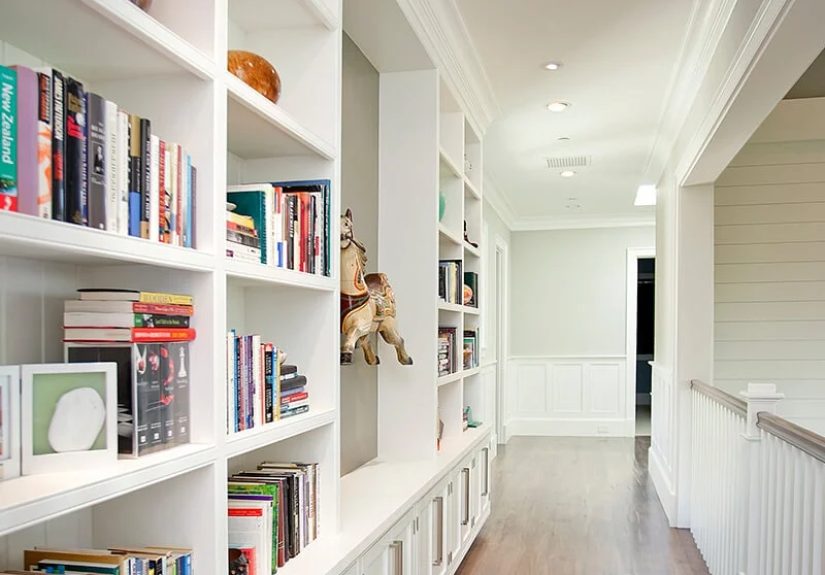
If your hallway needs serious storage, consider built-ins, shallow cabinets, closed shoe storage, or floor-to-ceiling shelving. Built-ins work especially well in hallways near bedrooms, bathrooms, kitchens, or stairs because they can hold linens, pantry overflow, cleaning supplies, shoes, or seasonal items.
For a budget-friendly version, use matching cabinets or slim shoe units and paint them the same color as the wall. Add attractive hardware to make them look intentional. Closed storage is usually best for busy households because it hides visual clutter. Open shelving can look beautiful, but only if you are willing to style and maintain it. Otherwise, it becomes a public exhibition titled “Things We Couldn’t Find a Place For.”
17. Add One Bold, Memorable Moment
The most successful hallway decorating ideas often include one memorable feature. It might be a colorful runner, oversized artwork, a sculptural light fixture, patterned wallpaper, painted doors, a vintage mirror, or a dramatic console table.
Because hallways are transitional spaces, they are great places to take a design risk. You can try a bolder color, a quirkier print, or a more personal display than you might choose for a living room. The key is restraint. Pick one star and let the supporting pieces stay calm. A hallway should have personality, not five personalities arguing at once.
Practical Experience: What Actually Works When Decorating a Hallway
From real-life decorating experience, the first thing to understand is that hallways are judged by movement. A living room is experienced while sitting. A bedroom is experienced while resting. A hallway is experienced while passing through, carrying groceries, chasing a sock-stealing dog, or trying not to step on shoes. That means every design choice must survive real traffic.
One of the biggest lessons is to measure before buying anything. A console table that looks slim online can feel like a roadblock once installed. Leave enough walking space for people to pass comfortably, especially if the hallway is used by kids, pets, or guests with bags. In narrow hallways, wall-mounted pieces usually work better than floor furniture. Hooks, sconces, picture ledges, and mirrors give style without stealing precious inches.
Another important experience-based tip is to decorate in layers, not all at once. Start with the foundation: paint, lighting, and rug. These three elements create most of the mood. After that, add function with hooks, baskets, a bench, or a shelf. Finally, add personality with art, plants, family photos, or decorative objects. When you reverse that order, you may end up with cute accessories in a space that still feels dark, awkward, or unfinished.
Lighting deserves special attention. Many hallways feel gloomy not because the decor is wrong, but because the light is weak or cold. A warmer bulb, better ceiling fixture, or pair of sconces can make the same paint color and artwork look completely different. If the hallway has no natural light, avoid relying on one overhead bulb. Layered lighting makes the space feel more welcoming and less like a hotel corridor where something suspicious might happen in a movie.
Rugs are another area where experience matters. A beautiful high-pile runner may look luxurious, but it can become annoying if doors scrape over it or if it traps every crumb from the outside world. Low-pile, washable, or durable wool-style runners are usually better for real homes. Always use a rug pad. It keeps the runner in place, protects the floor, and prevents the rug from creeping down the hall like it has somewhere important to be.
Clutter control is the difference between a decorated hallway and a hallway wearing accessories over a mess. If shoes, bags, and mail always land there, do not pretend they will magically stop. Give them a home. Use a closed shoe cabinet, labeled baskets, a tray for keys, and hooks for daily items. Pretty storage is still storage, and it is often the reason a hallway stays attractive after the first week.
Finally, the best hallway decor feels connected to the rest of the home. It does not need to match every room exactly, but it should share a color, material, or mood with nearby spaces. If your living room has warm wood, repeat wood frames in the hallway. If your kitchen has brass hardware, use brass hooks or lighting. These small connections make the hallway feel like part of the home, not an afterthought squeezed between rooms.
Conclusion
Decorating a hallway is about making a small space work beautifully. You do not need a massive budget, a professional designer, or a corridor wide enough for a royal procession. You need thoughtful choices: better lighting, a runner that adds warmth, mirrors that reflect light, storage that hides clutter, and decor that shows personality without blocking the path.
The best hallway decorating ideas balance style and function. A gallery wall can tell your story. A bold paint color can create drama. A storage bench can make daily routines easier. A mirror can brighten the space. A single statement piece can transform a plain pass-through into one of the most charming parts of your home.
So do not ignore the hallway. It may be small, narrow, or awkward, but it has serious design potential. With the right details, it can become the space that quietly ties your home togetherand maybe even earns a compliment before guests reach the living room.
Note: This article is written for general home-decor inspiration. For electrical lighting installation, heavy mirrors, built-ins, or structural changes, consult a qualified professional and follow local safety requirements.