Table of Contents >> Show >> Hide
- First, What Does “See From Space” Actually Mean?
- 10 Surprising Things You Can See From Space
- 1. City Lights That Look Like Earth’s Nighttime Nervous System
- 2. The Great Barrier Reef, a Living Wonder With Electric Blue Edges
- 3. Dubai’s Palm Islands and Artificial Archipelagos
- 4. Giant Open-Pit Mines That Look Like Earth Took a Scoop Out of Itself
- 5. Spain’s “Sea of Greenhouses”
- 6. The Pyramids of Giza, With the Right Lens and Lighting
- 7. Wildfire Smoke Plumes That Stretch for Hundreds of Miles
- 8. Volcanic Eruptions and Ash Clouds
- 9. Hurricanes With Clear, Swirling Eyes
- 10. Auroras Dancing Along the Edge of the Atmosphere
- Bonus Myth-Buster: Why the Great Wall Is Not the Champion
- Why Seeing Earth From Space Matters
- Experience Section: What It Feels Like to Imagine Seeing These Wonders From Space
- Conclusion
Ask someone what can be seen from space, and there is a very good chance they will proudly announce, “The Great Wall of China!” Then, somewhere in orbit, an astronaut politely sighs into a pouch of recycled coffee. The truth is more interesting: the Great Wall is difficult or impossible to see from Earth orbit without powerful camera equipment, and it is definitely not visible from the Moon. But do not worryEarth has plenty of visual drama left in the tank.
From the International Space Station, satellites, and high-resolution astronaut photography, our planet becomes a living, swirling, glowing, occasionally smoky masterpiece. Some things visible from space are natural wonders, like coral reefs and hurricanes. Others are proof that humans are excellent at rearranging dirt, water, light, and traffic patterns. This guide explores 10 surprising things you can see from space, how they appear from orbit, and why they matter far beyond the “wow, that looks cool” factor.
First, What Does “See From Space” Actually Mean?
Before we blast off into the list, let’s clear the launchpad. “Visible from space” can mean several different things. Something might be visible to the naked eye from low Earth orbit, which is where the International Space Station travels. It might be visible in astronaut photos using telephoto lenses. Or it might appear clearly in satellite images captured with sensors designed to detect light, heat, vegetation, water, smoke, or atmospheric gases.
That distinction matters. A city at night can glow like a circuit board from orbit. A pyramid may be photographed in detail with a strong lens. A wildfire smoke plume can stretch across states and show up clearly in satellite imagery. The Great Wall, despite its legendary reputation, blends into the landscape and is too narrow to stand out easily. In other words, space is not a magic magnifying glassbut with the right viewpoint and instruments, Earth becomes a very revealing place.
10 Surprising Things You Can See From Space
1. City Lights That Look Like Earth’s Nighttime Nervous System
At night, cities become some of the easiest human-made features to spot from space. They do not just look like random bright blobs. From orbit, urban lights reveal coastlines, highways, neighborhoods, ports, bridges, and economic activity. Major cities can look like golden spiderwebs, with roads stretching outward like glowing veins.
NASA’s nighttime imagery has shown how cities cluster along coastlines, rivers, transportation corridors, and trade routes. The view is beautiful, but it is also useful. Scientists use night-light data to study urban growth, disaster recovery, power outages, energy use, and population patterns. So yes, from space Las Vegas basically announces itself like a cosmic billboard, but the science behind those lights is serious.
City lights are also a reminder that humans leave fingerprints even when the Sun goes down. From orbit, civilization does not whisper. It sparkles.
2. The Great Barrier Reef, a Living Wonder With Electric Blue Edges
The Great Barrier Reef is one of the most famous natural features visible from space, especially in satellite images and astronaut photography. Stretching along Australia’s northeastern coast, this reef system is not one single coral wall but a vast maze of reefs, lagoons, channels, and coral cays.
What makes it stand out from orbit is contrast. Shallow reef waters can appear bright turquoise or milky blue, while deeper ocean areas look darker and richer. That color difference helps astronauts and satellites distinguish reef structures from surrounding water. In images, the reef can look almost painted onto the sea, as if Earth got artistic during lunch break.
Its visibility from space is not just a neat trivia fact. Satellite observation helps scientists monitor coral bleaching, water quality, storm damage, and long-term reef health. Seeing the Great Barrier Reef from above reminds us that beautiful things can be enormous, fragile, and worth paying attention to.
3. Dubai’s Palm Islands and Artificial Archipelagos
Some human-made structures are difficult to see from space. Dubai’s artificial islands are not shy about being exceptions. The Palm Islands and The World archipelago were designed on such a grand scale that their shapes are clearly recognizable in astronaut and satellite images.
Palm Jumeirah, with its trunk, fronds, and crescent-shaped breakwater, looks almost too perfect to be real. The World Islands, arranged to resemble a map of the globe, add another layer of “humans really did that” energy. From space, these artificial coastlines look like a mix of engineering, ambition, and someone doodling during a very expensive meeting.
They are surprising because they show how dramatically people can alter coastlines. Space-based images reveal not only the finished shapes but also construction phases, sediment movement, water color changes, and coastal development patterns. From orbit, land reclamation stops being an abstract concept and becomes a visible redesign of the planet’s edge.
4. Giant Open-Pit Mines That Look Like Earth Took a Scoop Out of Itself
Open-pit mines are among the clearest human-made marks visible from space. One striking example is Utah’s Bingham Canyon Mine, one of the largest open-pit mines in the world. It measures more than 4 kilometers wide and about 1,200 meters deep, making it large enough to stand out clearly in satellite imagery.
From above, open-pit mines often look like huge spirals, terraced bowls, or geological thumbprints. Roads wind around the pit in tight curves. Waste rock piles, processing areas, and color changes in exposed soil create patterns that are easy to detect from orbit.
The view is visually fascinating, but it also raises important questions. Space imagery helps track land use, environmental change, mining expansion, and reclamation efforts. A giant mine seen from space is both an engineering achievement and a reminder that extracting resources leaves marks big enough for satellites to notice. Subtle? Not exactly. Earth is basically wearing the receipt.
5. Spain’s “Sea of Greenhouses”
In Almería, Spain, tens of thousands of hectares of greenhouses cover the landscape so densely that the region has earned the nickname “sea of greenhouses.” From space, the area appears as a bright, pale patch near the Mediterranean coast, almost like someone laid a massive white blanket over the land.
The greenhouses are used to grow fruits and vegetables, and their reflective roofs make them especially visible in satellite imagery. The effect is so strong that scientists have studied how the greenhouse surfaces may create local cooling by reflecting sunlight back into the atmosphere.
This is one of the more surprising things visible from space because it is not a monument, a mountain, or a city. It is agricultureorganized, industrial, highly reflective agriculture. From ground level, you see rows of plastic-covered growing spaces. From orbit, you see a human-made climate and food-production system stamped across the landscape.
6. The Pyramids of Giza, With the Right Lens and Lighting
Can astronauts see the pyramids from space? With the naked eye, not easily. With high-resolution photography and the right lighting, absolutely. Astronaut images from the International Space Station have captured the Giza Plateau in impressive detail, including the pyramids of Khufu, Khafre, and Menkaure.
Lighting matters a lot. Low Sun angles create shadows that help the pyramid shapes stand out from the surrounding desert and urban development. In some images, the pyramids appear as crisp geometric forms, while in others they nearly disappear into the beige background like ancient architecture playing hide-and-seek.
The pyramids are surprising because they connect deep human history with modern spaceflight. Structures built thousands of years ago can be studied today from a space station traveling roughly 17,000 miles per hour. That is a pretty impressive upgrade from “standing in the sand and squinting.”
7. Wildfire Smoke Plumes That Stretch for Hundreds of Miles
Wildfires can become highly visible from space, especially when they produce large smoke plumes. Satellites and astronauts have photographed smoke spreading across entire regions, sometimes reaching high into the atmosphere and traveling far from the fire itself.
Intense fires can generate pyrocumulus or pyrocumulonimbus cloudstowering cloud formations created by extreme heat. These can lift smoke above the lower atmosphere, allowing it to spread over long distances. From orbit, a wildfire plume can look like a gray river flowing across the sky.
This visibility is not just dramatic; it is essential. Satellite imagery helps emergency managers track fire growth, smoke direction, air quality impacts, and risks to communities. From space, wildfires are not isolated dots on a map. They become atmospheric events, reshaping skies far beyond the burn zone.
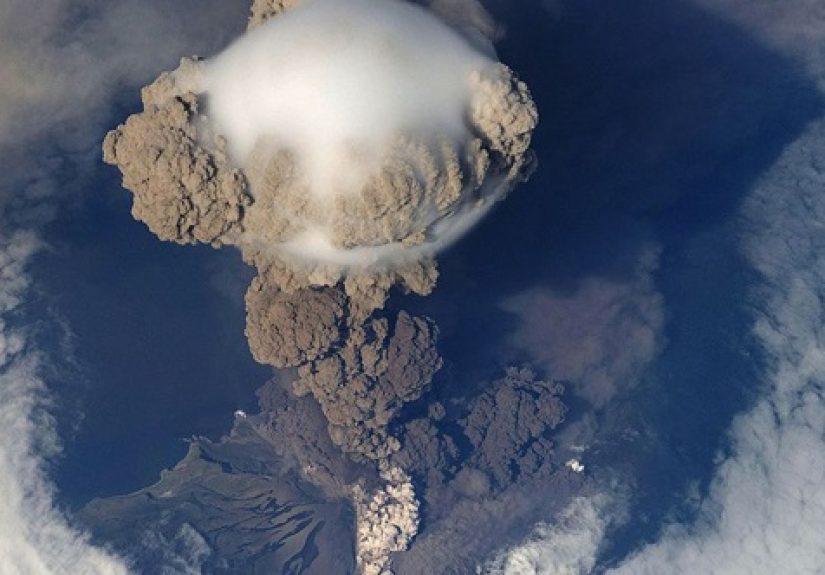
8. Volcanic Eruptions and Ash Clouds
Volcanic eruptions are another powerful natural event visible from space. Satellites have captured ash plumes from volcanoes such as Iceland’s Eyjafjallajökull, Alaska’s Cleveland Volcano, and Sicily’s Mount Etna. These plumes can rise high into the atmosphere and drift across huge areas.
Volcanic ash is more than a dramatic photo opportunity. It can threaten aircraft engines, disrupt flights, affect air quality, and influence weather and climate patterns. Satellite sensors help track ash clouds, sulfur dioxide, heat signatures, and eruption activity, giving scientists and aviation authorities critical information.
From space, a volcano can look both beautiful and mildly terrifyingwhich is probably the correct emotional response to a mountain throwing pulverized rock into the sky. The view reveals how connected Earth systems are: geology, atmosphere, transportation, and human safety all collide in one smoky plume.
9. Hurricanes With Clear, Swirling Eyes
Hurricanes may be destructive on the ground, but from space they often look strangely elegant. Astronauts aboard the International Space Station have photographed the eyes of major hurricanes, including storms with massive circular cloud walls and tightly organized spiral bands.
From orbit, the scale becomes obvious. A hurricane is not just “bad weather.” It is a rotating engine of heat, moisture, clouds, and wind that can span hundreds of miles. The eye, when visible, appears as a calm-looking center surrounded by towering clouds. It is beautiful in the same way a lion is beautiful: admire respectfully and do not stand too close.
Satellite imagery is vital for hurricane monitoring. Meteorologists use space-based data to track storm location, intensity, structure, rainfall, sea surface temperatures, and movement. Without satellites, modern hurricane forecasting would be far less accurate. Space gives us the big picture when the atmosphere decides to go full drama mode.
10. Auroras Dancing Along the Edge of the Atmosphere
Auroras are visible from space in a way that ground observers can only partially imagine. From Earth, we look up at curtains of green, red, purple, or blue light. From orbit, astronauts can look across the atmosphere and see auroras glowing along the planet’s curved edge.
Green auroras are often caused by excited oxygen atoms high in the atmosphere, commonly around 100 to 250 kilometers above Earth. When charged particles from the Sun interact with Earth’s magnetic field and atmosphere, the result can be one of the most spectacular natural light shows in the solar system.
From the International Space Station, auroras can appear as glowing ribbons, sheets, or waves wrapping around the planet. They are beautiful, but they also point to space weather activity that can affect satellites, communications, navigation systems, and power grids. In other words, auroras are not just pretty. They are the sky’s way of saying, “The Sun sent mail.”
Bonus Myth-Buster: Why the Great Wall Is Not the Champion
The Great Wall of China deserves respect as an extraordinary historical structure, but it is not the easiest human-made object to see from space. NASA has noted that the wall is not visible from the Moon and is difficult or impossible to see from Earth orbit without high-powered lenses. The reason is simple: it is long, but it is also narrow and often similar in color to the surrounding terrain.
By contrast, airports, cities, reservoirs, open-pit mines, agricultural grids, and nighttime lights can be much more visible. This is a great example of how scale, contrast, color, lighting, and viewing tools matter more than fame. The Great Wall may win in history class, but from orbit, Las Vegas at night is waving both arms and wearing sequins.
Why Seeing Earth From Space Matters
These surprising things you can see from space are more than visual trivia. They help scientists, governments, and communities understand how Earth is changing. Satellite imagery can monitor deforestation in the Amazon, track volcanic ash, map wildfire smoke, measure city growth, and assess storm damage after hurricanes. Space-based observation turns our planet into a readable storysometimes inspiring, sometimes alarming, always informative.
The most powerful part is perspective. On the ground, a road is a road, a city is a city, and a reef is a vacation brochure with better fish. From space, those same features become patterns. You can see connections: rivers feeding farms, highways shaping cities, smoke crossing borders, storms spanning oceans, and human activity glowing at night.
That perspective also humbles us. Earth is huge, but not invincible. The atmosphere looks thin. Forest loss becomes visible. Coral reefs appear bright and delicate. Cities shine beautifully but also reveal how much energy we use. Space does not just show us what is big. It shows us what is connected.
Experience Section: What It Feels Like to Imagine Seeing These Wonders From Space
Imagine floating inside the cupola of the International Space Station, forehead pressed close to the window, while Earth rolls silently beneath you. There is no dramatic movie soundtrack, no narrator booming about destiny, and no wind in your hair because, well, your hair is probably floating like a confused sea creature. Below you, the planet moves with impossible calm.
First comes the darkness of night over a continent. Then city lights appear. They do not look like single dots; they look like living networks. A coastline glows, highways stretch outward, and tiny clusters of light mark towns you may never visit but suddenly feel connected to. You might recognize a famous city by its shape, or maybe you would just stare and think, “Wow, humanity really enjoys electricity.”
Then the station crosses into daylight. The ocean brightens. A reef appears below as a pale blue shimmer against darker water. From ground level, a reef is something you snorkel above while trying not to kick coral or embarrass yourself in flippers. From space, it becomes a delicate pattern in the sea, both huge and fragile. You understand, almost instantly, why scientists watch these places so carefully.
Later, you spot smoke. It begins as a smudge, then stretches into a long gray veil. A wildfire hundreds of miles away has written itself into the atmosphere. From Earth, people may smell it, flee it, fight it, or watch the sky turn orange. From orbit, you see the scale all at once. The plume does not care about county lines or national borders. It moves where the air takes it.
A hurricane would be even more overwhelming. From below, it is sirens, rain, news alerts, boarded windows, and nervous waiting. From above, it looks organizedalmost elegant. That contrast is unsettling. The storm’s eye may appear calm, but the surrounding cloud walls tell the real story. Space gives beauty and danger the same camera angle, which is rude but educational.
Then, perhaps near the polar regions, an aurora rises along Earth’s edge. From the ground, people cheer when the northern lights ripple overhead. From orbit, the glow bends with the curve of the planet, like a green ribbon tied around the atmosphere. It would be hard not to feel small in that moment, but not in a bad way. More like the universe has politely reminded you to stop worrying about your inbox for five minutes.
The most surprising experience might be noticing human patterns. Mines, roads, artificial islands, greenhouse seas, and city lights all show how much we shape the planet. Some features inspire awe. Others invite responsibility. Seeing them from space would not make Earth feel distant. It would probably make it feel more personal, because everything visible down there is part of one shared home.
That is the quiet magic of space observation. It turns geography into emotion. It makes science feel immediate. It proves that a coral reef, a storm, a city, a volcano, and a glowing aurora are not separate postcards. They are chapters in the same planetary storyand we are very much in the story, whether we packed snacks or not.
Conclusion
The list of surprising things you can see from space is far richer than old trivia suggests. The Great Wall myth may get the headlines, but the real stars are city lights, coral reefs, artificial islands, vast mines, greenhouse landscapes, ancient pyramids, wildfire smoke, volcanic ash, hurricanes, and auroras. Some are visible to astronauts with the right conditions. Others require cameras, satellites, or specialized sensors. All of them reveal something important about Earth.
From orbit, our planet is not just blue and beautiful. It is active, bright, engineered, stormy, fragile, and alive. The next time someone says only one thing can be seen from space, you can smile gently and prepare to ruin that myth with style.