Table of Contents >> Show >> Hide
- First: What Does “Shrink” Even Mean for a Black Hole?
- The Classical Rule: Horizons Don’t Like to Get Smaller
- Why Shrinking Is Hard: You’d Need “Negative Energy” (Classically)
- The Quantum Rule: Black Holes Can Shrink (Hawking Radiation)
- Why We Still Say They “Can’t Shrink” in the Real Universe
- Common Confusion: “But Black Holes Shoot Stuff Out!”
- What We’ve Actually Measured: “Area Doesn’t Shrink” Gets Real Data
- So Why Black Holes “Can’t Shrink”the Honest Answer
- of Experiences Related to “Why Black Holes Can’t Shrink”
Black holes have a reputation: they eat, they don’t spit, and they definitely don’t go on diets. In pop science, a black hole is basically the cosmic version of a Roomba with unlimited appetite and zero remorse. So when someone asks, “Can a black hole shrink?” the knee-jerk answer is: “Nope. That’s literally their whole brand.”
But physics loves ruining simple brands. The truth is more interesting (and way funnier) than the slogan. In classical general relativity, there’s a powerful reason black holes “can’t shrink.” In quantum physics, there’s a powerful reason they can. And in the real universe (the one with leftover heat from the Big Bang and lots of stray matter), there’s a powerful reason they almost never shrink in any way that matters to… well, anyone with a calendar.
Let’s unpack the “can’t shrink” claimcarefully, honestly, and with enough humor to keep your event horizon from collapsing into a singularity of boredom.
First: What Does “Shrink” Even Mean for a Black Hole?
When people say a black hole is “bigger” or “smaller,” they usually mean the size of its event horizon the invisible boundary where “escape” stops being a verb and becomes a punchline. For a simple, non-spinning black hole, the horizon radius (the Schwarzschild radius) scales directly with mass: more mass → bigger horizon.
So “shrinking” typically means the event horizon gets smaller, which usually means the black hole loses mass-energy. That’s the part that classical physics really doesn’t want to allow.
The Classical Rule: Horizons Don’t Like to Get Smaller
In the early 1970s, Stephen Hawking developed a result now often summarized as: the total area of a black hole’s event horizon can’t decreaseat least not in ordinary (“classical”) general relativity under standard assumptions.
This idea is closely tied to what’s sometimes called the second law of black hole mechanics, because it resembles the everyday second law of thermodynamics: entropy (loosely, disorder) tends to increase. For black holes, the horizon area behaves like entropy’s geometric cousin: it tends to go up, not down.
Why would area only increase?
The intuitive version is that the event horizon is a one-way membrane. Matter and energy fall in, and the horizon adjusts outward to “wrap” the added mass. Even if the black hole is spinning, charged, or being perturbed, classical physics still pushes the horizon area toward non-decrease.
The more technical version involves assumptions about the kinds of energy and matter allowed in spacetime and about how singularities are hidden (cosmic censorship). Under those conditions, the math says: you don’t get smaller horizons from normal, positive-energy stuff.
A real, modern example: black hole mergers
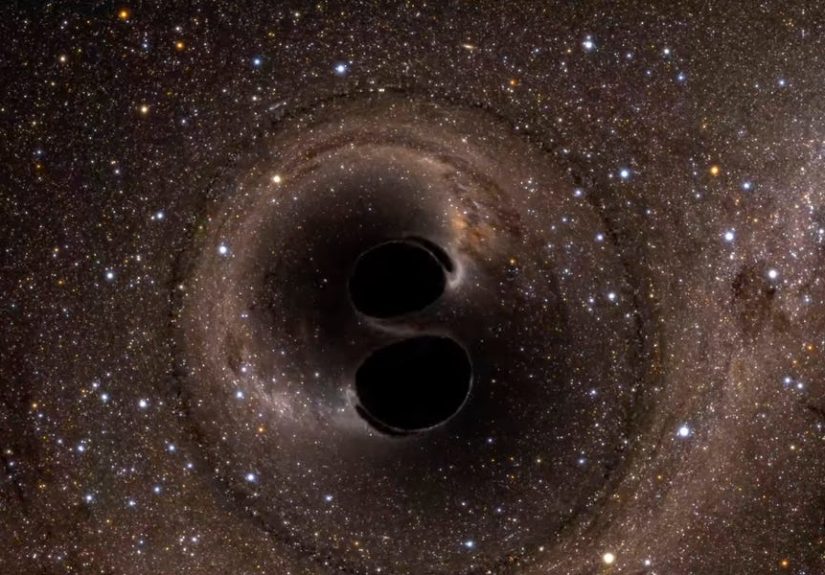
If you’ve seen those famous LIGO “chirps,” you’ve watched two black holes spiral together and merge. During a merger, some energy leaves the system as gravitational wavesso you might think, “Ah! Energy left. Shouldn’t something shrink?”
Here’s the twist: even though the system radiates energy away, the resulting single black hole still ends up with an event horizon area larger than the total area of the two original horizons. In an especially clear LIGO event (GW250114), the initial total horizon area was reported around 240,000 km² and the final around 400,000 km²a clean increase. That’s the “no shrink” rule, caught on tape as spacetime audio.
Why Shrinking Is Hard: You’d Need “Negative Energy” (Classically)
To make a black hole’s horizon shrink in classical general relativity, you’d need to reduce the black hole’s mass. But the event horizon is built from lightlike paths (null rays) that are “focused” by gravity. Under the usual energy conditions, positive energy makes those rays converge in a way that prevents the horizon area from decreasing.
Put bluntly: normal matter doesn’t come with a “refund” option. Once positive energy crosses the horizon, the black hole’s bookkeeping says “thank you for your donation,” and the horizon does what it does best: it grows (or, at minimum, doesn’t shrink).
So if classical physics is the whole story, the headline “Why Black Holes Can’t Shrink” would be basically correct. And scientists might have moved on to more cheerful topics, like gamma-ray bursts or the heat death of the universe.
Unfortunately for simple headlines, quantum physics showed uplike a raccoon at a campsiteflipped the lid, and rummaged through everything.
The Quantum Rule: Black Holes Can Shrink (Hawking Radiation)
In 1974, Hawking found that when you combine quantum field theory with the curved spacetime around a black hole, black holes shouldn’t be perfectly black. They should emit a faint thermal glow now called Hawking radiation.
One popular way to picture it: empty space isn’t truly empty. Quantum fluctuations constantly create pairs of “virtual” particles that usually annihilate quickly. Near a black hole horizon, one partner can fall in while the other escapes. From far away, it looks like the black hole is emitting particles.
Here’s the key point: if energy escapes, the black hole must lose energy, and therefore lose mass. That means the horizon can shrink over timein quantum theory.
So… doesn’t that directly contradict “can’t shrink”?
Yes, and Hawking said so himself: quantum effects violate the classical “area never decreases” rule. But they don’t destroy the deeper thermodynamic logic. Instead, the story upgrades to the generalized second law: the total entropy of “black hole + outside world” doesn’t decrease. The black hole’s area can go down, while the entropy carried away by radiation can go up enough to keep the combined total behaving nicely.
Temperature explains why shrinking is usually invisible
Hawking radiation has a temperature inversely related to black hole mass: smaller black holes are hotter and radiate more; big black holes are colder and radiate less. For a black hole with about the mass of our Sun, the predicted temperature is ridiculously tinyabout 6 × 10⁻⁸ K.
That’s not “cold.” That’s “your freezer is a supernova by comparison.”
Why We Still Say They “Can’t Shrink” in the Real Universe
If black holes can shrink via Hawking radiation, why do so many science explainers still treat them like cosmic hoarders?
Because in practice, for the black holes we actually observestellar mass and supermassive black holesHawking shrinkage is laughably slow, and the universe keeps feeding them anyway.
Reason #1: The universe isn’t a vacuumit’s a snack bar
Space contains radiation (like the cosmic microwave background), dust, gas, and the occasional unlucky star that wanders too close. Black holes absorb that stuff.
NASA puts it plainly: black holes may shrink in theory, but for most known black holes it would take far longer than the age of the universe to evaporate in any noticeable way. So on human timescales, the “shrink” dial doesn’t just move slowlyit might as well be glued.
Reason #2: Hawking radiation is weaker than basically everything
A stellar-mass black hole is colder than the background radiation bathing the universe today, which means it tends to absorb more energy than it emits. So even though Hawking radiation exists in principle, the black hole’s net trend can still be growth.
In other words: the black hole is technically on a diet plan, but the fridge is open, the party is loud, and someone keeps offering it free pizza.
Reason #3: The timescales are absurd
The lifetime of an evaporating black hole grows extremely fast with mass. Small black holes could evaporate quickly (if they existed in the right mass range), but astrophysical black holes live for times so enormous that writing them down feels like the universe is trying to flex.
That’s why NASA can simultaneously say: “Yes, black holes can get smaller,” and also: “Don’t hold your breath unless your plan is to hold it longer than the lifespan of stars, galaxies, and possibly the concept of breathing.”
Common Confusion: “But Black Holes Shoot Stuff Out!”
You’ve seen images of black hole jetsmassive, bright beams launched from galaxy centers. Doesn’t that mean the black hole is losing mass and shrinking?
Usually, no. The key detail: the dramatic light and jets we observe come from matter outside the event horizon from hot gas in the accretion disk, magnetic fields, and plasma near the black hole, not from inside the horizon. X-ray observatories emphasize that we’re seeing the environment around the black hole, not the interior.
The black hole itself can still be gaining mass overall, while the surrounding disk turns some incoming matter into radiation and outflows before it ever crosses the horizon.
What We’ve Actually Measured: “Area Doesn’t Shrink” Gets Real Data
This is where the story goes from chalkboard to “we literally heard spacetime do the thing.”
Gravitational-wave observatories have used black hole mergers to test the horizon-area rule. Early tests used the first historic detection (GW150914). Later, improved sensitivity produced exceptionally clear signals that let researchers measure the system with higher precision and check whether the final horizon area is at least the sum of the initial areas.
The result: the data align with the prediction that in classical general relativity, the total horizon area doesn’t decrease in these mergersexactly the kind of “no shrink” behavior the classical theorem suggests.
So Why Black Holes “Can’t Shrink”the Honest Answer
If you want the headline version without lying:
- Classically: black holes can’t shrink because the event horizon area is constrained to be non-decreasing under standard assumptions. Mergers, accretion, and ordinary processes don’t reduce horizon area.
- Quantum mechanically: black holes can shrink because Hawking radiation allows them to lose mass, violating the classical area rulewhile still preserving a generalized thermodynamic “no decrease” law for total entropy.
- In the real universe today: most black holes are so cold and so massive that Hawking shrinkage is negligible, and they tend to gain mass from their environment. So they “can’t shrink” in any practical, observational sense for the black holes we actually see.
That’s why the phrase “black holes can’t shrink” keeps showing up. It’s not that physics forbids it completely. It’s that classical physics strongly resists it, quantum physics allows it extremely grudgingly, and the universe takes that allowance and rounds it down to “effectively zero” for any black hole you’ve ever met in the wild.
In other words: black holes can shrink the same way glaciers can do parkoursure, in theory, with enough time and the right conditions, amazing things can happen. But if you’re waiting around to witness it, bring snacks. And maybe a new universe.
of Experiences Related to “Why Black Holes Can’t Shrink”
If you’ve ever fallen into a late-night space rabbit hole (pun fully intended), you’ve probably had this experience: you start with a simple question“How big is a black hole?”and two hours later you’re whispering “event horizon” like it’s a spell you learned from an ancient wizard who majors in differential geometry.
One of the most common “hands-on” experiences people have with the idea that black holes can’t shrink is actually a sound experience. You don’t need a telescope; you need speakers. When you listen to the chirp from a black hole merger, it’s strangely emotional: a rising pitch that ends abruptly, like the universe clearing its throat and then slamming a door. Even if you don’t understand every equation, you can feel the message: something enormous just happened, and it happened according to rules. The idea that the final black hole’s horizon area is bigger than the two originals turns a spooky cosmic collision into a kind of cosmic accounting lessonnature balancing the books in gravitational waves.
Another common experience is the “museum moment.” Many science centers and planetariums have black hole exhibits that let you spin a funnel-shaped gravity well and watch balls spiral inward. It’s simple, a bit theatrical, and technically not the exact geometry of spacetimebut it teaches the key intuition: gravity doesn’t merely pull; it reshapes the paths things are allowed to take. When the balls roll in, nobody expects them to roll back out. That’s the emotional core of an event horizon: not just a strong pull, but a one-way story.
Then there’s the experience of reading about Hawking radiation for the first time and feeling your brain do a tiny somersault. The black hole that “can’t shrink” suddenly becomes a black hole that can leakso slowly it’s basically a cosmic drip faucet, but still. People often describe an odd mix of disappointment and relief. Disappointment, because you wanted a dramatic black hole evaporation you could watch like fireworks. Relief, because physics stays consistent: energy is conserved, thermodynamics survives, and the universe isn’t casually handing out free lunches.
Finally, there’s the “everyday analogy” experiencetrying to explain this to a friend without summoning a chalkboard. You end up saying things like: “It’s like a bank account that can only increase in the classical rules, but quantum rules allow microscopic fees, and the fees are so tiny you’ll never notice unless you wait longer than the age of the universe.” Your friend nods politely. You nod back. Somewhere in the distance, a black hole continues to not shrink.