Table of Contents >> Show >> Hide
- So, Where Is the Titanic Now?
- Is the Titanic Still Underwater?
- How Deep Is the Titanic Wreck?
- When Was the Titanic Found?
- What Does the Titanic Look Like Now?
- Is the Titanic Disappearing?
- Why Hasn’t the Titanic Been Brought to the Surface?
- Who Protects the Titanic Wreck Site?
- What Have Recent Expeditions Revealed?
- Why Are People Still So Fascinated by the Titanic?
- The Human Experience of Thinking About Where the Titanic Is Now
- Final Answer: Where Is the Titanic Now?
- SEO Tags
If you have ever looked at the ocean and thought, “Surely a ship that famous would have been hauled up by now,” welcome to the club. The Titanic has inspired more questions than almost any ship in history, and one of the biggest is also one of the simplest: Where is the Titanic now? And yes, to answer the suspenseful part right away, the Titanic is still underwater.
Not just a little underwater, either. We are talking about a crushing, pitch-black, deep-ocean grave nearly two and a half miles beneath the surface of the North Atlantic. It is still there, still broken into sections, still slowly changing, and still holding a strange grip on the public imagination. More than a century after it sank, the wreck remains one of the most haunting places on Earth.
In this guide, we will break down exactly where the Titanic is, how deep it lies, what condition it is in today, why nobody has simply “brought it up,” and what modern expeditions have revealed. Think of this as your no-nonsense, deep-sea answer to one of history’s biggest maritime questions.
So, Where Is the Titanic Now?
The Titanic rests on the floor of the North Atlantic Ocean, about 400 nautical miles from Newfoundland, Canada. Its bow section sits at approximately 41°43′57″ N, 49°56′49″ W, and the wreck lies around 12,500 feet below the ocean’s surface. In plain English, that means the ship is still exactly where the ocean left it after the disaster of April 1912: deep, dark, cold, and far beyond the reach of casual visitors.
This is not a neat, movie-style image of a full ship parked neatly on the seabed like a forgotten sedan in a lake. The Titanic is in two main pieces: the bow and the stern. The bow is the more recognizable section, largely intact and standing as the famous “front of the ship” most people picture. The stern, by contrast, is badly mangled and shattered, a wreck of a wreck. The two sections lie about 2,600 feet apart, with a debris field scattered between them.
That debris field contains everything from structural fragments to personal belongings and interior pieces. It is one reason the site feels less like a single shipwreck and more like a frozen disaster scene spread across the seabed. The ocean did not just sink the Titanic. It rearranged it.
Is the Titanic Still Underwater?
Yes, the Titanic is still underwater, and there is no realistic plan to raise the entire ship. The wreck remains on the ocean floor in international waters, where it is treated not only as a famous shipwreck but also as a maritime memorial linked to the more than 1,500 people who died in the sinking.
The idea of raising it sounds tempting. After all, plenty of smaller wrecks have been recovered. But the Titanic is not a lost rowboat with a dramatic backstory. It is a massive liner that broke apart, settled across a large area, and has spent more than a century being weakened by pressure, corrosion, deep-sea currents, and metal-eating microorganisms. Trying to lift it would be like trying to pick up a century-old lace curtain with a bulldozer. Technically bold, emotionally chaotic, and very likely to end badly.
That is why most serious discussion today centers on documenting, studying, and preserving the site rather than dragging the whole vessel to the surface like the world’s saddest fishing catch.
How Deep Is the Titanic Wreck?
The wreck lies about 12,500 feet, or roughly 3,800 meters, below the surface. That is about 2.4 miles down. The depth matters because it explains nearly everything about the ship’s current condition and why it remained undiscovered for so long.
At that depth, the Titanic exists in an environment that is brutally hostile to humans and unforgiving to machinery. There is no sunlight. The water is near freezing. The pressure is enormous. Only highly specialized submersibles and remotely operated vehicles can safely reach the site. This is not a place for scuba divers, casual explorers, or anyone who saw one ocean documentary and got a little too confident.
For decades, the sheer depth and remoteness of the site made locating the wreck incredibly difficult. The Titanic sank in 1912, but the wreck was not found until 1985. Even once the general area was understood, the deep ocean is so vast that finding the remains of a ship there was like looking for a dropped earring in a stadium-sized dark room.
When Was the Titanic Found?
The Titanic wreck was discovered on September 1, 1985, by an international expedition led by Woods Hole Oceanographic Institution and the French oceanographic institute IFREMER. The discovery finally solved one of the biggest maritime mysteries of the twentieth century.
Before that moment, people knew where the ship had gone down in general terms, but not where the wreck itself had settled. Oceanographer Robert Ballard became one of the key names associated with the discovery, and the find changed public understanding of the Titanic forever. It turned the story from historical tragedy into something far more immediate: a real place, a real site, and a real underwater memorial.
When images of the wreck emerged, they hit the public like a tidal wave of emotion. The bow, sitting upright on the seabed, looked ghostly and familiar. Suddenly the Titanic was not just a line in a history book. It was still there. Waiting in darkness.
What Does the Titanic Look Like Now?
The answer depends on which part you mean.
The Bow
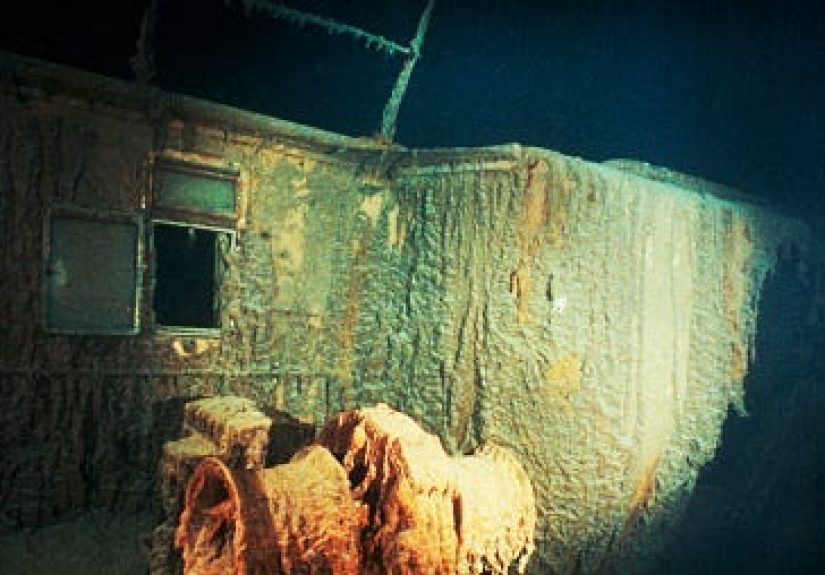
The bow remains the most recognizable part of the wreck. It is the section that appears in documentaries, articles, and dramatic still images because it still resembles the ship people know. You can see the railings, anchor gear, and the sweeping shape of the front. It is damaged, of course, but it still has presence. It looks less like a pile of scrap and more like a fallen monument.
The Stern
The stern is another story entirely. When the Titanic split during the sinking, the stern section descended in a far more violent way. Researchers believe it twisted and tumbled before smashing into the ocean floor. As a result, it is heavily distorted and much harder to interpret. If the bow is a haunting portrait, the stern is a punch of chaos.
The Debris Field
Between and around the major pieces is an enormous debris field. Boilers, metal fragments, fittings, and scattered remnants of the ship and its contents remain spread over the seabed. This field offers clues about how the ship broke apart and sank, but it also gives the site its emotional weight. The Titanic is not just “a wreck.” It is a wide underwater landscape of loss.
Is the Titanic Disappearing?
Yes, slowly but unmistakably. The Titanic is still underwater, but it is not staying frozen in time. The wreck is deteriorating year by year.
Deep-sea bacteria feed on the iron and help create formations known as rusticles, those eerie rust-colored structures that hang from parts of the ship. Add in salt corrosion, ocean currents, and the simple fact that the wreck has been underwater for more than a century, and you get an unavoidable truth: the Titanic is decaying.
Recent expeditions have shown just how real that process is. New imagery released in 2024 revealed that part of the iconic bow railing had collapsed, a striking reminder that even the most photographed parts of the wreck are changing. Modern mapping and high-resolution imaging have also captured new details across the site, preserving a digital record of a ship that is gradually being reclaimed by the sea.
This is one of the reasons researchers race to document the Titanic now. It is not because the ship will vanish overnight in one big dramatic puff of rust, but because each expedition captures features that may look different next time. The wreck is still there, but the version of it people imagine from older photos is already becoming history.
Why Hasn’t the Titanic Been Brought to the Surface?
Because almost everything about that idea works against reality.
First, the ship is far too deep. Second, it is not one solid object anymore. Third, it is structurally fragile. Large parts of it are weakened after more than a century on the seabed. Any attempt to raise major sections could cause them to collapse. It is one thing to recover individual artifacts from a debris field. It is another to hoist a legendary wreck that has effectively fused with its underwater environment.
There is also the ethical issue. The Titanic wreck is widely regarded as a memorial site. Many experts argue that it should be treated with the same respect given to a gravesite. That does not mean nothing can ever be studied, photographed, or conserved, but it does mean there is a strong push against sensational or destructive interference.
So the short version is this: the Titanic remains underwater because it is too deep, too delicate, too scattered, too culturally important, and too ethically sensitive to be treated like a salvage project from an action movie.
Who Protects the Titanic Wreck Site?
The wreck sits in waters beyond national jurisdiction, which makes protection a little more complicated than putting up an underwater “please do not touch” sign. Over time, the United States and the United Kingdom have implemented agreements and preservation measures aimed at safeguarding the site and reducing harmful disturbance.
That matters because the Titanic is not just historically famous. It is scientifically important, culturally powerful, and emotionally loaded. It is also vulnerable. Once a site like this is disturbed carelessly, that history cannot simply be patched back together with a wrench and an apology.
As a result, the modern approach leans toward respectful documentation, careful research, and controlled treatment of artifacts rather than reckless treasure-hunting. The days of treating the Titanic like an underwater yard sale are viewed much more critically now.
What Have Recent Expeditions Revealed?
Recent missions have transformed how people understand the Titanic today. Instead of relying only on dramatic still photos, researchers now use high-resolution imaging, robotic exploration, and large-scale digital mapping to create more complete records of the wreck.
One of the biggest breakthroughs has been detailed 3D scanning, which helps researchers study not just what the Titanic looks like, but how the ship broke apart and how the wreck sits on the seafloor. These scans have confirmed the dramatic separation of bow and stern and provided sharper insight into the debris field.
New expeditions have also highlighted change over time. The wreck is not static. Railings fall. Surfaces weaken. Details once visible may disappear. At the same time, researchers have occasionally rediscovered objects long associated with the ship’s story, such as decorative pieces and artifacts documented in new imagery. Every mission adds information, but it also reinforces the same sobering point: the Titanic is not waiting forever.
Why Are People Still So Fascinated by the Titanic?
Part of it is scale. Part of it is tragedy. Part of it is the irresistible collision between human ambition and nature’s indifference. The Titanic was supposed to symbolize modern engineering, wealth, glamour, and confidence. Then it sank on its maiden voyage and turned into one of the most famous disasters in history. That would be enough on its own.
But the wreck adds another layer. Knowing that the ship still exists underwater makes the story feel unfinished. It is not just a tale from 1912. It is a physical reality that remains in the Atlantic right now. That is powerful. It turns curiosity into almost geographic obsession. People do not just ask what happened. They ask where it is, what it looks like, and whether it is still down there.
And honestly, there is something deeply human about that. We want proof. We want connection. We want to know that the thing we have heard about for years is not imaginary. The Titanic gives us that in the most haunting way possible.
The Human Experience of Thinking About Where the Titanic Is Now
There is a difference between knowing the facts of the Titanic and actually sitting with them. Reading that the wreck lies 12,500 feet underwater is one thing. Pausing to imagine that distance is something else entirely. It means darkness so complete it would swallow a flashlight beam whole. It means pressure so intense it can crush unprepared equipment. It means a place on Earth that still feels remote, even in an age of satellites, smartphones, and people somehow reviewing mayonnaise on the internet with great seriousness.
For many people, the emotional experience begins the moment they see a real image of the wreck. Not a movie set. Not an artist’s rendering. The actual bow, sitting upright in the deep ocean like a silent witness. It is eerie because it is recognizable. You know exactly what you are looking at, and yet it feels impossible that it is still there. It is like history forgot to leave.
Museum visitors often describe a similar feeling when they stand in front of Titanic artifacts or read passenger stories. A shoe, a letter, a dish, or a pocket watch can do something a timeline cannot. It reminds you that this was not only a famous ship. It was a moving world filled with ordinary routines, private hopes, and people who expected to arrive in New York. That emotional weight follows you back to the question of where the Titanic is now. It is not just “underwater.” It is underwater with memory attached.
There is also a strange awe in the science of it. Modern deep-sea scans and robotic dives let people experience the Titanic in ways earlier generations could not. You may never descend to the site yourself, but detailed imagery gives you a front-row seat to a place once almost unreachable. That creates a new kind of experience: part education, part wonder, part grief. You are not simply learning about a shipwreck. You are witnessing time at work.
And that may be the most powerful part of all. The Titanic is still underwater, but it is not frozen. It is changing. Every collapsed railing, every fading surface, every new map is a reminder that even the grandest human creations do not beat the ocean forever. The experience of thinking about the Titanic today is really the experience of confronting scale: the scale of ambition, the scale of loss, and the scale of time.
That is why people keep asking about it. Not because they forgot the ending, but because the ending keeps deepening. The Titanic did not just sink and vanish from culture. It settled into the seafloor and became a permanent conversation between history and the sea. And for anyone who has ever been moved by that story, the location of the wreck is more than a point on a map. It is a place the imagination returns to again and again, trying to understand how something so huge could disappear, and how something so lost could still feel so present.
Final Answer: Where Is the Titanic Now?
The Titanic is still underwater on the floor of the North Atlantic Ocean, about 400 nautical miles from Newfoundland, Canada, at a depth of roughly 12,500 feet. The wreck is split into two main sections, surrounded by a large debris field, and continues to deteriorate over time.
So if you were hoping for a dramatic twist in which the Titanic is secretly parked in a giant museum garage somewhere, sorry to disappoint. The real answer is far more haunting and, in many ways, more powerful. The ship remains where it fell, deep in the Atlantic, still teaching historians, scientists, and the curious public something new every time it is studied.
The Titanic is not just underwater. It is part of the ocean now, part memorial, part archaeological site, and part warning against the very human habit of believing we are unsinkable.