Table of Contents >> Show >> Hide
- What Is the Sun Line (Apollo Line), Exactly?
- A Quick Reality Check (Because Skin Is Not a Crystal Ball)
- How to Find the Sun Line on Your Palm
- What the Sun Line Means in Palmistry (Common Interpretations)
- Where the Sun Line Starts (Palmists Love This Part)
- Sun Line “Quality”: Breaks, Chains, Forks, and Other Tiny Drama
- Sun Line vs. Fate Line: What’s the Difference?
- Can the Sun Line Change Over Time?
- How to Use Sun Line Reading Without Making It Weird
- Experiences: of “Sun Line” Moments People Commonly Talk About
- Conclusion
You know that moment when you’re staring at your hand like it’s a tiny topographic map of your life,
and you think, “Okay… which one of these squiggles means I’m secretly destined to be iconic”?
If you’ve heard about the Sun linealso called the Apollo line or line of success
you’ve basically found palmistry’s “spotlight” storyline.
In traditional palm reading, the Sun line is associated with things like recognition, creative fulfillment,
and the kind of confidence that makes people say, “They’ve got something.” Not necessarily “instant celebrity,”
more like “your gifts don’t stay hidden forever.” And yes, palmists sometimes talk about it as a sign of
public image, legacy, or pride in your work.
Let’s decode what palmistry traditions say the Sun line means, how readers interpret different shapes and markings,
and how to use the whole idea in a grounded wayso you don’t quit your job because your palm made eye contact with you.
What Is the Sun Line (Apollo Line), Exactly?
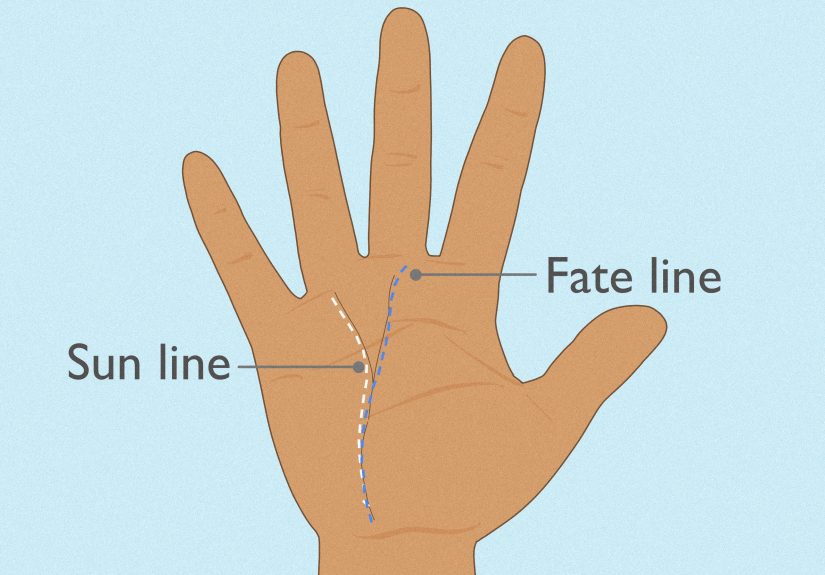
The Sun line is typically described as a vertical line that runs up the palm toward the
ring finger (the “Apollo finger” in many palmistry systems). It’s considered one of the
“major” lines in beginner guides, though it’s also commonly noted that not everyone has a strong Sun line
and that its appearance can vary a lot.
In palmistry, the Sun line is linked to themes like:
- Recognition: being seen, credited, appreciated, or acknowledged
- Creative expression: art, performance, design, storytelling, craftsmanship
- Personal satisfaction: feeling proud of your work (even if it’s not viral)
- Reputation: how you’re perceived, your “public story,” and the glow you give off
- Momentum: when your effort starts paying back in visible ways
Translation: in traditional interpretations, the Sun line isn’t just about fame. It’s about what happens
when your talent meets timing, confidence, opportunity, and follow-through.
A Quick Reality Check (Because Skin Is Not a Crystal Ball)
Palmistry is a cultural and spiritual practicenot a scientifically validated method for predicting the future.
The “lines” on your palm are palmar creases (flexion creases), and research suggests many of
these creases form early in fetal development. In medicine, crease patterns can sometimes be discussed as
anatomical features or diagnostic clues in specific contexts (which is a totally different goal than fortune-telling).
Also, readings can feel weirdly accurate because humans are meaning-making machines. Broad statements can “fit”
many people, and a skilled reader can pick up on cues (a phenomenon often discussed as cold reading in skeptical literature).
None of that means palmistry can’t be meaningfulit just means it works best as a reflective tool, not a life GPS.
How to Find the Sun Line on Your Palm
Grab good lighting. Relax your hand (don’t stretch your skin tight like you’re auditioning for “America’s Next Top Palm”).
Then look for a line that:
- Runs vertically (more up-and-down than side-to-side)
- Sits under or toward the ring finger
- May start from the middle/lower palm and move upward
Two traditional tips you’ll see in beginner guides:
- Dominant hand (the one you write with): often read as “current path” or what you’re building now.
- Non-dominant hand: often read as “inborn traits,” baseline tendencies, or early influences.
If you don’t see a clear Sun line, don’t panic. In palmistry traditions, absence is not a curse; it’s more like
“this storyline isn’t loud in the map.” (Also: you can still be talented. Your hands did not cancel your potential.)
What the Sun Line Means in Palmistry (Common Interpretations)
1) A Deep, Clear Sun Line
Traditionally, a strong, clean Sun line suggests visible confidence and a greater likelihood that
your skills are recognizedespecially in creative, public-facing, or leadership paths. Palmists often associate
this with sustained effort that results in a reputation people notice.
Example: You consistently produce good work, and eventually people start seeking you outclients,
collaborators, an audience, a promotion, a “How are you so good at that?” moment.
2) A Faint or Short Sun Line
A lighter Sun line is often interpreted as quiet talent or recognition that grows slowly.
Some readers describe this as “your shine is real, but it builds over time,” or “your fulfillment is more internal.”
Example: You’re creative, but you don’t crave attentionor you’re still practicing, building skill,
and learning how to show your work without wanting to crawl into a blanket fort afterward.
3) No Visible Sun Line
In palmistry, not having a distinct Sun line is commonly framed as:
success isn’t your primary motivator, or your “recognition path” is less tied to public validation.
Many modern guides emphasize that you can be successful and fulfilled without this line being prominent.
Example: You find joy in mastery, relationships, or serviceand your accomplishments don’t require applause to be real.
(But applause is still allowed. You are not obligated to be humble 24/7.)
4) Multiple Sun Lines
More than one Sun line (or branches feeding into it) is often read as multiple talents or multiple
sources of fulfillmentlike someone who does “a practical job” and also makes music, runs a side business,
or has a public hobby that brings recognition.
Example: You’re a spreadsheet wizard by day and a ceramic artist by nighttwo different arenas, two different spotlights.
Where the Sun Line Starts (Palmists Love This Part)
In many palmistry traditions, the “start point” is treated like the origin story of your recognition:
where your confidence comes from, what “feeds” your shine, and when it tends to show up.
Here are common interpretations you’ll see across beginner and intermediate explanations:
Starting Near the Wrist or Lower Palm
Often read as early encouragement or a life path where creative identity is present from the beginning.
Some interpret it as “you’ve always been wired to make an impact.”
Starting From the Life Line
Frequently interpreted as recognition that grows out of self-driven effort, personal resilience,
or a skill developed through lived experience.
Starting From the Head Line
Commonly linked (in palmistry) to success through study, strategy, and mental clarity.
Think: earning recognition via expertise, problem-solving, writing, analysis, or building systems.
Starting From the Heart Line
Often associated with recognition tied to relationships, values, and emotional intelligencework that
connects with people (teaching, caregiving, community leadership, performance, storytelling).
Starting From the Fate Line
Commonly interpreted as recognition that is influenced by career direction or external circumstances
opportunities, timing, or roles that place you in view.
Sun Line “Quality”: Breaks, Chains, Forks, and Other Tiny Drama
Palmistry doesn’t just look at “Do you have the line?” It looks at how it behaves. Here are classic
interpretations (with a friendly reminder that these are symbolic traditions, not guaranteed outcomes):
Breaks in the Sun Line
Usually read as a pause or change in recognitioncareer shifts, burnout, a move, a new identity,
or a season where your work goes private before it goes public again.
Example: You switch industries, start over, or take time off. Your “spotlight” flickers, not because you failed,
but because you’re re-routing.
Chained or “Beaded” Sun Line
Often interpreted as inconsistent confidence, scattered effort, or external noisedoing great work but
feeling unsure, overthinking, or splitting energy across too many directions.
Forks at the Top
A fork near the top is sometimes read as two outlets for recognitiontwo careers, two creative lanes,
or a main talent plus a public side passion.
Islands (Oval Shapes Along the Line)
Often read as a phase of confusion, vulnerability, or reputation stresslike being misunderstood,
doubting yourself, or dealing with obstacles that temporarily blur your visibility.
Stars, Crosses, and “Trident” Endings
Traditional palmistry sometimes treats these as “big signals.” Depending on the school, a star might be read as a sudden
burst of recognition, while a trident-like ending might be read as amplified success or expansion.
(Different palmistry systems disagree here, so take it as symbolism rather than a universal rulebook.)
Sun Line vs. Fate Line: What’s the Difference?
Beginners often mix these up, because both can appear as vertical lines.
In many palmistry explanations:
- Fate line = structure, responsibility, “the path,” career pressure, external forces
- Sun line = recognition, joy, creative identity, reputation, fulfillment
A popular way palmists describe it is: the Fate line shows what you’re doing; the Sun line shows how much
you’re seen for itand how satisfying it feels.
If the Sun line is strong while the Fate line is faint, some palmists interpret that as “you shine when you do things
your own way,” even if your career path looks unconventional. If the Fate line is strong but the Sun line is faint,
some interpret it as “responsible and steady,” but still learning to prioritize joy, creativity, or visibility.
Can the Sun Line Change Over Time?
You’ll hear two truths that can live in the same room without fighting:
- Biology truth: Palmar creases are real anatomical features, many formed early in development.
- Palmistry truth: Readers often say lines can “strengthen,” “fade,” or appear more noticeable with life changes.
In practical terms, what people often observe is that tiny lines can become more visible as hands changehydration,
skin texture, manual work, aging, lighting, and even how you hold your hand can affect what you see. Palmists interpret
these shifts symbolically as changes in focus, confidence, and life direction.
If you want to explore this without going off the deep end, take a clear photo of both palms every few months in the
same lighting. Treat it like journaling. Your hand becomes a conversation starter with yourself, not a verdict.
How to Use Sun Line Reading Without Making It Weird
The best way to use palmistry (for most people) is as a reflection tool. If your Sun line is clear, faint, broken,
or absent, try these questions:
Reflection Prompts
- Recognition: Where do I want to be seenand where do I prefer privacy?
- Creative fulfillment: What activity makes me lose track of time in a good way?
- Confidence: What would I do if I assumed I was allowed to be good at it?
- Consistency: What tiny habit would help my talent show up more often?
- Reputation: What do I want to be known for (even in a small circle)?
If palmistry gives you language for your goals, awesome. If it makes you anxious, scale it back. A line on your palm
should never have more authority than your values, your choices, and your actual lived reality.
Experiences: of “Sun Line” Moments People Commonly Talk About
Since palmistry is interpretive, “experiences” around the Sun line often show up as stories people tell after they
start paying attention to their talents and visibility. Here are a few patterns that come up again and againnot as
proof of destiny, but as relatable human behavior with a palmistry soundtrack.
1) The “I didn’t realize this counted as talent” realization.
Someone notices a faint Sun line and thinks it means they’re doomed to obscurity. Then they list the things people
constantly ask them for: advice, designs, playlists, edits, troubleshooting, pep talks, recipes. The “Sun line moment”
is when they stop dismissing their strengths as “normal” and start treating them as skills. In palmistry language,
it’s like the line goes from “faint” to “acknowledged”not because the skin changed overnight, but because their
self-perception did.
2) The “quiet era” before the visible era.
People with a broken or interrupted Sun line often connect the symbolism to a real season: taking care of family,
changing majors, moving cities, recovering from burnout, or rebuilding after a setback. They describe it as a chapter
where they did important work that wasn’t public. Later, when they return to a craft or career, recognition comes
fasterbecause the foundation was built in private. Palmistry frames this as “the shine returns.” Real life frames it
as “compound growth.”
3) The “two spotlights” experience.
People who notice branching lines or multiple vertical lines under the ring finger area often describe having two lanes
that feed their identity: a stable job plus a creative outlet, or a technical role plus a public-facing hobby.
The experience isn’t always glamorousit can look like late nights, trial-and-error, and learning boundariesbut it
usually comes with a satisfying feeling: “I’m more than one label.” Palmistry calls that “multiple sources of success.”
Your calendar calls it “busy,” but your soul might call it “alive.”
4) The “recognition isn’t the same as happiness” plot twist.
Some people with a strong Sun line still report feeling weird when praise arrives. They expected applause to feel like
a permanent emotional upgrade. Instead, it can feel like pressure, imposter syndrome, or the fear of being one-hit-wondered.
This is where the Sun line, interpreted thoughtfully, becomes less about chasing fame and more about building
sustainable fulfillment: creating for the right reasons, surrounding yourself with honest feedback, and defining success
in a way that doesn’t require strangers to validate your nervous system.
If you take nothing else from these stories, take this: whether your Sun line is bold, shy, or playing hide-and-seek,
you can still develop your gifts. Visibility is a strategy. Fulfillment is a practice. And your palm is allowed to be
interesting without being in charge.
Conclusion
In palmistry tradition, the Sun (Apollo) line is a symbol of recognition, creative expression, reputation,
and personal satisfaction. A strong line is often read as “your gifts are visible,” while a faint, broken, or absent line
is typically read as “your path is quieter, more complex, or still unfolding.” The fun (and useful) part isn’t treating
it like fateit’s using it as a mirror: What do you want to be known for? What lights you up? And what would change if
you acted like your talents deserved consistency?
Because in the end, the most powerful interpretation is the one where you do the work, tell your story, and let the
“Sun line” be what it was always best at: a little reminder to make space for what makes you shine.