Table of Contents >> Show >> Hide
- What Makes a Kani Shawl So Special?
- Step by Step: How Handwoven Kani Shawls Are Made in Kashmir
- 1. The story starts with the fiber
- 2. Then comes dyeing, where the palette gets its personality
- 3. The design is translated into talim
- 4. The loom is prepared with warp arrangement, dressing, and threading
- 5. Weaving begins, and this is where the real magic happens
- 6. Clipping, finishing, washing, and ironing complete the shawl
- Why the Patterns Look So Alive
- From Mughal Courts to European Closets
- How to Recognize the Real Craft Behind the Shawl
- Why This Craft Still Matters
- What It Feels Like to Watch a Kani Shawl Come to Life
- Conclusion
Some textiles keep you warm. A true Kani shawl also keeps alive a whole system of memory, math, rhythm, patience, and human stubbornness. And honestly, stubbornness is the right word here, because no one making a handwoven Kashmiri shawl has ever looked at the process and said, “You know what this needs? More shortcuts.” The beauty of these shawls lies in the exact opposite idea. Every motif, every color join, every floating paisley-shaped curve is built slowly by hand, one tiny move at a time.
That is why watching Kanihami shawls being made in Kashmir feels so mesmerizing. You are not just seeing a luxury garment come together. You are seeing a living technology older than modern fashion’s attention span, and far more elegant than anything that arrives in a plastic mailer two days after you panic-bought it online. A real Kani shawl is not rushed. It is planned, translated, dyed, warped, woven, finished, and only then allowed to become the soft miracle people drape over their shoulders.
What many shoppers call a “Kanihami shawl” is typically referring to the famous Kani weaving tradition of Kashmir, a craft celebrated for using pashmina or cashmere yarn, a coded design system called talim, and dozens of small wooden bobbins instead of a single shuttle. The result is a woven shawl whose pattern is built into the fabric itself rather than sitting on top like decoration added at the last minute. That difference matters. It is the difference between ornament and architecture.
What Makes a Kani Shawl So Special?
Kani shawls belong to the great tradition of Kashmir shawls, which became famous for their softness, warmth, and astonishing detail. Historically, these shawls were associated with elite dress in South Asia and later exploded into fashion culture in Europe. By the late eighteenth and early nineteenth centuries, Kashmir shawls were not merely accessories; they were status objects, diplomatic gifts, collector’s pieces, and the ancestors of the “paisley” craze that still shows up everywhere from scarves to neckties to wallpaper.
But a Kani shawl is special even within that glamorous family. Its signature method is a form of twill tapestry weaving. Instead of sending one shuttle across the whole width of the cloth, artisans work with many small wooden spools, or kanis, each carrying a different colored yarn. These are inserted only where a color is needed. At each change of color, the yarns interlock. That creates crisp motifs, dense patterning, and a fabric that feels unified rather than patched together on the surface.
In plain English, the design is woven from the inside out. In even plainer English, this is the textile equivalent of painting a mural with tweezers. No wonder the finished shawl looks so refined.
Step by Step: How Handwoven Kani Shawls Are Made in Kashmir
1. The story starts with the fiber
Before there is a shawl, there is pashmina, the famously fine undercoat associated with cashmere-producing goats from cold mountain regions. This fiber became legendary because it is both warm and light, which sounds like a contradiction until you actually touch it. Kashmiri weavers built an international reputation by transforming this delicate material into cloth that could feel featherlight yet still stand up to brutal winter cold.
The raw material must first be processed carefully. Fine fiber is sorted and prepared for spinning. This stage sounds unglamorous, but it is absolutely foundational. A shawl cannot become elegant later if the yarn is uneven now. Luxury starts long before the loom.
2. Then comes dyeing, where the palette gets its personality
Once the yarn is ready, it is dyed in the colors required for the final design. Traditional Kashmir shawls are known for rich, nuanced palettes rather than loud, cartoonish blasts of color. Deep reds, blues, greens, yellows, creams, blacks, and softer earth tones all appear across historical examples. The magic is not only in the shades themselves, but in how they are balanced. A good Kani shawl does not scream. It glows.
This is where the future pattern is already being planned, because every color must exist in yarn form before the weaving starts. Modern fast fashion asks, “Can this print be applied later?” Kani weaving asks a more serious question: “Can this idea be built thread by thread from the ground up?”
3. The design is translated into talim
Here is the part that separates Kani weaving from casual admiration and moves it into the realm of genius. The shawl design is converted into talim, a written instruction system that tells the weaver exactly how the pattern should be executed. Think of it as a coded script, a textile score, or a weaving language. It is not merely a pretty sketch clipped beside a loom. It is a precise technical guide.
The weaver follows these instructions line by line. That means the beauty of the finished shawl depends not only on visual imagination, but also on disciplined reading, interpretation, and repetition. In other words, the pattern is not freestyle. It is choreography.
This is one reason Kani shawls feel so intellectually beautiful. Their grace is engineered. The curved boteh, the flowering vines, the striped borders, the all-over jamawar fields, the corner medallions, the repeating butis: none of it appears by accident. Everything is planned, counted, and woven with astonishing control.
4. The loom is prepared with warp arrangement, dressing, and threading
After the yarn and design are ready, the warp is arranged and the loom is dressed. This setup stage is technical, quiet, and easy to underestimate if you are only obsessed with the pretty parts. But the loom is where the logic of the shawl becomes physical. Tension, alignment, and threading all have to be right, because an intricate design cannot survive sloppy groundwork.
Historical scholarship on Kashmir shawls shows that loom capabilities affected pattern structures. Earlier shawls might be woven in one piece with more straightforward symmetry, while later market pressures encouraged sectional construction and denser effects. In short, design and technology were always in conversation. The loom was never just a passive frame; it helped shape the look of the shawl itself.
5. Weaving begins, and this is where the real magic happens
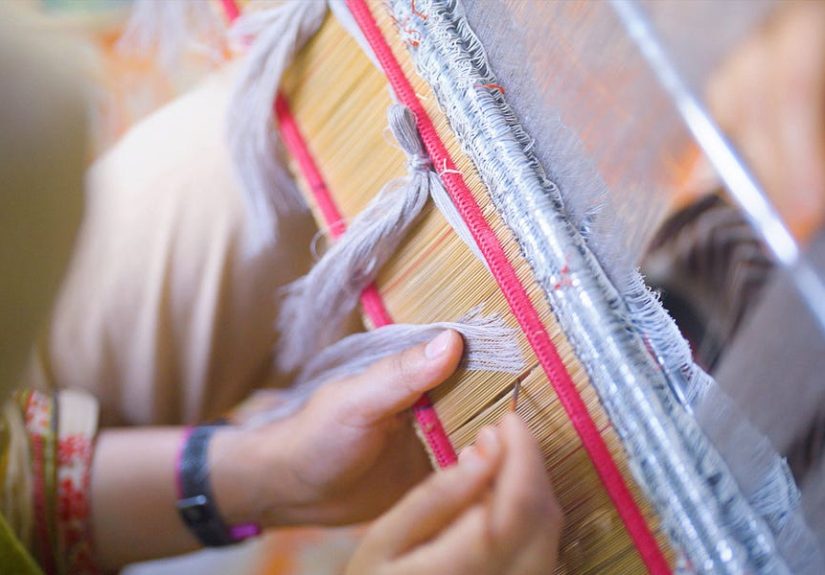
Now the kanis come out. Each small wooden bobbin carries a colored yarn. The weaver inserts it only in the area where that color belongs, then interlocks it with neighboring yarns wherever colors meet. The pattern grows bit by bit across the surface. Not fast. Not casually. Certainly not while multitasking through six meetings and a podcast.
A Kani shawl can require multiple weavers, and even simpler pieces may take months. More complicated examples can take far longer. That timeline makes sense once you understand the method. Every curve has to be articulated through the structure of the cloth. Every motif has to remain balanced. Every color join has to behave. This is slow weaving because it is intelligent weaving.
The most distinctive motifs often include the boteh, also recognized in the West as the paisley form, along with floral sprays, stylized leaves, striped arrangements, and dense all-over jamawar patterning. In many historical examples, these motifs seem to sway, bloom, and pulse across the field of the shawl. That visual liveliness comes from the marriage of drawing and structure. The motif is not pasted onto the cloth. The motif is the cloth.
6. Clipping, finishing, washing, and ironing complete the shawl
Once weaving is done, the shawl still is not finished. It goes through clipping and surface finishing, then washing and ironing. These steps refine the hand, settle the fabric, and help the textile achieve the smooth, elegant presence people expect from genuine Kashmiri shawls.
It is easy to imagine that finishing is just a beauty treatment. It is not. It is part of revealing what the weaving has already achieved. A great shawl does not become great in finishing, but finishing lets greatness show up properly dressed.
Why the Patterns Look So Alive
If you have ever seen an old Kashmir shawl in a museum, you know the feeling: you look once for color, twice for pattern, and then a third time because your eyes suddenly realize the pattern is doing something much more complicated than expected. The motifs are structured, but they never feel stiff. They move. They unfurl. They seem to breathe.
Part of that effect comes from the boteh or buta motif, the curved cone or teardrop form that later became widely known as paisley in the West. Museums in the United States repeatedly point to these forms as a hallmark of Kashmir shawls. Early shawls often balanced plain grounds with decorated ends, while later pieces became denser and more elaborate, especially as European demand influenced design choices.
That evolution matters because it explains why some shawls feel almost minimal and others look delightfully maximalist, like someone told the flowers to stop being polite and start decorating every available inch. Neither approach is random. Both reflect changing tastes, weaving strategies, and market histories.
From Mughal Courts to European Closets
Kashmir shawls were admired long before Europe became obsessed with them. They were associated with courtly life under the Mughals, and rulers used luxurious textiles as gifts, rewards, and symbols of prestige. Later, Kashmir shawls became wildly fashionable in Europe, where they paired beautifully with the looser silhouettes of early nineteenth-century dress.
That international fame came with a twist. European manufacturers, especially in France and Great Britain, began producing imitations. The town of Paisley in Scotland became so closely associated with these designs that its name eventually stuck to the motif itself. That is one of fashion history’s great branding coups: a Kashmiri visual language traveled so successfully that much of the world now remembers the Scottish label before the Kashmiri origin.
Unfortunately, imitation also meant competition. Mechanized industries could produce shawl-inspired goods faster and more cheaply. Historical sources describe how that pressure contributed to changes in Kashmir’s shawl industry and, eventually, to serious decline in the nineteenth century. Some later shawls were woven in sections and pieced together, showing how workshops adapted in response to demand, scale, and changing economics.
So when you watch a Kani shawl being made today, you are not just watching a pretty craft survive. You are watching a craft that endured global fashion mania, copying, industrial pressure, and market collapse, yet somehow still kept enough of its soul to remain recognizable.
How to Recognize the Real Craft Behind the Shawl
Plenty of modern products borrow the look of Kashmir shawls. Much fewer embody the original logic of Kani weaving. A true handwoven Kani shawl is defined by process as much as appearance. It should be handwoven, created with kanis rather than a standard shuttle, built through twill tapestry interlocking, and guided by the traditional talim system. Official GI documentation in India emphasizes precisely these standards.
That means authenticity is not just about saying “Kashmir-inspired” in a product description and hoping nobody asks follow-up questions. It is about origin, method, materials, and the continuity of local knowledge. A machine can imitate the mood. It cannot recreate the rhythm of the real thing.
And yes, this is the part where it becomes very clear that the cheapest shawl on the internet with “luxury artisan vibe” in the caption is probably not carrying four or five generations of weaving intelligence in its fibers. Shocking, I know.
Why This Craft Still Matters
Kani weaving matters because it proves that craft is not a leftover from the past. It is a sophisticated system of design thinking. It combines fiber knowledge, dye knowledge, coded instruction, loom control, pattern mathematics, and finishing skill. That is not nostalgia. That is expertise.
It also matters because the shawl embodies a rare kind of cultural continuity. The same object holds together local materials, regional aesthetics, historic trade, imperial fashion, European imitation, museum conservation, and modern conversations about authenticity and craft protection. Few textiles carry so much history without ever becoming dull.
And perhaps most importantly, Kani shawls remind us that slowness is not the enemy of beauty. In fact, it may be one of beauty’s best business partners.
What It Feels Like to Watch a Kani Shawl Come to Life
If you ever have the chance to watch a Kani shawl being woven in Kashmir, do not expect spectacle in the usual modern sense. There are no flashing screens, no grand reveal buttons, no dramatic “before and after” moment every thirty seconds. The experience is quieter than that, and much richer. You stand near the loom, and at first it may even seem almost too modest for the legend surrounding it. A wooden setup. Fine yarn. Hands moving. A repeated motion. Then your eyes adjust, and you begin to notice the miracle hiding in plain sight.
You notice how the weaver’s attention never really leaves the cloth. You notice how the small bobbins are not random tools tossed around for convenience, but participants in an organized conversation. One color enters, another waits, a third interlocks, and suddenly a fragment of border appears where a moment earlier there was only possibility. Watching that happen is a little like watching handwriting become music. The pattern does not arrive all at once. It accumulates, confidently, with zero interest in impressing you quickly.
You also become aware of time in a totally different way. In everyday life, we treat time like a thief. In a weaving room, time feels more like a collaborator. The shawl is not fighting the clock. It is using it. Every hour adds clarity. Every repeated gesture adds precision. Every color join asks for care. It is the opposite of disposable design. The cloth teaches patience without ever sounding preachy about it.
There is also a sensory side to the experience that photographs cannot quite capture. The yarn has a softness that looks almost weightless, yet the woven fabric carries surprising authority. The colors feel deep rather than loud. The motifs, especially the boteh and floral forms, seem to emerge from the structure the way leaves emerge from a branch. Even the nearly finished shawl has a strange dual personality: delicate in touch, strong in composition, quiet in mood, but visually unforgettable.
And then there is the emotional effect. You realize that what you are watching is not only skill, but inheritance. The coded language of talim, the knowledge of yarn, the muscle memory at the loom, the understanding of balance and spacing, the instinct for when a pattern is truly alive instead of merely correct: these things do not appear overnight. They are learned, practiced, corrected, and passed on. A Kani shawl is not just handmade. It is hand-remembered.
That may be the most powerful part of the experience. You leave with a new respect for the shawl, yes, but also for the people who keep making it in a world addicted to speed. The finished textile looks luxurious when folded over an arm or draped across a shoulder. But after watching it being made, luxury stops meaning price alone. It starts meaning labor, lineage, restraint, intelligence, and care. Once you see that, a real Kani shawl no longer feels like a fashion extra. It feels like woven time, and that is much harder to forget.
Conclusion
To watch how Kanihami shawls are made by hand in Kashmir is to understand that real craftsmanship is built on precision, not performance. The process begins with fine pashmina fiber, moves through dyeing and the talim design code, passes through painstaking loom work with tiny kanis, and finishes only after careful washing and refinement. Along the way, the shawl becomes more than cloth. It becomes evidence of a cultural system that values memory, mastery, and beauty with backbone.
That is why Kani shawls continue to fascinate museums, collectors, designers, and ordinary people who simply know excellence when they see it. They are soft, yes. They are warm, yes. But above all, they are intelligent textiles. And in a world overflowing with things made quickly and forgotten faster, that kind of intelligence feels rare enough to wear proudly.