Table of Contents >> Show >> Hide
- What Happened to Voyager 1’s Thrusters?
- Why the Thruster Reconfiguration Was So Difficult
- A Quick Timeline of Voyager 1’s Thruster Challenges
- Why Keeping Voyager 1 Pointed at Earth Matters
- The Engineering Lesson: Redundancy Is Beautiful
- Voyager 1 and the Deep Space Network
- How Old Hardware Keeps Doing New Science
- Why This Story Captures the Public Imagination
- What Voyager 1’s Thruster Fix Means for the Future
- Practical Experiences and Lessons from the Voyager 1 Thruster Reconfiguration
- Conclusion: A Tiny Thruster Fix with a Giant Meaning
Voyager 1 completes tricky thruster reconfiguration may sound like a headline from a space opera, but it is real engineering from one of humanity’s oldest and most beloved spacecraft. Nearly five decades after launch, NASA’s Voyager 1 is still talking to Earth from interstellar space, still collecting data, and still making engineers perform the cosmic equivalent of fixing a vintage car while it is speeding away at highway speed multiplied by “please do not ask.”
The recent thruster reconfiguration was not a flashy rocket burn or a Hollywood-style rescue mission. It was quieter, stranger, and in many ways more impressive. Voyager 1’s small hydrazine thrusters are responsible for keeping its antenna pointed toward Earth. Without that careful orientation, the spacecraft cannot reliably receive commands or send back its priceless science and engineering data. The problem? Some of the tiny fuel tubes inside its thrusters had become increasingly clogged after 47 years in deep space.
NASA’s Jet Propulsion Laboratory team solved the issue by switching Voyager 1 to another thruster branch after weeks of planning. That sentence sounds simple. In reality, it involved limited power, cold hardware, aging spacecraft systems, long communication delays, and a machine built in the 1970s still operating billions of miles from home. In short, it was less like clicking “restart” and more like performing delicate surgery through a telescope while the patient is outside the solar system.
What Happened to Voyager 1’s Thrusters?
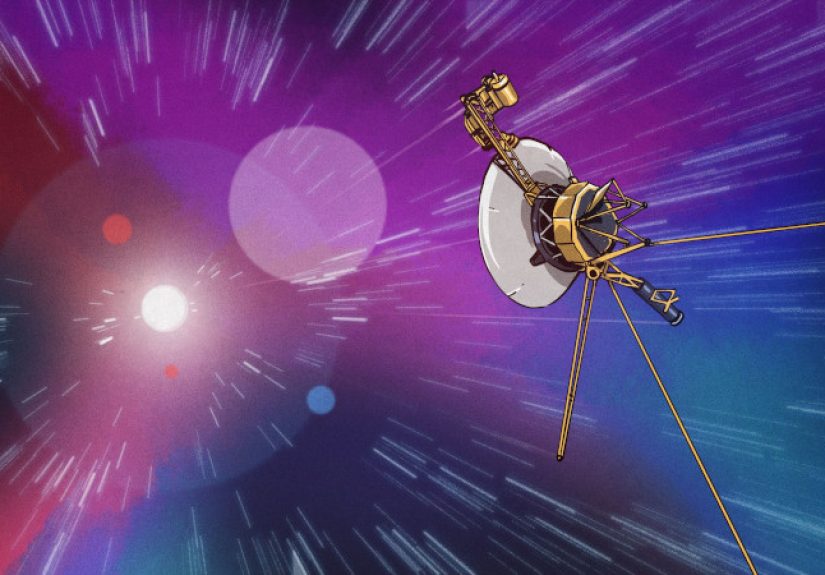
Voyager 1 uses small thrusters to make tiny adjustments that keep its high-gain antenna aimed at Earth. These thrusters do not blast the spacecraft around like a sci-fi fighter jet. They release very short puffs of gas, measured in tens of milliseconds, to gently tilt the spacecraft. When everything is working normally, those tiny pushes help maintain the communication link between Voyager 1 and NASA’s Deep Space Network.
After decades of operation, the spacecraft’s fuel system began showing its age. A rubber diaphragm in the fuel tank can produce silicon dioxide as it ages. Over time, that material can build up in extremely narrow fuel tubes inside the thrusters. The original tube opening was already tiny, roughly 0.01 inches wide. In the affected system, residue had narrowed the opening dramatically, reducing the efficiency of the thrusters.
That is a big problem when your spacecraft is more than 15 billion miles from Earth and depends on accurate pointing to communicate. If Voyager 1’s antenna drifts too far off target, Earth becomes harder to “hear,” and Voyager becomes harder to command. There is no service station, no spare parts delivery, and no intern with a wrench. There is only careful diagnosis, clever command sequencing, and a lot of patience.
Why the Thruster Reconfiguration Was So Difficult
Voyager 1 was designed with redundancy, which is one reason it has lasted so long. The spacecraft has multiple thruster branches, including attitude propulsion thrusters and trajectory correction maneuver thrusters. During the mission’s early planetary flybys, different thrusters served different purposes. Now that Voyager 1 is on a stable path out of the solar system, its most important pointing job is simpler: keep the antenna aimed toward Earth.
That simplicity helped engineers consider switching to another set of thrusters. However, “switching” on a 47-year-old spacecraft is not like changing TV channels. Some thruster branches had been unused for long periods. Some heaters had been turned off to save power. Parts of the spacecraft had become colder than engineers preferred. Turning cold thrusters on too abruptly could damage them, leaving Voyager 1 with fewer options.
The Power Problem
Voyager 1 is powered by radioisotope thermoelectric generators, which convert heat from decaying plutonium into electricity. That power supply has been slowly declining for decades. Every watt matters. To keep the spacecraft alive, engineers have shut down nonessential systems and some heaters over the years. That conservation strategy has worked, but it also means the spacecraft runs colder and with less flexibility.
Before activating the alternate thruster branch, engineers needed to warm it. But powering the thruster heaters required electricity that Voyager 1 did not casually have lying around. The team had to determine what could be safely turned off temporarily to free enough power without causing a bigger problem. Shutting down a science instrument briefly was considered risky because there was no guarantee it would restart. Eventually, engineers found a safer approach: temporarily turn off one of the spacecraft’s main heaters for about an hour to power the thruster heaters.
The Temperature Problem
Temperature is not just a comfort issue in deep space. Hardware that is too cold can behave unpredictably. Fuel lines can become vulnerable. Electronics may not respond as expected. Old mechanical and thermal systems may have margins that nobody wants to test casually. The Voyager team had to think like conservators handling an ancient manuscript, except the manuscript is moving through interstellar space and occasionally needs to fire thrusters.
The warm-up plan worked. After the careful power trade and heater operation, NASA confirmed that the needed thruster branch was back in action. The reconfiguration allowed Voyager 1 to continue pointing itself toward Earth, preserving the communications lifeline that makes the mission valuable.
A Quick Timeline of Voyager 1’s Thruster Challenges
Voyager 1’s thruster story has unfolded over many years. It is not a single malfunction but a long-running lesson in managing aging systems with patience and creativity.
1977: Launch of a Legend
Voyager 1 launched on September 5, 1977, from Cape Canaveral. Its original mission focused on flybys of Jupiter and Saturn. The spacecraft was not expected to become a 21st-century interstellar explorer that would still be producing headlines in the 2020s. Yet here we are, cheering for a machine old enough to have opinions about disco.
1979–1980: Jupiter and Saturn Flybys
Voyager 1 transformed planetary science during its flybys. It discovered a thin ring around Jupiter, identified new Jovian moons, studied Saturn’s rings and moons, and provided detailed observations of Titan’s thick atmosphere. After Saturn, Voyager 1’s trajectory carried it out of the planetary plane and toward interstellar space.
2002: First Major Thruster Branch Switch
Engineers noticed clogging in the attitude propulsion thruster branch used for pointing and switched to a second branch. This was an early sign that the spacecraft’s aging fuel system would require long-term management.
2018: Switch to Trajectory Correction Thrusters
When the second attitude thruster branch also showed signs of clogging, engineers switched to trajectory correction maneuver thrusters. These had originally been used for different mission needs, but Voyager 1’s simpler interstellar pointing requirements made them useful for antenna control.
2024: Tricky Thruster Swap Completed
By 2024, the trajectory correction thruster tubes had become even more clogged than earlier branches had been when they were retired from regular use. Engineers planned a careful return to an attitude propulsion thruster branch. The operation required warming cold thrusters with limited electrical power. The team confirmed the reconfigured thruster branch was working, keeping Voyager 1’s antenna pointed at Earth.
2025: Backup Thruster Revival Adds More Resilience
In 2025, NASA engineers revived a set of Voyager 1 thrusters that had been considered inoperable since 2004. That work was motivated by the need for backup options as residue buildup continued to threaten active thrusters. It also had a deadline: communication constraints related to a Deep Space Network antenna upgrade. The revival showed once again that Voyager engineering is part science, part detective work, and part respectful negotiation with vintage hardware.
Why Keeping Voyager 1 Pointed at Earth Matters
Voyager 1 is not sending back glamorous new photos. Its cameras were shut down long ago after the famous “family portrait” of the solar system and the unforgettable Pale Blue Dot image. Today, its mission is mostly about particles, magnetic fields, plasma waves, and the structure of interstellar space. That may sound less dramatic than close-up images of Jupiter, but scientifically, it is extraordinary.
Voyager 1 is the first human-made object to enter interstellar space. It crossed the heliopause in August 2012, moving beyond the bubble of particles and magnetic fields created by the Sun. Along with Voyager 2, it remains one of the only spacecraft providing direct measurements from this distant region. Every bit of data helps scientists understand how the Sun interacts with the galaxy around it.
That data depends on communication. Communication depends on pointing. Pointing depends on thrusters. So yes, a tiny clogged tube matters enormously. It is the difference between receiving rare interstellar measurements and losing contact with one of the most important spacecraft ever built.
The Engineering Lesson: Redundancy Is Beautiful
Voyager 1’s survival is a tribute to redundancy. Engineers built the spacecraft with backup systems because deep-space missions are unforgiving. That redundancy has paid off many times. When one thruster branch degraded, another could be used. When a system was thought unusable, later teams revisited old assumptions and sometimes found a workaround.
Modern engineering often celebrates speed, sleekness, and software updates. Voyager celebrates something different: durability. It reminds us that good design is not only about what works on launch day. It is about what still works after radiation, freezing temperatures, power loss, and 47 years of cosmic solitude.
There is also a human lesson here. The engineers working on Voyager 1 today are solving problems on hardware designed before many of them were born. They rely on archived documentation, institutional memory, testing, simulation, and cautious creativity. In a world where phones become “old” after three years, Voyager 1 is out there proving that some machines deserve a standing ovation and maybe a tiny retirement cake.
Voyager 1 and the Deep Space Network
NASA communicates with Voyager 1 through the Deep Space Network, a global system of giant antennas located in California, Spain, and Australia. Because Earth rotates, having stations around the world allows NASA to maintain contact with distant spacecraft as our planet turns. For Voyager 1, the link is especially demanding because of the spacecraft’s immense distance and faint signal.
Commands sent from Earth take many hours to reach Voyager 1. Engineers cannot simply send a command and watch an instant response. They must wait for the signal to travel out to the spacecraft and then wait again for confirmation to return. This delay makes every operation more deliberate. A mistake cannot be corrected quickly. Planning must be careful, conservative, and deeply informed by how the spacecraft is likely to behave.
How Old Hardware Keeps Doing New Science
Voyager 1 continues to operate because NASA has repeatedly made smart tradeoffs. Instruments and heaters have been powered down to conserve electricity. Systems are prioritized according to the mission’s most important goals. The spacecraft no longer does everything it once did, but it still does things no other spacecraft can do from its location.
Recent power-saving decisions have become increasingly difficult. In 2026, NASA shut off Voyager 1’s Low-Energy Charged Particles experiment to preserve the mission and keep other science instruments operating. That decision was not made lightly. Each instrument represents decades of work, discovery, and emotional attachment. But the mission’s remaining power must be managed carefully if Voyager 1 is to keep sending data from interstellar space.
The thruster reconfiguration fits into this larger pattern. It was not just a repair; it was a strategic move to extend the spacecraft’s life. By preserving pointing capability, engineers preserved the possibility of more science. In deep space, survival is science. Staying alive is part of the experiment.
Why This Story Captures the Public Imagination
People love Voyager 1 because it feels almost mythic. It left Earth in 1977, visited giant planets, revealed strange moons, carried a golden record with sounds and greetings from Earth, turned back to take a portrait of home, and then kept going. It is both machine and messenger. It represents human curiosity in physical form.
The thruster reconfiguration story adds another chapter to that myth. It shows that exploration is not always about launching something new. Sometimes it is about refusing to give up on something old that still has something to say. Voyager 1 is not the shiny new spacecraft in the hangar. It is the veteran explorer with faded paint, a stubborn antenna, and a support team that knows every quirk by heart.
There is humor in the situation, too. Imagine explaining to someone in 1977 that in 2024 engineers would still be troubleshooting Voyager 1’s plumbing from Earth while the spacecraft was cruising through interstellar space. They might have laughed. Then they might have asked whether we had flying cars by then. Awkward pause.
What Voyager 1’s Thruster Fix Means for the Future
The successful thruster reconfiguration does not make Voyager 1 immortal. Its power supply continues to decline. Its systems continue to age. More instruments may need to be shut down. Eventually, Voyager 1 will fall silent. But the reconfiguration buys time, and time is precious when a spacecraft is collecting data from a place no other operating spacecraft has reached.
Each additional month of Voyager 1 data helps scientists study the interstellar medium, including magnetic fields, plasma waves, cosmic rays, and the boundary effects of the heliosphere. It also helps engineers understand how spacecraft age across extreme timescales. That knowledge can inform future deep-space missions, especially those designed to last for decades.
The mission’s legacy is already secure. Voyager 1 does not need another achievement to be considered historic. Yet every successful workaround feels like a bonus encore. It is as if the spacecraft keeps stepping back onto the stage, giving a little wave with its high-gain antenna, and saying, “One more song.”
Practical Experiences and Lessons from the Voyager 1 Thruster Reconfiguration
The Voyager 1 thruster reconfiguration offers more than a fascinating space headline. It provides real-world lessons that apply to engineering, project management, technology maintenance, and even everyday problem-solving. The first lesson is simple: document everything. Voyager 1 survives partly because teams can still study how its systems were designed, tested, and operated decades ago. Without strong documentation, troubleshooting a spacecraft from the 1970s would be nearly impossible. The same principle applies to businesses, software teams, factories, and homeowners trying to remember which breaker controls the kitchen lights.
The second lesson is that backup systems matter, even when they seem excessive. Redundancy can look expensive or unnecessary when everything is new. But years later, when a primary system degrades, a backup can become the hero of the story. Voyager 1’s multiple thruster branches gave engineers options. Options create resilience. Whether you are designing a spacecraft, managing a website, or running a small business, having a fallback plan can turn a crisis into a manageable inconvenience.
The third lesson is patience. Voyager engineers cannot rush. Commands take many hours to reach the spacecraft, and confirmation takes many hours to return. That delay forces a disciplined style of thinking. Every command must be checked. Every assumption must be challenged. Every consequence must be considered. In fast-moving workplaces, this is a refreshing reminder that speed is not always the same as progress. Sometimes the smartest move is to slow down before making a decision that cannot be easily reversed.
The fourth lesson is creative conservation. Voyager 1’s power is limited, so engineers constantly make tradeoffs. They decide which heaters, instruments, or systems can remain on and which must be shut down. This resembles managing an aging building, an old server, or a long-running content website. Resources decline, priorities change, and success depends on using what remains wisely. The goal is not to preserve everything forever. The goal is to preserve what matters most for as long as possible.
The fifth lesson is respect for legacy systems. Many organizations treat old technology as a nuisance, but Voyager 1 proves that legacy systems can still deliver extraordinary value when maintained intelligently. The trick is to understand their limits. You cannot treat a 47-year-old spacecraft like a new probe. You must work with its history, not against it. That means reading old records, consulting experienced people, testing cautiously, and accepting that some fixes require unusual thinking.
Finally, the Voyager 1 story teaches emotional endurance. Long missions require teams to care across generations. The people who launched Voyager are not the same people solving today’s thruster problems, yet the mission continues because knowledge, responsibility, and curiosity have been passed forward. That is a powerful model for any long-term project. Great work is rarely finished by the same hands that started it. Sometimes the best thing a team can do is build something strong enough for future people to save, improve, and celebrate.
Conclusion: A Tiny Thruster Fix with a Giant Meaning
Voyager 1 completes tricky thruster reconfiguration is more than a technical update. It is a reminder that exploration depends on persistence as much as ambition. The spacecraft is old, cold, power-limited, and unimaginably far away, yet it continues to teach us about the space between stars. NASA’s engineers solved a delicate problem with careful planning, deep expertise, and a willingness to coax one more chapter from a machine that has already exceeded every reasonable expectation.
Voyager 1 will not last forever. No spacecraft does. But every successful repair, every recovered signal, and every packet of interstellar data extends one of the greatest exploration stories in human history. Somewhere beyond the heliosphere, a small spacecraft keeps its antenna pointed home. And here on Earth, we keep listening.
Note: This article is written from publicly available NASA/JPL mission information and reputable U.S.-based space reporting, with source links intentionally omitted for clean web publishing.