Table of Contents >> Show >> Hide
- Why Spider Web Types Matter
- The Main Types of Spider Webs
- Specialized Types of Spider Webs
- How to Identify Types of Spider Webs Around Your Home and Yard
- What Spider Webs Reveal About Spider Behavior
- Common Myths About Spider Webs
- Field Notes and Everyday Experiences With Types of Spider Webs
- Conclusion
If you have ever walked through a garden at sunrise and suddenly noticed what looks like a lace curtain floating between two shrubs, congratulations: you have met one of nature’s most overachieving architects. Spider webs are not random tangles tossed into the air for Halloween aesthetics. They are carefully engineered tools, and different spiders build different designs for very specific reasons. Shape, silk placement, stickiness, and location all matter. In other words, a web is not just a web. It is a strategy.
That is what makes the topic of types of spider webs so fascinating. Some webs are the classic wheel-shaped spirals that show up in storybooks. Others are flat silk hammocks stretched across grass. Some are messy, irregular traps in the corner of a basement. A few are downright sneaky, like triangle webs that act like tiny catapults or purse webs that hide a spider inside a silk tube like a very patient ambush hunter.
Depending on the guide you read, you will usually see four main web types listed first: orb webs, sheet webs, funnel webs, and cobwebs. But specialized designs deserve attention too, especially if you want a fuller understanding of spider behavior. This guide breaks down the most important types of spider webs, how they work, where you are likely to find them, and what they reveal about the spiders that build them. Along the way, we will also clear up a few myths, because not every web means danger, and not every spider is trying to audition for a haunted house.
Why Spider Web Types Matter
A spider web is basically a hunting method you can see. The structure tells you what kind of prey the spider expects, where it likes to live, and how it plans to catch dinner without burning extra energy. A web stretched across open air is ideal for flying insects. A sheet over low vegetation works better for bugs that hop, land, or stumble. A tangled cobweb in a quiet corner is perfect for a spider that prefers a messy but effective trap.
Web design also helps with identification. Even if you never spot the spider itself, the silk often gives away the general type of builder. That wheel-like spiral on the porch? Probably an orb weaver. The flat web with a tunnel disappearing into the grass? Likely a funnel weaver. The dusty-looking mess above a garage window? Most likely a cobweb spider, not a tiny silk vandal with no respect for geometry.
The Main Types of Spider Webs
1. Orb Webs
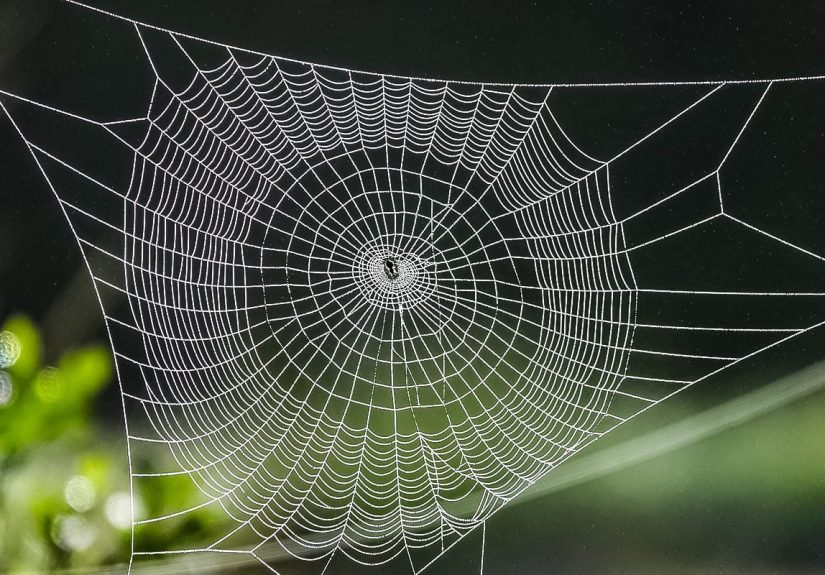
Orb webs are the celebrities of the spider world. These are the classic circular webs with radiating spokes and a spiral capture zone stretched between them. If a child draws a spider web from memory, odds are high they are drawing an orb web.
What makes orb webs so effective is their combination of order and function. The outer frame anchors the web. Radial threads work like spokes on a bicycle wheel. The capture spiral is the sticky part designed to snag insects. Many orb weavers place dry, non-sticky lines where they need to walk and sticky silk where they expect prey to crash-land. That is right: even spiders understand the importance of not gluing themselves to their own work.
These webs are often built in gardens, around porch lights, between tree branches, and near places where flying insects travel. Species such as garden spiders, barn spiders, and orchard orbweavers are well-known examples. Many orb-weaving spiders rebuild their webs regularly, sometimes daily, and recycle protein by eating the old silk before spinning a fresh version. That sounds weird until you remember that construction materials are expensive and spiders do not have a hardware store account.
Orb webs are especially easy to spot after rain or in morning dew, when every silk strand suddenly turns into silver thread. They are also a good reminder that beauty and brutality can share the same zip code. Pretty to us, disastrous to a mosquito.
2. Sheet Webs
Sheet webs look more like silk platforms or hammocks than circular traps. They are usually spread horizontally or at a shallow angle across grass, shrubs, or low plants. At first glance, they can seem simple, but that understatement is part of the trick.
The spider often waits underneath the sheet or along its edge. When a small insect falls onto the web, bumps into supporting threads above it, or lands where it should not, the spider rushes in from below. In many yards, these webs become highly visible at dawn when dew collects on them and turns an ordinary lawn into a field of little silk trampolines.
Sheet webs are common in low vegetation and are often associated with small spiders that do not need flashy architecture to get the job done. They are practical, efficient, and quietly successful. If orb webs are the glamorous downtown condos of spider engineering, sheet webs are the sensible ranch houses with excellent pest-control ratings.
3. Funnel Webs
Funnel webs combine a flat web surface with a retreat shaped like a tube or funnel. The spider usually hides inside that narrow tunnel, waiting for vibrations to signal that prey has landed on the sheet portion of the web. Then it runs out with startling speed, grabs the insect, and drags it back into the funnel. Efficient. Dramatic. A little rude, depending on your perspective.
In the United States, funnel-web builders are often grass spiders or other funnel weavers found in lawns, foundation plantings, shrubs, woodpiles, and corners of structures. Their webs may spread across grass or shrubs and slope inward toward the retreat.
One important point: American funnel weavers are often confused in conversation with the notorious Australian funnel-web spiders. They are not the same thing. In U.S. home-and-garden contexts, the funnel webs you see in grass or hedges are usually made by relatively harmless spiders that are much more interested in insects than in people.
4. Cobwebs or Tangle Webs
Cobwebs, also called tangle webs, are the opposite of orb webs in appearance. They are irregular, messy, three-dimensional, and seemingly chaotic. “Seemingly” is the key word. What looks like a silk accident is actually a highly workable trap.
These webs are common in corners of ceilings, under outdoor furniture, around sheds, in crawl spaces, and around cluttered storage areas. House spiders and widow relatives are classic tangle-web builders. Some of these webs include sticky trip lines that snag wandering insects. Once prey becomes entangled, the spider moves in quickly.
The term “cobweb” also gets used for old abandoned spider silk that has collected dust and debris. That means every cobweb started its life as a perfectly respectable spider web before time, gravity, and household neglect got involved.
Not every messy web belongs to a dangerous spider. That is worth repeating, because plenty of harmless cobweb spiders build untidy traps indoors and outdoors. The web style tells you more about hunting strategy than about how worried you should be.
Specialized Types of Spider Webs
5. Triangle Webs
Triangle webs are a specialized design made by certain triangle weaver spiders, especially in the genus Hyptiotes. Instead of spinning a full orb, these spiders build a smaller, triangular section of web and hold it under tension with their body and silk line.
When prey touches the web, the spider releases tension rapidly, causing the web to spring forward like a miniature net launcher. It is one of the more surprising examples of how web-building is not always passive. Some spiders do not just wait for dinner. They actively slingshot it into a worse situation.
Triangle webs are less commonly noticed than orb webs, partly because they are smaller and partly because most people are not walking around expecting woodland shrubs to contain mechanical ambush systems.
6. Purse Webs
Purse webs are one of the strangest and most memorable web types. Rather than building an exposed snare, purse-web spiders construct a silk tube that is partly buried in soil or attached along bark, rocks, or other surfaces. The tube is often coated with soil, sand, or debris, which helps it blend into the environment.
The spider stays inside the tube. When an insect walks across the outside, the spider bites through the silk, subdues the prey, and pulls it in. It is a wonderfully unnerving design if you are an insect and a wonderfully clever one if you are writing about spider web types.
Purse webs are not the kind most people notice in everyday yards, but they deserve a place in any complete discussion because they show how flexible spider silk architecture can be. Not every web needs to be wide, visible, or sticky. Sometimes stealth wins.
7. Other Web Variations
Once you start looking closely, spider web design becomes a whole genre of structural experimentation. Some spiders make bowl-shaped or dome-like webs. Others add extra silk decorations to orb webs. Some species reduce a familiar pattern into a simpler version adapted to a very specific habitat. And, of course, many spiders do not use prey-catching webs at all. They may use silk for egg sacs, retreats, draglines, or shelter while hunting actively instead of waiting in a trap.
That is why any article about types of spider webs should avoid pretending the spider world fits neatly into a tiny chart. The major categories are useful, but spiders have never been especially committed to making biology feel tidy for humans.
How to Identify Types of Spider Webs Around Your Home and Yard
If you want to recognize spider webs in real life, start with a few basic clues:
- Look at the shape. Circular usually suggests an orb web. Flat and platform-like suggests a sheet web. A tunnel or retreat points to a funnel web. Irregular three-dimensional silk points to a cobweb.
- Check the location. Webs stretched across open gaps often belong to orb weavers. Low grass and shrubs frequently hold sheet and funnel webs. Corners, eaves, and cluttered spaces are cobweb territory.
- Notice where the spider waits. In the center of the web, underneath it, inside a funnel, or hidden in a retreat all tell different stories.
- See what time makes it visible. Dew and low-angle morning light make many webs much easier to spot, especially sheet and orb webs.
- Pay attention to tidiness. Neat geometry usually means one kind of strategy; deliberate chaos usually means another.
This approach will not always get you to species level, but it can quickly help you sort common spider web types with surprising accuracy.
What Spider Webs Reveal About Spider Behavior
Spider webs are not just traps. They are communication systems, vibration sensors, shelters, and engineering solutions made from protein. A spider reads a web the way a musician reads vibration from a string. Tiny changes tell it whether the visitor is prey, a leaf, a potential mate, or something much bigger that calls for a tactical retreat.
Different silk types also play different roles. In orb webs, the capture spiral may be sticky while frame and radial lines are not. Some spiders use silk for safety lines when moving, for wrapping prey, for protecting eggs, or for lining retreats. So when people talk about spider silk as if it does one thing, that undersells the material dramatically. Spider silk is more like a toolkit than a single product.
Web type also reflects energy economics. A spider that rebuilds daily is making one kind of trade-off. A spider hiding in a funnel or purse web is making another. The web is a visible record of how that species balances cost, risk, and reward.
Common Myths About Spider Webs
Myth: All spider webs are sticky.
Nope. Some parts are sticky, some are not, and some web types rely more on structure, timing, or entanglement than on glue-like adhesion.
Myth: Every cobweb means a dangerous spider.
Also false. Plenty of harmless spiders build irregular tangle webs. A messy web is not a medical diagnosis.
Myth: Spiders only make webs to catch food.
Not even close. Silk is used for shelter, courtship, egg protection, movement, and safety lines, in addition to prey capture.
Myth: A web that looks old was always meant to look that way.
Sometimes an actual cobweb is just an abandoned web that has collected dust. Even spider architecture ages badly if nobody maintains the property.
Field Notes and Everyday Experiences With Types of Spider Webs
One of the best ways to understand types of spider webs is not by staring at diagrams, but by noticing them where you already live. A backyard, parking area, garden path, porch rail, or patch of grass can become a sort of open-air museum if you slow down enough to look. The funny part is that most people do not notice spider webs until they walk face-first into one, which is the least educational and most dramatic possible introduction.
Early morning is the ideal time. Dew turns almost invisible silk into bright architecture. Orb webs suddenly look like delicate wheels hung in midair. Sheet webs appear across lawns like tiny frost blankets. Funnel webs reveal themselves as sloping runways that vanish into a tunnel. In that light, the difference between web types becomes obvious even to someone who usually files all spiders under “please stay over there.”
A porch tells a different story from a lawn. Around porch lights, orb weavers often choose spots where flying insects predictably gather at night. It is smart real estate. The spider does not need to chase anything when the buffet is basically coming to it. In a garage or shed, irregular cobwebs show up in corners and around beams, especially where there is little disturbance. These webs feel less glamorous than garden webs, but they are just as purposeful. They are built for traffic patterns, not for compliments.
Gardens are where spider web types really start to feel personal. Once you learn the basics, you stop seeing “a spider web” and start seeing a decision. Why here? Why this shape? Why low to the ground instead of high between branches? Why a funnel retreat instead of an exposed hub? Those questions make even an ordinary walk more interesting. You begin to notice how certain webs appear near shrubs, how some are rebuilt after storms, and how others seem to collect debris until they blend into the background.
There is also something oddly reassuring about realizing how many spiders are quietly working pest-control shifts without asking for recognition. The orb weaver between tomato stakes, the sheet-web spider hidden in groundcover, the funnel weaver tucked into grass at the edge of the yard, and the cobweb spider in an out-of-the-way corner are all solving the same problem in different ways: how to catch insects efficiently. Their tools just happen to look wildly different.
For kids, gardeners, photographers, and curious neighbors, webs can become an easy entry point into backyard natural history. You do not need advanced gear. You mostly need patience, good light, and the willingness to stop dismissing all silk as spooky decoration. The more you notice these structures, the less random they seem. A web becomes a clue. A clue becomes a pattern. And pretty soon you are the person saying things like, “Ah yes, classic funnel architecture,” which is either charming or a sign that the spider has won your respect.
That is really the lasting experience of learning spider web types. You move from vague awareness to recognition. What once seemed like a single creepy category opens into a set of elegant designs, each matched to a way of living. And once that happens, even a humble web in wet grass can feel less like clutter and more like field evidence that nature is full of specialists doing brilliant work on a silk budget.
Conclusion
Spider webs are far more diverse than the single spiral shape most people imagine. The major types of spider webs include orb webs, sheet webs, funnel webs, and cobwebs, while specialized forms such as triangle webs and purse webs show just how inventive spider architecture can become. Each web reflects a different hunting style, habitat, and silk strategy.
Once you know what to look for, spider webs become easier to read. A neat wheel suspended in air, a hammock over grass, a tunnel in a silk sheet, or a dusty tangle in a quiet corner all reveal something about the spider behind them. And that is what makes the subject so rewarding: these are not random strands. They are visible blueprints of behavior, adaptation, and survival.