Table of Contents >> Show >> Hide
- Why Black and White Makes Cats Look Like Legends
- Step One: Train Your Eye to “See” in Monochrome
- Lighting: The Secret Ingredient (Cats Are Just the Bonus)
- Camera Settings That Actually Work (Even if Your Cat Won’t)
- Composition Tricks That Make a Cat Photo Feel “Designed”
- Work With Your Cat’s Mood, Not Against It
- Editing Black and White Cat Photos (Without Turning Them Into Gray Soup)
- “So Here Are Mine”: A Mini Collection of Black-and-White Cat Photo Ideas
- 1) The Window-Sill Philosopher
- 2) Whisker Spotlight
- 3) The Tuxedo Cat Poster
- 4) The Shadow Pounce
- 5) The Staircase Noir
- 6) The Yawn That Looks Like Opera
- 7) The Paw-on-the-Armrest Classic
- 8) The Backlit Halo (Careful Version)
- 9) The “Ears First” Portrait
- 10) The Mirror Doppelgänger
- 11) The Blanket Fort Royalty
- 12) The Mid-Sprint Blur (Intentional Art, Not a Mistake)
- How to Build a Black-and-White Cat Series (Instead of Random Singles)
- 500-Word Experience Add-On: The Monochrome Cat Photo Day (A Familiar Adventure)
Confession: I don’t trust anyone who says they’re “not a cat person.” Cats are tiny, velvet-furred plot twists. They appear. They vanish. They judge. They nap like they invented rest. And when you photograph them in black and white, something magical happens: the drama turns cinematic, the mischief turns mythic, and the whiskers become tiny neon signs that read main character.
So nothere will never be enough black and white photographs of cats. That’s not a problem to solve; it’s a lifestyle to embrace. This guide shows you how to create your own monochrome cat series with real, practical technique (and a little humor), plus a mini “collection” of shot ideasmy go-to setups you can recreate in your home.
Why Black and White Makes Cats Look Like Legends
Color photos can be adorable. Black and white photos can be timeless. When you remove color, your viewer stops thinking about the red toy on the carpet or the green blanket in the corner and starts noticing what matters most: light, shape, texture, and expression.
Monochrome highlights what cats do best
- Texture: fur patterns, plush cheeks, wiry whiskers, velvety ears.
- Contrast: bright window light against shadowy corners; white paws on dark furniture; a tuxedo cat basically doing free graphic design.
- Emotion: the squint, the slow blink, the “I heard a snack bag” pupil expansion.
- Story: black and white naturally feels like a memory, a scene, or a moment stolen from a classic film.
Step One: Train Your Eye to “See” in Monochrome
Black and white photography is less about the cat (sorry, cats) and more about light behavior. Before you even pick up your camera, do a quick “tone scan” of the room:
- Find your brightest light source. Usually a window or doorway.
- Look for clean shadows. Shadows create shape and mood.
- Check tonal separation. If your cat is gray and your couch is gray, you’re filming a stealth documentary. Change the background.
- Notice texture zones. A woven blanket, a scratched cat tree, a sunlit wooden floorthese add richness in black and white.
Shortcut: many cameras and phones let you preview in black and white while still saving a color file. That means you can compose in monochrome (smart) without permanently losing color data (also smart). Think of it as wearing “monochrome glasses” while keeping your options open.
Lighting: The Secret Ingredient (Cats Are Just the Bonus)
If you want black and white cat photos that feel intentionallike they belong in a coffee-table book titled Felines Who Know Too Muchlight comes first.
Best easy lighting setups
- Window light (classic): Place your cat near a window, but not in harsh direct sun. Aim for soft light that wraps around their face.
- Open shade (moody): If your porch or balcony has shade, it creates gentle contrast without squint-inducing brightness.
- Doorway light (cinematic): Stand your cat just inside a doorway with brighter light behind you. It’s instant “film noir at home.”
Avoid: on-camera flash in close quarters. It can flatten texture and can also annoy your subjectwho already has strong opinions about your life choices.
Camera Settings That Actually Work (Even if Your Cat Won’t)
You can shoot great black and white cat photos with a phone, a mirrorless camera, or a DSLR. The goal is the same: freeze motion when needed, keep eyes sharp, and preserve detail in fur.
If you’re using a phone
- Use Portrait mode carefully: it can blur whiskers or cut out ear tips like your phone is auditioning for a horror movie. Take a few versions.
- Tap to focus on the eye. Always the eye. If the eye is sharp, the photo feels sharp.
- Use burst/continuous shooting for action and micro-expressions.
- Expose for fur detail: if you have a dark cat, slightly brighten exposure; if you have a white cat, slightly lower exposure to avoid blown highlights.
If you’re using a camera
- Shutter speed: 1/250 for calm cats, 1/500+ for zoomies, 1/1000 if your cat is basically a furry meteor.
- Aperture: f/1.8–f/2.8 for dreamy portraits; f/4–f/5.6 if you want both eyes and whiskers sharp.
- ISO: raise it when needed. A slightly grainy sharp photo beats a silky smooth blurry one every time.
- Shoot RAW if you can: it protects highlight/shadow detail and gives better control when converting to black and white.
Composition Tricks That Make a Cat Photo Feel “Designed”
Cats are unpredictable, but composition is your stable ground. Use these techniques to turn chaos into art:
1) Get to eye level
Yes, it may require lying on the floor. Welcome to the club. Eye-level photos feel intimate and powerful, especially in black and white.
2) Use negative space
A small cat in a big frame can look thoughtful, funny, or mysterious. Try placing your cat in one corner and leaving the rest as clean wall, shadow, or softly textured background.
3) Look for leading lines
Stair rails, window frames, floorboard lines, couch edgesthese can guide attention right to your cat’s face, like a spotlight you didn’t have to pay for.
4) Embrace shadows (politely)
Black and white loves shadow. Let one side of the face fall darker. Let a paw disappear into a pool of black. This is where “cute” turns into “iconic.”
Work With Your Cat’s Mood, Not Against It
Great cat photography is part technical skill, part diplomacy, part reading body language like you’re decoding a tiny, furry Morse code machine. Here’s how to keep things stress-free:
- Start when your cat is naturally calm: after a meal, after a nap, or during a sunbeam session.
- Use quiet encouragement: treats, a favorite toy, or slow blinking. Avoid loud noises or sudden movements.
- Watch the signals: tail flicking, ears pinned back, wide pupils, crouching, retreatingthese can mean “I’m done.” Respect it and pause.
- Keep sessions short: 5–10 minutes can be plenty. Multiple mini-sessions beat one long negotiation.
Editing Black and White Cat Photos (Without Turning Them Into Gray Soup)
The best monochrome edits have a full tonal rangetrue blacks, clean whites, and a rich ladder of grays in between. Here’s a simple workflow that keeps fur detailed and faces expressive:
1) Convert with control, not a “one-click goodbye”
Instead of permanently stripping color information, use a black-and-white conversion tool (like a B&W mix) so you can adjust how different colors translate into tones. This helps separate fur from backgrounds and keeps faces sculpted.
2) Set black and white points
Use your histogram or basic sliders to ensure you have real blacks and real whitesthen refine midtones so fur doesn’t become a flat blanket of gray.
3) Add contrast in a smart way
A gentle S-curve (or a subtle contrast boost) can make whiskers pop and eyes feel alive. Don’t overdo itunless you’re intentionally going for “cat poster from a 1940s detective film.”
4) Dodge and burn (the elegant cheat code)
Lighten the eyes and highlights on the face slightly. Darken distracting bright patches in the background. This guides the viewer exactly where you want them to look.
5) Optional: a touch of grain
A little grain can make black and white feel organic and classic. The key word is “little,” not “your photo looks like it was printed on a tortilla.”
“So Here Are Mine”: A Mini Collection of Black-and-White Cat Photo Ideas
I can’t physically hand you a stack of my cat prints through the internet (technology is cruel), but I can share the shot concepts I keep returning tothe ones that reliably produce black-and-white magic. Pick three and try them this week.
1) The Window-Sill Philosopher
Setup: cat on a windowsill, soft side light. Tip: expose for the face, not the bright window. Caption vibe: “I am contemplating taxes.”
2) Whisker Spotlight
Setup: a single lamp bounced off a white wall (or soft window light). Framing: tight crop on muzzle and whiskers. Editing: emphasize micro-contrast.
3) The Tuxedo Cat Poster
Setup: dark background (blanket/couch) + your black-and-white cat. Composition: center framing, symmetrical. Result: instant graphic design.
4) The Shadow Pounce
Setup: toy dragged across a patch of light on the floor. Settings: faster shutter speed. Goal: capture the body as a shape with dramatic shadow.
5) The Staircase Noir
Setup: cat on stairs with rail shadows. Composition: let the lines lead to the eyes. Caption vibe: “The case of the missing kibble.”
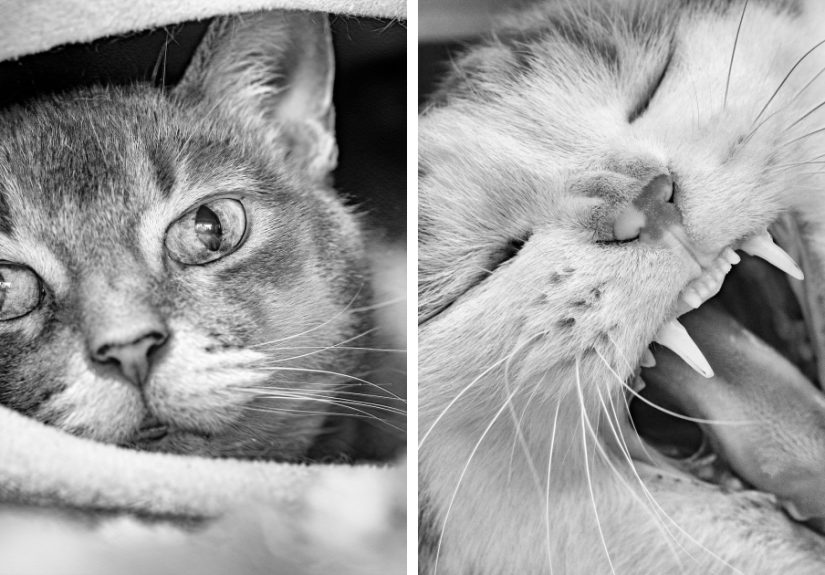
6) The Yawn That Looks Like Opera
Setup: wait for post-nap stretch. Technique: burst mode. Editing: keep highlights gentle; let the mouth be the drama.
7) The Paw-on-the-Armrest Classic
Setup: couch armrest, side light. Framing: paw in foreground, face behind. Trick: focus on the nearer eye if visible.
8) The Backlit Halo (Careful Version)
Setup: cat sitting with window behind them, but angle so light wraps around the outline. Goal: bright rim light around ears and fur without losing face detail.
9) The “Ears First” Portrait
Setup: frame the ears and eyes as the main geometry. Humor: “Satellite dishes locked onto snack frequency.”
10) The Mirror Doppelgänger
Setup: cat near a mirror in soft light. Composition: show both faces if possible. Editing: keep tones gentle to avoid harsh reflections.
11) The Blanket Fort Royalty
Setup: cat under a blanket “tent” near a window. Result: cozy shadows and expressive eyes. Caption vibe: “Behold my castle.”
12) The Mid-Sprint Blur (Intentional Art, Not a Mistake)
Setup: lower shutter speed slightly and pan with movement. Goal: sharp-ish face, dreamy motion in body. Disclaimer: expect many missesthis is normal and emotionally character-building.
How to Build a Black-and-White Cat Series (Instead of Random Singles)
If you want your photos to feel like a “collection,” give yourself a simple structure:
- Pick a consistent light source: “window portraits only,” or “afternoon couch light.”
- Repeat one framing rule: always eye level, or always include negative space.
- Choose a tone style: soft and airy, or high-contrast noir.
- Tell a tiny story: “morning window watch,” “nap-to-zoomies arc,” or “the secret life of a hallway lurker.”
Do that for two weeks and you’ll have something better than a folder of cute picsyou’ll have a body of work. Your cat will still pretend it was all their idea.
500-Word Experience Add-On: The Monochrome Cat Photo Day (A Familiar Adventure)
You decide today is the day. You’re going to make black and white cat photos that look like museum printsclean tones, dramatic light, the kind of image that whispers, “Yes, this animal has opinions about modern architecture.” You even tidy the background, which your cat interprets as suspicious behavior.
You start with the easiest light in the house: a window. The sun is doing that soft, angled thing where everything looks expensive. You place a blanket nearby for texture. You set your camera (or your phone) to preview in monochrome, and suddenly the room looks differentless “random household” and more “scene from an art film.” You feel powerful. The cat feels… unconvinced.
At first, your subject refuses to sit where you planned. Naturally. Cats don’t take direction; they offer alternative solutions. Your cat strolls past the perfect patch of light and flops directly into a dim corner like a protest. You wait. You pretend you weren’t trying. You become an amateur philosopher of patience. Five minutes later, the cat wanders back into the light on their own, as if discovering it for the first time, like a tiny furry Columbus.
You get low. Floor-level. The cat blinks slowly, and for a moment you have that rare, calm connection: the face is relaxed, the ears are neutral, the tail is still. You tap focus on the eye. The eye catches the window highlighta bright little dot that makes the whole portrait feel alive. You take one shot. Then another. Then burst mode, because a fly exists somewhere in the universe and your cat is now tracking it like a stealth fighter pilot.
You review the photos and notice something black and white does that color often hides: the fur texture looks sculpted. The whiskers stand out like fine ink lines. The shadow side of the face adds mystery, not gloom. You don’t need a complicated prop. You don’t need a costume. You just need light and timing and a respectful distance from the cat’s personal boundaries.
Later, your cat does a full yawnmouth wide, eyes squinting, expression pure opera. You catch it mid-note. You laugh out loud. In black and white, the yawn looks dramatic instead of goofy, like your cat is singing about betrayal and the shortage of snacks in this household.
When you finally stop, you realize you didn’t “capture” your cat as much as you collaborated. The cat provided the charisma and the chaos. You provided the light, the framing, and the refusal to give up after the first ten blurry shots. And when you export your favorites, you understand the title all over again: there aren’t enough black and white photographs of catsbecause every new one feels like a different story.