Table of Contents >> Show >> Hide
- Why Do Stairs Hurt Your Knees So Much?
- Simple Stair Tweaks That Make a Big Difference
- Knee-Friendly Strengthening Exercises
- Lifestyle Tweaks That Take Pressure Off the Knee Joint
- When to See a Doctor or Physical Therapist
- Frequently Asked Questions About Stairs and Knee Pain
- Real-Life Experiences: Finding Relief, One Step at a Time
- Conclusion: You’re Not Doomed to Fear Every Staircase
If you’ve ever climbed a flight of stairs and thought, “Wow, I didn’t sign up for this leg day,” you’re not alone. Stairs and knee pain go together so often that doctors actually use stair climbing as a clue to what’s going on inside your joint. The good news? Knee pain on stairs doesn’t automatically mean you’re headed for surgery or a lifetime of elevators. With the right information, you can often calm the pain, strengthen your knees, and get back to taking the stairs on your own terms.
In this guide, we’ll break down why stairs trigger knee pain, which conditions are most likely to be involved, and practical changes you can start todayfrom smarter stair technique to simple exercises and lifestyle tweaks. Think of it as a step-by-step (literally) plan for happier knees.
Why Do Stairs Hurt Your Knees So Much?
On flat ground, your knees already do a lot of work. Add stairs and the load increases dramatically. When you go up or down each step, your knee bends more and has to support several times your body weight. Researchers estimate that climbing stairs can put roughly three to six times your body weight through the knee joint with each step. In a big 2014 study of people at risk for osteoarthritis, going up and down stairs was the first activity that changed from “no pain” to “some pain” for many participants.
In other words, stairs are like a stress test for your knees. If something’s irritated, weak, or worn out, stairs will probably expose it.
Common Conditions Behind Stair-Related Knee Pain
1. Patellofemoral Pain Syndrome (“Runner’s Knee”)
Patellofemoral pain syndrome (PFPS) is one of the biggest culprits when your knee hurts going up or down stairs. The pain usually sits around or behind the kneecap and often feels like a dull ache at the front of the knee. It tends to flare when you:
- Climb stairs (especially going down)
- Squat or kneel
- Run or jump
- Sit for long periods with knees bent (like on a long car ride)
PFPS often comes from a mix of factors: weak hip and thigh muscles, tight tissues around the kneecap, changes in training, or simply doing more bent-knee activities than your joints are ready for. The kneecap doesn’t track smoothly in its groove, so the cartilage and surrounding tissues get irritated when you load the jointexactly what happens on every stair step.
2. Knee Osteoarthritis
Osteoarthritis (OA) is essentially “wear and tear plus inflammation” inside the joint. The cartilage that cushions your bones thins over time, and the joint can become stiff, swollen, and painfulespecially with weight-bearing activities like walking, standing up, and stair climbing.
With knee OA, people often describe:
- Stiffness in the morning or after sitting
- Aching or grinding sensation when bending the knee
- Pain that worsens with activity and eases with rest
- More difficulty going downstairs than upstairs
Stairs are tough because they combine body weight plus a deeper knee bend, exactly the position that compresses the joint surfaces.
3. Meniscus, Tendon, and Other Issues
Stair pain can also show up with other knee problems, such as:
- Meniscal tears – the cushioning “shock absorbers” between your thigh and shin bone may tear with twisting, squatting, or injuries, causing pain with bending or weight bearing.
- Tendinitis – overuse of the patellar tendon (below the kneecap) or quadriceps tendon (above) can make stair climbing feel sharp and angry.
- Bursitis – inflamed fluid sacs around the knee can hurt when you bend and load the joint.
The exact cause matters, but the everyday picture is similar: bending plus load equals pain, and stairs deliver both in generous amounts.
Red-Flag Signs: When Stair Pain Needs Quick Medical Care
Most knee pain from stairs is annoying rather than dangerous, but there are times you should call a healthcare professional promptly, such as when:
- The knee suddenly swells, locks, or feels stuck
- You can’t fully straighten or bend the knee
- You hear a loud “pop” with immediate pain during an injury
- The knee feels unstable, like it might give way
- Pain is severe, constant, or associated with fever or redness
When in doubt, get it checked. It’s much easier to adjust your routine early than to fix months of compensating on a painful knee.
Simple Stair Tweaks That Make a Big Difference
You don’t always have to swear off stairs completely. Sometimes small changes can dial down the pain while you work on strengthening and healing.
Use the “Up with the Good, Down with the Bad” Rule
Physical therapists and arthritis specialists often teach a simple rule to reduce stress on your painful knee:
- Going up: Lead with your stronger, less painful leg. Bring the sore leg up to the same step afterward.
- Going down: Lead with the more painful or weaker leg, and let the stronger leg follow and do more of the controlling work.
This strategy helps the healthier leg take more of the load when it’s most demanding.
Hold the Handrail (No, It’s Not Cheating)
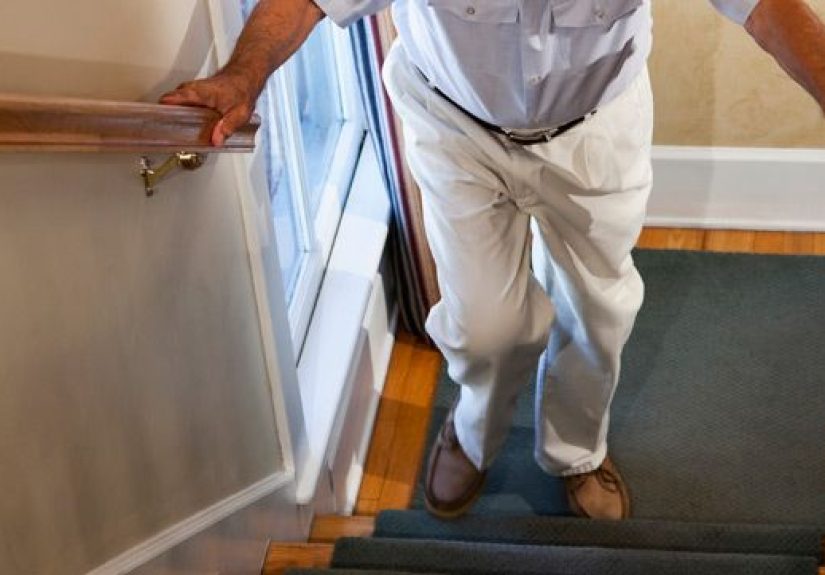
Grab the handrail for balance and support. Using your arms takes some pressure off the knees and keeps you more stable. If you’re using a cane, ask a physical therapist how to coordinate the cane and handrail safelyit’s a small technique change that can pay off in less pain and fewer trips or slips.
Face Forward and Take Your Time
Always face forward when going up or down. Turning sideways can throw off your balance and twist your knee in odd directions. Take one step at a time if needed, especially if you’re in a flare of pain or early in rehab. There’s no prize for racing up the stairs if your knee complains for the rest of the day.
Adjust Step Height and Frequency
If you have control over your environment, choose stairs with lower risers or use a single low step repeatedly for exercise instead of a long, steep staircase. At home or work, consider:
- Bundling errands so you use the stairs less often
- Using an elevator when your knee is flaring
- Storing daily items on the main level to reduce extra trips
These are not “giving up” stepsthey’re strategic steps to protect your joints while you build them back up.
Knee-Friendly Strengthening Exercises
Long-term, the real “secret sauce” for knee pain on stairs is strengthening the muscles that support the jointespecially the quadriceps (front of thigh), hamstrings (back of thigh), glutes (butt muscles), and hip muscles. Stronger muscles help absorb shock, guide the kneecap, and take pressure off the joint surfaces.
Always check with your healthcare provider or physical therapist before starting a new exercise program, especially if you have significant pain, arthritis, or a recent injury. That said, here are common starter moves therapists often use.
1. Seated or Chair Squats
How to do it:
- Stand in front of a chair with feet hip-width apart.
- Push your hips back and slowly sit down, lightly touching the chair, then stand back up.
- Keep your knees in line with your toes and your chest lifted.
Chair squats mimic the motion of sitting and standing, a key everyday movement that prepares your knees for stairs without the full load and angle of a deep squat.
2. Step-Ups on a Low Step
How to do it:
- Stand in front of a low step or bottom stair and hold a railing or counter for balance.
- Place one foot on the step, push through the heel, and lift yourself up.
- Gently lower back down with control.
- Start with 8–10 reps per side and adjust the height based on comfort.
This exercise uses the same muscles you need for real-life stair climbing, but you control the height, speed, and number of reps.
3. Wall Sits (Short Holds)
Wall sits can build endurance in your quadriceps without the pounding of running or jumping.
How to do it: Slide your back down a wall until your knees are slightly bent (not a deep 90-degree angle if that hurts). Hold for 10–20 seconds, then stand. Repeat a few times, stopping if pain spikes.
4. Hip and Glute Strengtheners
Weak hip muscles can let the knee collapse inward on stairs, increasing stress on the joint. Try:
- Side-lying leg raises – lying on one side, lift the top leg up and back slightly to target the hip.
- Glute bridges – lying on your back with knees bent, lift your hips toward the ceiling, squeezing your glutes.
These moves don’t directly bend the knee much, but they build the support system that keeps your knee aligned while you climb.
Lifestyle Tweaks That Take Pressure Off the Knee Joint
Manage Body Weight (Even Small Changes Help)
Extra body weight increases the load on your kneessometimes by three to six pounds of force for every pound of body weight when you go up or down stairs. That means even a modest weight loss (if recommended by your provider) can meaningfully reduce stress on your knees every single step.
Choose Knee-Friendly Activities
Joint experts often recommend low-impact aerobic exercise like walking on level ground, cycling, or swimming as a first-line way to reduce osteoarthritis pain and keep joints mobile. Regular movement improves circulation, joint lubrication, muscle strength, and moodall of which can make stairs more manageable over time.
Supportive Shoes and Simple Gear
Your knees love good neighbors. Choose footwear that offers cushioning and support, avoid very high heels, and consider shock-absorbing insoles if recommended by a professional. Some people get short-term relief from knee sleeves, taping, or braces, especially during higher-demand activities like stairs or longer walks.
Respect Flare Days
On days when your knee is extra cranky, dial back stair use, use the elevator, or rearrange tasks to minimize up-and-down trips. Alternate activity with short rest breaks, and use ice or heat as advised by your provider. Working with your bodynot against itisn’t weakness; it’s strategy.
When to See a Doctor or Physical Therapist
Not all knee pain needs an urgent specialist visit, but it’s smart to check in with a healthcare professional if:
- Pain has lasted more than a few weeks and isn’t improving
- You struggle with daily tasks like stairs, getting out of a chair, or walking errands
- The knee keeps swelling, locking, or buckling
- You’ve had a recent injury, twist, or fall
A doctor or physical therapist can evaluate your joint, confirm (or rule out) conditions like PFPS, osteoarthritis, or meniscal tears, and tailor a treatment plan that fits your life. That might include supervised exercises, gait training, short-term medications, injections in some cases, or a discussion about assistive devices or, rarely, surgery.
Frequently Asked Questions About Stairs and Knee Pain
Is it bad for my knees to use stairs if they already hurt?
Not automatically. In many cases, controlled, gradual stair use is safe and can even be part of rehab. But if stairs cause sharp pain, swelling, or lingering soreness that gets worse over time, you may need to modify how often and how you use stairsor avoid them temporarilyuntil your knee is stronger and calmer.
Are stairs worse than walking on flat ground?
Yes, in terms of joint load. Stairs demand a deeper knee bend and a higher force with each step, so they tend to provoke pain sooner than flat walking. That’s why you might feel perfectly fine on level surfaces but wince as soon as you hit the staircase.
Will strengthening exercises really help?
For many people, yes. Strengthening the quadriceps, hamstrings, glutes, and hip muscles often improves knee pain and function. It won’t change advanced arthritis overnight, but it can reduce symptoms, improve stability, and help delay more invasive treatments.
Can I ever get back to “normal” stairs again?
Plenty of people do. With a mix of smart activity, strengthening, weight management (if needed), and medical care when appropriate, many individuals regain comfortable stair use or at least significantly reduce pain. The process takes time, but each small stepliterallyadds up.
Real-Life Experiences: Finding Relief, One Step at a Time
Research and anatomy are helpful, but if you’re the one gripping the handrail and bargaining with your knees every morning, you probably also want to know what this looks like in real life. While everyone’s situation is different, these composite stories reflect common experiences people share when they start taking their knee and stair pain seriously.
Maria: “I Thought I Was Just Out of Shape”
Maria, a 43-year-old office worker, started noticing a sharp ache under her kneecap whenever she climbed to her third-floor apartment. At first, she blamed her desk job and tried to “push through.” But the pain crept into other moments: getting up from the couch, kneeling to clean, even sitting through movie night.
When she finally saw a physical therapist, she learned she had classic patellofemoral pain. Her quads were weak, her hips weren’t doing much of the stabilizing, and she tended to let her knees fall inward on stairs. The therapist taught her simple exerciseschair squats, step-ups on a very low step, side-lying leg liftsand showed her how to use the “up with the good, down with the bad” rule plus the handrail.
The first two weeks were not glamorous. Maria felt silly doing tiny step-ups in her living room and frustrated that she couldn’t just sprint up the stairs like before. But week by week, she noticed she could climb a little faster with less pain. Three months later, stairs still weren’t her favorite activity, but they no longer dictated where she could live or whether she’d accept a dinner invitation at a walk-up restaurant.
James: Learning to Respect an Arthritic Knee
James, 62, had been ignoring his “creaky” right knee for years, chalking it up to “getting older” and a long history of pickup basketball. When his doctor finally confirmed knee osteoarthritis, James was sure the verdict was either surgery or a recliner.
Instead, his care team focused on realistic, daily steps: losing a small amount of weight, walking regularly, using an exercise bike a few times a week, and strengthening his legs and hips. They also coached him on stair strategyusing the railing, going one step at a time when needed, and taking breaks on landings instead of powering through pain.
For James, the breakthrough wasn’t just physical. Once he stopped seeing stairs as proof that his body was “failing” and started seeing them as a challenge he could train for, his mindset shifted. He tracked his progress by how many stairs he could climb with a pain level of 3 out of 10 or less. Months later, he still had arthritis, but he also had stronger legs, better endurance, and a game plan. The stairs to his favorite fishing pier no longer felt like a blockade.
Lena: The Runner Who Needed to Slow Down
Lena, 29, loved running and high-intensity interval workouts. When a nagging ache around her kneecap made going downstairs feel like a punishment, she worried she’d lose her stress relief and social life. Her sports medicine provider diagnosed patellofemoral pain and pointed out that her training jumpsadding speed, hills, and stair sprints at the same timehad overloaded her knees.
At first, Lena hated the idea of “cutting back.” But scaling down didn’t mean quitting; it meant restructuring. She swapped some runs for cycling and strength sessions, lowered the intensity of stair workouts, and learned to listen to the difference between normal muscle fatigue and joint pain. She also worked on hip and core strength, which helped her knees track better.
A few months later, Lena was back to running racesbut now she treated her post-race stair climb as a test of how well she’d managed her training load, not as an automatic badge of honor. When her knees whispered complaints, she adjusted early instead of waiting for them to scream.
Each of these experiences underscores the same message: knee pain on stairs is common, but it’s rarely hopeless. Whether you’re dealing with early arthritis, runner’s knee, or an irritated tendon, you’re not stuck at the bottom of the staircase. With information, support, and consistent small changes, you can often reclaim those stepsone careful, confident stride at a time.
Conclusion: You’re Not Doomed to Fear Every Staircase
Stairs and knee pain might seem like an inseparable duo, but they don’t have to control your life. Understanding why stairs hurt, recognizing common knee conditions, and applying simple technique tweaks can reduce your discomfort. Pair that with targeted strengthening, supportive lifestyle habits, and timely medical advice, and you have a realistic path toward more comfortable movement.
You may not learn to love stairsbut with the right steps, you can stop dreading them.
meta_title: Steps to Relief: Stairs and Knee Pain
meta_description: Learn why stairs trigger knee pain and discover safe techniques, exercises, and lifestyle tweaks to climb more comfortably.
sapo: Knee pain every time you face a staircase? You’re not imagining itstairs put several times your body weight through your knee joint, which can expose early osteoarthritis, runner’s knee, or old injuries. This in-depth guide breaks down why stairs hurt, which conditions might be involved, and the practical changes you can make right now, from “up with the good, down with the bad” stair strategies to simple strengthening moves and lifestyle tweaks that ease pressure on your joints. Whether you’re managing arthritis, recovering from an injury, or just tired of wincing on every step, you’ll find realistic, doctor-informed tips and relatable real-life experiences to help you take back your stairsone confident step at a time.
keywords: stairs and knee pain, knee pain climbing stairs, knee pain going down stairs, patellofemoral pain syndrome, knee osteoarthritis, knee strengthening exercises, stair safety tips