Table of Contents >> Show >> Hide
- Who Was Serge Mouille?
- What Makes the Serge Mouille Floor Lamp So Iconic?
- Popular Serge Mouille Floor Lamp Styles
- How to Style a Serge Mouille Floor Lamp
- Is the Serge Mouille Floor Lamp Practical?
- Original, Reissue, or Reproduction?
- Best Rooms for a Serge Mouille Floor Lamp
- How to Choose the Right Serge Mouille Floor Lamp
- Care and Maintenance Tips
- Why Designers Still Love It
- Experience Section: Living With a Serge Mouille Floor Lamp
- Conclusion
A Serge Mouille floor lamp does not enter a room quietly. It leans, stretches, pivots, and points as if it has just remembered something important across the sofa. In a world full of ordinary lightingpolite drum shades, safe pharmacy lamps, and floor lamps that look like they were designed during a committee lunchthe Serge Mouille floor lamp has the confidence of a sculpture and the usefulness of a task light. It is dramatic without shouting, minimalist without being cold, and French enough to make your reading corner feel like it owns a tiny black turtleneck.
Originally created by French designer and metalworker Serge Mouille in the early 1950s, this lamp has become one of the most recognizable icons of mid-century modern lighting. Its long, slender arms, shell-like aluminum shades, black painted finish, brass details, and angular tripod base make it instantly identifiable. Whether you are looking at the one-arm floor lamp, the three-arm “Lampadaire Trois Bras,” or later signal-style designs, the appeal is the same: this is lighting that feels alive.
But is a Serge Mouille floor lamp only a design-world trophy, or is it actually useful in a real home with books, coffee cups, pets, and someone wondering where the remote went? The answer is pleasantly simple: it is both. It is a collector-worthy design object and a highly practical source of directional light. Let’s take a closer look at what makes it special, how to style it, what to know before buying, and why this elegant black lamp still looks fresh more than 70 years after it first appeared.
Who Was Serge Mouille?
Serge Mouille was born in Paris in 1922 and trained as a silversmith at the École des Arts Appliqués. That early training matters because his lamps do not look like products assembled from standard parts. They look shaped, balanced, and considered. Mouille understood metal the way a chef understands butter: with respect, confidence, and a healthy refusal to overdo it.
Before becoming famous for lighting, Mouille worked as a metal craftsman and teacher. His background included chandeliers, sconces, handrails, and custom metalwork. In the early 1950s, designer Jacques Adnet commissioned him to create lighting for the Compagnie des Arts Français. That commission helped push Mouille into the world of modern lighting, where he developed lamps that were both functional and sculptural.
His work stood apart from the more decorative lighting styles popular at the time. Instead of heavy ornament, Mouille favored strong silhouettes, asymmetry, precision, and movement. His lamps often resemble insects, branches, or mechanical creatures, yet they never feel gimmicky. They are clean, architectural, and quietly witty. A Serge Mouille floor lamp can look like a crane, a praying mantis, or a sketch in motiondepending on your imagination and how much coffee you have had.
What Makes the Serge Mouille Floor Lamp So Iconic?
1. A Sculptural Shape That Moves Through Space
The first thing people notice about a Serge Mouille floor lamp is its silhouette. The lamp does not simply stand upright like a post. It reaches. The arms extend outward with a graceful tension, while the shade seems to hover in place. This creates what designers often call a kinetic quality: the lamp appears to suggest movement even when it is completely still.
The three-arm floor lamp is especially famous for this effect. With several arms extending in different directions, it can illuminate multiple zones while acting as a visual centerpiece. In a living room, it can light a sofa, an accent chair, and a side table without requiring three separate lamps. In a studio apartment, it can define zones without adding walls. In a stylish corner, it can do the emotional labor of being both furniture and art.
2. The Famous Black Metal Finish
Serge Mouille’s “Formes Noires,” or black forms, are central to his legacy. The matte black finish gives the lamps their graphic quality. Against a white wall, the lamp reads almost like a drawing. Against wood, stone, or warm upholstery, it becomes softer and more organic. Against a cluttered room, it politely suggests that perhaps everyone should calm down and remove three throw pillows.
Although some Serge Mouille floor lamps are available in white, the black version remains the classic choice. It pairs beautifully with mid-century modern interiors, but it also works in contemporary, industrial, Scandinavian, Parisian, minimalist, and eclectic spaces. That versatility is part of the lamp’s staying power.
3. Adjustable Shades and Directional Light
The shade is one of the most important parts of a Serge Mouille floor lamp. Mouille’s shades are often described as shell-like or breast-like in form, with soft curves that contrast with the angular arms. The inside of the shade is typically white, helping reflect light efficiently and creating a warmer, more usable glow.
Unlike a basic floor lamp that throws light in one general direction, a Serge Mouille floor lamp is designed for adjustment. Depending on the model, the arm may rotate, and the shade may tilt or pivot. This makes it ideal for reading, conversation areas, home offices, and living rooms where you want flexible light without relying entirely on overhead fixtures. Overhead lighting has its place, of course, but nobody has ever said, “This room needs more ceiling glare.”
Popular Serge Mouille Floor Lamp Styles
One-Arm Floor Lamp
The one-arm Serge Mouille floor lamp is sleek, simple, and surprisingly adaptable. It usually features a slender stem, a long projecting arm, a rotating shade, and a stable base. This version is perfect beside a lounge chair, sofa, desk, or bed. It gives you the drama of a Mouille design without needing the floor space required by the larger three-arm model.
The one-arm model is also a smart choice for smaller apartments. It can slide into a corner and still make a strong visual statement. Use it where you need a reading light but do not want a lamp that feels bulky. Its long arm lets it reach over furniture, while the adjustable shade helps focus light exactly where you need it.
Three-Arm Floor Lamp
The three-arm floor lamp, often known as the “Lampadaire Trois Bras,” is the showstopper. Designed in the early 1950s, it is one of Mouille’s most celebrated lighting pieces. With three rotating arms and articulated shades, it delivers both functional flexibility and major design presence.
This lamp is best suited for rooms with enough space to let it breathe. Place it near a sectional, behind a pair of lounge chairs, or in a large open-plan living area. It can replace several smaller lamps while becoming the focal point of the room. Think of it as the lighting equivalent of a jazz trio: elegant, expressive, and somehow better when it spreads out.
Straight Floor Lamp
The straight Serge Mouille floor lamp offers a cleaner vertical profile. It often features a tripod-style base, a slim mast, and an adjustable reflector. This style is excellent when you want the Mouille look but prefer something more compact and upright. It works well in reading corners, bedrooms, offices, and narrow living areas where a wide arm span may be impractical.
How to Style a Serge Mouille Floor Lamp
Use It as a Living Room Anchor
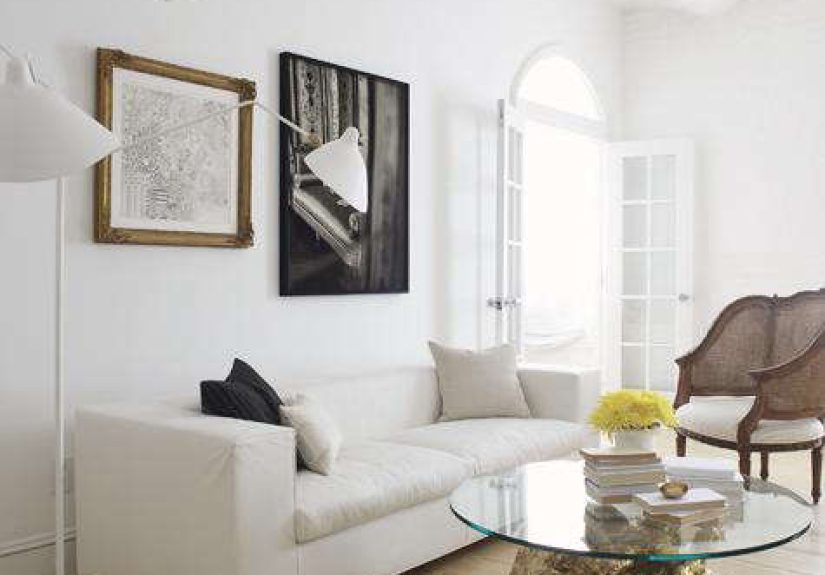
A Serge Mouille floor lamp can anchor a seating area the way a large plant, bold artwork, or sculptural chair might. Place it beside or behind a sofa to create height and visual rhythm. The black lines can balance soft upholstery, rounded coffee tables, and textured rugs.
If your living room feels too safe, the lamp adds edge. If your room already has strong design features, the lamp adds refinement. The trick is to let it stand out without crowding it. Give the arms space and avoid surrounding the lamp with too many competing objects. This is not the lamp to hide behind a ficus unless your ficus has a very strong design education.
Pair It With Natural Materials
The black metal frame looks especially good with natural materials such as walnut, oak, leather, linen, wool, travertine, marble, and rattan. These materials soften the graphic quality of the lamp and make the room feel layered rather than stark.
For example, pair a one-arm floor lamp with a caramel leather lounge chair and a small wood side table. Add a textured rug, a stack of books, and a ceramic cup that says, “I am tasteful, but I still microwave leftovers.” The result feels warm, lived-in, and elevated.
Let It Contrast With White Walls
One of the easiest ways to showcase a Serge Mouille floor lamp is to place it against a light wall. The black arms create a striking line drawing effect, almost like functional wall art. This works especially well in minimalist apartments, galleries, lofts, and rooms with clean architecture.
If your walls are darker, the lamp can still work beautifully, but you may want to support it with lighter furniture, metallic accents, or artwork so the silhouette does not disappear. The goal is contrast, not camouflage.
Is the Serge Mouille Floor Lamp Practical?
Yes, but with a few realistic expectations. This is not a bargain-bin floor lamp designed to be dragged from room to room during a cleaning frenzy. It is a refined piece of lighting that rewards thoughtful placement. Its adjustable shade makes it excellent for reading and mood lighting, while the sculptural frame makes it valuable even when switched off.
Many modern editions use standard bulb bases, such as E26 in the United States, making bulb replacement relatively simple. LED bulbs are often a good choice because they use less energy and produce less heat than incandescent bulbs. A warm white LED can preserve the cozy, flattering glow you want from a living room lamp.
One thing to consider is scale. Some Serge Mouille floor lamps are tall and wide, especially the three-arm versions. Before buying, measure your space carefully. Check height, arm extension, shade position, cord placement, and clearance around furniture. A lamp that looks elegant in a showroom can feel like a stylish octopus if placed in a tiny hallway.
Original, Reissue, or Reproduction?
Original Vintage Serge Mouille Lamps
Original vintage Serge Mouille lamps are rare, highly collectible, and often expensive. Auction records show that original examples, especially early three-arm floor lamps, can command serious prices. These pieces are sought after by collectors, design historians, and anyone whose furniture budget has clearly reached “museum wing” status.
Buying an original requires expertise. Condition, provenance, production date, hardware, finish, wiring, and documentation all matter. If you are considering a vintage Serge Mouille floor lamp, work with reputable dealers or auction houses and ask detailed questions. A beautiful lamp is wonderful; an expensive mystery with a plug is less wonderful.
Authorized Reissues
Authorized reissues are a popular choice for people who want the authentic design without chasing a rare vintage piece. Editions Serge Mouille has produced reissues based on original measurements, materials, and manufacturing methods. These pieces are often numbered and made in France, preserving much of the character of the original designs.
Authorized reissues are still investment pieces, but they offer more predictable quality and availability than vintage examples. They are ideal for homeowners, designers, and collectors who want a real Serge Mouille lamp that can be used daily.
Reproductions and Inspired Versions
The popularity of Serge Mouille’s designs has led to many reproductions and “inspired by” lamps. Some are affordable and attractive, while others cut corners in materials, proportions, finish, or adjustability. If your goal is the exact design legacy, buy authorized. If your goal is simply to bring a similar sculptural black floor lamp into your home at a lower price, compare carefully.
Look for strong construction, stable bases, smooth shade movement, safe wiring, and accurate proportions. The magic of a Serge Mouille floor lamp lives in the balance. When the arms are too thick, the shade is too flat, or the base feels clumsy, the lamp loses its elegance fast.
Best Rooms for a Serge Mouille Floor Lamp
Living Room
This is the natural habitat of the Serge Mouille floor lamp. Use it beside a sofa, behind a sectional, or between two lounge chairs. It can serve as task lighting, ambient lighting, and a design statement all at once.
Bedroom
A one-arm model can work beautifully as a bedside reading light, especially in rooms where you want to avoid bulky table lamps. It brings a boutique-hotel feeling without requiring you to fold towels into swans.
Home Office
In a home office, a Serge Mouille floor lamp adds personality and useful directional light. Place it near a reading chair, behind a desk, or in a corner that needs visual height. It helps the workspace feel designed rather than improvised from leftover furniture.
Studio Apartment
Because the lamp can define a zone, it is excellent for open-plan spaces. A three-arm lamp can visually separate a living area from a dining area, while a one-arm lamp can create a reading nook even when the “nook” is technically three feet from the kitchen sink.
How to Choose the Right Serge Mouille Floor Lamp
Start with the size of your room. If you have generous square footage, a three-arm floor lamp can be spectacular. If your space is smaller, the one-arm or straight floor lamp may be more practical. Next, consider how you plan to use the light. For reading, you need adjustability and focused illumination. For atmosphere, shade direction and bulb warmth matter more.
Also think about finish. Black is the classic and most versatile choice, especially if you want strong contrast. White can feel softer, lighter, and more architectural in pale interiors. Finally, consider authenticity. Decide whether you want an authorized reissue, a vintage collector’s piece, or a budget-friendly inspired design. There is no single correct answer, but there is a correct answer for your room, budget, and level of design obsession.
Care and Maintenance Tips
A Serge Mouille floor lamp is fairly easy to care for, but it deserves a gentle hand. Dust the frame and shade regularly with a soft cloth. Avoid harsh chemical cleaners, especially on painted metal finishes. If the shade interior is white, keep it clean so it reflects light properly.
Check joints and moving parts occasionally, especially if you adjust the lamp often. Do not force the arms or shades beyond their intended range. If you own a vintage lamp, consult a qualified professional before rewiring or restoring it. Original parts and finishes can affect value, so restoration should be thoughtful rather than enthusiastic in the “I watched one video and bought sandpaper” sense.
Why Designers Still Love It
The Serge Mouille floor lamp remains popular because it solves a rare design problem: it is both bold and restrained. Many statement pieces become tiring after a few years. This lamp does not. Its lines are simple enough to feel timeless, but its form is distinctive enough to stay interesting.
It also works across design styles. In a mid-century room, it feels historically correct. In a modern room, it feels sculptural. In a traditional room, it creates contrast. In an eclectic room, it adds discipline. It is one of those rare pieces that can make other objects around it look more intentional.
Experience Section: Living With a Serge Mouille Floor Lamp
The real charm of a Serge Mouille floor lamp becomes obvious after you stop treating it like a famous object and start living with it. On day one, you may admire the silhouette from across the room. By week two, you realize you have started adjusting the shade depending on whether you are reading, chatting, scrolling, or pretending not to scroll. The lamp becomes part of the room’s rhythm.
In a living room, the experience is especially satisfying because the lamp changes the mood without needing much effort. During the day, it acts like sculpture. The black metal frame draws crisp lines through the space, making even simple furniture feel more curated. At night, the shade creates a focused pool of light that feels intimate and calm. It is not the kind of lamp that floods the whole room like a supermarket aisle. Instead, it creates atmosphere. It says, “Come sit here,” not “Please report to checkout lane seven.”
One of the most useful experiences is discovering how flexible directional lighting can be. A standard floor lamp usually has one job: glow upward, glow downward, or stand in the corner looking guilty. A Serge Mouille floor lamp feels more interactive. You can angle the shade toward a book, rotate the arm toward a chair, or use the lamp to highlight an artwork, plant, or textured wall. In a three-arm model, each shade can support a different activity. One light can brighten a reading chair, another can warm the sofa, and a third can softly illuminate a corner. This layered lighting makes a room feel more expensive, even if the snack situation on the coffee table suggests otherwise.
Placement matters more than people expect. If the lamp is too close to a wall, the arms may feel cramped. If it sits in a busy walkway, it can become a stylish obstacle course. The best spot is usually just behind or beside furniture, where the arm can extend naturally over a seating area. Once the lamp has enough breathing room, it looks intentional rather than oversized.
The other lived-in detail is bulb choice. A warm LED bulb usually gives the best everyday result. Too cool, and the lamp can feel clinical. Too bright, and the beautiful shade becomes less romantic and more interrogation-room chic. A warm, dimmable bulb helps preserve the softness of the design while keeping it practical for reading and conversation.
Cleaning is simple but noticeable. Dust can gather on the black frame and inside the shade, especially in sunny rooms where every particle seems to audition for a documentary. A soft microfiber cloth keeps the finish looking crisp. The lamp does not need fussy maintenance, but it does reward regular attention.
The biggest surprise is how easily the lamp becomes the room’s personality. Guests notice it. Designers respect it. Even people who do not know Serge Mouille by name tend to ask about it. That is the sign of great design: it communicates before anyone explains it. It is functional, beautiful, a little theatrical, and still relaxed enough for everyday living. In short, a Serge Mouille floor lamp is not just something you buy to light a room. It is something you live around, adjust, admire, and eventually wonder how the room ever looked complete without it.
Conclusion
The Serge Mouille floor lamp is more than a famous mid-century modern lighting design. It is a masterclass in balance: practical but artistic, minimal but expressive, historic but still completely current. Its slender arms, sculptural shades, black metal finish, and adjustable lighting make it one of the most enduring floor lamps ever created.
Whether you choose a one-arm model for a reading nook, a three-arm lamp for a dramatic living room, or a straight floor lamp for a compact space, the appeal is the same. A Serge Mouille floor lamp brings movement, elegance, and personality into a room. It is not cheap, and it is not invisible. But if you want lighting that feels thoughtful, collectible, and genuinely useful, this French icon earns its reputation one beautifully angled beam at a time.
Note: This article synthesizes real design history, product specifications, museum references, authorized reissue information, retailer details, and auction-market context into original, publication-ready content.