Table of Contents >> Show >> Hide
- Why Quiet Furniture Feels So Right Right Now
- Meet Melo: Spanish Roots, Swedish Discipline
- What Makes Furniture “Quiet” Instead of Just Plain
- The Spanish-Meets-Scandi Twist
- Why American Homes Keep Falling for This Look
- How to Borrow the Melo Mindset in Your Own Home
- Living With Quiet Furniture: The Experience Behind the Aesthetic
- Final Thoughts
Some furniture enters a room like it owns the deed, the zip code, and possibly your personality. Then there is the other kind: the quiet kind. It does not beg for attention, does not sparkle like it is auditioning for a reality show, and does not require a five-minute monologue to explain why it matters. It simply works. It settles in. It makes the whole room feel calmer, smarter, and a little more grown-up.
That is exactly the appeal of quiet furniture from Melo, a design company with a Spanish-born point of view and a distinctly Scandinavian sense of restraint. The combination is intriguing because it sounds like a contradiction at first. Spain conjures warmth, sunlight, tactility, and soul. Scandinavia brings to mind pale wood, pared-back shapes, clean lines, and the disciplined art of leaving things out. Put them together, and you get furniture that feels modest but memorable, soft-spoken but deeply intentional.
In a moment when American interiors are moving away from fast, flashy trend cycles and toward rooms that feel grounded, tactile, and peaceful, this kind of furniture hits differently. It is not just minimalist. It is warm minimalism. It is not just functional. It is emotionally intelligent. And it is not “boring,” despite what that one friend with the neon velvet sofa may claim. In fact, quiet furniture can be one of the hardest things to design well, because when you remove noise, every proportion, finish, joint, and curve has to pull its weight.
Melo makes a strong case for this quieter way of living. The brand’s pieces feel like they were designed for people who want less visual chatter and more breathing room. They belong to the same broader conversation that has made Scandinavian-inspired design, organic modernism, and quiet luxury so appealing in the United States. But Melo’s work also has its own personality: disciplined, handcrafted, and subtly warm, like a sunbeam that learned excellent posture.
Why Quiet Furniture Feels So Right Right Now
For years, interiors bounced between extremes. On one side, there was all-white austerity so severe it felt like the room might fine you for leaving a mug on the table. On the other, there was maximalist energy: louder colors, louder shapes, louder everything. Somewhere in the middle, many homeowners started craving something calmer. Not empty. Not cold. Just calmer.
That is where quiet furniture thrives. It favors natural wood, simple silhouettes, soft edges, useful forms, and restrained detailing. It lets material and craftsmanship do the talking instead of relying on gimmicks. A quiet coffee table is not trying to be a spaceship. A quiet stool does not need twelve decorative flourishes and a backstory involving “disruption.” It just needs to be beautifully made, pleasant to look at, and good at its job.
This shift also reflects how people actually live now. Homes need to function across more hours and more purposes. A dining table may also be a desk. A stool may become a nightstand. A mirror must be useful, but it should also help bounce light around a room. Furniture that is adaptable, visually light, and psychologically calming makes sense for real life, especially in smaller homes, apartments, and hybrid work spaces.
There is also a deeper emotional reason quiet furniture resonates. A room full of highly performative pieces can feel exhausting. Quiet furniture lowers the volume. It lets your eye rest. It lets architecture, daylight, and texture become part of the experience. Instead of asking, “Look at me,” it asks, “How would you like to feel here?” That is a much more interesting design question.
Meet Melo: Spanish Roots, Swedish Discipline
Melo is compelling because the brand story mirrors the furniture itself: understated, thoughtful, and rooted in real materials. The company is associated with Dalarna, Sweden, and its founder, Carmelo Medina Tadeo, comes from Gran Canaria in Spain. That biographical crossover matters. It helps explain why the furniture feels Scandinavian in its structure yet warmer and more human than strict minimalism often does.
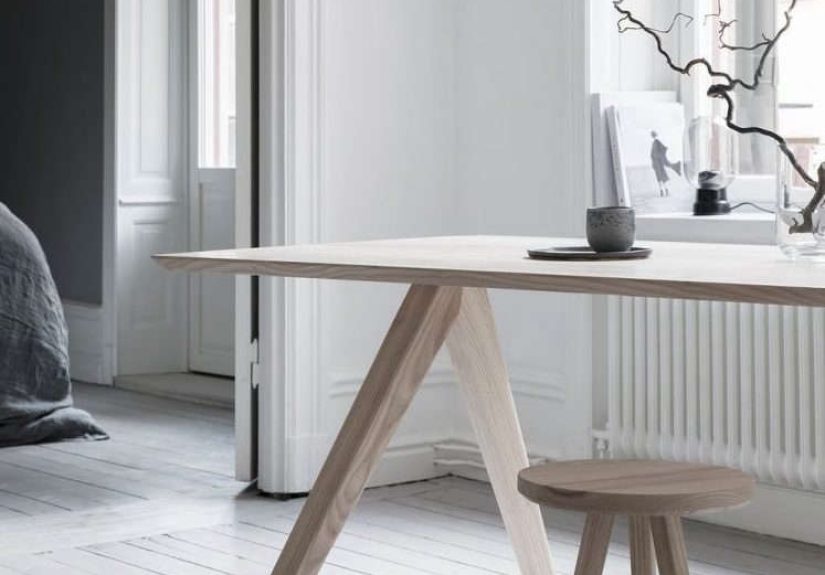
The pieces that drew attention to the company are simple on paper but rich in execution: an ash coffee table, a wall-mounted magazine rack, a versatile ash table that can work as a dining table or writing desk, a compact stool used as a nightstand, and a standing mirror with a matte black painted back. Everything is handmade to order in Mockfjärd, a village in Dalarna, and the emphasis is clearly on natural wood, quiet finishes, and utility without fuss.
That handmade-to-order approach matters because it changes the emotional tone of the furniture. You do not read these pieces as disposable placeholders. You read them as long-term companions. An ash table with softly rounded edges and stabilizing iron details feels different from a trend-driven table produced to survive exactly one apartment lease and a mild existential crisis.
Even the product descriptions reveal Melo’s worldview. The ash coffee table is treated with white wax and a clear matte wax rather than a glossy finish that screams for attention. The wall rack fits flush against the wall with no visible screws, which sounds like a small detail until you realize that small details are exactly where quiet design wins. The brand is not trying to reinvent what a table or mirror is. It is trying to refine those objects until they feel inevitable.
What Makes Furniture “Quiet” Instead of Just Plain
1. Material Leads the Conversation
Quiet furniture starts with honest materials. Light woods such as ash, oak, beech, and pine have long been central to Scandinavian-inspired interiors because they add warmth without heaviness. Melo’s use of ash is especially fitting. Ash has a clean grain, a pale but not sterile tone, and a visual softness that works beautifully in minimal interiors. It reads as natural, calm, and durable all at once.
2. The Lines Are Clean, but Not Severe
Minimalist design can go wrong when it becomes too sharp, too sterile, or too eager to prove how little it needs. Quiet furniture avoids that trap. Melo’s pieces rely on straightforward geometry, but they soften the effect with rounded edges and balanced proportions. That keeps the furniture from feeling clinical. In other words, the room still has a pulse.
3. Function Is Not an Afterthought
One reason Scandinavian design remains so influential is its refusal to separate beauty from usefulness. Melo’s table can be a desk or dining table. The stool can work as a seat or nightstand. The magazine rack can hold books, paintings, or photographs. Quiet furniture earns its place by doing more than one thing gracefully. This kind of flexibility is not just convenient; it is elegant.
4. Craftsmanship Replaces Decoration
When a piece lacks flashy ornament, construction quality becomes visible. Joints, finishes, hardware, balance, thickness, and the meeting of materials all matter more. That is why handcrafted furniture often feels more luxurious than heavily embellished furniture. The luxury is in the precision. Melo’s restraint is not emptiness; it is confidence.
5. It Leaves Room for the Rest of Your Life
Good quiet furniture does not dominate the room. It collaborates with the room. It works with daylight, textiles, art, ceramics, books, and the accidental poetry of daily life. That is a huge reason people respond to it emotionally. It supports living instead of staging a coup against it.
The Spanish-Meets-Scandi Twist
Here is the interesting part: Melo does not feel like a copy-and-paste Scandinavian brand. The Spanish connection does not announce itself through obvious motifs, and that is exactly why it works. You do not need flamenco references carved into a table leg. The “Spanish-meets-Scandi” quality is more atmospheric than literal.
It shows up in the balance between restraint and warmth. Pure minimalism can sometimes drift into emotional flatness. But when a designer brings in a Mediterranean sensitivity to light, material, and lived-in comfort, the result gets softer. The room still feels edited, but not chilly. The forms stay spare, but they do not feel joyless. There is a subtle generosity in that approach.
This is the sweet spot many American homeowners are chasing right now. They want calm rooms, but not severe ones. They want simplicity, but not emptiness. They want furniture that looks timeless, but they do not want to feel like they are living in a design museum where touching the coffee table might trigger an alarm.
That blend of warmth and discipline is what makes Melo feel current without looking trendy. It belongs to the larger design conversation around quiet luxury, organic modernism, and warm minimalism, yet it retains a handmade, personal character that keeps it from feeling mass-produced or algorithm-approved.
Why American Homes Keep Falling for This Look
There are practical reasons Scandinavian-influenced furniture performs so well in the American market. First, it is adaptable. A light-wood table can live in a Brooklyn apartment, a California bungalow, a Michigan cabin, or a renovated suburban home without looking misplaced. It plays well with midcentury pieces, vintage rugs, plaster walls, black accents, linen upholstery, and even the occasional inherited oddball object that no one else understands but you refuse to part with.
Second, this look supports how people want their homes to feel. The modern American interior is less interested in formality and more interested in ease. Rooms are expected to be livable, flexible, and emotionally restorative. Quiet furniture contributes to that mood because it does not create visual stress. Light woods reflect daylight. uncluttered silhouettes make small rooms feel larger. Natural materials add texture without chaos. The effect is subtle, but powerful.
Third, there is a growing fatigue with disposable home goods. Consumers are more aware of quality, longevity, and sustainability than they were a decade ago. Furniture that looks like it can age gracefully is attractive for both aesthetic and ethical reasons. A piece that welcomes dents, patina, and daily use has far more staying power than something designed to look perfect only in product photography.
Finally, quiet furniture photographs well, which in the age of online inspiration is not exactly a minor detail. But more importantly, it lives well off-camera. That is the difference between a trend and a lasting design language. Trend furniture is optimized for the reveal. Quiet furniture is optimized for the years that follow.
How to Borrow the Melo Mindset in Your Own Home
You do not need to buy the exact pieces to learn from them. The real takeaway from a company like Melo is not “everyone needs the same ash table.” It is that furniture becomes more sophisticated when it is reduced to what matters.
Start with one anchor piece in a light natural wood. It could be a dining table, a bench, a nightstand, or a coffee table. Look for clean lines, visible craftsmanship, and proportions that feel calm rather than bulky. Then support that piece with soft textures: linen curtains, wool throws, cotton upholstery, woven baskets, or a natural-fiber rug.
Keep the palette restrained but not lifeless. White, cream, sand, mushroom, warm gray, muted green, and earthy brown all work beautifully with ash and oak. Add black sparingly for contrast, the way Melo does with its mirror backing or the way many Scandinavian interiors use darker accents to sharpen an otherwise pale scheme.
Most importantly, edit your visual noise. Quiet furniture needs breathing room. That does not mean your home should look empty. It means every object should have a reason to be there. Let one ceramic bowl be lovely. Let one lamp be sculptural. Let one stack of books stay because you actually read them. Quiet design is not about deprivation. It is about clarity.
Living With Quiet Furniture: The Experience Behind the Aesthetic
Living with quiet furniture is a surprisingly physical experience. You notice it in the morning before you fully notice the room. Light lands across a pale wood tabletop and does not bounce back harshly. A stool beside the bed holds a glass of water, a book, and yesterday’s bracelet without looking overwhelmed. A mirror does not dominate the wall; it simply gives the room another breath. The effect is not dramatic, but it is steady, and steady is underrated.
There is also a mental shift that comes with furniture like this. Loud furniture asks you to keep admiring it. Quiet furniture lets you get on with your life. You sit down with coffee, answer emails, cut bread, fold laundry, or stare into the middle distance like a poet who has just remembered a utility bill. The furniture remains useful, composed, and oddly reassuring through all of it. It becomes part of your routine without draining your attention.
That is why quiet furniture often feels luxurious in a deeper way than flashy furniture. Luxury, in this context, is not about excess. It is about ease. It is about having a table that feels good under your hands every day. It is about a finish that ages with dignity. It is about corners that are softened, not weaponized. It is about a room that still looks calm even when life in it is not entirely calm, which, to be fair, is most of life.
There is an intimacy to well-made quiet furniture because it rewards repeated contact. The grain becomes familiar. The proportions make more sense the longer you live with them. You realize that a good minimalist piece is never really empty; it is concentrated. It contains fewer gestures, but each one is more deliberate. That restraint can make daily life feel a little less cluttered mentally, not just visually.
People often assume quiet design lacks personality, but the opposite is usually true. A quieter room reveals the personality of the person living in it more clearly. Your books matter more. Your habits show up more honestly. The bowl you brought back from a trip, the lamp inherited from a grandparent, the coat casually hung over the chair, the little stack of magazines you swear you are keeping for “reference” and not because you are emotionally attached to nice paper goods, all of it becomes more visible against a calmer background.
That is perhaps the real gift of furniture from a Spanish-meets-Scandi design company like Melo. It does not try to replace life with style. It gives life a better frame. It understands that beauty can be useful, that restraint can be warm, and that a home does not need to be noisy to be memorable. Sometimes the most effective piece in a room is the one that lowers its voice and lets everything else breathe.
Final Thoughts
Melo’s furniture is not trying to win a volume contest. That is exactly why it lingers in the mind. With Spanish roots, Swedish craftsmanship, and a design language built on light wood, practical elegance, and visual calm, the brand captures what so many homeowners want right now: spaces that feel grounded, beautiful, and easy to live in.
Quiet furniture is not about absence. It is about precision. It is about choosing fewer, better things. It is about trusting natural materials, clean lines, and thoughtful craftsmanship to create atmosphere without theatrics. And in a culture that often confuses louder with better, that kind of design feels not only refreshing, but quietly radical.