Table of Contents >> Show >> Hide
- What Is the “Ghost” in the Particle Accelerator?
- Meet the Super Proton Synchrotron: CERN’s Famous Workhorse
- How Physicists Found the Accelerator Ghost
- Why Resonance Can Be a Problem in Particle Accelerators
- What This Discovery Means for Future Physics
- Is This Related to Ghost Particles?
- The Real Magic Is the Mathematics
- Why Regular Readers Should Care
- Experience-Based Reflections: What the Accelerator Ghost Teaches Us
- Conclusion
Some ghosts rattle chains. Some knock over lamps. The one haunting CERN’s famous Super Proton Synchrotron, however, is much more sophisticated: it hides in four-dimensional phase space and quietly nudges proton beams off course. That is admittedly less cinematic than a translucent Victorian figure floating through a hallway, but for accelerator physicists, it is plenty spooky.
In recent research published in Nature Physics, scientists working with CERN’s Super Proton Synchrotron, or SPS, measured a long-theorized resonance structure that can disturb particle beams. Popular coverage has nicknamed it a “ghost,” but the phenomenon is not paranormal. It is a real mathematical and physical structure created by nonlinear resonance inside a particle accelerator. In simple terms, the beam can start “dancing” to an unwanted rhythm, and when that dance grows too strong, some particles drift away from their ideal path.
That matters because modern particle physics depends on beams that are bright, stable, intense, and extremely well controlled. A particle accelerator is not just a metal tunnel where particles go very fast and scientists hope for the best. It is a precision instrument where magnets steer, radiofrequency systems accelerate, sensors monitor, and physicists tune everything like a cosmic violin. When a hidden resonance appears, it can degrade the beam and limit what experiments can achieve.
What Is the “Ghost” in the Particle Accelerator?
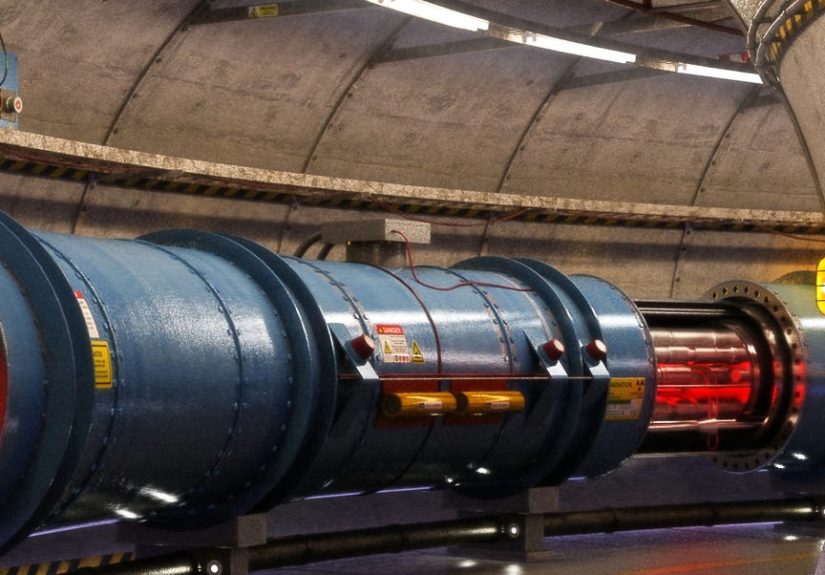
The “ghost” is a resonance structure observed in the Super Proton Synchrotron, one of the key machines in CERN’s accelerator complex. The SPS is nearly seven kilometers around and serves as a crucial stepping stone for beams headed toward experiments, including the Large Hadron Collider. It also supports fixed-target research programs that help scientists study particles, forces, and the behavior of matter at tiny scales.
Researchers did not find a mysterious new particle wearing a bedsheet. They found what accelerator physicists call “fixed lines” produced by nonlinear resonance. These fixed lines live in phase space, the mathematical space used to describe a particle’s position and motion. Because the effect involves both horizontal and vertical motion, the structure is best understood in four dimensions. That phrase alone is enough to make most people reach for coffee, but the idea becomes clearer with an everyday example.
Imagine carrying a cup of coffee while walking. One step makes the coffee move a little. Another step adds more motion. If your walking rhythm matches the natural sloshing rhythm of the coffee, the waves grow. Suddenly your mug performs an unpaid internship as a fountain. Resonance works in a similar way: repeated pushes at the wrong frequency can amplify motion. In an accelerator, those pushes can come from magnetic imperfections, beam dynamics, and nonlinear interactions.
Meet the Super Proton Synchrotron: CERN’s Famous Workhorse
The Super Proton Synchrotron is not the flashiest machine at CERNthat title usually goes to the Large Hadron Colliderbut the SPS is one of the most important. Commissioned in the 1970s, it has played several roles over its long life. It has accelerated protons, supplied beams to major experiments, and helped enable landmark discoveries, including work related to the W and Z bosons.
Today, the SPS remains vital because particle beams often travel through a chain of accelerators. A beam is prepared, accelerated in stages, focused, cleaned, and then delivered where researchers need it. The SPS helps boost particles to high energies before they move on to other experiments or machines. Think of it as an elite training gym for particles before they enter the big leagues.
Because the SPS handles intense beams, small sources of instability can become major engineering headaches. A tiny error repeated thousands of times around a ring can become a measurable beam problem. That is why the discovery of this four-dimensional resonance structure is important. It gives physicists a clearer map of a hidden effect that can cause beam degradation and particle loss.
How Physicists Found the Accelerator Ghost
Finding this “ghost” required more than switching on a flashlight and yelling, “Come out, resonance!” The team used beam position monitors around the SPS to measure how particles moved over thousands of passages through the accelerator. These monitors tracked whether the beam remained centered or shifted in the horizontal and vertical planes.
To make sense of the data, researchers used a mathematical tool called a Poincaré section. In a periodic system, such as particles repeatedly circling an accelerator, a Poincaré section lets scientists take snapshots of motion at regular intervals. Instead of trying to watch every wiggle continuously, they record the system at consistent points and build a map of its behavior.
That map revealed the fixed-line structure predicted by theory and simulations. In other words, the ghost was not invented by a dramatic headline. It was a real feature of beam dynamics that had been expected mathematically but was extremely difficult to measure experimentally.
Why Four Dimensions?
When people hear “four-dimensional,” they often imagine science fiction portals or a sofa disappearing into time. In accelerator physics, the phrase has a more practical meaning. A particle moving through a ring can be described by its position and momentum. When both horizontal and vertical motion are involved, the description needs more than a simple two-dimensional drawing.
The resonance structure measured in the SPS is embedded in a four-dimensional phase space. That makes it hard to visualize, because human brains are excellent at spotting snacks across a room but less naturally gifted at imagining four-dimensional curves. Physicists solve this problem with mathematics, projections, simulations, and careful measurements.
Why Resonance Can Be a Problem in Particle Accelerators
Resonance is not always bad. Musical instruments rely on it. Radio systems use it. Bridges, engines, clocks, and even playground swings can involve resonant behavior. The trouble starts when resonance amplifies motion where stability is needed.
Particle accelerators use electromagnetic fields to push charged particles to high speeds. Magnets steer and focus the beam, while radiofrequency cavities add energy. Ideally, the particles follow a carefully designed path. In reality, magnets are not perfect, beams are not infinitely thin, and particles interact with fields in complex ways. Nonlinear effects can appear, and those effects can kick particles into unwanted patterns.
When particles drift too far from the intended path, they may be lost from the beam. Beam loss is not just a statistical inconvenience. It can reduce experimental quality, create unwanted radiation, limit beam intensity, and make machine operation harder. For future accelerators that aim for higher brightness and intensity, understanding these effects is essential.
What This Discovery Means for Future Physics
The discovery does not mean CERN found supernatural activity under the French-Swiss border. It means physicists have taken a major step toward understanding beam behavior in high-intensity circular accelerators. That knowledge can help improve present machines and guide the design of future facilities.
Better beam control can support many goals. It can help produce cleaner collisions, improve fixed-target experiments, reduce unwanted particle loss, and make accelerator operation more efficient. For machines such as the LHC and potential future colliders, every improvement in beam quality matters. Particle physics is a field where tiny corrections can lead to enormous discoveries.
The finding also highlights the importance of experimental confirmation. Simulations had suggested that coupled resonance structures could affect beam stability. But seeing the effect in a real accelerator is a different achievement. It turns a theoretical warning sign into a measurable, studyable feature of the machine.
Is This Related to Ghost Particles?
The word “ghost” appears often in physics, which can make things confusing. Neutrinos are sometimes called ghost particles because they pass through matter with very little interaction. Dark matter is sometimes discussed in ghostly language because it is invisible but gravitationally influential. Quantum field theory has its own technical uses of “ghost” as well.
The CERN accelerator ghost is different. It is not a new particle, not dark matter, and not a neutrino. It is a resonance pattern affecting particle motion inside the SPS. The nickname is catchy because the structure was invisible, elusive, and able to disturb the machine. But scientifically, the key terms are nonlinear resonance, fixed lines, phase space, beam dynamics, and particle loss.
The Real Magic Is the Mathematics
The most fascinating part of this discovery is that it shows how mathematics can reveal hidden architecture inside a machine. The accelerator tunnel may be made of magnets, vacuum chambers, sensors, cables, and concrete, but the beam also moves through a mathematical landscape. That landscape includes stable regions, unstable regions, resonant islands, and fixed structures that determine whether particles behave beautifully or go rogue.
In a way, the “ghost” is a reminder that nature often hides complexity behind smooth appearances. A beam may look like a single stream of particles, but inside that stream are countless individual motions. Each particle has its own tiny story, and the accelerator’s fields shape those stories turn after turn.
Physicists are not simply chasing particles. They are chasing patterns. They build maps of motion, test predictions, compare theory with data, and adjust machines with extraordinary care. The ghost in the SPS is one more pattern brought out of hiding.
Why Regular Readers Should Care
It is easy to assume that particle accelerator discoveries are interesting only to people who own multiple chalkboards and have strong opinions about Hamiltonian dynamics. But accelerator science touches much more than fundamental physics. Particle accelerators are used in medicine, materials research, cancer treatment, semiconductor development, chemistry, biology, and industrial imaging.
Lessons learned from high-energy machines often ripple outward. Better beam diagnostics, stronger modeling tools, improved magnets, and smarter control systems can influence other accelerator technologies. Even when a discovery begins in a famous research tunnel, its practical value may eventually appear in hospitals, laboratories, and manufacturing facilities.
There is also a broader lesson: precision science depends on understanding tiny effects. The universe does not always shout. Sometimes it whispers through a measurement that looks slightly wrong. Sometimes it hides in a curve. Sometimes it haunts a particle accelerator as a four-dimensional resonance.
Experience-Based Reflections: What the Accelerator Ghost Teaches Us
Anyone who has worked around complex systems, even far outside physics, can recognize the story behind this discovery. A machine performs well most of the time, but something small keeps going wrong. The error is intermittent. The pattern is hard to see. Everyone knows the system has a “ghost,” but nobody can point to it yet. Then someone gathers better data, changes the perspective, and suddenly the ghost becomes a map.
That experience is common in engineering, software, medicine, aviation, and even everyday life. A car makes a strange sound only on rainy mornings. A website crashes only when traffic spikes and one old plug-in wakes up from its digital coffin. A printer refuses to work unless approached with the emotional calm of a monk. The problem feels supernatural until measurement gives it a name.
The CERN discovery is a beautiful reminder that hidden problems often require a new dimension of thinking. In the SPS case, looking at one plane of motion was not enough. Researchers needed to observe both horizontal and vertical behavior and interpret the result in a richer mathematical space. The lesson is practical: when a problem refuses to be solved, the issue may not be effort. It may be perspective.
For science communicators, the story is also a masterclass in making difficult physics inviting. “Fixed lines induced by nonlinear resonance in a synchrotron” is accurate, but it will not make most readers cancel dinner plans. “The ghost haunting a famous particle accelerator” opens the door. Once readers step inside, they can learn that the real story is not spooky at all. It is about resonance, beam stability, mathematical modeling, and the patient work of experimental physics.
For students, this discovery offers encouragement. Advanced physics can look intimidating from the outside, but many of its ideas connect to familiar experiences. Resonance appears in swings, music, coffee cups, washing machines, bridges, and trampolines. Phase space may sound abstract, but it is essentially a way to describe where something is and how it is moving. The difficulty grows, yes, but the roots are surprisingly human.
For researchers and engineers, the SPS ghost is a reminder that old machines can still teach new lessons. The Super Proton Synchrotron has been operating for decades, yet it continues to reveal subtle physics. Age does not make a machine scientifically boring. Sometimes the longer a system operates, the more valuable it becomes as a testing ground. It has history, instrumentation, operational knowledge, and enough mysteries left to keep experts humble.
Most of all, this story captures the charm of modern physics: the universe is weird, but not random. The ghost was not magic. It was structure. It was not chaos. It was a pattern waiting for the right tools. And once physicists found it, the haunting became something better than a scare storyit became knowledge.
Conclusion
Physicists finding the ghost haunting a famous particle accelerator may sound like the beginning of a sci-fi comedy, but the real achievement is serious and impressive. By measuring a four-dimensional resonance structure in CERN’s Super Proton Synchrotron, researchers confirmed a difficult prediction about how particle beams behave in complex machines.
This discovery helps scientists understand why beams can degrade, how particles can drift from their intended paths, and what future accelerators may need to avoid similar problems. The ghost is not supernatural. It is a hidden resonance, revealed by mathematics, measurement, and persistence. Honestly, that might be even cooler.