Table of Contents >> Show >> Hide
- Which “Porno” Are We Talking About?
- How a Porn Parody Accidentally Became a Pretty Good TNG Episode
- The Plot: A Boldly Go-Where-Canon-Left-A-Hole Sequel
- Production Values: Why It Looks Like TNG (From a Distance, in Good Lighting)
- The “Adult Parody” Industry Didn’t Invent ThisStar Trek Fandom Did
- So Why Did This Particular TNG Porno Get the “Best Story” Reputation?
- What About the Other Star Trek Porn Parodies?
- Should You Watch It?
- Conclusion: The Funniest Truth Is That It Makes Sense
- Fan Experiences: The (Mostly) Not-Awkward Way People Engage With This Legend
Somewhere in the multiverse, there’s a timeline where Paramount greenlit a lost season of The Next Generation in 2011… and then immediately slapped an “Adults Only” sticker on it, because apparently the fastest way to get a big-budget replica of the Enterprise-D bridge is to fund it with the power of horny capitalism.
Yes, we’re talking about a Star Trek porn parody. But not the kind that exists purely to make you spit out your raktajino laughing at pun names (though, credit where it’s due, adult parody titles can be Olympic-level wordplay). This one is notorious for a different reason: it triesearnestly, almost stubbornlyto be a real Star Trek: The Next Generation episode. Continuity, character voices, deep-cut props, the works. The adult scenes are there because that’s the genre, but the skeleton underneath is… weirdly solid science-fiction TV.
Which “Porno” Are We Talking About?
The headline claim usually points to Star Trek: The Next Generation – A XXX Parody (released in 2011), a film that multiple pop-culture outlets covered with the same baffled tone you use when your golden retriever suddenly recites Shakespeare. Some earlier adult parodies leaned harder into spoofing, like 2009’s This Ain’t Star Trek XXX, which is openly built around classic Original Series beats and fandom nostalgia. But the “best story” reputation? That tends to land on the TNG one, because it aims for something dangerously close to “missing episode” energy.
How a Porn Parody Accidentally Became a Pretty Good TNG Episode
Here’s the part that makes Trekkies sit upright: the TNG parody’s creative approach wasn’t “Step 1: Sex. Step 2: Sprinkle in a phaser.” Reports from set coverage describe the director-writer (Sam Hain) doing the reversebuilding a TNG plot first, then fitting adult scenes around it. That choice changes everything. Instead of characters acting like strangers wearing familiar uniforms, they behave like people who’ve lived together in the utopian pressure cooker of Starfleet.
Continuity Nerds, You’re Safe Here
The story is designed to land in a specific era of the series, complete with a season-six-ish stardate vibe and a “this could slot between episodes” attitude. It also stuffs the frame with affectionate continuity winkslittle details that say, “No really, the writers watched the show on purpose.” Think: Picard’s famous little fish tank, Picard’s flute, and the kind of “oh my god they remembered that” fan-service you usually only get from licensed novels or obsessive fan films.
That’s why the internet started sharing safe-for-work edits: when you cut out the adult material, what remains is surprisingly watchable as a short fan episode. In other words, this may be the only time in media history where someone said, “Let’s remove the porn,” and the result was… still entertaining.
The Plot: A Boldly Go-Where-Canon-Left-A-Hole Sequel
The premise is the kind of hook that would’ve played well in a real writers’ room: the Enterprise finds Tasha Yaralive. Not “hologram alive,” not “alternate universe cameo alive,” not “we found her identical twin who is definitely not a twin alive.” Just… alive, preserved in a stasis chamber, as if the show itself decided to undo one of its earliest, most controversial character exits.
And then it twists the knife in the nerdiest way possible: it’s not our Tasha. It’s connected to the alternate-timeline Tasha from “Yesterday’s Enterprise”, one of the franchise’s best-loved episodes. That episode already did the emotional heavy liftingbringing Yar back, giving her agency, and letting her choose a meaningful (and tragic) path. The parody asks: what if she survived longer than canon suggested, and what if she somehow came home?
Why “Yesterday’s Enterprise” Is Such a Smart Anchor
If you want a story that feels like real Trek, you hitch it to a moral and emotional dilemma, not just a shiny alien of the week. “Yesterday’s Enterprise” is built on sacrifice, identity, and the uncomfortable truth that the “right timeline” can still be cruel to individuals. Using that as a foundation gives the parody a head start: there’s already grief, unresolved relationships, and a crew who would be shaken by seeing a friend returned from the dead.
Even if you never watch a single frame, the outline alone reads like respectable fan fiction: the crew has to verify who she is, what she knows, what she’s been through, and whether she’s being used as leverage by old enemies. That’s Trek DNA: suspicion, diplomacy, science, and the slow realization that the “miracle” is also a problem.
Production Values: Why It Looks Like TNG (From a Distance, in Good Lighting)
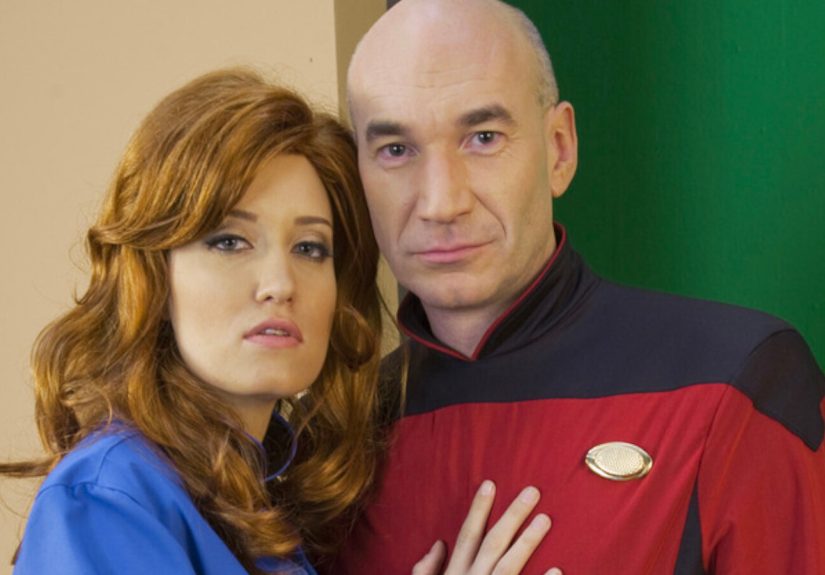
Another reason this parody became internet-famous is bluntly visual: it doesn’t look cheap. Coverage from the time describes an impressively built bridge setdesigned to mimic the Enterprise-D layout in a way that goes beyond “we found a beige hallway.” Costumes, wigs, and props were built to evoke the show’s signature look, and the result is close enough that your brain does a double-take.
The casting approach is also part of the legend. Because you can’t exactly ring up Sir Patrick Stewart and say, “Hey, want to reprise Picard for a project that will definitely be discussed at your next Shakespeare fundraiser?” the production leaned on an impersonator who looks convincingly Picard-adjacent. It’s uncanny in the way theme-park performers can be uncanny: you know it’s not the original, but your nostalgia reflex still fires.
The “Adult Parody” Industry Didn’t Invent ThisStar Trek Fandom Did
To understand why a Star Trek porno could evolve into a “pretty good Trek story,” you have to remember a key fact: Star Trek basically invented modern fandom. Long before social media, fans were organizing letter-writing campaigns, building conventions, printing zines, and creating their own stories to keep the universe alive between official releases.
In the 1970s, when there was no new televised Trek, the fan community didn’t just rewatch episodes. They made culture: fanzines, reference guides, and the early building blocks of what we now call transformative works. That environment didn’t only tolerate unofficial storytellingit encouraged it.
Slash Fiction: The Original “Wait, Fans Wrote What?”
If you’ve heard the term “slash fiction,” you’ve already touched Star Trek’s weirdly influential legacy. The “slash” label is widely associated with early Kirk/Spock (K/S) stories circulated in fandom communities. Decades later, filmmakers and writers still cite Star Trek as a foundational influence on the fanfiction ecosystembecause it demonstrated that a passionate audience will fill every empty space a canon leaves behind.
One of the earliest widely discussed Kirk/Spock stories, Diane Marchant’s “A Fragment Out of Time” (published in a 1970s Star Trek fanzine), is frequently referenced as a landmark in slash fandom history. Whether you frame it as queer subtext finding daylight or simply as fans doing what fans doturning chemistry into narrativeit’s part of the same lineage: when canon says “not today,” fandom says, “cool, we’ll write it ourselves.”
So Why Did This Particular TNG Porno Get the “Best Story” Reputation?
Let’s be precise: it’s not “the best Star Trek story ever” in the sense of outclassing The City on the Edge of Forever, The Inner Light, or In the Pale Moonlight. That would be like saying the best meal in New York is a surprisingly decent hot dog you found at 2 a.m. outside a jazz club. The point is context: within its category, and compared to what you’d expect from an adult parody, it overachieves.
It Treats the Characters Like Characters
Many parodies (adult or otherwise) flatten personalities into catchphrases. This one tries to keep the crew recognizable: Picard is stern and deliberate, Riker is confident, Data is curious, and the ship’s relationships feel connected to the series’ existing emotional map. The adult content is an add-on, not the engine. Strip the add-on away, and you still have a plot with a beginning, middle, and end.
It’s Basically a Fan Film Wearing a Different Genre Jacket
That’s why “clean edits” became a thing. People weren’t sharing it because they wanted a laugh at Starfleet uniforms in an unexpected place. They shared it because the remaining narrative felt like a compact, oddly affectionate fan episodeone that cared about continuity enough to make Trekkies argue about where it fits in the timeline like it’s a lost VHS from 1993.
What About the Other Star Trek Porn Parodies?
The TNG parody isn’t the first time adult media took a swing at Star Trek. Earlier productions focused on the Original Series, partly because its pop-culture silhouette is instantly recognizable: Kirk, Spock, and the bridge are basically universal symbols of retro sci-fi. For example, coverage of This Ain’t Star Trek XXX emphasized how it tried to recreate sets and moments from classic episodes, leaning heavily into fandom familiarity and playful homage.
Pop-culture criticism has also noted the broader “porn parody” wave of the late 2000s and early 2010s, when adult studios put surprising money into costumes, sets, and extremely committed mimicry. In that environment, Star Trek was inevitable: it’s iconic, it’s theatrical, and it already has an audience trained to care about continuity details like uniform collars.
Should You Watch It?
If your interest is culturalhow fandom works, why parody exists, and how stories mutate when people love a universe too much to leave it alonethen the phenomenon is worth knowing about. But you don’t need to watch the explicit version to understand the point. The internet has circulated safe-for-work edits precisely because the “Trek-ness” is what people wanted to examine.
Treat it like a media oddity: a case study in how a franchise’s gravitational pull can shape even the most unlikely productions. Also: maybe don’t put it on during family game night, unless your family game night already includes debates about whether the Enterprise-D carpet was secretly the Federation’s greatest engineering achievement.
Conclusion: The Funniest Truth Is That It Makes Sense
Star Trek has always inspired people to build: clubs, conventions, zines, fan films, cosplay, and whole careers in science and engineering. Once you accept that, it’s less shocking that someone also built a meticulously Trek-shaped story inside an adult parody framework. It’s bizarre, yes. But it’s also strangely on-brand: take a weird scenario, apply earnest world-building, and commit so hard that the audience ends up debating continuity instead of asking, “Why does this exist?”
So, was one of the best Star Trek stories ever a porno? Maybe not in the “top five episodes” sense. But in the “this should not be this good, and yet here we are” sense? Absolutely. It’s a reminder that when a fandom is big enough, every genre becomes a holodeck programand somewhere, someone is always trying to write the missing episode.
Fan Experiences: The (Mostly) Not-Awkward Way People Engage With This Legend
Let’s talk about the real “experience” layer, because the most Star Trek part of this whole saga isn’t the parodyit’s how fans react to it. If you’ve spent time in Trek spaces (conventions, Reddit threads, group chats, that one coworker who says “stardate” unironically), you’ve seen the pattern: fans don’t just consume media, they process it together. They annotate it. They argue about it. They turn it into a collective in-joke with footnotes.
In practice, the “best story was a porno” claim usually shows up the same way a bizarre piece of trivia does. Someone brings it up as a conversation grenadethen immediately reassures everyone that the interesting part is the plot and the production design, not the explicit content. That’s why safe-for-work edits are often the entry point: they let fans discuss the narrative as if it’s a strange little apocryphal episode. You can press play without feeling like you need to apologize to your future self.
The viewing experience, as described by many curious-but-not-here-for-that viewers, tends to become a kind of informal scavenger hunt. You’re not watching for “spice”; you’re watching for continuity Easter eggs. You pause to go, “Waitwas that Picard’s flute reference?” You rewind because you swear you saw the fish tank. You notice the costuming choices and start grading them the way you’d grade a fan film: “The combadge is decent, the lighting is trying its best, and the carpet looks like it came from a respectable Embassy Suites, which is basically perfect for Season 6.”
Then comes the most Trek-fan moment of all: the timeline debate. Someone will claim it fits right after a specific episode, someone else will disagree, and a third person will show up with a spreadsheet. (This is not a joke. Trek fandom can and will bring Excel to a phaser fight.) The parody’s attempt to anchor itself near late-series continuity is catnip for people who love “where does this fit?” puzzles. It’s the same impulse that fuels endless reading orders for novels and viewing guides for franchise chronology.
Another common “experience” is the tone whiplashlaughing at the premise, then getting blindsided by a moment that feels sincere. Star Trek fans are used to big feelings sneaking up on them. One minute you’re joking about warp cores, the next you’re emotional about a character’s sacrifice. So when a parody unexpectedly hits an earnest character beat, it can trigger the same reaction as an official episode: “Hold on… that was actually kind of thoughtful?” It’s not that it becomes high art; it’s that it remembers Trek’s core trickmake the audience care, even in ridiculous circumstances.
Finally, there’s the social ritual of how people recommend it. Nobody casually drops it like a normal show suggestion. It’s more like, “Okay, hear me out,” followed by a five-minute disclaimer, followed by “watch the clean edit,” followed by “I swear I’m recommending it for the story,” followed by a nervous laugh. That whole dance is fandom culture in miniature: shared curiosity, shared embarrassment, shared delight at finding something unexpectedly clever in the strangest corner of media.
And honestly? That’s kind of beautiful. Star Trek’s been teaching people for decades that difference doesn’t have to be scaryit can be interesting, even funny. This bizarre little footnote in Trek history ends up proving the same point in its own chaotic way: stories don’t live in one “proper” place anymore. They migrate. They remix. They show up where you least expect them. Sometimes they even show up in a genre you’d never bring home to your parents… and still manage to sneak in a surprisingly Trek-like heart.