Table of Contents >> Show >> Hide
- Why Minimal Brass Lighting Works So Well
- Wall Light or Ceiling Light: Which One Makes More Sense?
- What “Minimal” Actually Looks Like in Brass Lighting
- Understanding Brass Finishes Before You Buy
- How to Size and Place a Minimal Brass Wall / Ceiling Light
- Best Rooms for Minimal Brass Wall and Ceiling Lights
- Bulbs, Color Temperature, and Dimmers: The Unsexy Details That Matter a Lot
- Common Mistakes to Avoid
- How to Style Minimal Brass Lighting So It Looks Expensive
- Experience: Living With a Minimal Brass Wall / Ceiling Light
- Conclusion
Note: This web-ready article is intentionally written without source links and without publishing artifacts such as contentReference or oaicite markers.
Minimal brass wall and ceiling lights are having a long, luxurious momentand unlike some home trends that burn bright for six minutes and vanish like a scented candle in a windstorm, this one actually has staying power. Why? Because brass brings warmth, minimalism brings restraint, and good lighting makes almost every room look more expensive, more thoughtful, and slightly more emotionally stable. That is a lot to ask from one fixture, yet here we are.
If you are shopping for a minimal brass wall light, a brass ceiling light, or a versatile fixture that can bridge both style and function, the good news is that the category is full of smart choices. The even better news is that you do not need a design degree, a moody loft in Brooklyn, or a dramatic scarf collection to choose the right one. You just need to understand how brass behaves, how light works in a room, and how to avoid buying a fixture that looks amazing online but turns your hallway into a dim cave with commitment issues.
Why Minimal Brass Lighting Works So Well
The magic of a minimal brass wall or ceiling light is in the balance. Brass adds visual warmth, while a minimal silhouette keeps the fixture from feeling too ornate, fussy, or stuck in a time warp. In practical terms, that means a slim cone sconce, a globe flush mount, a tube light, or a low-profile dome fixture can fit into modern, transitional, midcentury, Scandinavian, and even classic interiors without looking like it wandered in from the wrong decade.
Minimal brass fixtures also play nicely with other materials. They look sharp against white walls, rich against dark paint, soft with plaster, crisp with tile, and surprisingly friendly next to black hardware, wood cabinetry, linen shades, stone counters, and frosted glass. Brass is one of those rare finishes that can feel polished without being cold and elegant without being snobbish.
That versatility is why designers keep returning to brass sconces and flush mounts in bedrooms, hallways, bathrooms, entryways, and kitchens. A good fixture can act like jewelry for the roombut the tasteful kind, not the kind that clanks loudly and introduces itself before you do.
Wall Light or Ceiling Light: Which One Makes More Sense?
Choose a minimal brass wall light when:
You want targeted illumination, mood lighting, or a fixture that visually lowers the light level in the room. Wall sconces are especially useful beside beds, flanking mirrors, brightening hallways, framing built-ins, or creating a softer glow than a single overhead light can offer. Downward-facing sconces are great for reading and task lighting, while upward or diffused styles help wash the wall with a gentler ambient effect.
Choose a minimal brass ceiling light when:
You need general illumination and want to preserve headroom. Flush mount brass ceiling lights are especially good for low ceilings, smaller bedrooms, entryways, closets, hallways, and bathrooms. Semi-flush fixtures give a little more presence and decorative shape, but they still stay compact enough for rooms where a pendant would feel like an aggressive overhead personality.
Choose both when you want the room to feel finished
This is where the real design magic happens. Layered lighting usually looks better and works better than relying on one giant central fixture. A brass flush mount can provide ambient light, while matching or coordinating sconces add human-scale warmth, focused light, and a more custom look. In other words, the ceiling light handles the chores, and the sconces handle the charm.
What “Minimal” Actually Looks Like in Brass Lighting
Minimal does not mean boring. It usually means the fixture has a clean profile, limited ornament, disciplined geometry, and thoughtful materials. In the brass category, the most common minimal forms include:
- Single-arm cone sconces
- Globe sconces with frosted or opal glass
- Linear tube wall lights
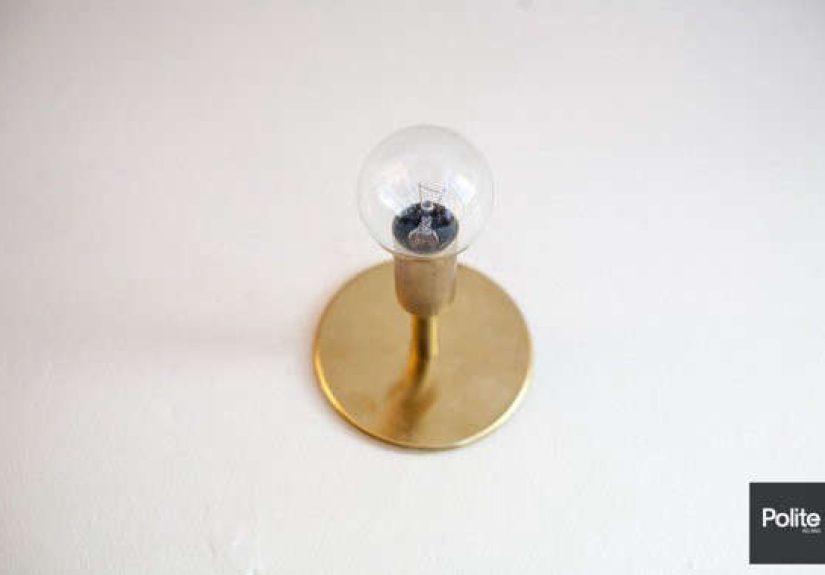
- Low-profile dome flush mounts
- Simple disc-and-cylinder combinations
- Brass-and-glass ceiling fixtures with exposed but refined hardware
These forms work because they prioritize proportion and finish over ornament. A slim brass arm with a neat shade can feel far more luxurious than a bulky fixture with too many curves trying desperately to be “statement lighting.” Sometimes minimalism is not about doing less. It is about editing harder.
Understanding Brass Finishes Before You Buy
Not all brass looks the same, and this is where many people accidentally buy a fixture that clashes with their room. The finish changes the mood dramatically.
Polished brass
Bright, reflective, and more glamorous. This finish works well when you want the light fixture to sparkle, especially in bathrooms, formal powder rooms, or rooms with mirrors and crisp surfaces.
Brushed or satin brass
Softer, more muted, and often the best choice for modern interiors. It gives you warmth without too much shine, making it ideal for minimalist spaces where subtlety matters.
Antique or aged brass
Richer and moodier, with a lived-in character. This finish is excellent if you want warmth and patina without the full brightness of polished brass.
Unlacquered brass
The romantic troublemaker of the group. It starts bright and develops a natural patina over time. If you love the idea of a fixture aging gracefully and picking up character, unlacquered brass is wonderful. If you want your light to look exactly the same forever, choose a protected finish and save yourself the emotional processing.
A helpful rule is to coordinate brass with nearby hardware, plumbing, or other lightingbut do not obsess over exact matching. A room often looks more natural when finishes relate rather than clone one another. Warm metals can mix beautifully when the shapes and undertones feel intentional.
How to Size and Place a Minimal Brass Wall / Ceiling Light
Wall sconces
As a general starting point, many designers and lighting specialists install sconces around 60 to 72 inches from the finished floor, with adjustments based on ceiling height, furniture placement, mirror height, and how the fixture throws light. In hallways, spacing them roughly six feet apart can work well, though architecture should always have the final vote.
By the bed, the bottom of the shade should usually sit high enough to avoid glare when seated, but low enough to provide useful light for reading. Around mirrors, symmetry matters, but so does actual function. A sconce that flatters your face is welcome. One that turns your morning routine into an interrogation scene is not.
Flush and semi-flush ceiling lights
For low ceilings, flush mount lights are the MVP. They sit close to the ceiling, save headroom, and provide a neat, finished appearance. Semi-flush lights work when you want more decorative presence, but they should not hang too low. In small rooms, a compact brass-and-glass fixture often feels lighter than a chunky solid shade. In larger rooms, the fixture diameter should relate to the scale of the space rather than disappearing like a timid button on a cathedral ceiling.
Best Rooms for Minimal Brass Wall and Ceiling Lights
Bedroom
Minimal brass sconces are excellent bedside lighting. A pair of cone sconces or globe wall lights creates symmetry, frees up nightstand space, and gives the room a hotel-like polish. Add a dimmer, and the whole space becomes calmer, warmer, and much less dependent on the dreaded “big light.”
Bathroom
Brass performs beautifully in bathrooms, especially with opal glass, milk glass, or frosted globes that soften illumination. A pair of minimal brass sconces flanking a vanity mirror can deliver a cleaner, more flattering effect than relying only on overhead light. Just make sure the fixture is rated appropriately for damp conditions when needed.
Hallway
This is where minimal brass lighting quietly shows off. Repeating a simple brass sconce down a hallway creates rhythm, warmth, and a more considered architectural feel. It is a subtle move, but it can make a plain corridor feel designed instead of merely survived.
Entryway
A brass flush mount in the entry sets the tone immediately. It says, “Yes, someone thought about this house.” If you have the wall space, a matching or complementary sconce near a console can add depth and make the welcome feel warmer.
Kitchen
Try a minimal brass sconce over a sink, along a breakfast nook, or on a wall that needs visual balance. In compact kitchens, a brass flush mount keeps the ceiling clean while still adding character. Brass works especially well with white oak, painted cabinetry, marble-look surfaces, and textured tile backsplashes.
Bulbs, Color Temperature, and Dimmers: The Unsexy Details That Matter a Lot
You can buy the prettiest minimal brass light in America and still end up with terrible ambience if the bulb is wrong. Warm white bulbs generally create the most inviting glow in bedrooms, living areas, and entryways. In task-driven spaces like bathrooms and kitchens, the goal is still clarity, but not icy, overlit misery.
Diffused shades, frosted globes, and dimmable fixtures are especially helpful in minimal interiors because they keep the light soft and architectural. LED options are widely available and energy-efficient, and many newer sconces and flush mounts are designed with LED compatibility in mind. If your fixture can take a dimmer, do it. Your future evening self will be grateful.
Common Mistakes to Avoid
- Choosing brass that is too shiny for the rest of the room
- Buying a tiny fixture for a large wall and hoping confidence will fix it
- Installing sconces without considering glare, bed height, or mirror placement
- Using only overhead lighting when the room really needs layers
- Ignoring damp ratings in bathrooms or covered outdoor areas
- Picking a beautiful fixture with the wrong light direction for the task
Minimal lighting succeeds when it feels intentional, not accidental. The fixture should look like it belongs to the room and behave like it actually wants to help.
How to Style Minimal Brass Lighting So It Looks Expensive
Start with contrast. Brass looks incredible against matte paint, plaster-like finishes, dark cabinetry, and natural wood. Add one or two other warm elements nearbya wood frame, woven texture, linen shade, leather pull, or bronze accentand the light will feel integrated instead of isolated.
Then consider repetition. A brass wall sconce feels good. A second brass touch somewhere else in the room often makes it feel deliberate. That second touch could be a mirror frame, cabinet hardware, a faucet, or even a picture frame. You do not need to turn the room into a brass convention. Just give the eye a few related notes to follow.
Finally, let the shape do the work. In minimalist spaces, form matters. A globe, cone, tube, or shallow dome in brass can read like sculpture when everything around it is calm and edited. That is the beauty of this category: it can be quiet and still memorable.
Experience: Living With a Minimal Brass Wall / Ceiling Light
The first thing people notice after installing a minimal brass wall or ceiling light is usually not the brass. It is the feeling. Rooms begin to look less flat and more layered. A hallway that used to be just a route from one room to another suddenly feels intentional. A bedroom that once depended on one overhead fixture becomes softer at night, easier to wind down in, and far more forgiving when the laundry chair is doing what the laundry chair does best.
Many homeowners describe the change as subtle at first and dramatic over time. A brass sconce beside the bed frees up tabletop space, which sounds minor until you realize your nightstand can now hold a book, a glass of water, and your phone charger without looking like a tiny storage unit under pressure. In the bathroom, a simple brass wall light near the mirror can make daily routines feel more polished. It is still toothpaste and under-eye circles, of course, but somehow the room feels like it is rooting for you.
There is also something deeply satisfying about the way brass interacts with daylight. In the morning, it catches natural light softly and adds warmth without shouting for attention. At night, especially with a warm bulb and a dimmer, the same fixture feels richer and moodier. This day-to-night flexibility is part of why minimal brass lighting tends to stay appealing long after trendier finishes start feeling tired.
People also tend to appreciate how adaptable these fixtures are as their style evolves. Maybe the room starts modern and monochrome, then picks up vintage furniture, more texture, darker paint, or a bolder rug. Minimal brass lighting usually keeps up. It does not demand a single decorating style. It just quietly improves the room and lets everything else get on with its life.
Even maintenance becomes part of the experience. A brushed brass finish is relatively easygoing. An unlacquered brass fixture changes over time, and that can feel personal in the best way. The patina reflects real use, real air, real touch, real living. Instead of fighting every sign of age, some people end up loving the evidence that the fixture has become part of the home rather than a static showroom object.
In practical everyday terms, the right minimal brass wall or ceiling light often solves more than one problem at once: it brightens a dark spot, adds character, improves scale, softens the mood, and helps the room feel complete. That is a pretty strong résumé for one hardwired object. And unlike many “small upgrades” that promise life-changing results and deliver only a mild sense of regret, this one usually earns its keep.
If you choose carefullygood proportions, the right finish, the right bulb, the right placementa minimal brass light does not just illuminate a room. It changes how the room is experienced. It makes spaces feel warmer, calmer, and more considered. It adds design without clutter, function without heaviness, and style without trying too hard. Honestly, that is more than can be said for most things hanging around the house.
Conclusion
A minimal brass wall or ceiling light is one of the smartest upgrades for anyone who wants warmth, versatility, and quiet sophistication. Whether you choose a slim cone sconce, a globe vanity light, a linear tube fixture, or a low-profile flush mount, the winning formula is the same: clean form, useful light, the right brass finish, and thoughtful placement. Get those details right, and your lighting will not just brighten the roomit will define it.