Table of Contents >> Show >> Hide
- What Exactly Was the B-29?
- Why the B-29 Felt Like the Future
- From Ambitious Idea to Flying Reality
- How the B-29 Entered Combat
- The B-29 and the Air War Over Japan
- The Most Famous B-29s: Enola Gay and Bockscar
- After World War II: The B-29 in a New Era
- Why the B-29 Still Fascinates People
- What It Feels Like to “Meet” a B-29 Today
- Conclusion
- SEO Tags
If World War II had a “wow, that thing looks expensive” airplane, it was the Boeing B-29 Superfortress. This was not just another bomber with a bigger lunchbox and more engines. The B-29 was a technological leap: bigger, faster, longer-ranged, and more advanced than the heavy bombers that came before it. It looked less like a patched-together war machine and more like the future showed up early, wearing aluminum skin and carrying a very serious attitude.
Even today, the B-29 has a magnetic reputation. Aviation fans admire it for its engineering. Historians study it because it changed the air war in the Pacific. Museum visitors stare at it because photographs do not prepare you for its size. And the rest of us? We meet the B-29 and quickly realize this airplane was never built to whisper. It was built to dominate the sky.
What Exactly Was the B-29?
The Boeing B-29 Superfortress was a four-engine, long-range heavy bomber developed for the U.S. Army Air Forces during World War II. It was designed to fly higher, farther, and with heavier bomb loads than earlier bombers such as the B-17 Flying Fortress. On paper, that already sounds impressive. In practice, it made the B-29 one of the most sophisticated propeller-driven bombers of the war.
Its mission profile was shaped by geography as much as engineering. The Pacific theater was huge. Japan was far away. Bases were limited. Fighters could not always escort bombers over those distances. The United States needed an aircraft that could reach strategic targets deep inside enemy territory and still make it home. The B-29 was the answer, although like many answers written in wartime, it arrived with a few headaches, a mountain of complexity, and an invoice large enough to make accountants reach for smelling salts.
Why the B-29 Felt Like the Future
Pressurized Crew Compartments
One of the B-29’s most remarkable features was its pressurized crew compartments. That may sound ordinary now, but in the early 1940s it was a major advancement for a bomber. Earlier crews often faced bitter cold, oxygen equipment, and exhausting high-altitude conditions. The B-29 changed that equation. Its forward and aft crew sections were pressurized, connected by a tunnel over the bomb bays, giving airmen a far more workable environment on long missions.
In simple terms, the B-29 let crews do brutal work in something closer to an airplane than a freezing metal punishment tube. That did not make combat comfortable, of course. It just meant the aircraft was designed with serious attention to endurance, crew performance, and the realities of very long-range operations.
Remote-Controlled Gun Turrets
The B-29 also introduced a central fire-control system with remotely controlled gun turrets. Instead of relying entirely on traditional manned gun positions sticking out into the slipstream, gunners operated sighting stations and used an analog computing system to help direct defensive fire. The setup was revolutionary for its era. It reduced drag, improved crew comfort, and gave the bomber a level of integrated defensive technology that sounded almost science fiction in 1944.
That system is part of why the B-29 still feels modern when you read about it. Not “modern” as in “please sync your phone with Bluetooth,” but modern in the sense that engineers were already thinking in systems, sensors, automation, and efficiency rather than just bolting more guns onto a problem and calling it innovation.
Range, Payload, and Presence
The B-29 could carry bomb loads up to 20,000 pounds and strike targets at long distances from base. It was also, at the time of its introduction, the world’s heaviest production airplane. Its size was not just for show. Every foot of that airframe reflected a strategic need: more fuel, more bombs, more reach, and more survivability over enormous stretches of ocean and hostile territory.
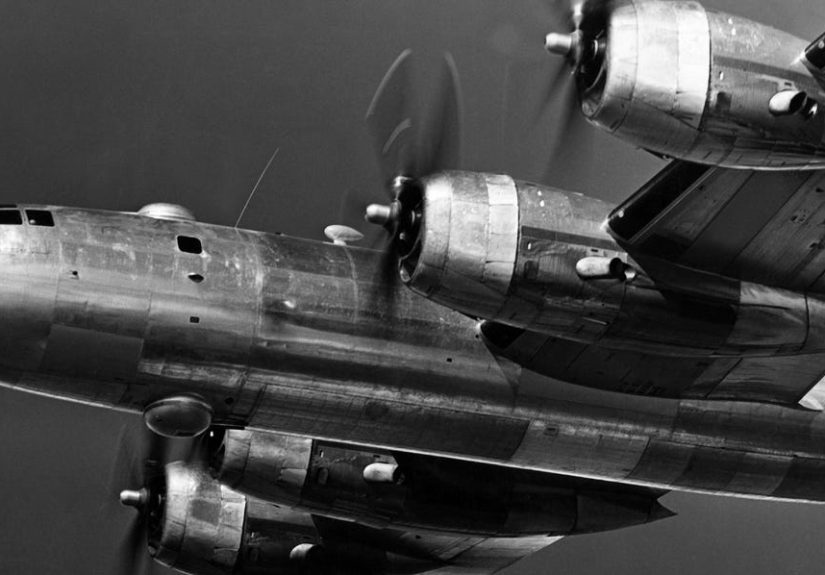
And yes, it looked the part. The B-29 did not merely arrive at an airfield. It occupied the airfield. Its wingspan, tall landing gear, sleek fuselage, and four Wright R-3350 engines gave it a presence that still turns museum floors into quiet zones.
From Ambitious Idea to Flying Reality
The roots of the B-29 go back to the late 1930s, when the U.S. Army Air Corps wanted a very long-range bomber capable of carrying heavy loads at high speed and altitude. In January 1940, requirements called for a bomber that could fly fast, carry a large payload, and deliver blows at great distance. Boeing’s answer became the B-29.
The first XB-29 flew on September 21, 1942. That first flight mattered, but the development story was anything but smooth. The B-29 program was bold, rushed, and immensely complicated. Production moved ahead even before the aircraft had fully proven itself. That was a wartime gamble, and it tells you how badly the United States wanted the airplane to work.
It eventually did work, and in spectacular fashion, but not because the path was easy. The Superfortress demanded enormous industrial effort, engineering refinement, testing, redesign, and field modification. In other words, the B-29 was not born polished. It was dragged into greatness by necessity, urgency, and a lot of very determined people.
How the B-29 Entered Combat
The B-29 first flew combat missions from India and forward staging bases in China under the Twentieth Air Force. Its first combat mission was flown on June 5, 1944, against Bangkok, Thailand. Just ten days later, B-29s struck the steel mills at Yawata in Japan, marking the bomber’s first raid against the Japanese home islands.
These early operations proved the airplane could hit hard, but they also revealed the brutal logistics of using China-based staging fields. The aircraft often had to haul much of its own fuel and bombs forward before it could carry out a mission. That is not strategic bombing so much as strategic self-delivery. Still, those operations provided valuable experience and helped shape later B-29 tactics.
The real shift came when B-29s began operating from the Mariana Islands. From there, the bomber became the central tool in the strategic air campaign against Japan. A shakedown raid hit Truk in late October 1944, and on November 24, 1944, Marianas-based B-29s launched their first mission against Tokyo. From then on, the Superfortress became a defining presence in the Pacific war.
The B-29 and the Air War Over Japan
Once established in the Marianas, the B-29 gave the United States the ability to strike Japan repeatedly and at scale. At first, planners emphasized high-altitude daylight precision bombing. That approach sounded neat and rational on briefing maps, but real weather over Japan often refused to cooperate. High winds and cloud cover reduced bombing accuracy, which forced commanders to rethink how the aircraft would be used.
The result was a shift toward lower-altitude incendiary attacks and mining operations, both of which the B-29 performed with devastating effectiveness. This phase of the campaign is central to understanding the aircraft’s historical impact. The B-29 was not just an engineering marvel. It became a war-winning instrument in a campaign that applied relentless pressure on Japan’s industry, infrastructure, and war-making capacity.
The airplane also benefited from the capture of Iwo Jima. The island’s airfields became emergency landing sites for damaged or fuel-starved Superfortresses. One B-29, famously nicknamed Dinah Might, made an emergency landing there on March 4, 1945, while fighting on the island was still ongoing. That moment captured the strange intersection of strategy and survival: a bomber too valuable to lose, an island too contested to feel safe, and a war in which every runway mattered.
The Most Famous B-29s: Enola Gay and Bockscar
No discussion of the B-29 can avoid the two aircraft most permanently linked to its legacy: Enola Gay and Bockscar. These specially modified “Silverplate” B-29s carried the atomic bombs dropped on Hiroshima on August 6, 1945, and Nagasaki on August 9, 1945. Those missions placed the B-29 at the center of one of the most consequential and morally debated moments in modern history.
That history deserves sober treatment. The aircraft itself was a machine; the decisions behind its use were political, military, and human. The B-29 therefore sits at an unusual crossroads in public memory. It is admired as a masterpiece of engineering and remembered as a vehicle in missions that helped bring World War II to its end while also introducing the world to nuclear warfare in combat.
Today, Enola Gay is preserved by the Smithsonian’s National Air and Space Museum, while Bockscar is displayed at the National Museum of the United States Air Force. Their survival ensures the B-29 story is not locked away in grainy film reels and footnotes. It stands in front of visitors at full scale, asking hard questions without saying a word.
After World War II: The B-29 in a New Era
The B-29 did not vanish when World War II ended. It continued to serve into the early Cold War and saw combat again during the Korean War. By then, however, aviation had changed fast. Jet fighters like the MiG-15 created a far more dangerous environment for propeller-driven bombers. B-29 operations had to adapt, and night missions became increasingly important.
That postwar service says a lot about the aircraft. Truly great military designs often have second lives, even after the original war ends, because they combine utility with adaptability. The B-29 was one of those aircraft. It also helped shape later Boeing designs and postwar transport developments, extending its influence beyond combat itself.
Why the B-29 Still Fascinates People
The B-29 fascinates people because it combines opposites. It was elegant and brutal. It was advanced and troublesome. It was futuristic, yet powered by pistons and propellers. It represented both technical optimism and the darkest possibilities of industrial warfare.
It also helps that the airplane is simply dramatic. The shape is beautiful. The scale is startling. The nickname “Superfortress” is gloriously unsubtle, as if someone in 1944 said, “Fortress is good, but could we make it sound like it benches more weight?” Boeing did, and the name stuck.
For aviation historians, the B-29 is a bridge between eras. It closes the chapter on the classic heavy bomber and opens the door to the more integrated, technologically ambitious aircraft that followed. For museum visitors, it is something more immediate: proof that engineering can be both brilliant and deeply entangled with history’s hardest chapters.
What It Feels Like to “Meet” a B-29 Today
Meeting a surviving B-29 today is not like glancing at an old airplane behind velvet rope and reading a polite little plaque. It is more like being introduced to a celebrity who also happens to be a steel-and-aluminum apartment building with wings.
Start with the size. In photos, the B-29 looks large. In person, it looks improbable. The fuselage seems taller, the wings broader, and the engines more serious than your brain had budgeted for. You walk toward it thinking, “Yes, yes, historic bomber, very important,” and then you get close enough to stand under one wing and your internal monologue changes to, “Good grief, this thing is enormous.”
If you see a preserved example in a museum, the experience is quiet but powerful. The airplane does not move, yet it still has momentum in a strange emotional sense. You look at the nose glazing, the gun positions, the long polished fuselage, and the name painted on the side, and suddenly the aircraft stops being an abstract “asset” from a history book. It becomes a place where real crews worked, sweated, argued, concentrated, feared, joked, and flew into missions with no guarantee of coming back.
If you are lucky enough to see one of the two airworthy B-29s, FIFI or Doc, the experience shifts from visual to visceral. The engines do not merely start; they announce themselves. The sound is not the neat, tidy buzz people imagine from old propeller aircraft. It is deeper, heavier, more physical. You do not just hear the airplane. You feel it in your chest, in the pavement, and in the way everybody nearby suddenly stops trying to finish their sentence.
That is when the B-29 stops being “history” and becomes presence. The spinning propellers blur. The air changes. The bomber that once crossed oceans and targeted cities looks ready, even now, to taxi out and remind the modern world that the age of piston engines was fully capable of producing giants.
There is also something unexpectedly human about meeting a B-29 today. The restoration stories behind Doc and FIFI are full of volunteers, mechanics, donors, pilots, and historians who refused to let these machines disappear. In that sense, the experience is not just about the 1940s. It is also about the present-day effort to preserve memory through motion, maintenance, and public display.
And maybe that is the best reason to meet a B-29 at all. It shrinks the distance between textbook and reality. It reminds you that history was built by people with slide rules, rivet guns, checklists, and impossible deadlines. It reminds you that technology can inspire awe and unease at the same time. Most of all, it reminds you that the past was not small, flat, or simple. Sometimes it was 141 feet of wingspan, four roaring engines, and one unforgettable silhouette against the sky.
Conclusion
The B-29 Superfortress was more than a bomber. It was a turning point in aviation history. It brought together pressurization, remote fire control, heavy payload, long range, and industrial ambition in one remarkable aircraft. It helped transform the Pacific air war, shaped postwar aviation, and became inseparable from some of the most important events of the twentieth century.
To meet the B-29 is to meet a machine that still carries the weight of innovation, conflict, and memory. It is a marvel. It is a warning. It is history with rivets. And nearly eighty years later, it still knows how to make people stop, look up, and say the same thing in different ways: they really built that?