Table of Contents >> Show >> Hide
- What Is Jenga?
- How to Set Up a Jenga Tower
- Basic Jenga Rules
- How Many Players Can Play Jenga?
- Jenga Tips for Beginners
- Advanced Jenga Strategy
- Common Jenga Mistakes to Avoid
- Fun Jenga Variations
- Jenga Rules for Kids and Families
- Jenga Winning Tips: How to Stay Calm Under Pressure
- Experience Section: Real-Life Lessons from Playing Jenga
- Conclusion
Jenga looks innocent. It sits on the table like a tidy little wooden apartment building, smiling politely and pretending it is not about to expose everyone’s shaky hands, questionable decision-making, and deep fear of gravity. But that is the magic of the game. The rules are simple enough for a first-time player to learn in one minute, yet every move feels like a tiny engineering exam with an audience.
Whether you are hosting family game night, planning a party, teaching kids a classic tabletop game, or trying to become the person nobody wants to sit after, this guide covers the essential Jenga rules and tips you need. You will learn how to set up the tower, how turns work, what counts as a legal move, how to win, common mistakes to avoid, and smart strategies for keeping the tower alive longer than everyone’s confidence.
The main goal is beautifully simple: remove one block from the tower, place it on top, and do not be the person who turns a calm living room into a wooden avalanche zone.
What Is Jenga?
Jenga is a classic block-stacking game of skill, balance, patience, and quiet panic. A standard Jenga set includes 54 rectangular wooden blocks. At the start of the game, those blocks are stacked into a tower with 18 levels. Each level contains three blocks placed side by side, and every new level is turned at a right angle to the level below it.
Players take turns removing one block from the tower and placing it on the top. As the game continues, the tower becomes taller, weaker, and dramatically more judgmental. The game ends when the tower falls. The winner is the last player who successfully completed a turn before the collapse.
How to Set Up a Jenga Tower
Setting up the tower correctly matters. A messy tower may look funny, but it can make the game unfair before anyone even starts. To build a standard Jenga tower, place three blocks side by side on a flat surface. Then add three more blocks on top, turning them 90 degrees so they run in the opposite direction. Continue this pattern until all 54 blocks are used.
The finished tower should have 18 levels. Try to keep the sides lined up as evenly as possible. If your Jenga set includes a stacking sleeve or loading tray, use it to straighten the tower. If not, your hands will do the job, assuming they are not already trembling with competitive energy.
Best Surface for Playing Jenga
Play on a stable, level surface such as a dining table, coffee table, hardwood floor, or outdoor table with a firm base. Avoid wobbly card tables, soft carpets, bouncy patio furniture, or anything that moves when someone laughs too hard. Jenga already has enough chaos built in. It does not need help from a table with commitment issues.
Basic Jenga Rules
The official Jenga rules are easy to understand, which is one reason the game has stayed popular for decades. The challenge is not remembering the rules; the challenge is following them while the tower leans like it has just heard bad news.
Rule 1: Take One Block per Turn
On your turn, remove exactly one block from the tower. You may choose a block from any level below the highest completed level. In simple terms, do not take blocks from the very top completed layer or from the incomplete layer being built above it.
Rule 2: Place the Block on Top
After removing a block, place it on the top of the tower. Continue the same three-block pattern. Blocks on the new top level should be placed side by side in the same direction, and each completed level should be perpendicular to the level below it.
Rule 3: Use Only One Hand at a Time
This is one of the most important Jenga rules. You may use only one hand at a time to touch the tower. You can switch hands during your turn, but both hands cannot touch the tower at the same time. That means no two-handed hugging, bracing, squeezing, or emotional support for the blocks.
Rule 4: You May Test Blocks
You are allowed to gently tap or touch blocks to see which ones are loose. This is not just allowed; it is smart. However, if you move a block and decide not to take it, return it to its original position before choosing another block. Think of it as polite block etiquette.
Rule 5: Your Turn Must Be Completed Safely
A turn is complete when you successfully remove a block and place it on top without making the tower fall. Many players also use the common timing rule that the next player’s turn begins when they touch the tower or after a short pause once the block has been placed. In casual games, simply agree on this before starting so nobody becomes a courtroom attorney over a pile of wood.
Rule 6: The Tower Falling Ends the Game
The game ends when the tower collapses. The player who caused the collapse loses. The winner is the last player who completed a successful turn before the tower fell. If the tower falls because someone bumps the table, reaches across the pizza, or performs an unnecessary victory dance, most groups count that person as responsible.
How Many Players Can Play Jenga?
Jenga can be played by one or more players. With one player, it becomes a personal challenge: how high can you build before gravity sends its invoice? With two players, it becomes a tense duel. With a group, it becomes a social game full of cheers, jokes, advice nobody asked for, and dramatic silence when the tower starts to lean.
For parties, Jenga works well with 2 to 6 players. Larger groups can still play by forming teams or rotating turns. Team Jenga is especially useful for classrooms, family gatherings, and events where everyone wants to participate without waiting until next Thursday for their turn.
Jenga Tips for Beginners
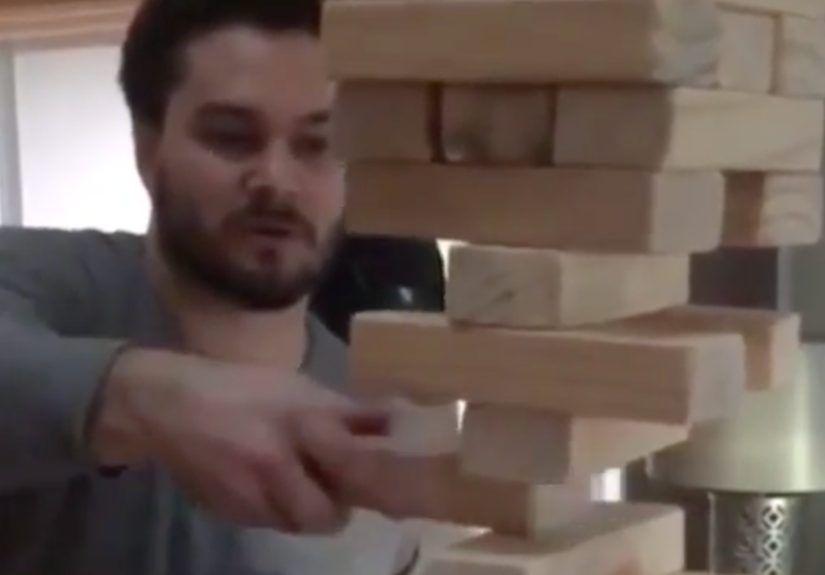
New players often make the same mistake: they grab the first block they see and pull like they are starting a lawn mower. Jenga rewards patience, not panic. Before removing a block, take a few seconds to study the tower. Look for loose blocks, weak layers, and the direction the tower is leaning.
Start with Center Blocks
In the early game, center blocks are often safer than side blocks. Removing a center block can leave two side blocks supporting the level, which may keep the tower balanced. Removing a side block too early can shift weight unevenly and make the tower lean before the game has properly warmed up.
Push Before You Pull
Instead of pulling a block straight toward you, try gently pushing it from the opposite side. A smooth push often creates less sideways force than a dramatic pull. Once the block slides out enough, you can carefully remove it and place it on top. The key word is carefully. Jenga is not a strength test. It is a whispering contest with physics.
Use the Tap Test
Lightly tap different blocks to feel which ones move easily. Loose blocks are usually safer choices. Stuck blocks are warning signs. Do not fall in love with a stubborn block just because you touched it first. If it refuses to move, let it enjoy its career in structural support.
Watch the Lean
Before choosing a block, check which way the tower is leaning. If the tower leans left, removing a block from the left side may make the lean worse. Try to choose a move that balances the structure rather than exaggerating the tilt. Every tower has a mood. Learn to read it.
Advanced Jenga Strategy
Once you know the basic Jenga rules, strategy becomes the real fun. There is no guaranteed way to win every time because each tower is slightly different. The blocks vary subtly, the surface changes, and every player adds their own questionable energy. Still, certain strategies can improve your chances.
Think One Move Ahead
Do not only ask, “Can I remove this block?” Ask, “What will the tower look like after I remove this block?” A move that is safe right now may create a nightmare for your next turn. If you can remove a block while leaving the tower awkward for the next player, you have made a strong strategic play.
Place Blocks with Purpose
The placement on top matters as much as the removal. If you place a block on the heavy side of the tower, you may make the lean worse. If you place it on the lighter side, you may restore balance. In competitive play, some players intentionally place blocks in ways that make the tower more difficult for the next person. This is legal, strategic, and mildly villainous.
Do Not Rush
Speed is rarely your friend in Jenga. A fast move can shake the tower, surprise your hand, and ruin a perfectly playable block. Take your time, breathe normally, and ignore the friend chanting “pull it, pull it, pull it” like they are helping. They are not helping. They are seasoning the chaos.
Use Gentle Finger Control
Most good Jenga moves use small, controlled finger motions. Try nudging the block with one finger, sliding it millimeter by millimeter, and keeping your hand relaxed. A stiff hand transfers more force to the tower. A relaxed hand gives you better control and helps prevent sudden jerks.
Switch Hands When Needed
The one-hand rule does not mean you must use the same hand for the entire turn. You may switch hands as long as only one hand touches the tower at a time. If your angle is awkward, switch to the hand that gives you better control. There is no bonus prize for using your non-dominant hand while silently regretting your life choices.
Common Jenga Mistakes to Avoid
Even experienced players make avoidable mistakes. The most common one is removing a block without checking the whole tower first. A block may feel loose, but if the tower is already leaning in that direction, your move could still be risky.
Another mistake is placing the removed block carelessly on top. Dropping, tapping, or sliding too aggressively can shake the entire tower. Remember, your move is not complete until the block is safely placed. The top of the tower deserves the same respect as the bottom.
Players also tend to panic when the tower moves. A little movement does not always mean disaster. Sometimes the tower shifts and settles. If you freeze, breathe and wait a moment. The tower may stabilize. If it does, continue slowly. If it does not, well, at least everyone gets a memorable sound effect.
Fun Jenga Variations
Classic Jenga is excellent, but variations can make game night even more entertaining. Just make sure everyone agrees on the rules before starting.
Team Jenga
Divide players into teams and take turns by team order. This version is great for larger groups. It also lets teammates give advice, which is either helpful or a fast way to discover who should not work in construction.
Timed Jenga
Give each player a time limit, such as 30 seconds or one minute. Timed Jenga adds pressure and keeps the game moving. It is best for confident players because beginners may find the timer stressful.
Question Jenga
Write light conversation questions on the blocks. When a player removes a block, they answer the question before placing it on top. This is popular for classroom icebreakers, family nights, and parties. Keep the questions friendly and age-appropriate so the game stays fun.
Challenge Jenga
Add simple challenges such as “use your non-dominant hand,” “hum while you move,” or “skip your next complaint.” Keep challenges safe and reasonable. The point is laughter, not turning the living room into a stunt show.
Jenga Rules for Kids and Families
Jenga is a good family game because it teaches patience, focus, hand-eye coordination, and turn-taking. For younger children, consider using relaxed rules. You can allow extra time, help with tower setup, or skip strict debates about the highest completed level. The goal is to make the game enjoyable, not to create a tiny rules committee.
For mixed-age groups, adults should model gentle play. Show kids how to tap blocks, move slowly, and accept the tower falling as part of the fun. Nobody wins forever in Jenga. Eventually, gravity collects from everyone.
Jenga Winning Tips: How to Stay Calm Under Pressure
The best Jenga players are not always the ones with the steadiest hands. Often, they are the ones who stay calm longest. Pressure makes people rush, grip too hard, or choose blocks without thinking. A calm player notices details others miss.
Before each move, take one breath and scan the tower from bottom to top. Look for gaps, tilted levels, and loose blocks. Then test gently. Once you commit to a block, move it slowly and consistently. When placing it on top, keep your fingers light and avoid pushing down too hard.
Also, ignore table talk. Other players may gasp, laugh, offer fake advice, or say things like, “Wow, bold choice.” This is part of the game’s natural ecosystem. Smile politely and continue making the move that seems safest.
Experience Section: Real-Life Lessons from Playing Jenga
After enough rounds of Jenga, you start to notice that the game is not only about blocks. It is about people. Every player has a personality that appears the moment the tower reaches a dangerous height. There is the Engineer, who crouches to eye level and studies the structure like they are approving a bridge. There is the Gambler, who grabs a block quickly and somehow survives. There is the Nervous Negotiator, who whispers encouragement to the tower. And then there is the Chaos Friend, who says, “Relax, it is just a game,” while leaning on the table.
One useful experience is learning that the easiest-looking move is not always the best move. A block on the side may slide out beautifully, but if the tower is already leaning that way, it can turn into a trap. In many games, the smartest move is the boring move: a center block that moves smoothly, a careful top placement, and no dramatic celebration. Jenga rewards quiet competence. It does not care about your flair.
Another lesson is that touch matters. Beginners often use too much force because they think a stuck block needs power. In reality, it usually needs patience. A tiny tap can reveal whether a block is loose. A slow push can do more than a hard pull. The tower gives feedback if you pay attention. When it shifts, creaks, or leans, it is basically speaking fluent wood.
Jenga also teaches emotional control in a funny way. The tower may wobble during your turn and then settle safely. If you panic, you may make the second mistake that actually knocks it down. Many successful moves happen after a pause. Stop moving, let the tower settle, and continue only when it feels stable. That pause can save your turn.
For parties, the best experience comes from setting the mood before the first move. Put the tower where everyone can see it. Make sure the table is steady. Keep drinks away from the danger zone. Decide whether table talk is allowed, whether players can tap multiple blocks, and how long a player has to finish a turn. These small agreements prevent playful arguments from becoming full legal documentaries.
In family games, Jenga is at its best when winning is not the only goal. Kids love the suspense, but they also learn to lose gracefully when the tower falls. Adults learn this too, though some adults need more practice. The crash is not failure; it is the punchline. Everyone rebuilds, the blocks go back into neat rows, and the next round starts with fresh confidence that will almost certainly be misplaced.
The biggest practical tip from real games is simple: respect the top placement. Many players survive the removal and lose while placing the block on top. They rush because they feel the hard part is over. It is not. The turn ends only when the block is safely stacked. Place it gently, balance it with the existing top layer, and do not press down unless necessary.
Finally, Jenga is more fun when you embrace the suspense. The leaning tower, the silent room, the one block sliding out like it has a dramatic soundtrackthis is why people keep playing. Learn the rules, use smart tips, and try to win. But when the tower falls, laugh. That wooden crash is not the end of the game. It is the official invitation to play again.
Conclusion
Jenga remains one of the best tabletop games because it combines simple rules with endless tension. You do not need a long rulebook, batteries, a screen, or a complicated scoring system. You need 54 wooden blocks, a steady surface, one hand, and enough courage to touch the tower when everyone else is watching.
To play well, remember the essentials: build the tower correctly, remove one block from below the highest completed level, use only one hand at a time, place each block carefully on top, and avoid making the tower fall. To play better, test blocks gently, choose loose pieces, watch the tower’s lean, control your breathing, and never underestimate the importance of top placement.
Jenga is part skill, part strategy, part luck, and part comedy. The rules keep it fair. The tips keep you alive longer. The crash keeps everyone coming back.
Note: This article is written in original American English for web publication and synthesized from official Jenga rules, reputable board-game references, and practical gameplay guidance.